
A City Turned Vertical on the River
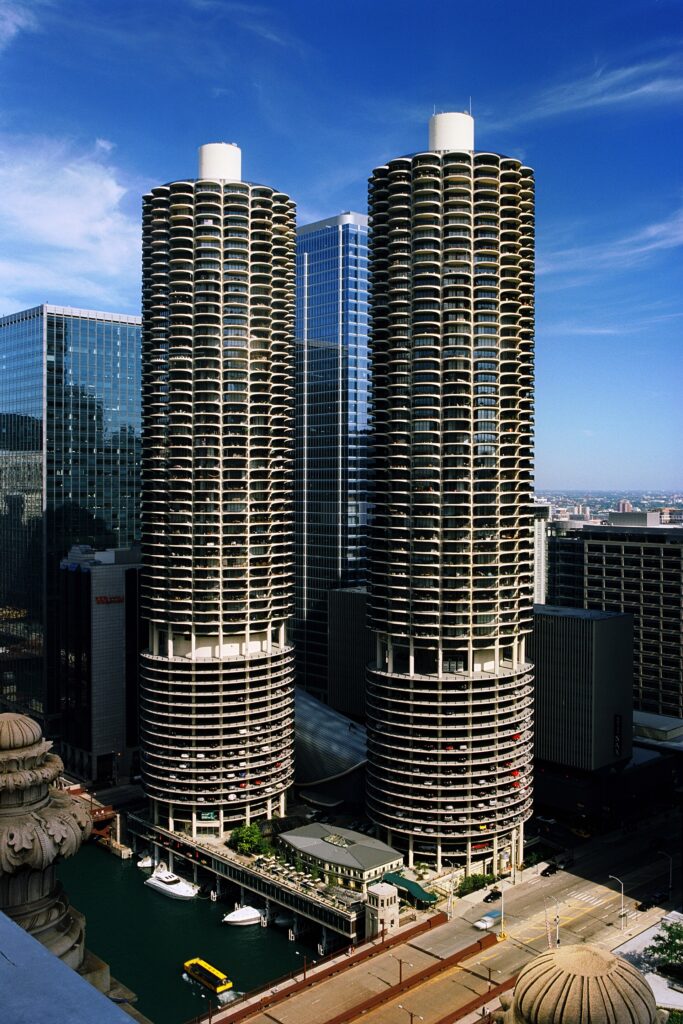
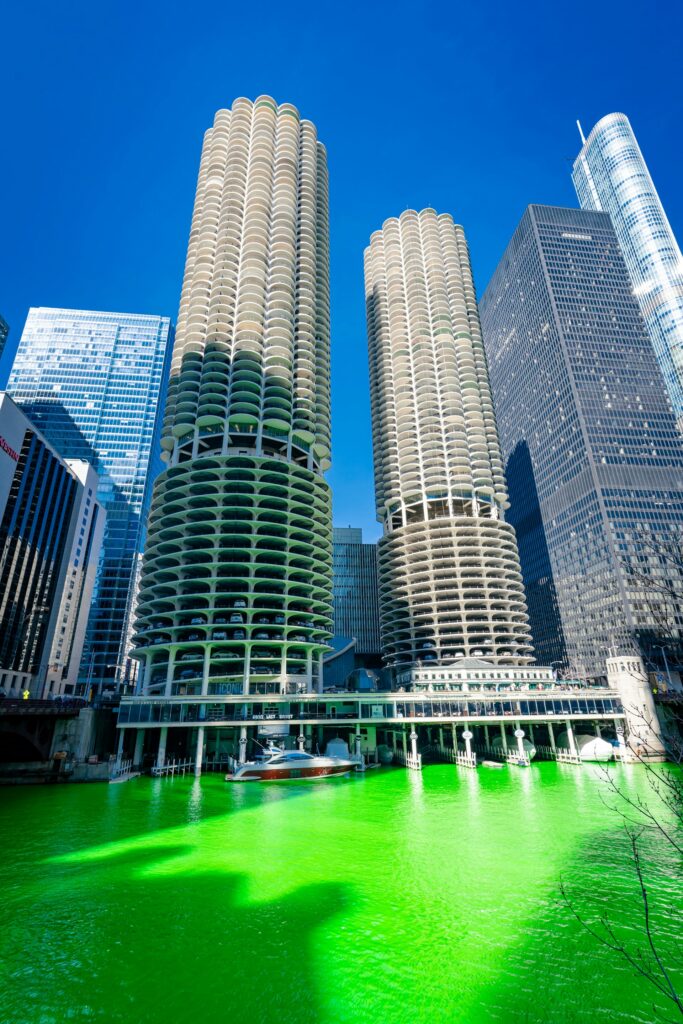
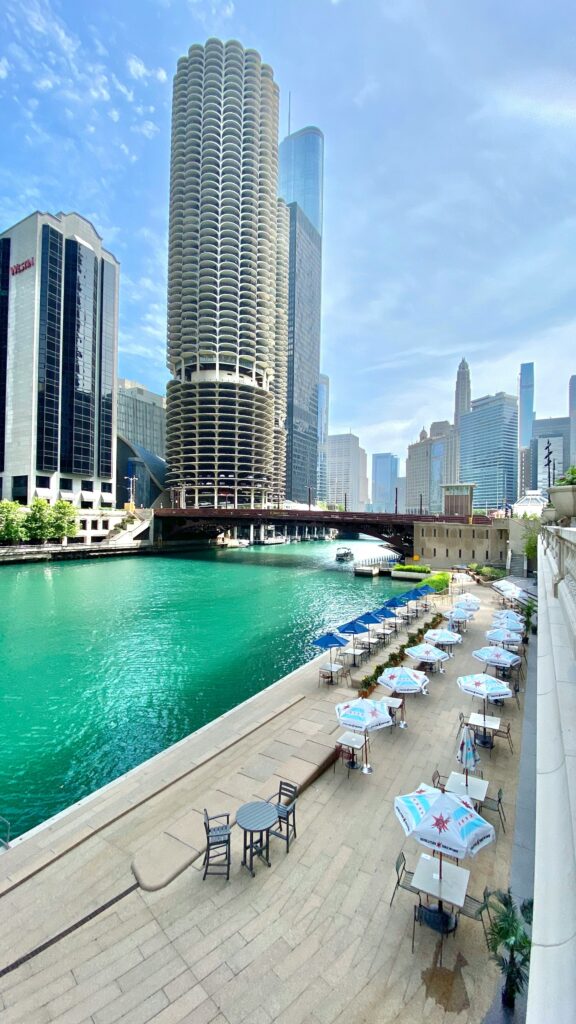
Marina City in Chicago is not simply a pair of residential towers. It is a mixed-use urban proposition in concrete, assembled on the north bank of the Chicago River as housing, parking, recreation, commerce, and spectacle were compressed into a single engineered precinct.
Designed by Bertrand Goldberg and developed from the end of the 1950s into the 1960s, the complex emerged at a moment when central Chicago was losing middle-class residents to the suburbs. Its strongest analytical lens is therefore not only architectural form, but urban strategy: Marina City was conceived as an instrument for reversing metropolitan dispersal.
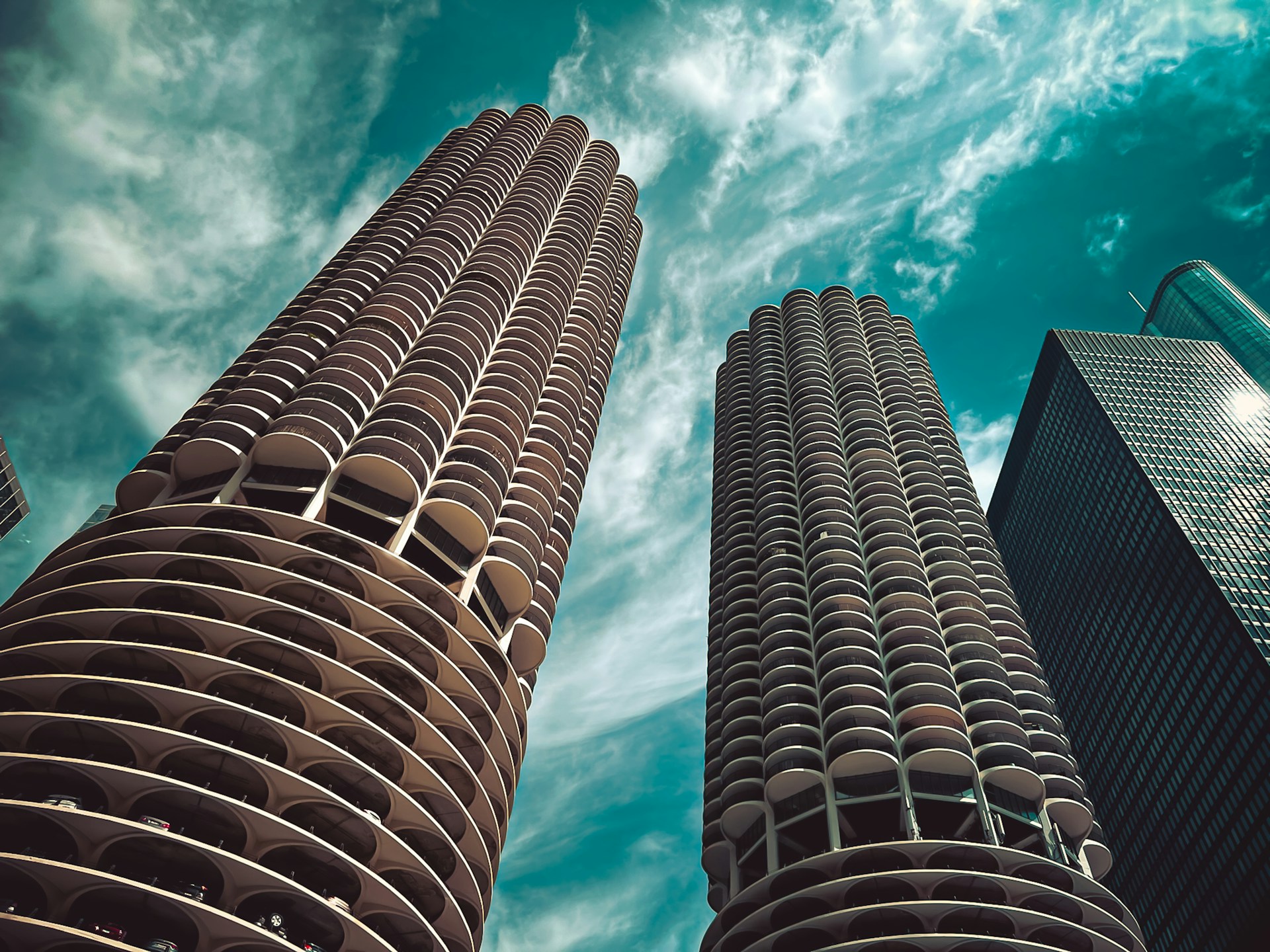
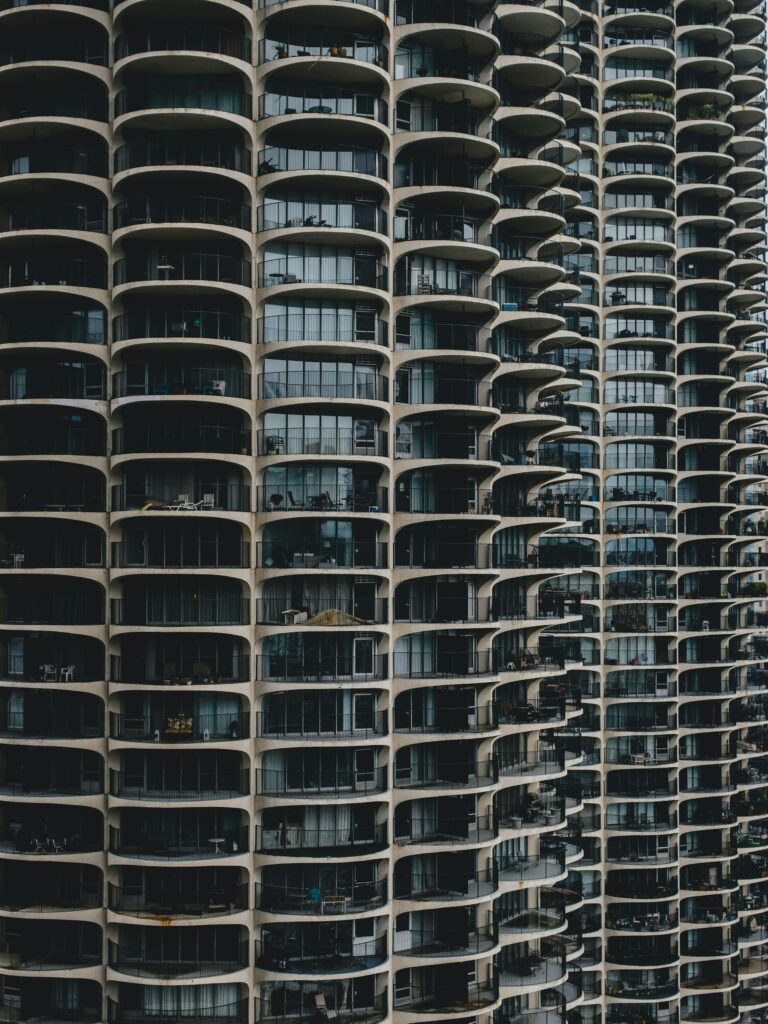
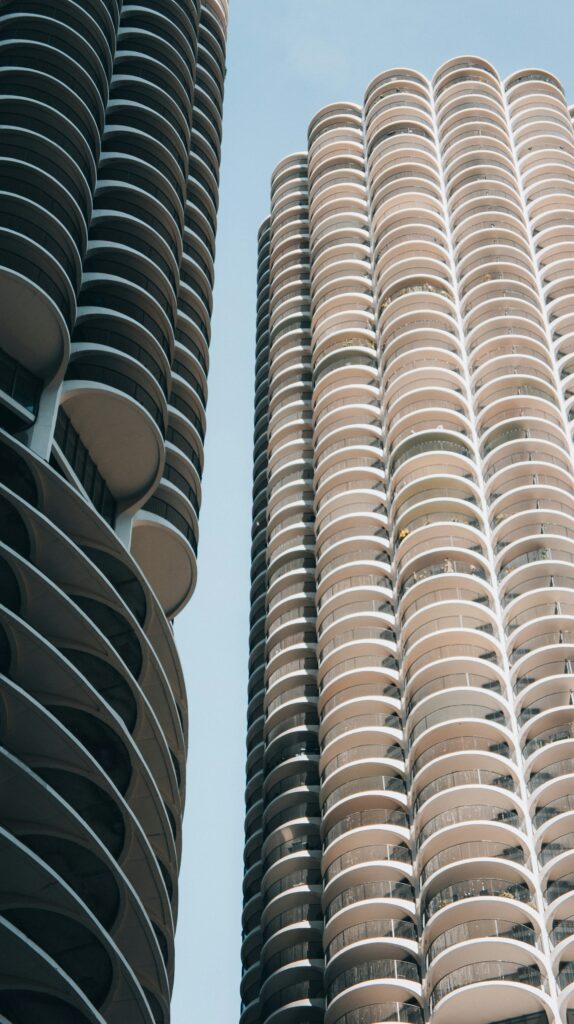
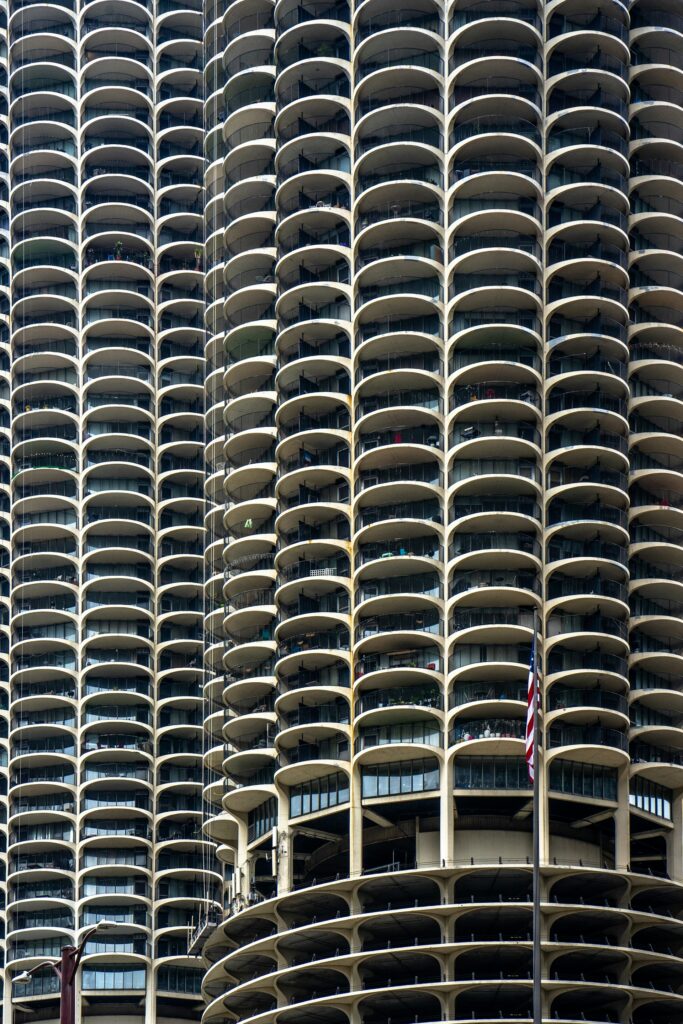
The architecture remains startling because it rejects the rectilinear language that dominated postwar Chicago. Goldberg used cast-in-place reinforced concrete to produce cylindrical towers, radial floor plates, scalloped balconies, and an almost biological formal logic that made the complex legible as infrastructure and image at once.
Yet the project matters just as much for how its program was stacked. Marina, parking garage, apartments, offices, theater, retail, and leisure were arranged as a vertical neighborhood, making the building an early and unusually complete model of dense mixed-use urban living rather than a conventional apartment block with amenities attached.
What makes Marina City especially revealing is that its technical, economic, and symbolic ambitions are inseparable. The towers are feats of reinforced-concrete planning and construction, but they are also a financing experiment, a union-backed development, and one of the clearest statements of postwar Chicago’s belief that architecture could reorganize urban life.
Marina City in Numbers
3 acres
The approximate size of the former rail-yard site on the Chicago River selected for Goldberg’s mixed-use urban experiment
65 stories
The height in floors of each residential tower, including the parking levels, apartments, and top mechanical and roof-deck zones
587 ft
The approximate roof height of each tower, which made them the tallest residential reinforced-concrete towers in the world when completed
2 towers
The paired residential cylinders that turned the project into one of Chicago’s most legible and reproducible skyline images
19 floors
The number of open parking levels at the base of each tower, turning automobile storage into the project’s most publicly visible lower register
40 floors
The number of apartment stories in each tower above the glazed transition level that separates parking from residential life
896 apartments
The total original residential count across both towers, giving the development metropolitan density within a compact riverfront footprint
16 bays
The number of wedge-shaped residential sectors arranged around each circular corridor on a typical apartment floor
32 ft
The diameter of the central core that concentrates elevators, stairs, utilities, and much of the towers’ organizational logic
16 columns
The perimeter supports that supplement the central core and help stabilize the radially cantilevered floor system
70 boats
The approximate docking capacity of the marina set beneath the platform at river level, giving the development its name and literal water access
10 stories
The height of the office building completed as part of the original development, later converted to hotel use
$36 million
The widely cited development cost in the early 1960s, split between residential and commercial phases and backed by unusually complex financing
1963
The year the residential towers opened to tenants after the core-and-slab concrete construction sequence reached full height
1967
The completion year generally used for the whole complex, reflecting the later finish of the theater and full mixed-use ensemble
1977
The year the apartments were converted from rentals to condominiums, reshaping ownership and long-term maintenance responsibilities
2016
The year Marina City received official Chicago Landmark designation, confirming its legal status as a protected work of major civic significance
What is most intriguing about Marina City is that its famous “corncob” silhouette is only the visible outcome of a much deeper idea: Goldberg used reinforced concrete, radial planning, mixed-use stacking, and union-backed financing to compress an entire theory of anti-suburban urban life into one riverfront megastructure that behaves simultaneously as housing block, parking machine, civic image, and prototype for downtown reinvestment.
Engineering and Construction of Marina City
The engineering logic of Marina City begins with Goldberg’s insistence that urban density need not be housed in the steel-and-glass box. Reinforced concrete was not chosen merely for economy. It offered a structural and formal medium capable of carrying the project’s radial plan, continuous balconies, sculptural parking ramps, and mixed-use stacking without surrendering to Chicago’s rectilinear commercial grammar.
Central core / radial organization
Each tower is organized around a cylindrical service core that concentrates elevators, stairs, mechanical systems, and circulation. Around that core runs a circular corridor, and beyond it a ring of wedge-shaped units whose kitchens and bathrooms are placed toward the center while living spaces open outward to the perimeter glazing and curved balconies.
This arrangement matters structurally as well as spatially. The towers are often described through their core, but the final system was not a pure core-and-cantilever solution. Engineers added perimeter columns to supplement stability, producing a hybrid load path in which the central shaft organizes services and much of the structural logic while outer supports assist the radial floor plates and scalloped edge condition.
Concrete form / repetitive construction
The towers were cast in situ using repeated formwork sequences that exploited the geometric regularity of the circular plan. Technical accounts and preservation research emphasize the importance of fiberglass formwork in achieving a smoother exposed-concrete finish than would have been practical with more improvised methods, while also allowing repetition across dozens of levels.
Once the foundations were in place, construction advanced with unusual speed. Contemporary accounts note that the cores were pushed upward early and that a climbing-crane system enabled an accelerated floor cycle, making the project not only formally ambitious but also a demonstration of how repetitive concrete geometry could be industrialized within a high-rise urban context.
Parking as structure and façade
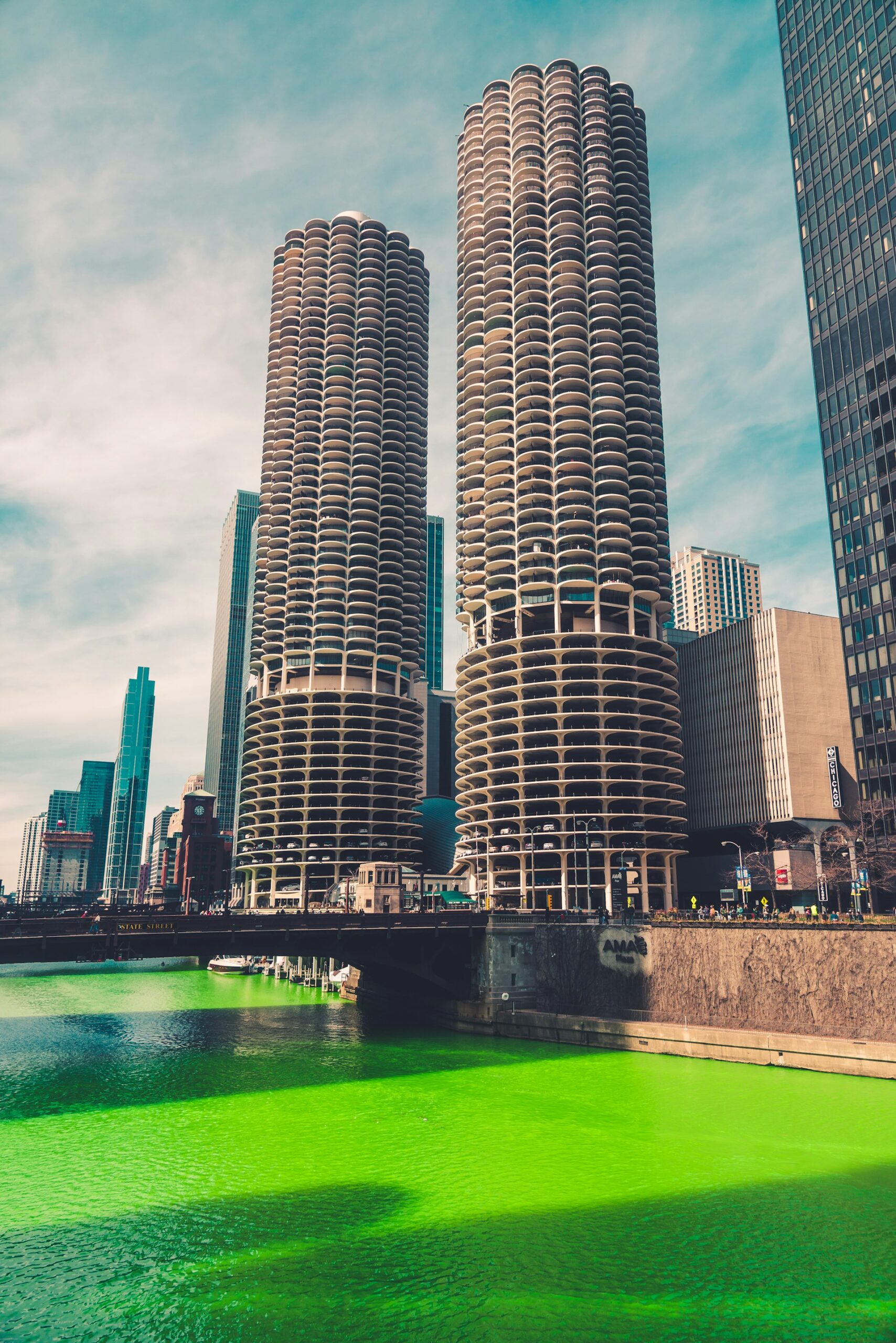
The most radical engineering move may be the decision to place nineteen open parking floors at the base of each tower. This was not hidden service space. It was made fully legible on the exterior, with the helical parking trays reading as an exposed infrastructural pedestal beneath the residential floors. Cars were thus absorbed into the architecture rather than banished from it.
That decision changed the building’s formal hierarchy. Instead of a neutral podium and a pristine tower above, Marina City stages the automobile, the dwelling, and the skyline as one continuous sectional composition. The result is a façade whose appearance is inseparable from circulation and use.
Material aging / repair / preservation
Preservation studies have shown that the exposed concrete later became one of the project’s greatest maintenance challenges. Coatings introduced after the condominium conversion altered the original grey concrete appearance, and later investigations traced deterioration to issues including limited cover over reinforcement and chloride-related corrosion in some areas.
That restoration history reveals something essential about Marina City: its visual identity depends on the technical condition of its concrete skin. The architecture cannot be separated from repair science, surface treatment, waterproofing strategy, and the long economics of façade stewardship.
Economics and Development Logic of Marina City
Marina City was not financed like a typical speculative apartment block. It was initiated through the Building Service Employees International Union and shaped by the ambition to build a development that could both earn revenue and demonstrate confidence in downtown Chicago at a time when suburban migration threatened the tax base and residential vitality of the center.
Union capital / leveraged development
The financing structure was heavily leveraged from the start. Widely cited contemporary records place the total development cost at $36 million, with roughly $23 million tied to the residential phase and the balance to commercial components. Mortgage commitments, bank lending, private investors, and federal housing guarantees all played important roles in making the scheme possible.
That complexity explains why Marina City should be understood as both architecture and financial engineering. The project depended on persuading lenders and federal authorities that dense downtown housing could be commercially viable at a scale far beyond the ordinary apartment market of its moment.
A city within a city as market proposition
Goldberg’s “city within a city” language was not metaphor alone. It was a revenue model. Parking, marina slips, offices, theater space, retail, restaurants, and leisure functions were intended to diversify income and make the site more attractive to residents who might otherwise choose suburban convenience. In that sense, mixed use operated as risk management as much as urban idealism.
The development’s vertical programming also converted the value of a difficult riverfront industrial site. By stacking many uses on a compact parcel, Marina City extracted extraordinary intensity from land that lacked the conventional residential amenities then associated with middle-class housing demand. The project therefore helped anticipate later downtown value logic in which accessibility, views, and mixed programming outweighed the older suburban package of land abundance and separation.
Ownership change / long-term operating burden
Yet Marina City’s financial history was not simple triumph. Later historical accounts describe the original investment structure as fragile because equity was relatively thin and borrowing levels were high. Over time, ownership models shifted, most notably with the 1977 condominium conversion, which redistributed responsibility for the residential towers and changed the economics of upkeep.
That shift had deep consequences for maintenance. A building whose identity depends on exposed concrete, complex vertical infrastructure, and heavily used common systems demands continuous capital. Marina City’s endurance therefore says as much about the economics of collective repair and governance as it does about the brilliance of its original conception.
Urban value creation
In the longer view, Marina City succeeded less as a perfect financial instrument than as a generator of downtown residential confidence. Architectural historians and civic institutions repeatedly treat it as an early catalyst in Chicago’s return to central-city living. Its greatest economic legacy may therefore be indirect: it helped normalize the idea that downtown could once again be a place to live, not only to work.
History and Urban Meaning of Marina City
Marina City belongs to a decisive postwar phase in Chicago’s history, when city leaders, unions, financiers, and designers were searching for ways to stop residential flight and preserve downtown relevance. The complex was conceived in 1959, in an atmosphere shaped by large-scale redevelopment politics and the growing fear that the urban core would lose both population and symbolic authority.
Against suburbanization
The project’s historical force lies in its direct confrontation with suburban migration. Rather than imitate suburban life at lower density, Goldberg proposed the opposite: more concentration, more programmatic overlap, and more urban proximity. Shops, leisure, transport, work, and housing were collapsed into one highly charged downtown section.
Chicago Architecture Center materials note that the experiment worked in practical terms. When the development opened, a high proportion of residents could walk to work, and a measurable share worked within the development itself. Marina City was therefore not only a symbolic statement but also a functioning reorganization of daily metropolitan geography.
Architectural dissent within Chicago modernism
Historically, Marina City also marks Goldberg’s break from the Miesian dominance of mid-century Chicago. Though trained in modernist disciplines, he refused the orthodoxy of the right-angled glass slab and instead pursued a more organic, expressive, and infrastructural version of modernism. This gave Chicago a second modern language, one grounded in concrete curvature rather than steel rectilinearity.
The towers’ public afterlife confirms how effectively that dissent worked. They became shorthand for Chicago in advertising, television, film, album art, and tourism imagery, but their visual fame should not obscure the deeper historical fact that they represented a different answer to the question of what modern urban living could look like.
Landmark status / preservation meaning
By the early twenty-first century, Marina City had become a preservation issue as well as an architectural monument. Its Chicago Landmark designation in 2016 recognized not only its unusual form but its importance to urban planning, postwar redevelopment, and the career of Bertrand Goldberg. That legal protection formalized what architectural culture had long understood: Marina City is central to Chicago’s civic and design history.
The landmarking also reframed the complex from experimental development to protected heritage. Once a bold intervention in a changing downtown, Marina City now occupies a second historical role as evidence of how postwar urban optimism, concrete technology, and mixed-use planning altered the city’s self-image.
Trivia
The Corncob Nickname Stuck
Chicagoans quickly compared the towers to corncobs, a rural metaphor attached to a deeply urban piece of architecture. The nickname has remained so durable that it sometimes eclipses the project’s formal and political sophistication. Few skyscrapers are recognized so instantly by a shape translated into everyday language.
A Union Built It
Many famous skyscrapers are associated with corporations or developers. Marina City was different, because the Building Service Employees International Union was central to its financing and political momentum. That origin gives the complex a rare place in American high-rise history: it is a landmark of organized labor as well as architecture.
Goldberg Hated Glass-Box Orthodoxy
Bertrand Goldberg studied in modernist circles but became one of their most eloquent dissidents. He argued that repetitive glass boxes could produce what he once called “psychological slums.” Marina City is the argument in built form: curved, thick, infrastructural, and overtly different from the Miesian skyline around it.
The Parking Garage Became a Landmark Too
Most towers try to hide where cars go. Marina City puts nineteen spiraling parking floors on display and turns them into the most theatrical part of the lower façade. That unapologetic visibility is one reason the complex still feels more infrastructural than decorative.
It Helped Sell Downtown Living Again
Today downtown housing feels normal in Chicago. In the early 1960s it was a harder proposition, especially for middle-class households being pulled outward by highways and suburban growth. Marina City mattered because it proved that dense central living could be marketed not as compromise but as convenience and status.
A Car Fell from the Tower in a Movie
Marina City entered popular film history when a famous car-drop scene was staged from one of its parking ramps in The Hunter. The stunt fixed the garage in public memory and reinforced the idea that Marina City was not merely background scenery. It was architecture dramatic enough to behave like a set piece.
The Marina Was Literal, Not Metaphorical
The word “Marina” was not branding poetry. Boats could actually dock below the platform at river level, which meant the development tied car circulation, pedestrian life, and water access into one stacked composition. Few urban housing projects have ever fused those layers so bluntly.
Wilco Put It on an Album Cover
For many people outside Chicago, Marina City is inseparable from the cover of Wilco’s Yankee Hotel Foxtrot. That cultural afterlife matters because it shows how the towers migrated from urban redevelopment object to portable symbol. Marina City became not just a place in Chicago but a graphic shorthand for Chicago itself.
There Was an Ice Rink
The original development included an ice rink among its leisure facilities, a reminder that Marina City was meant to package daily life, recreation, and work into one downtown address. That feature now feels almost improbable in such a dense mixed-use project. It captures how expansive Goldberg’s urban script really was.
The Towers Were Once the Tallest of Their Kind
When completed, Marina City’s towers were not only visually unusual; they held a world distinction as the tallest residential buildings and tallest reinforced-concrete structures of their type. Later towers surpassed them, but the historical importance of that milestone remains. The project was daring in measurement as well as form.
Its Shape Helped Define TV Chicago
Marina City’s curves made it irresistible to television and print media. The towers offered a silhouette unlike almost anything else in the city, so they became an easy visual marker in opening credits, magazine spreads, and skyline montages. Repetition across media turned architecture into brand recognition long before the social-media era.
Landmarking Came Decades Later
Marina City was completed in the 1960s but only gained official Chicago Landmark protection in 2016. That lag says something about the way modern architecture is often appreciated: first as novelty, then as familiarity, and only later as heritage. By the time protection arrived, the towers had already become inseparable from Chicago’s identity.
Sources and References
This article draws on scholarly and institutional material concerning Marina City, Bertrand Goldberg, postwar Chicago redevelopment, concrete preservation, and landmark designation.
Referenced source groups include:
- SAH Archipedia building documentation
- Docomomo US site and preservation materials
- Chicago Architecture Center interpretive resources
- City of Chicago landmark designation and preservation records
- scholarly books and monographs on Bertrand Goldberg and Marina City
- preservation and engineering studies on concrete repair and façade restoration
The article references data related to:
- site size and riverfront setting
- tower height, storey count, and apartment totals
- parking levels, marina capacity, and mixed-use program
- central-core planning and perimeter structural support
- construction chronology and development cost
- condominium conversion and long-term maintenance history
- urban redevelopment intent and anti-suburban planning logic
- Chicago Landmark designation and preservation significance
Some Marina City figures vary slightly between archival, institutional, and preservation sources, especially where different completion dates, rounded heights, or phase-specific counts are used. For that reason, selected numbers in this article are described as approximate where appropriate.