
A Terminal That Turned Flight into Structure
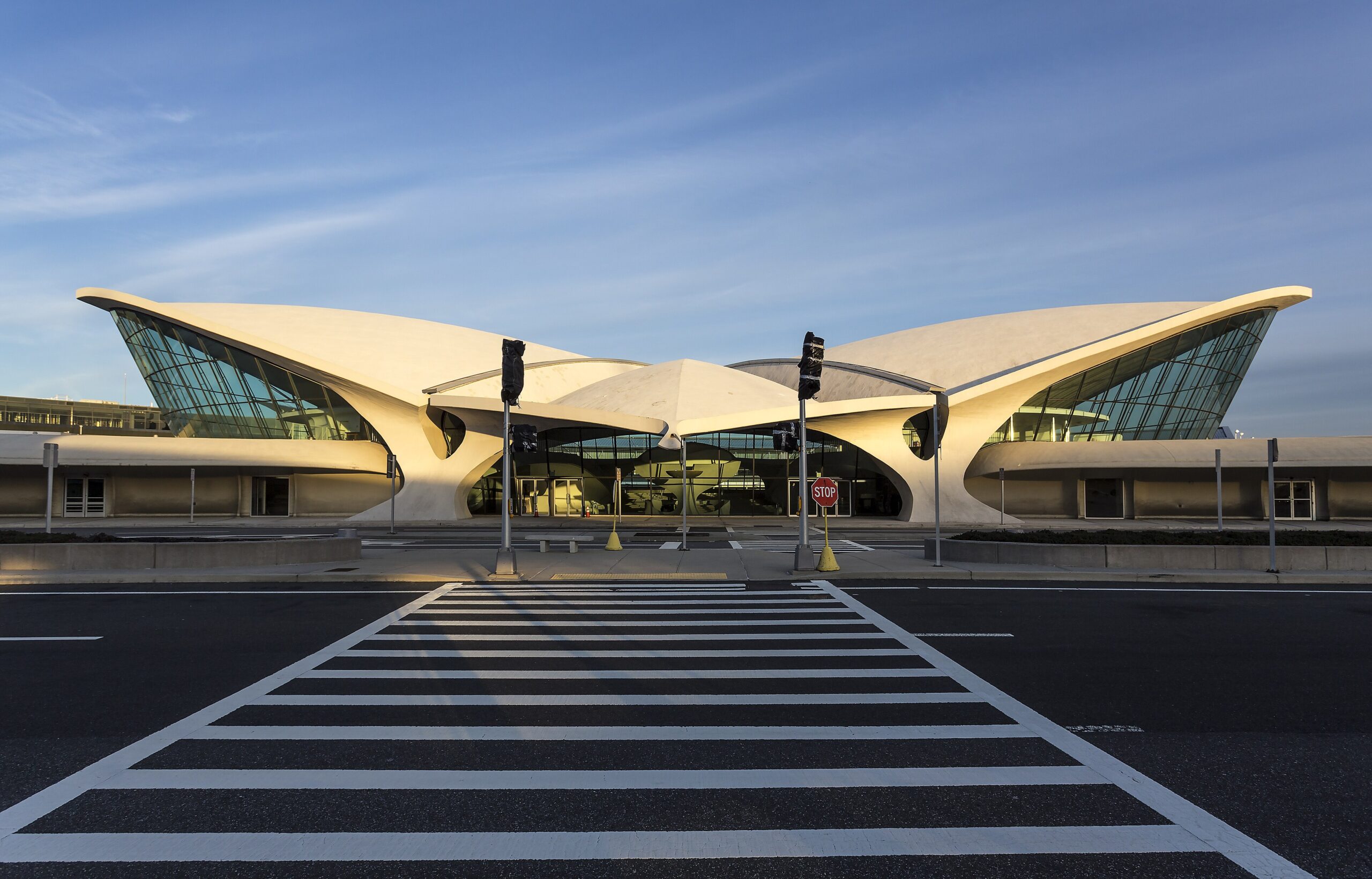
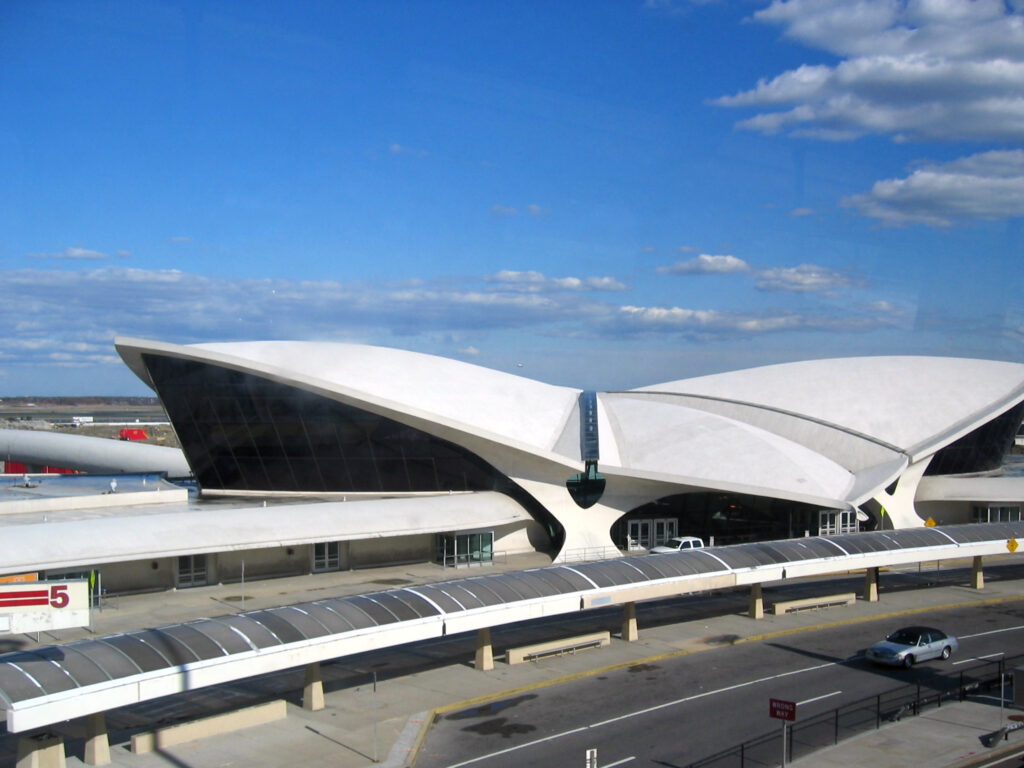
The TWA Flight Center at John F. Kennedy International Airport in New York City is one of the rare modern buildings in which architecture, engineering, corporate identity, and passenger movement become a single spatial argument. Designed by Eero Saarinen and Associates for Trans World Airlines, it opened in 1962 as an airport terminal but quickly became something larger: a cultural image of the Jet Age itself.
Its significance does not lie only in its sculptural silhouette. The building is important because it converts the idea of flight into a reinforced-concrete shell, a continuous interior landscape, and a carefully choreographed passenger sequence. Saarinen’s design does not merely symbolize aviation; it makes the visitor feel acceleration, anticipation, compression, release, and arrival through architectural form.
The terminal emerged from the airline-specific “Terminal City” model at Idlewild Airport, later renamed JFK. In that model, airlines did not simply rent anonymous gates; they commissioned buildings that projected corporate identity. For TWA, whose public image was tied to glamour, international mobility, and the leadership of Howard Hughes, Saarinen’s terminal became both infrastructure and advertisement.
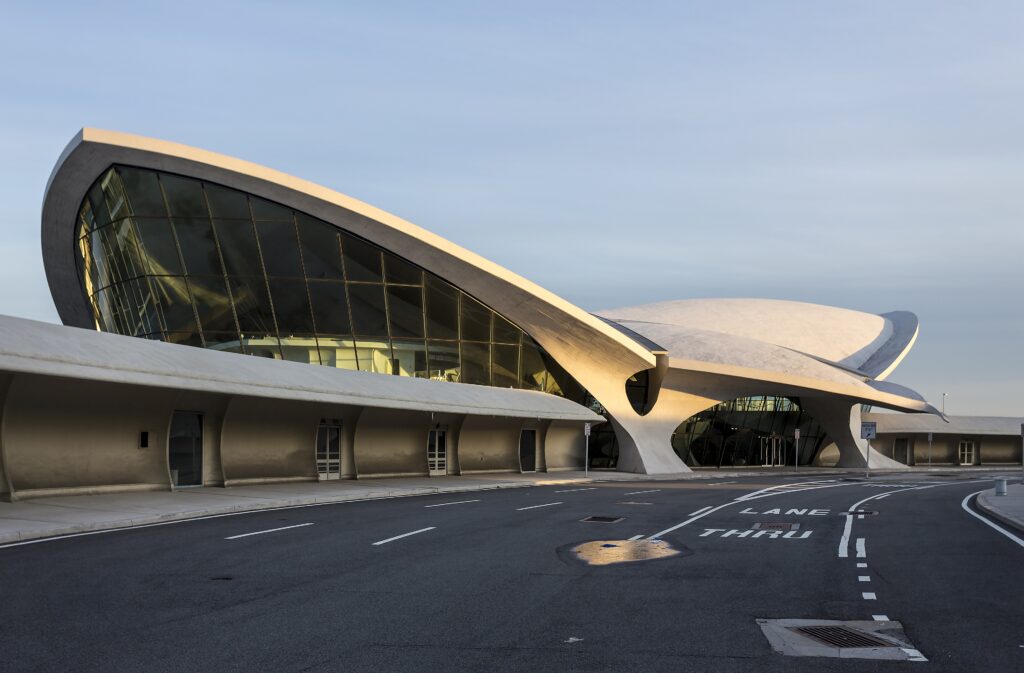
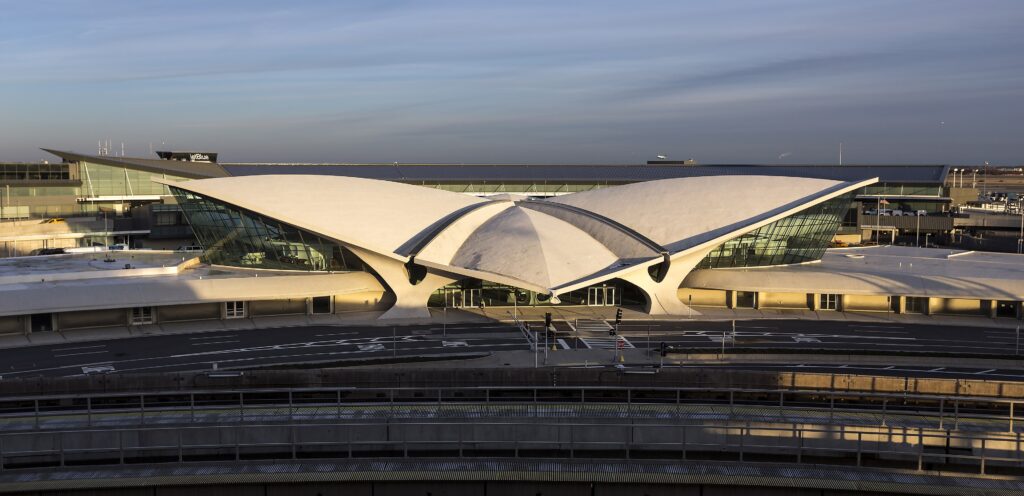
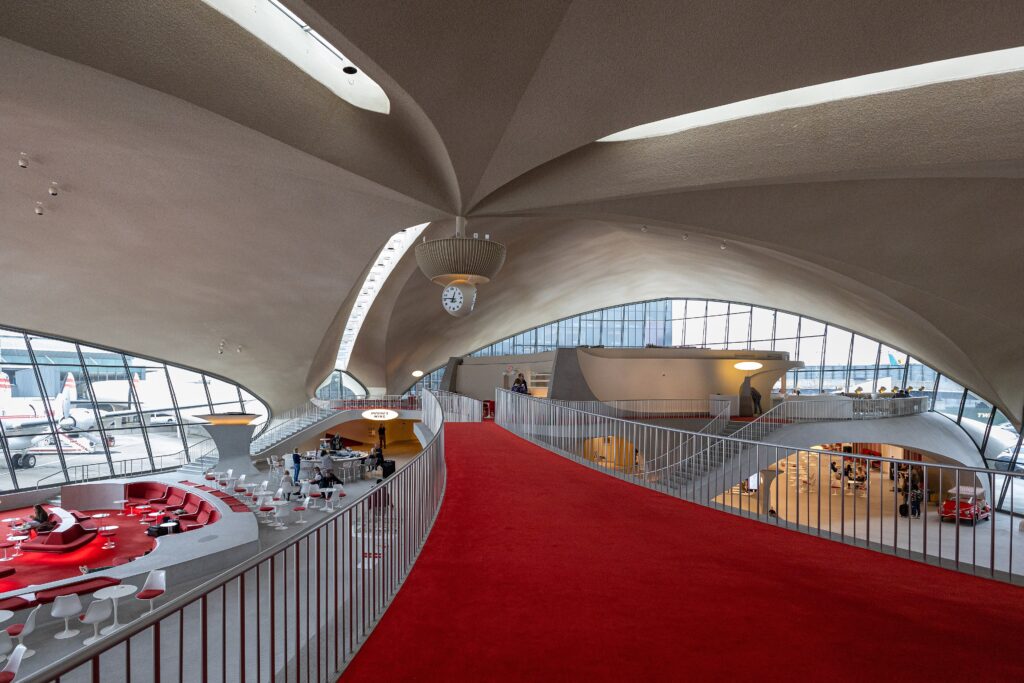
Technically, the building is dominated by its thin reinforced-concrete roof: four major shell segments gathered around a central zone, carried by powerful supports, split by skylight slots, and extended into a dramatic wing-like profile. The result is both structural and theatrical. Concrete behaves here not as inert weight but as a dynamic surface capable of spanning, lifting, enclosing, and directing space.
The most productive way to read the TWA Flight Center is not as nostalgic retro-futurism, but as a sophisticated experiment in mid-century infrastructure. Its later obsolescence, preservation battle, restoration, and conversion into the TWA Hotel reveal the economic difficulty of adapting highly specific transport architecture to changing aviation systems, security regimes, and real-estate models.
TWA Flight Center in Numbers
1962
The year the TWA Flight Center opened at Idlewild Airport, later renamed John F. Kennedy International Airport
$15 million
The commonly cited final cost of the original terminal, after the project rose above earlier budget expectations
4 shells
The principal reinforced-concrete roof segments that give the headhouse its wing-like structural figure
75 ft
The approximate height reached by the upward-sweeping roof shells above the terminal floor
80 ft
The approximate maximum cantilever often cited for the concrete roof, explaining the building’s suspended drama
5,500
The number of temporary supports reported for the scaffolding system used during construction of the roof
7–40 in
The approximate range of shell thickness, from thinner edge zones to heavily thickened convergence areas
35 plans
The number of aircraft-parking and operational layouts Saarinen’s team studied before fixing the terminal scheme
14 gates
The approximate number of large-jet positions TWA required during the terminal’s planning for the early jet era
900 ft
The average terminal-to-plane walking distance Saarinen’s office observed in airport research before design work
1994
The year the exterior and interior were designated New York City Landmarks, unusually early for a modern airport building
2005
The year the terminal was added to the National Register of Historic Places after sustained preservation pressure
$19 million
The public restoration investment reported after the preservation review of the JFK terminal redevelopment
$265 million
The widely reported private investment associated with the hotel conversion and rehabilitation program
512 rooms
The current hotel room count in the two new wings placed behind the restored Saarinen headhouse
50,000 ft²
The meeting and event area advertised by the TWA Hotel, showing how preservation became hospitality infrastructure
What is most revealing about the TWA Flight Center is that its apparent freedom is the visible residue of technical discipline: shell geometry, concrete thickness, temporary scaffolding, passenger-flow research, corporate branding, and later preservation economics all had to work together to make flight feel architectural.
Engineering and Construction of the TWA Flight Center
The engineering of the TWA Flight Center begins with a paradox: the building appears fluid, spontaneous, and almost airborne, yet it depends on an intensely disciplined reinforced-concrete shell system. Saarinen’s architecture sought motion, but the structure had to achieve equilibrium. That tension between visual flight and structural fixity is the intellectual core of the project.
Shell structure as architectural argument
The terminal’s headhouse is organized around four major reinforced-concrete shell segments. Two larger shells rise toward the sides, while two smaller shells slope toward the front and rear. The geometry creates a roof that seems to open outward like wings, but the system is not merely illustrative. The shells gather loads through curvature, thickened edges, and powerful supports, making the roof both enclosure and structural diagram.
Thin-shell concrete relies on shape as much as material strength. A flat slab must resist substantial bending, while a curved shell can distribute loads through membrane action, moving compression, tension, and shear across its surface. The TWA roof dramatizes this principle. Its visible form is not simply expressive decoration; it is the reason the roof can span and cantilever with such apparent lightness.
The reported range of shell thickness, from comparatively thin edge zones to much deeper areas near convergence, reveals the precision of the engineering. The shell is not a uniform sculptural cap. It is a differentiated structural body, thickened where forces accumulate and thinned where curvature and geometry can do more work.
Supports, forces, and the illusion of lift
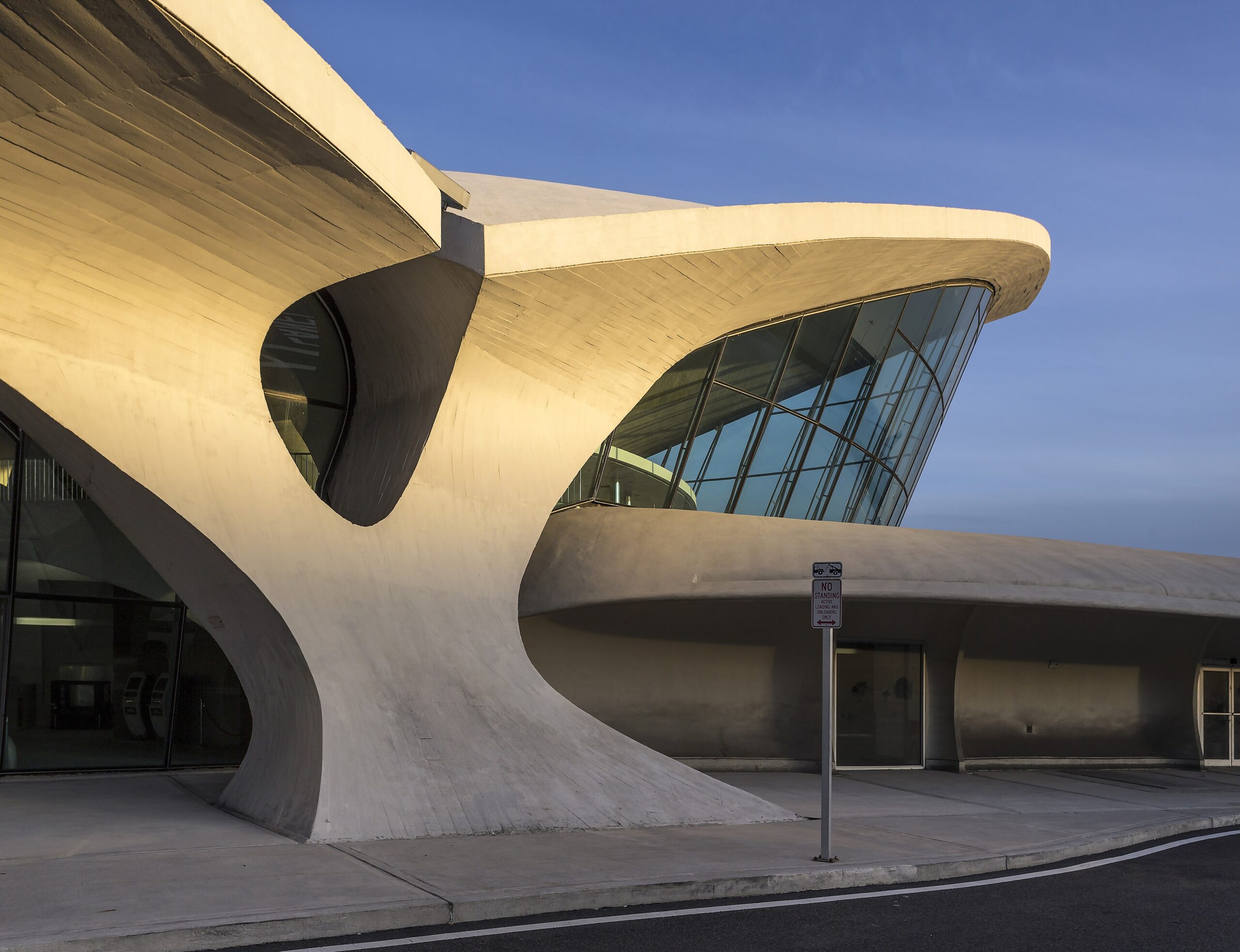
The Y-shaped supports are crucial. Saarinen avoided the visual language of conventional columns carrying a separate roof. Instead, the supports appear to grow into the shell, creating continuity between ground, pier, roof, and interior surface. This is an architectural choice, but also a structural one: the supports collect and redirect forces from the roof’s complex geometry into the foundations.
The roof’s cantilevered edges intensify the effect. A roof that projects outward must resist not only gravity but also bending, torsion, and local stress concentrations created by its irregular geometry. The approximate 80-foot cantilever commonly associated with the project explains why the terminal looks physically improbable. Its theatrical freedom is purchased through exact structural control.
The construction process made that control visible before the final building could exist. Contemporary accounts describe thousands of temporary supports and an elaborate scaffold system used to form and hold the concrete shells during curing. Once the roof had gained strength, the removal of the shoring was a decisive structural moment.
Circulation as engineering of experience
Saarinen’s team studied airport passenger movement intensely. Their research into walking distances, aircraft parking, baggage handling, and passenger flow shows that the building’s curves were not simply aesthetic gestures. The terminal was designed to make movement legible, even pleasurable, within a highly technical transportation system.
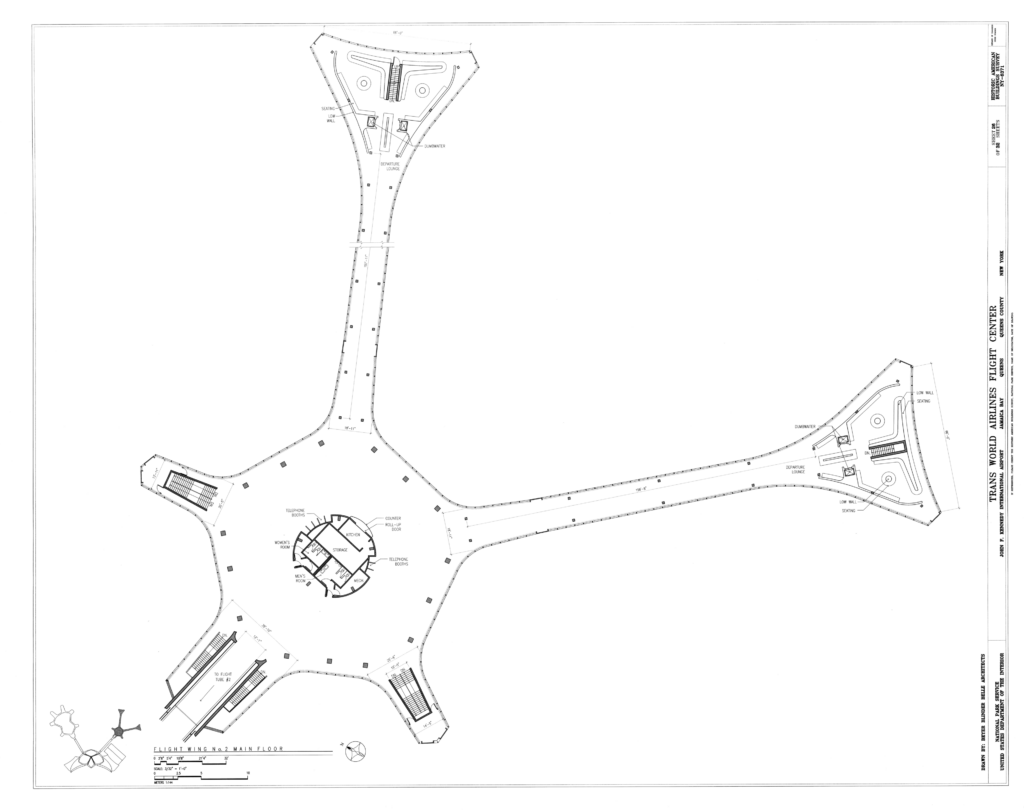
The flight tubes are the clearest example. They are not monumental in the same way as the headhouse, yet they are among the most important spatial inventions of the project. They turn a boarding connection into a cinematic sequence, compressing the passenger before release toward the aircraft zone.
The interior extends the same logic. Ramps, balconies, counters, lounges, and railings participate in the curvilinear language of the roof. Not every curve is structural, but nearly every curve is experiential. Saarinen made the passenger feel that the building itself was in motion, even when the operational task was waiting, checking in, or walking.
Obsolescence as an engineering problem
The TWA Flight Center also demonstrates the danger of designing infrastructure too precisely for one technological moment. It was conceived at the transition from propeller aviation to widespread jet service, before the full implications of larger aircraft, heavier passenger volumes, modern security screening, and hub-and-spoke operations were fully absorbed into terminal design.
When TWA ceased operations in 2001, the building lost the operating system for which it had been designed. It was too significant to demolish casually, but too constrained to absorb contemporary airport functions without damage. The engineering question therefore shifted from how to build the shell to how to preserve it while assigning new uses to the site.
The hotel conversion answered that question by separating symbolic value from repetitive program. The Saarinen headhouse became a lobby, dining, event, exhibition, and social space, while two new wings behind it absorbed the 512 guestrooms. This is an unusually clear adaptive-reuse strategy: preserve the irreplaceable geometry and passenger sequence, but locate the revenue-generating repetitive units in new construction.
Architecture of the TWA Flight Center
The architecture of the TWA Flight Center is often reduced to the metaphor of wings, but that shorthand underestimates the building. Saarinen was not simply drawing a bird or an airplane in concrete. He was designing an architectural equivalent of flight: a sequence of lift, suspension, acceleration, and release translated into roof geometry, interior circulation, color, glass, and public ritual.
The headhouse is the architectural core. It is neither a conventional terminal box nor a pure sculptural object. It is a spatial organism in which roof, wall, balcony, ramp, stair, lounge, and service counter are composed as one continuous environment. The building rejects the separation between structure and interior decoration; instead, it makes the passenger feel that every element belongs to the same aerodynamic world.
Saarinen’s handling of movement is especially important. The terminal does not organize passengers through a simple grid of corridors. It guides them through arcs, ramps, lowered lounges, glazed edges, and tubular passages. This makes circulation experiential rather than merely logistical. The architecture teaches the body how to move through the building before the passenger fully understands the plan.
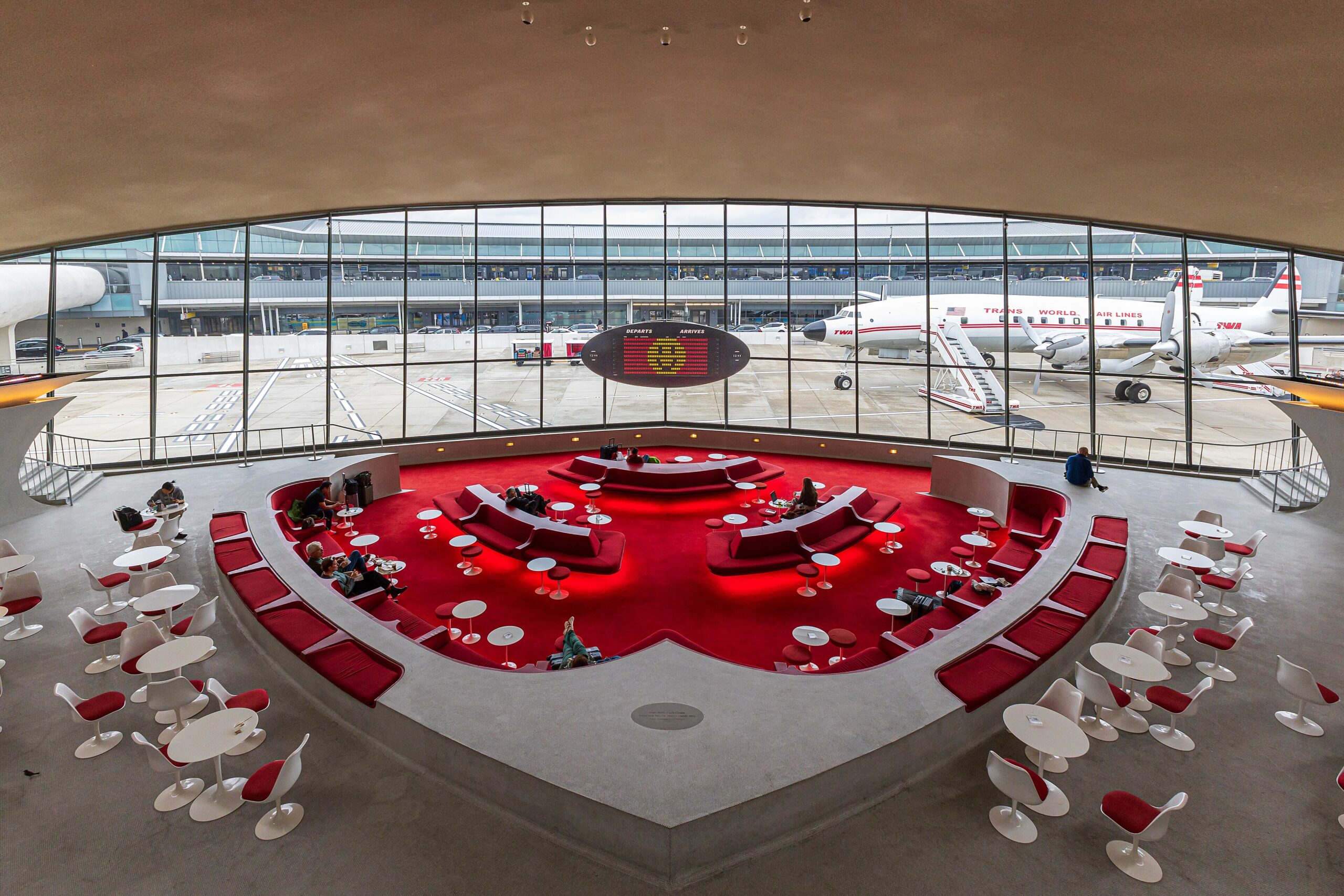
The Sunken Lounge is one of the most sophisticated moments in the design. By lowering the social waiting area below the main floor level, Saarinen transformed waiting into performance. Passengers became visible within a theatrical basin, while the airfield remained framed beyond the glass. The lounge turned aviation into a public spectacle without requiring literal decoration or narrative murals.
The building’s material palette reinforces this spatial drama. Pale concrete gives the shell a continuous, almost bodily presence, while glass opens the interior toward aircraft movement and daylight. Red upholstery and carpeting operate as graphic intensifiers. They do not simply add warmth; they mark zones of occupation inside the larger white structural volume, making people legible within the architecture.
The flight tubes extend the architectural idea beyond the main hall. They are corridors, but Saarinen refused to treat them as neutral connectors. Their oval section, continuous surface, and controlled perspective compress the body and frame the act of boarding as a transition from civic space to aircraft space. Few airport buildings have made the threshold between terminal and plane so memorable.
The terminal also reveals Saarinen’s interest in total design. Signage, seating, counters, lighting, and circulation were conceived as parts of a unified environment. This approach belongs to mid-century corporate modernism, but it is unusually intense here. TWA did not receive a generic building with applied branding; it received an architectural identity system in which the building itself became the brand.
As architecture, the TWA Flight Center sits between expressionism and infrastructure. Its forms are dramatic, but they remain tied to the practical problems of arrival, check-in, waiting, baggage, boarding, and aircraft adjacency. That dual condition is why the building still matters. It is a work of formal invention, but also a serious attempt to make modern transportation emotionally intelligible.
Economics of the TWA Flight Center
The economics of the TWA Flight Center begin with brand value. In the late 1950s and early 1960s, airlines were not merely transport providers; they were manufacturers of glamour, confidence, and technological optimism. TWA’s terminal was part of that economy. The building announced that flying with TWA was not a commodity transaction but an entrance into a modern international culture.
This explains why the original project could absorb cost escalation. Published accounts commonly cite a final cost of approximately $15 million, considerably above earlier budget expectations. From a narrow operational standpoint, this was expensive airport infrastructure. From a corporate-image standpoint, it was a permanent advertisement in concrete, glass, color, and movement.
The Port Authority’s “Terminal City” model shaped that logic. By allowing major airlines to commission their own terminals, JFK turned infrastructure into competitive identity. Each airline could use architecture to distinguish itself. Saarinen’s terminal became the most theatrical and intellectually coherent expression of that system.
The financial story became more complicated after TWA’s collapse. Once the airline disappeared, the terminal no longer had a direct commercial sponsor or a natural aviation function. The building was culturally priceless but economically awkward. Preservation therefore became a negotiation among airport expansion, public heritage obligations, private redevelopment, and the practical need to maintain a difficult landmark.
The Section 106 process and the later restoration investment were critical because they shifted the terminal from threatened relic to managed public asset. The reported $19 million Port Authority restoration stabilized the headhouse, repaired major envelope elements, removed inappropriate additions, and prepared the building for future reuse.
The hotel conversion added a different economic model. MCR and MORSE Development transformed the landmark into the centerpiece of a hospitality project, with new hotel wings, event space, food-and-beverage operations, a rooftop pool, museum-like displays, and highly visible airport branding. The widely reported $265 million redevelopment cost shows that the project was not simply preservation; it was preservation converted into revenue-producing experience.
From a real-estate perspective, the scheme is intelligent because it does not ask the historic terminal to behave like a normal hotel floor plate. Guestrooms are placed in new wings, while the headhouse provides identity, arrival, spectacle, and public value. The most expensive architectural object becomes the project’s brand engine rather than its repetitive income container.
The TWA Flight Center’s economic afterlife therefore has three phases. First, it served as airline image infrastructure. Second, it became a preservation liability within airport redevelopment. Third, it became an experiential hospitality asset. Each phase depends on the same fact: Saarinen’s building is too distinctive to be neutral.
Trivia
It Opened After Saarinen’s Death
Eero Saarinen died in 1961, before the terminal officially opened in 1962. One of his most famous buildings was therefore completed posthumously.
The Building Was Marketed Like a Monument
Before opening, TWA promoted the terminal aggressively. Its advertising value mattered almost as much as its practical function.
Grand Central Helped Shape It
Saarinen’s office studied passenger movement at Grand Central Terminal and noticed that people often moved in curves, not strict straight lines.
The Tubes Became Preservation Prizes
The oval flight tubes are among the most loved parts of the building because they turn a simple boarding passage into a cinematic event.
It Was Young for a Landmark
When New York City designated it in 1994, the building was only about thirty-two years old, unusually young for landmark protection.
It Became a Hotel Without Losing the Headhouse
The adaptive reuse strategy placed hotel rooms in new wings, allowing the Saarinen headhouse to remain the public architectural centerpiece.
Connie Became a Cocktail Lounge
The TWA Hotel includes a restored Lockheed Constellation called “Connie,” transformed into a cocktail lounge beside the terminal.
The Sunken Lounge Is Back
The restored Sunken Lounge turns waiting into theater again, with passengers and visitors staged against the terminal’s airfield-facing glass.
The Solari Board Became Atmosphere
The hotel uses a mechanical split-flap board as part of its Jet Age atmosphere, turning airport information into retro spectacle.
It Was Almost Too Specific
The same bespoke qualities that made the terminal extraordinary also made it difficult to adapt to larger jets, security screening, and modern airport operations.
Jet Age, But Not Fully Jet-Proof
The building became a symbol of jet travel, yet parts of its design were already challenged by the speed at which jet-aircraft operations evolved.
Concrete Became a Brand
The roof’s concrete shells did more than cover space. They made TWA’s identity visible from a distance, turning structure into corporate image.
Sources and References
[1] Advisory Council on Historic Preservation, Modern Masterpiece Poised to Take Flight: Historic TWA Terminal, Queens, New York, ACHP case-study PDF, archive file available 2018. URL: https://www.achp.gov/sites/default/files/2018-07/TWA%20Terminal.pdf. Material checked: 16.04.2026.
[2] Luke Fiederer, AD Classics: TWA Flight Center / Eero Saarinen, ArchDaily, published 16.06.2016, updated 22.10.2018. URL: https://www.archdaily.com/788012/ad-classics-twa-flight-center-eero-saarinen. Material checked: 16.04.2026.
[3] TWA Hotel, Overview | TWA Hotel at JFK Airport, official hotel information page, current web page. URL: https://www.twahotel.com/hotel. Material checked: 16.04.2026.
[4] National Park Service, National Register of Historic Places — TWA Flight Center listing context, federal historic-preservation register information, 2005 listing context. URL: https://www.nps.gov/subjects/nationalregister/. Material checked: 16.04.2026.
[5] Docomomo US, Jessica Smith and Kyle Driebeek, TWA Terminal, register entry, 2017/2021 page context. URL: https://www.docomomo-us.org/register/twa-terminal. Material checked: 16.04.2026.
[6] Helen Norman, MCR Development to transform JFK’s TWA Flight Center into US$265m hotel, Passenger Terminal Today, published 15.12.2015. URL: https://www.passengerterminaltoday.com/uncategorized/mcr-development-to-transform-jfks-twa-flight-center-into-us265m-hotel.html. Material checked: 16.04.2026.
[7] Nareit, MCR Unveils New TWA Hotel at JFK Airport, published 24.03.2020. URL: https://www.reit.com/news/reit-magazine/march-april-2020/mcr-unveils-new-twa-hotel-jfk-airport. Material checked: 16.04.2026.
[8] Elizabeth Cryan, MCR lands $290M loan for TWA Hotel at JFK, The Real Deal, published 17.06.2024. URL: https://therealdeal.com/new-york/2024/06/17/mcr-lands-290m-loan-for-twa-hotel-at-jfk/. Material checked: 16.04.2026.
[9] Ji Hye Song, Urban law and the expulsion of authenticity: preservation of the TWA terminal in the JFK Airport redevelopment plan, International Journal of Cultural Property, Cambridge University Press, 2021. URL: https://www.cambridge.org/core/journals/international-journal-of-cultural-property/article/urban-law-and-the-expulsion-of-authenticity-preservation-of-the-twa-terminal-in-the-jfk-airport-redevelopment-plan/BDDAE192280C370A9714210F6D9A0EB7. Material checked: 16.04.2026.
Some technical values for the TWA Flight Center vary among architectural histories, preservation summaries, and later redevelopment sources, especially shell thickness, cantilever length, roof weight, and construction quantities. Where sources differ, the article uses cautious wording such as “approximately,” “commonly cited,” or “reported.”