
A Suspension Bridge Built as Threshold, Structure, and Signal
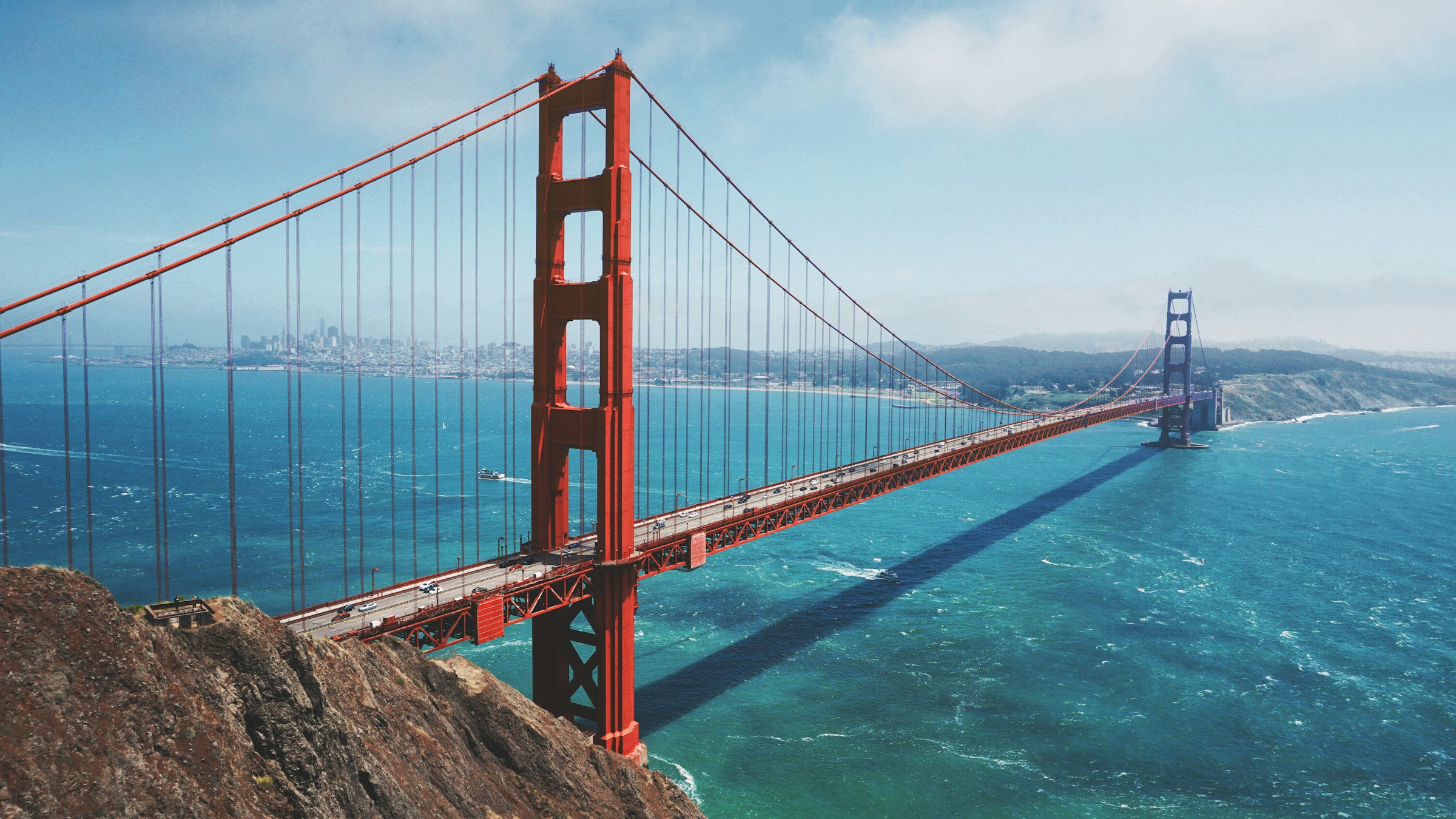
The Golden Gate Bridge is often treated as an image before it is treated as a piece of infrastructure. That is understandable: few works of civil engineering have entered global visual culture so completely. Yet the bridge is compelling precisely because its beauty is inseparable from technical discipline, site intelligence, and long-term public ambition.
Its setting is unusually severe. The bridge crosses the narrow strait between San Francisco Bay and the Pacific Ocean, where wind, fog, salt air, tidal currents, deep water, and seismic risk all converge. To span that opening elegantly was not just a question of scale. It required an answer to one of the most difficult combinations of environment and structure in twentieth-century American engineering.
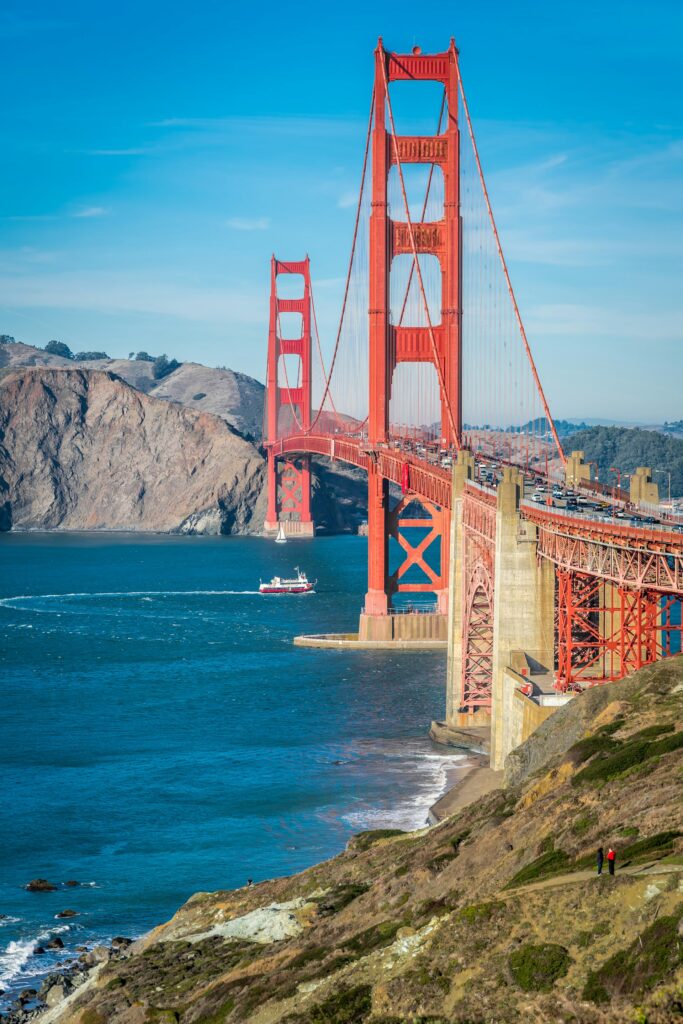
Completed in 1937, the bridge translated suspension-bridge logic into a form that felt both monumental and strangely light. The 4,200-foot main span was then the longest in the world, but the design never reads as merely oversized. Towers, cables, suspenders, stiffening truss, and roadway are composed with remarkable restraint, turning immense forces into an image of clarity rather than bulk.
The project’s design history matters as much as its final dimensions. Joseph Strauss drove the scheme politically, while Charles Alton Ellis, Leon Moisseiff, and architect Irving Morrow helped transform an initially heavier concept into the refined suspension bridge that was ultimately built. The result is one of the clearest cases in which engineering optimization and architectural judgment strengthened each other rather than competing.
Construction itself was an extraordinary feat of sequencing and risk management. The south tower foundation had to be established in hostile open water, cables had to be spun across a windy strait, and the whole structure had to be assembled with a precision that still defines long-span bridge practice. Even the famous safety net, which saved workers during construction, became part of the bridge’s engineering legacy.
What makes the Golden Gate Bridge enduring is that it has never been a frozen monument. It is continuously maintained, retrofitted, repainted, monitored, and adapted—through deck replacement, seismic work, and new safety infrastructure. In that sense, it is not only a masterpiece of 1930s engineering, but a living structural system whose relevance depends on perpetual technical care.
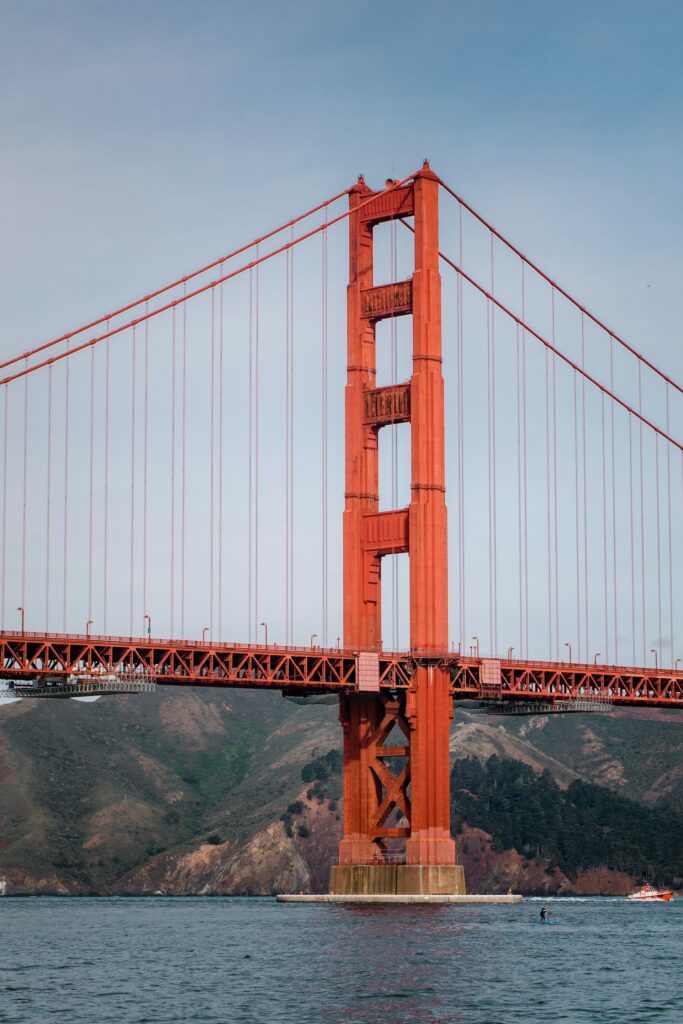
Golden Gate Bridge in Numbers
8,981 ft
The total length of the bridge with approaches, equivalent to about 2,737 meters
4,200 ft
The length of the main suspended span, the world record when the bridge opened in 1937
746 ft
The height of each tower above the water, equivalent to about 227 meters
220 ft
The vertical clearance above mean higher high water, allowing major ships to pass beneath the deck
90 ft
The full width of the bridge deck, containing roadway lanes, curbs, and pedestrian paths
62 ft
The roadway width between curbs, carrying the bridge’s six lanes of motor traffic
10 ft
The width of each sidewalk, giving the bridge its unusually public pedestrian character
36⅜ in
The diameter of each main cable, whose size conceals a vast internal bundle of steel wires
80,000 miles
The combined length of steel wire spun into the two main cables, enough to circle the Earth multiple times
27,572
The number of individual wires inside one main cable, organized into 61 carefully compacted strands
250 pairs
The number of suspender-rope pairs hanging from the main cables to support the deck at regular intervals
83,000 tons
The total structural steel used in the bridge, a reminder of how much mass lies behind its apparent lightness
389,000 yd³
The quantity of concrete used in the bridge’s anchors, piers, and massive support structures
1937
The opening year that turned the bridge into both a transportation link and a civic symbol overnight
1971
The year the original construction bonds were fully retired through toll revenue
$35 million
The original construction cost in 1930s dollars, extraordinary at the time and paid back through tolls
What is most intriguing about the Golden Gate Bridge is that its elegance is not decorative but structural: the same decisions that made it look impossibly light across a windswept, seismic strait—slender proportions, disciplined cable geometry, carefully weighted towers, and a deck designed to move rather than pretend to be rigid—are precisely the decisions that turned one of the most hostile bridge sites in America into a lasting work of civic engineering art.
Engineering and Construction of Golden Gate Bridge
The engineering of the Golden Gate Bridge begins with an unusually unforgiving site. The strait between San Francisco and Marin concentrates ocean wind, fog, corrosive salt air, strong tides, deep water, and seismic exposure into one narrow passage. The bridge therefore had to solve not one grand problem, but a dense stack of structural, geotechnical, and environmental constraints at once.
Foundations in open water
The hardest physical challenge was not the famous span itself, but the establishment of stable supports in hostile marine conditions. The south tower foundation, built in open water and extending roughly 110 feet below mean low water, demanded elaborate fendering, protective works, pumping, and sequencing before the tower could begin to rise.
That effort shows how misleading the bridge’s final image can be. What appears as a graceful line across the strait begins with massive concrete, excavation, and defensive engineering against waves, current, and impact. The bridge’s refinement rests on a very heavy base.
Wind / seismic / structural logic
The suspension scheme allowed the bridge to cover a great distance efficiently, but efficiency alone was never enough. At this site, the structure had to accept movement without losing composure, balancing flexibility with stiffness through the relationship between towers, cables, suspenders, and stiffening truss.
That logic became even more important in the decades after opening. Earthquake risk was not abstract in Northern California, and later retrofit campaigns made clear that the bridge’s long life would depend on continuous structural adaptation. The bridge is therefore a classic work of prewar engineering that now operates within a distinctly contemporary resilience regime.
Architectural meaning of the technical move
What makes this especially compelling is that the bridge’s defining architectural gesture is not ornamental, but proportional. Every major element—the towers, the catenary sweep of the cables, the narrowness of the deck, and the relative thinness of the truss—works to reduce visual drag while preserving structural credibility.
That decision is central to the bridge’s identity, because it converts extreme scale into visual calm. Instead of reading as a brute piece of infrastructure, the bridge feels measured, legible, and almost inevitable within the landscape. Its famous elegance is really the public face of disciplined load management.
Main span / stiffening system
Across the 4,200-foot main span, the roadway is held in suspension yet visually controlled by the stiffening system beneath it. The truss does not try to disappear completely; rather, it is calibrated to give the deck enough presence to resist wind and traffic effects without overwhelming the overall line of the bridge.
The result is better understood as a coordinated structural field than as a deck merely hanging from cables. Tower stiffness, cable geometry, deck behavior, and connection detailing all work together to give the bridge its distinctive combination of slenderness and authority.
Cable logic
Its main cables are especially important to that logic. Each cable measures 36⅜ inches in diameter and contains 27,572 wires organized into 61 strands, while the combined wire length in both cables reaches roughly 80,000 miles. Those numbers reveal the true scale behind what, from a distance, looks almost like a single drawn line in the sky.
Because the cable system gathers immense tensile capacity into such a refined form, it allows the bridge to achieve an extraordinary span without relying on heavy intermediate supports. In that sense, the bridge’s visual lightness is not a disguise, but a direct consequence of how efficiently tension is organized.
Cables as technical object
One of the most demanding technical components within this system is therefore not the tower silhouette or the roadway itself, but the cable-and-suspender network that quietly governs the whole structure. It is not simply a set of supporting elements, but the bridge’s primary engineered instrument.
Because the deck hangs from 250 pairs of suspender ropes and depends on the main cables for its essential structural logic, geometry, maintenance access, inspection, corrosion protection, and long-term behavior all had to be resolved as part of the bridge’s fundamental design intelligence.
Deck as spatial device
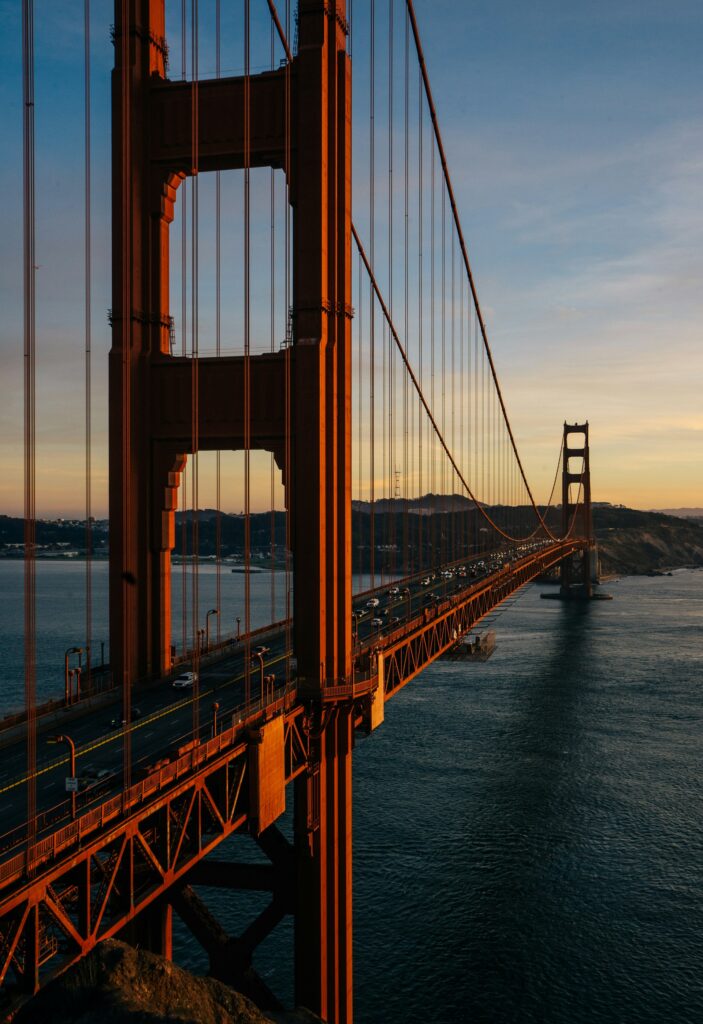
Its importance is not only technical but spatial. The roadway, sidewalks, and truss together create a public experience of exposure unlike that of most urban bridges: wind, fog, shipping, cliffs, and skyline are all felt directly, while the deck remains only lightly separated from the surrounding atmosphere.
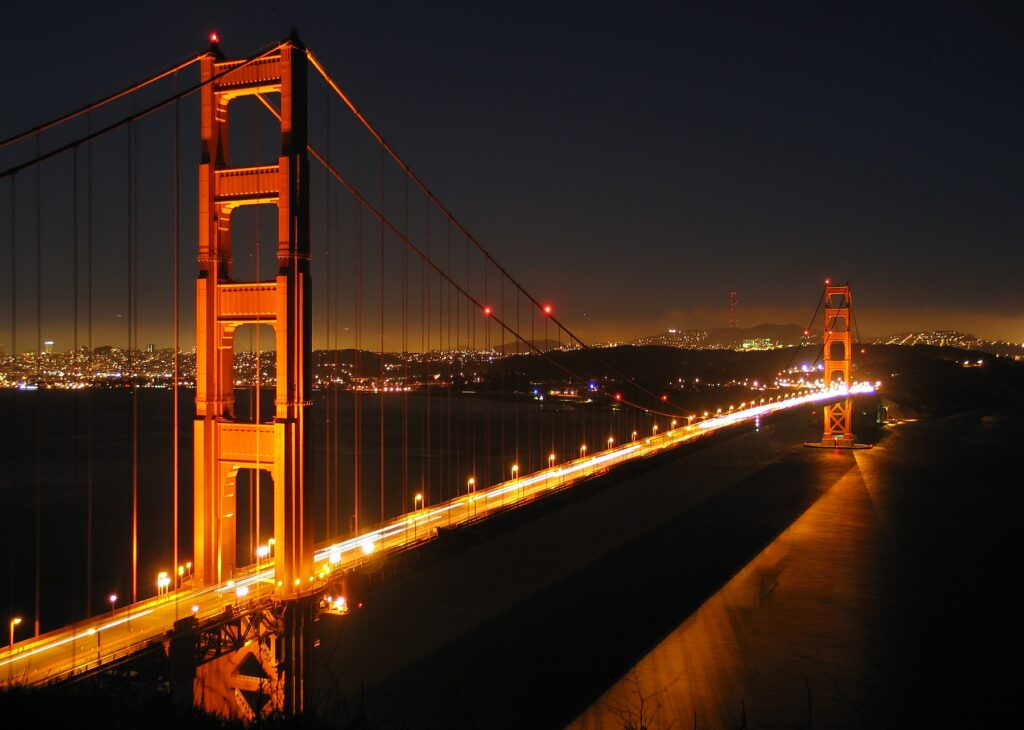
Sightlines, movement, and even color are part of that effect. Irving Morrow’s insistence on International Orange gave the bridge greater visibility in fog and against the landscape, proving that architectural judgment could reinforce operational logic rather than merely decorate it.
This level of integration is what ultimately defines the project. Golden Gate Bridge engineering is not only about spanning water; it is about reconciling marine foundations, wind behavior, seismic risk, cable technology, steel fabrication, public circulation, and long-term preservation within one continuous framework.
It is engineered less as a static monument than as a living system of ground, structure, maintenance, and adaptation. That is why the bridge remains so relevant: even now, through retrofit work and ongoing upgrades, it continues to demonstrate that the best infrastructure is never merely built once, but intelligently sustained.
Ecomonics of Golden Gate Bridge
Because the Golden Gate Bridge was conceived as public infrastructure rather than a private development, its economic story begins with political organization and collective risk. The project was financed through regional bond issuance backed by future toll revenue, which meant the bridge had to be imagined not only as a technical crossing but as a durable public asset capable of paying for itself over time.
The final construction cost of roughly $35 million was immense in Depression-era America. Yet what matters most is not only the size of that figure, but the financing model behind it. The bridge was built with the expectation that continuous use would translate into continuous income, turning mobility itself into the basis for debt service and long-term institutional stability.
That strategy proved durable. The original bonds were fully retired in 1971, with principal and interest paid largely through tolls rather than through a simple one-time subsidy model. In practical terms, the bridge became an example of how infrastructure could transform regional demand into a long-duration financial engine.
Its economic role today extends well beyond toll collection. The bridge carries major daily traffic, anchors tourism, reinforces Bay Area connectivity, and supports a vast maintenance and retrofit economy involving inspection, painting, seismic work, traffic operations, and safety systems. In other words, the bridge does not merely connect two shores; it supports a continuing ecosystem of movement, labor, and public expenditure.
In that sense, the Golden Gate Bridge is not only an engineering icon but a long-lived financial instrument shaped in steel, concrete, wire, and public governance. Its importance lies in how clearly it expresses the economics of durable infrastructure: large upfront capital, toll-backed repayment, relentless maintenance, and the recognition that public beauty is often inseparable from sustained institutional investment.
Trivia
It Once Held the World Record
When the bridge opened in 1937, its 4,200-foot main span was the longest suspension span on Earth. That record lasted until 1964, which means the bridge spent decades defining what a modern long-span crossing could look like. Its fame is partly the fame of having changed the benchmark itself.
The Safety Net Made History
A movable safety net was installed below the work zone during construction, an unusually advanced measure for its time. It saved 19 workers, who later became known as the “Halfway-to-Hell Club.” The bridge is remembered not only for its span, but also for having pushed jobsite safety forward.
International Orange Was a Strategic Choice
The bridge’s color is not just branding. International Orange improved visibility in fog and held its own against the muted grays, blues, and greens of the site. One of the world’s most recognizable aesthetic decisions was also a practical response to atmosphere.
The South Tower Was the Hardest Piece
The bridge’s most dramatic challenge was not drawing the span, but founding the south tower in rough open water. Waves, current, and exposure made that location brutally difficult to control. The bridge’s iconic silhouette owes a great deal to a foundation fight few visitors ever think about.
The Bridge Can Move More Than People Expect
Visitors often imagine iconic bridges as rigid objects, but the Golden Gate Bridge was designed to deflect under load and wind. Its movement is part of its intelligence, not a flaw in it. The bridge works because it accommodates force rather than pretending to defeat physics.
Each Tower Holds an Astonishing Number of Rivets
Each tower contains roughly 600,000 rivets, a reminder that the bridge was assembled in an era when industrial craft remained visibly embedded in major structures. The bridge is modern, but it is also deeply handmade by twentieth-century standards. Its precision still carries the texture of labor.
It Slimmed Down in 1986
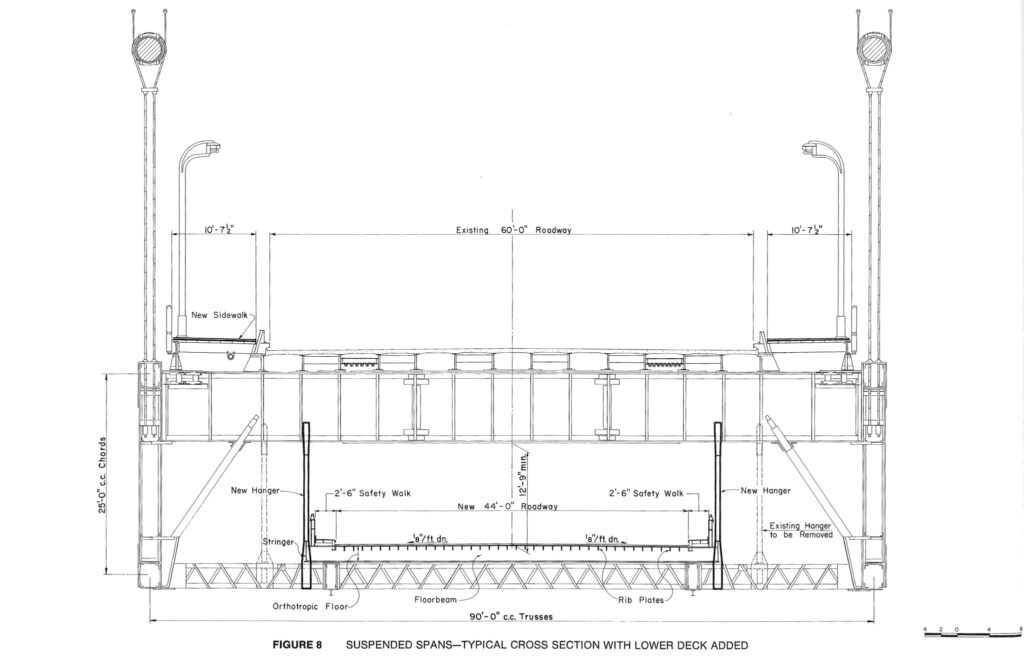
In 1986, the original concrete roadway was replaced with a lighter orthotropic steel deck. That change reduced dead load and improved structural performance without altering the bridge’s public identity. It is a perfect example of invisible modernization inside a historic silhouette.
The Bonds Were Paid Back by Use
The bridge’s original bonds were retired through toll revenue rather than disappearing into abstract civic myth. That financial fact matters because it ties the structure’s beauty to decades of ordinary daily use. One of the world’s great icons was also a working repayment machine.
A Continuous Barrier Now Runs the Full Length
As of 2024, a physical suicide deterrent barrier extends along the bridge’s full span. That change quietly altered one of the most photographed structures in the world. It is a reminder that even famous landmarks remain morally and operationally unfinished projects.
The Bridge Is Still Being Retrofitted
The Golden Gate Bridge looks timeless, but major seismic work continues well into the twenty-first century. That makes it less a finished relic than a continuously upgraded machine. Longevity here is an engineering program, not a romantic accident.
Strauss’s First Idea Was Heavier
Joseph Strauss originally advanced a more cumbersome hybrid scheme before the design evolved into the more elegant long-span suspension bridge we know today. That evolution matters because the final bridge is not simply the product of one authorial genius. It is the result of design refinement under pressure from engineers, architects, and site reality.
Fog Is Part of the Design Experience
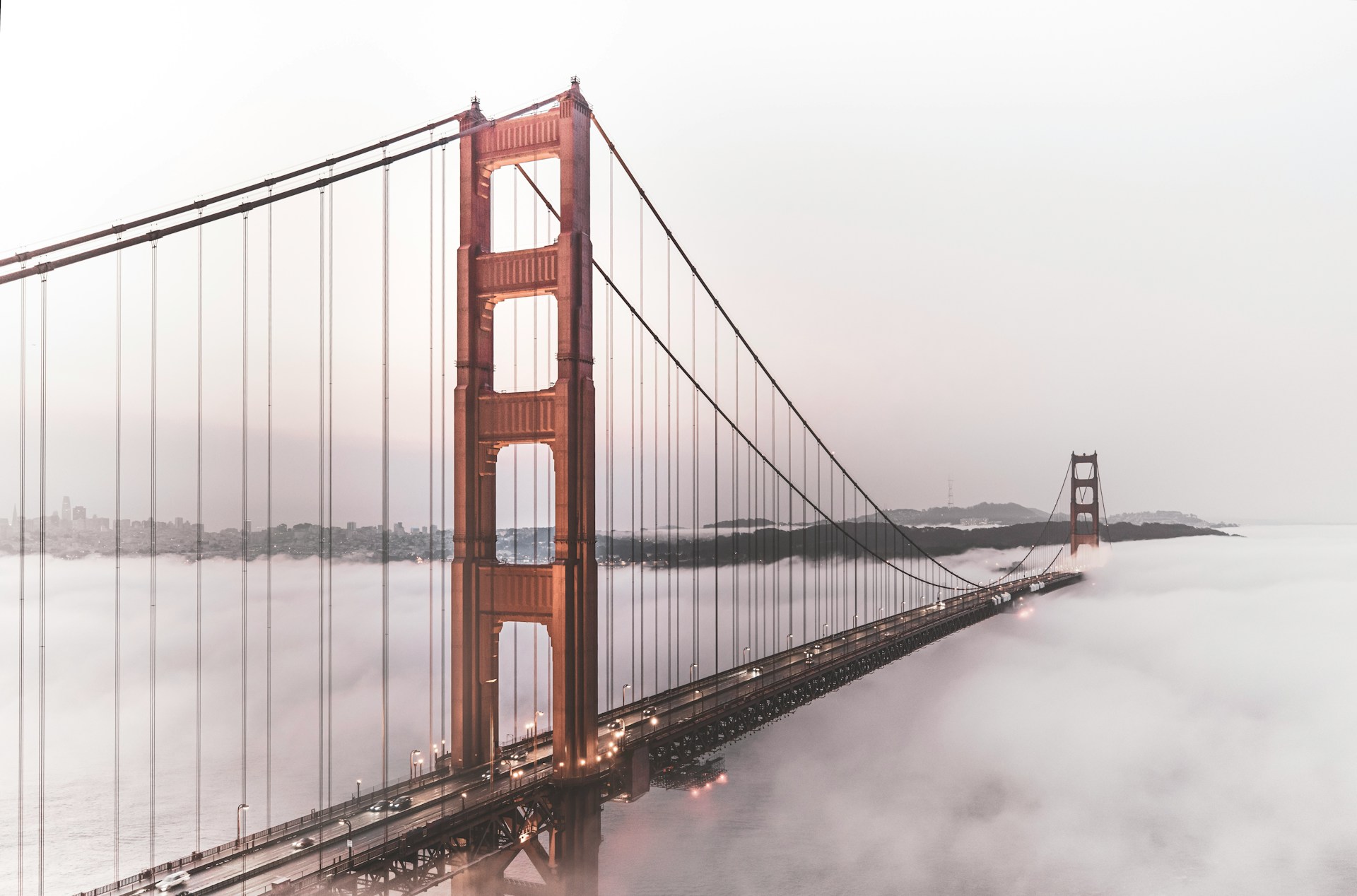
The Golden Gate Bridge is one of the few global landmarks whose atmosphere changes dramatically by the hour. In fog, the towers can seem detached from the deck, and the cables can vanish into blank air. That instability of appearance is one reason the bridge never feels visually exhausted, no matter how often it is photographed.
Sources and References
This article draws on official bridge documentation, engineering records, preservation material, public finance information, and widely cited institutional data concerning the Golden Gate Bridge and its long-term operation.
Referenced source groups include:
- Golden Gate Bridge, Highway and Transportation District official statistics and history
- National Park Service interpretation and heritage material
- American Society of Civil Engineers landmark documentation
- official seismic retrofit and safety barrier project information
- district traffic, toll, and public finance records
- institutional and public reporting on bridge engineering, maintenance, and resilience
The article references data related to:
- span lengths, tower heights, and deck dimensions
- cable diameter, wire counts, and suspender systems
- construction cost, bond financing, and toll repayment
- marine foundations and difficult south tower construction
- steel, concrete, and deck replacement strategy
- traffic volumes, public access, and operational role
- seismic retrofit and suicide deterrent system works
- the bridge’s architectural authorship, color strategy, and long-term maintenance
Some figures in major bridge infrastructure differ slightly between public sources, especially where values are rounded, converted between metric and imperial units, updated over time, or presented for different construction and operating phases. For that reason, selected numbers in this article are described as approximate where appropriate.