
A Cathedral Built as Monument, Reliquary, and Urban Claim
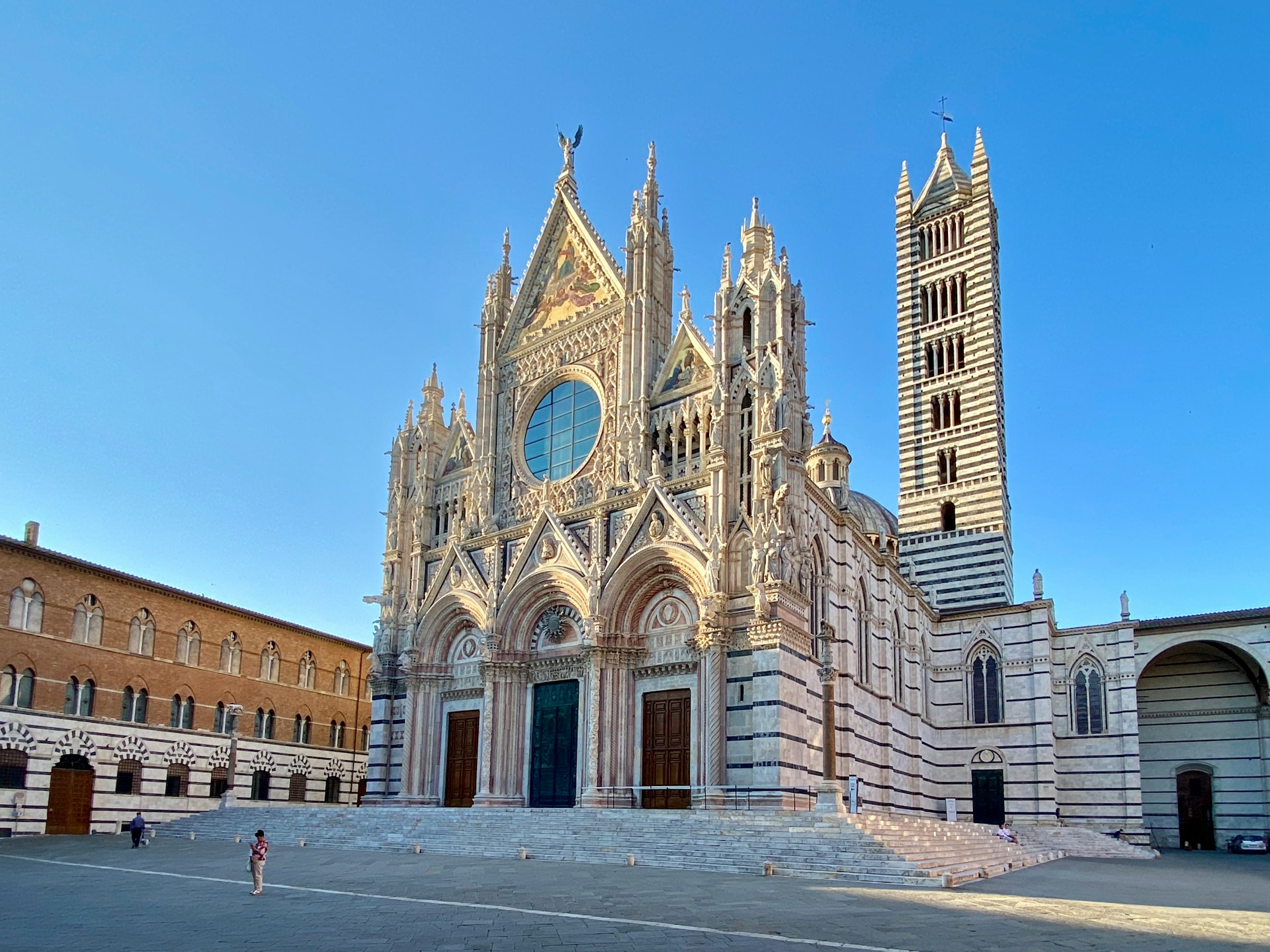
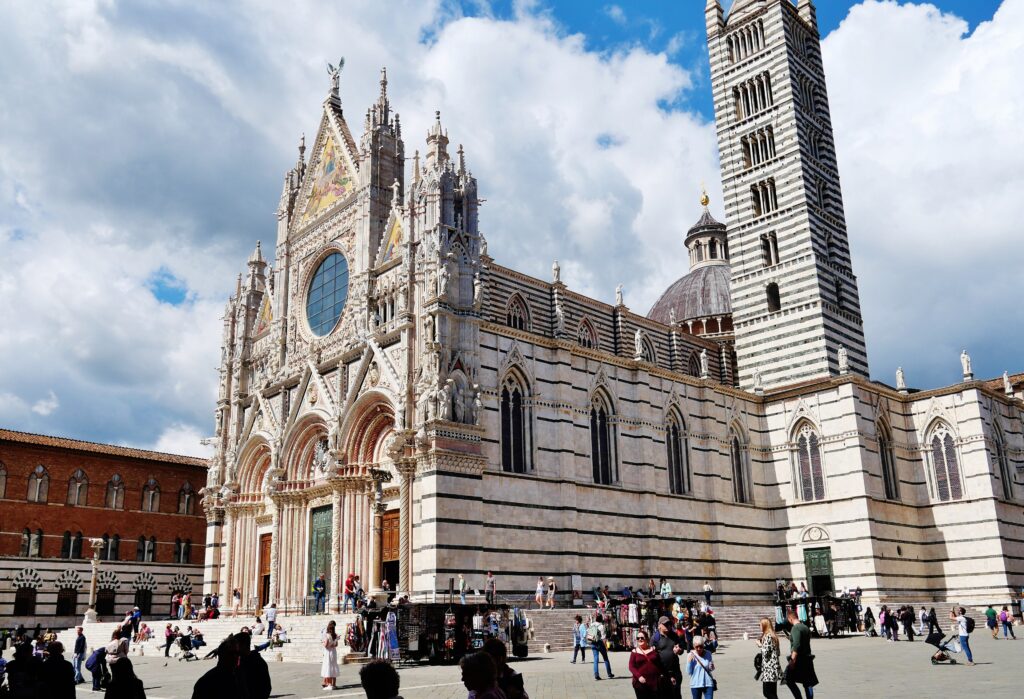
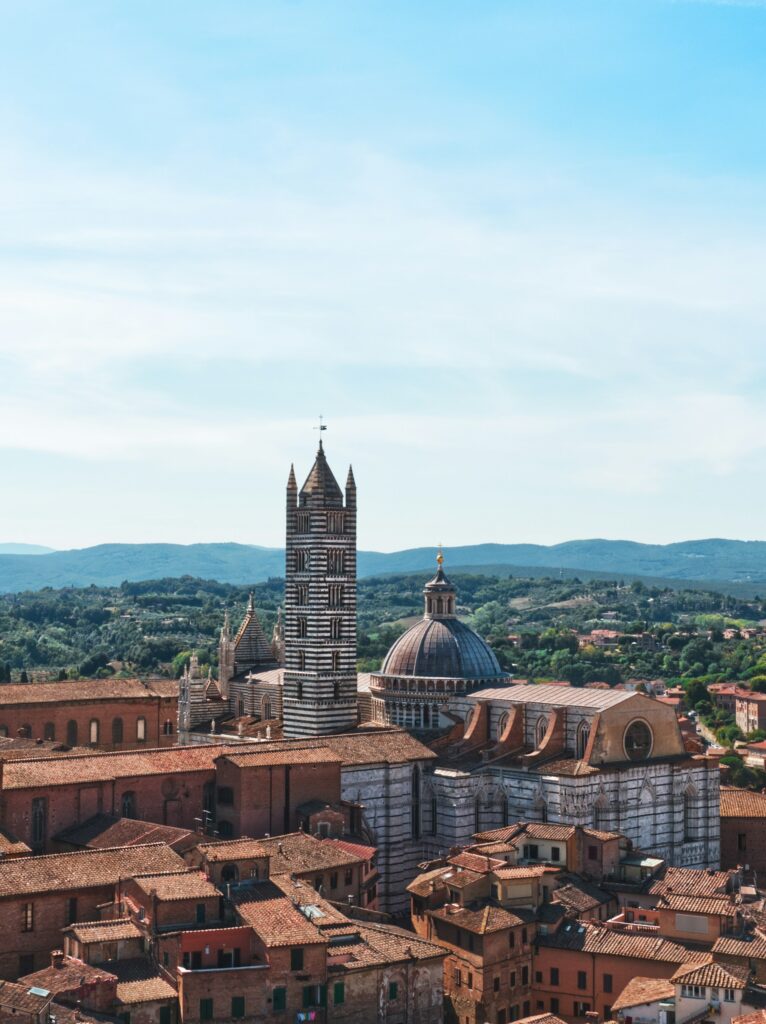
Duomo di Siena is not simply the cathedral of Siena. It is the most concentrated architectural statement of the city’s medieval ambitions: a church, a treasury of painting and sculpture, and a civic declaration in striped marble placed on the city’s highest ground.
Its importance lies partly in chronology. Begun in the late twelfth century and enlarged repeatedly through the thirteenth and fourteenth, the building condenses Romanesque inheritance, Tuscan marble craft, French Gothic aspiration, and later Renaissance and Baroque intervention into one unusually legible fabric.
What makes Siena’s cathedral especially revealing is that it was never a static object. The church that survives today is both a finished masterpiece and the fragment of a much larger project abandoned after the catastrophe of the Black Death and after serious structural doubts emerged in the vast new works begun in 1339.
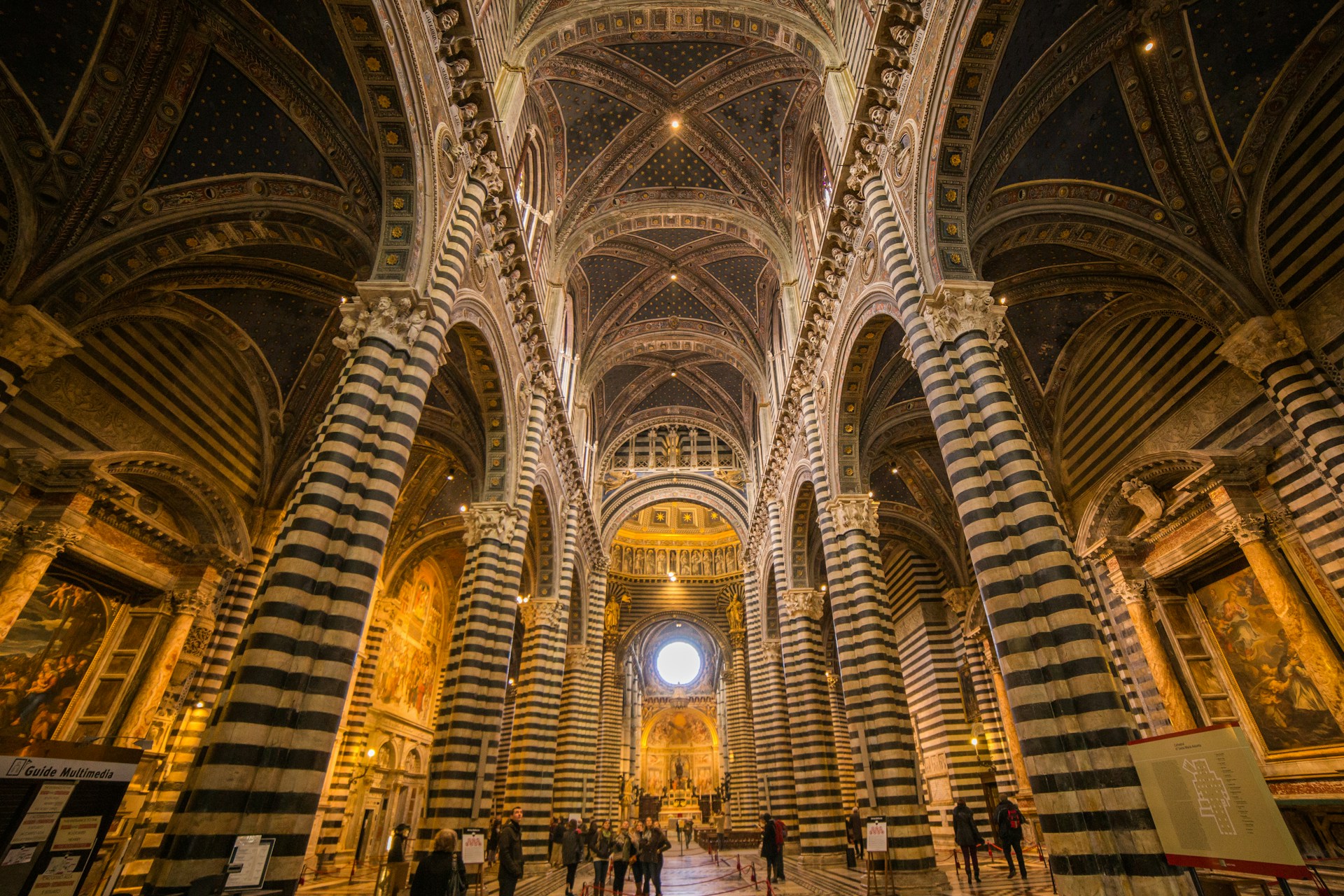
Inside, architecture and image are inseparable. The black-and-white banded walls, the hexagonal dome, Nicola Pisano’s pulpit, the Piccolomini Library, and above all the marble pavement produce a building whose primary medium is not empty volume alone but the continuous orchestration of surfaces, symbols, and liturgical movement.
For that reason, Siena Cathedral is best understood through three intertwined lenses: construction and enlargement, civic and devotional economics, and the long historical rivalry through which Siena tried to materialize political dignity in stone. The building matters not only because of its beauty, but because it records a republic imagining itself at monumental scale.
Duomo di Siena in Numbers
89.4 m
Approximate overall length of the cathedral, giving the present building a scale already large by Italian communal standards
77 m
Approximate maximum height to the top of the cathedral, making it the dominant vertical marker of Siena’s historic center
54 m
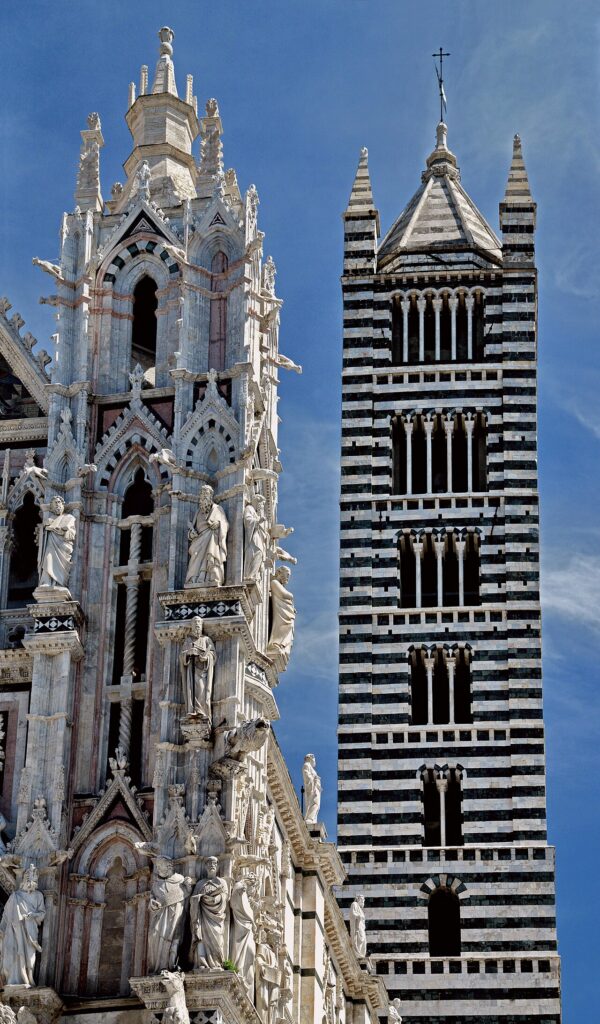
Approximate height of the campanile, whose vertical mass works as a separate load-bearing tower beside the church body
6 sides
The geometric base of the dome, an unusual hexagonal solution that makes the crossing structurally and spatially distinctive
3 aisles
The basilican section of nave and side aisles that organizes load, circulation, and ceremonial procession through the church
37
The number of marble pavement panels usually counted in the cathedral, making the floor one of the most extensive figured stone cycles in Europe
2 colors
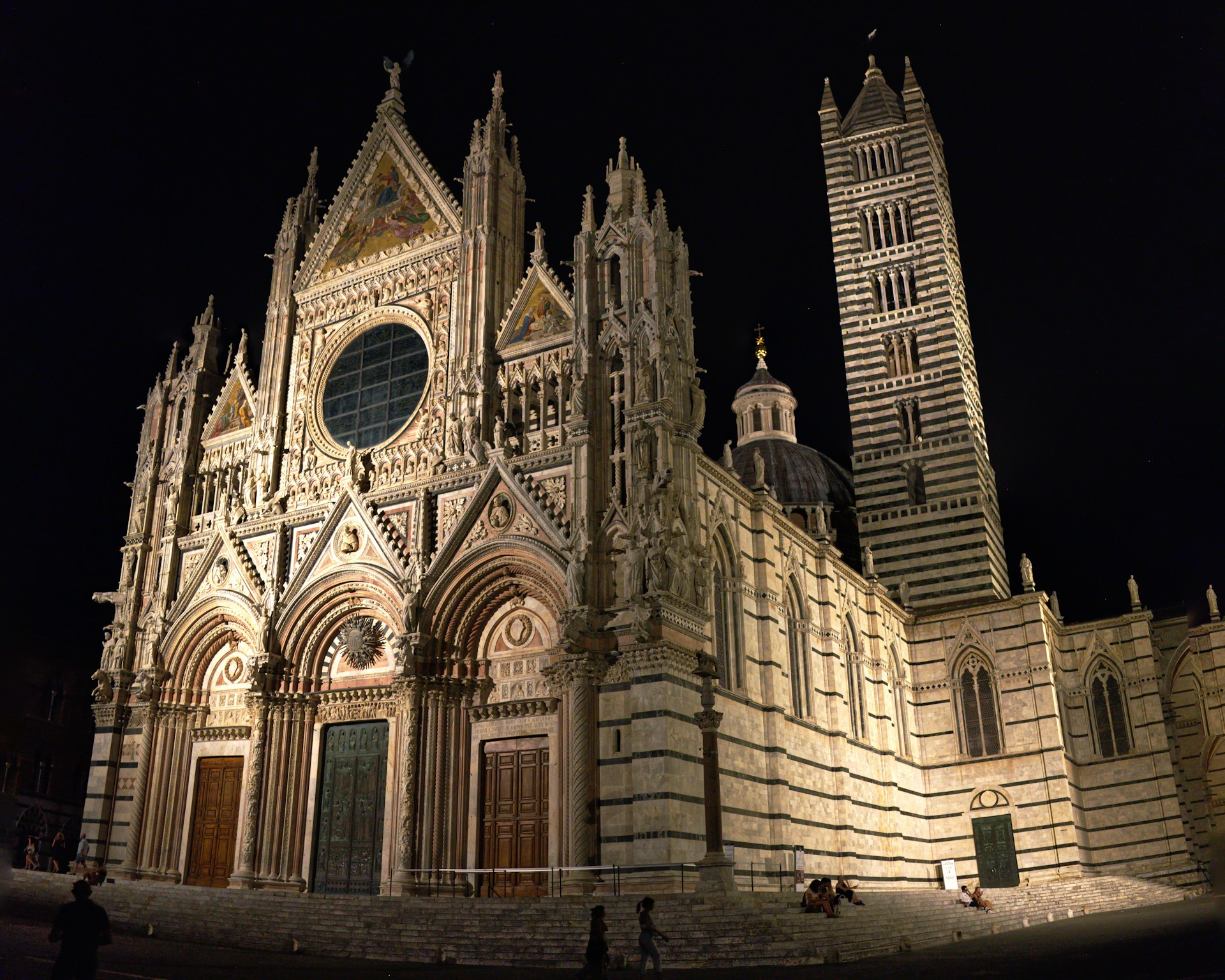
White and dark green-black marble organize the cathedral’s wall logic, turning civic identity into a full architectural ordering system
4 portals
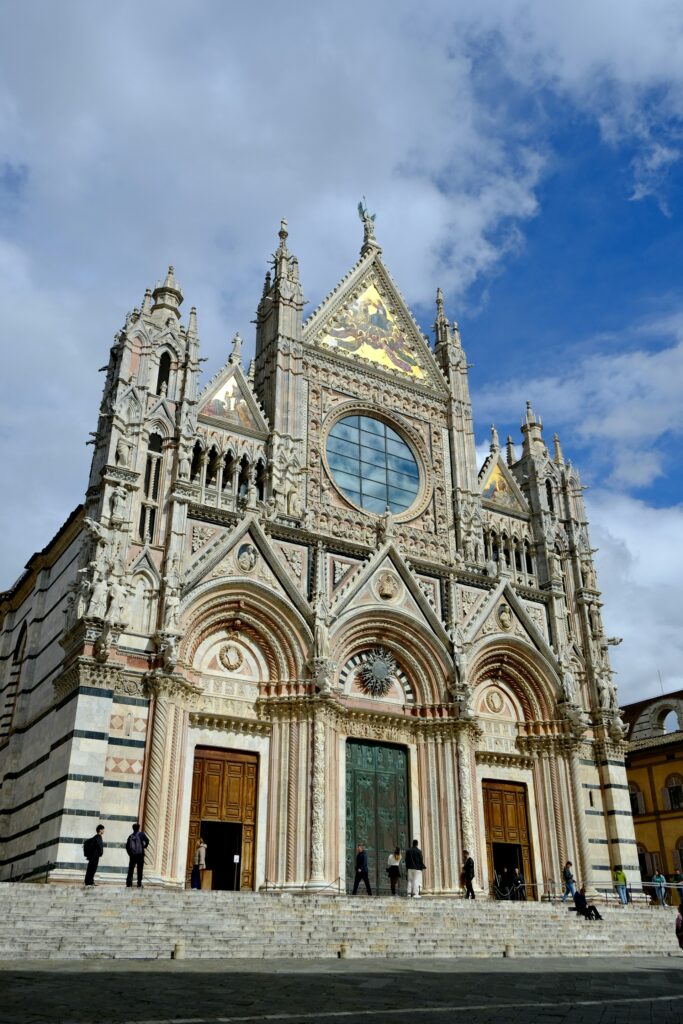
The main west façade distributes entry and sculptural emphasis across a multi-portal stone screen rather than a single dominant opening
3 levels
The west front is organized in layered vertical registers, allowing sculpture, windows, and gables to intensify upward rather than flatten across the elevation
1 great oculus
The large circular stained-glass window concentrates light and iconography into a single high-impact aperture in the cathedral’s interior system
50+ artists
Roughly the number of designers, sculptors, and craftsmen associated across centuries with the pavement alone, showing the scale of long-term artistic labor
1995
The year Siena’s historic center, crowned by the cathedral, was inscribed on the UNESCO World Heritage List under criteria (i), (ii), and (iv)
What is most intriguing about Duomo di Siena is that its deepest architectural truth lies in the tension between completion and incompletion: the building is at once a fully realized cathedral of marble, light, and image and the surviving fragment of a still more ambitious urban-religious project whose collapse reveals the limits of medieval civic power as clearly as its aspirations.
History of Duomo di Siena
The history of Siena Cathedral is inseparable from the history of Siena itself. Standing at the city’s symbolic summit, the church condensed the ambitions of a republic that understood architecture as an instrument of rank, devotion, and rivalry, especially in relation to Florence. The cathedral was never merely episcopal infrastructure; it was one of the principal stages on which Siena imagined itself.
The earliest phases belong to the late twelfth and early thirteenth centuries, but the building was repeatedly adjusted as the city’s resources, tastes, and political confidence evolved. This is why the cathedral contains Romanesque massing, Gothic enlargement, and later interventions without feeling incoherent. Its history is cumulative rather than purist.
The fourteenth century gave the cathedral its most dramatic historical turn. In 1339 Siena launched the “New Cathedral,” an expansion so large that the existing church would have been absorbed into a still greater composition. The project is often understood as the ultimate expression of Sienese confidence before plague, structural difficulty, and economic contraction exposed the limits of that confidence with brutal speed.
Yet failure became part of the monument’s historical force. The unfinished façade and surviving walls of the abandoned enlargement preserved in stone the memory of an interrupted future. Few cathedrals allow one to see so clearly both the ambition of a medieval city and the moment that ambition became unsustainable.
Later centuries did not erase that layered identity. Instead, they deepened it through selective enrichment: the Piccolomini Library inserted Renaissance humanist memory into the complex; Bernini’s works and the Chigi Chapel brought Baroque prestige; the preservation of the floor, sculpture, and associated museum spaces turned the cathedral into a continuous archive of Sienese artistic self-understanding.
Today the duomo’s historical meaning extends beyond the building envelope to the larger urban fabric of Siena, whose historic center entered the UNESCO World Heritage List in 1995. The cathedral remains the city’s crowning monument not because it is frozen in one stylistic moment, but because it records a long civic history in which art, religion, politics, and urban identity were repeatedly rewritten in marble.
Engineering and Construction of Duomo di Siena
The engineering of Siena Cathedral begins with aggregation rather than singular invention. The present church was built in stages from the late twelfth century onward on a constrained hilltop site, so its final form is the result of serial enlargement, recalibration, and decorative overlayering rather than one uninterrupted campaign.
Striped masonry as structural and symbolic system
The cathedral’s white and dark green-black marble banding is often read first as civic emblem, yet it is also a constructional strategy of facing and visual order. The alternation stabilizes perception across large wall surfaces, binds piers, arches, and spandrels into continuous horizontal fields, and turns masonry articulation into a legible rhythm that makes the interior feel both measured and ceremonial.
The nave and aisles rely on a comparatively conservative basilican logic, but that logic is intensified by surface treatment. Round arches, clustered supports, and striped walling produce a space in which weight is never denied; instead, mass is disciplined through pattern, giving the cathedral its peculiar balance between Romanesque gravity and Gothic aspiration.
Dome and crossing
The dome over the crossing is one of the cathedral’s most distinctive structural episodes. Rising from a hexagonal base rather than a simple circular drum, it negotiates the transition from the longitudinal body of the church to a centralized vertical accent, while the lantern later added above it sharpens the cathedral’s urban silhouette.
This crossing is essential to the building’s spatial logic. It interrupts the processional movement of the nave with a concentrated zone of vertical emphasis, allowing the cathedral to read not merely as a hall church but as a composite organism of nave, transept, dome, and liturgical focus.
Façade as stone screen
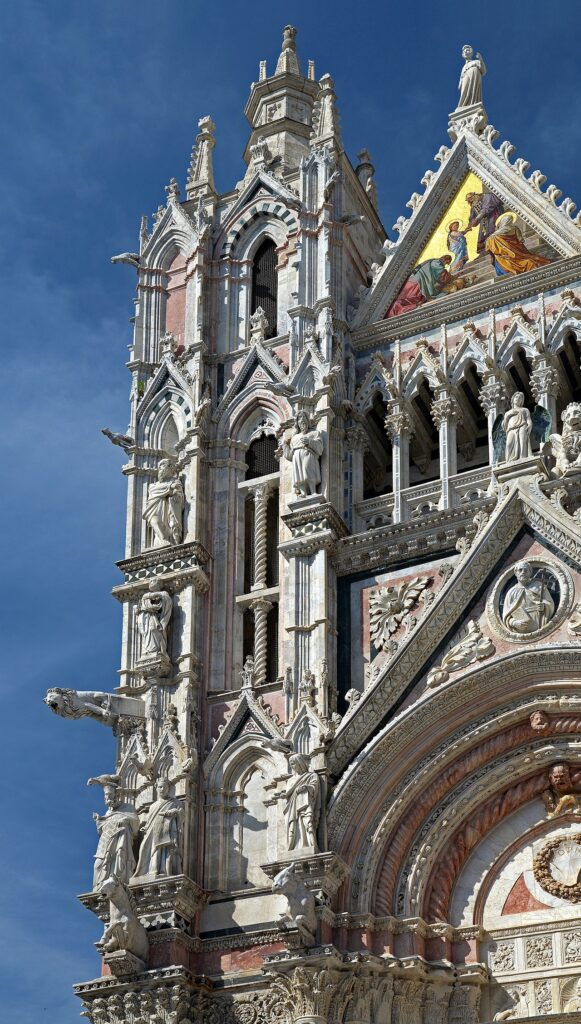
The west façade behaves less like a plain enclosure wall than like a sculptural screen. Giovanni Pisano’s lower zone, with its intense figural carving and sharply profiled portals, creates a threshold in which structure, iconography, and civic theater are inseparable.
Later completion of the upper façade altered the balance of the design, but that very layering is part of its meaning. Siena Cathedral does not conceal revision. It displays the cathedral workshop as a long-duration institution capable of changing elevation, ornament, and proportion while preserving the building’s larger identity.
Pavement as architectural medium
One of the cathedral’s most remarkable technical achievements is the marble floor. Executed across centuries through graffito and marble intarsia techniques, it turns the pavement into a monumental field of image and text. In most churches the floor is neutral support; at Siena it is a principal bearer of meaning, requiring visitors to read the building downward as much as upward.
The failed enlargement
The decisive engineering lesson of the complex lies south of the present church in the remains of the “New Cathedral.” The enlargement begun in 1339 would have reoriented the entire building and more than doubled its scale, but shallow foundations, concerns about material stability, and the demographic and economic shock of the plague made the project untenable.
Those surviving walls are therefore not incidental ruins. They are evidence of a medieval construction culture testing the upper limits of civic ambition. Siena Cathedral today is both the product of successful incremental building and the monument left behind by one of the most revealing structural overreaches in fourteenth-century Italy.
Ecomonics of Duomo di Siena
The economics of Siena Cathedral cannot be separated from the political economy of the medieval commune. The duomo was funded, administered, and enlarged through institutions that linked piety, taxation, civic prestige, artisanal labor, and the management of precious materials. It was not a private monument but a public-religious enterprise at the center of urban legitimacy.
The Opera di Santa Maria functioned as the cathedral’s durable managerial engine. Such an institution mattered economically because a building of this complexity required continuous procurement of marble, wood, metals, glass, sculpture, and specialist labor over generations. Siena’s cathedral was expensive not only because it was large, but because it was permanently open to improvement.
In the modern period the cathedral remains economically central, though by different means. It anchors Siena’s heritage economy, sustains museum and ticketing circuits across the monumental complex, and concentrates tourism value at the highest point of the city. The building demonstrates how a medieval religious investment can continue to operate as a long-term cultural asset centuries after the fiscal logic of its original commissioners disappeared.
Trivia
The Floor Is Usually Covered
Siena’s marble pavement is so fragile and so valuable that much of it is protected for most of the year. When the coverings are removed, the event itself becomes a seasonal cultural moment. The cathedral changes character as visitors suddenly experience the building not as striped walls above a neutral ground, but as a complete marble cosmos.
The City Tried to Outgrow It
The present cathedral was once meant to become only part of something far larger. In the 1339 enlargement plan, the existing building would have functioned as one arm of a new monumental complex. That unrealized ambition is still readable in the unfinished masonry beside the church.
A Library Inside a Cathedral
The Piccolomini Library was built to honor Pope Pius II and to house his manuscripts, yet it feels almost like an autonomous Renaissance jewel box inserted into the larger church. Its brightness and narrative frescoes create a striking contrast with the denser medieval interior. Few cathedrals contain a space so overtly dedicated to memory, scholarship, and papal lineage.
The Cathedral Teaches by Walking
Many churches communicate mainly through walls, altars, and windows. Siena Cathedral also teaches through the act of stepping. The floor’s sibyls, philosophers, and biblical scenes make movement through the building a form of reading.
The Dome Is Hexagonal
That hexagonal base is one reason the crossing feels so particular. The dome does not simply repeat a standard centralized formula but negotiates a more angular geometry. It is a small detail with a large effect on the building’s spatial identity.
Black and White Mean Siena
The cathedral’s stripes are tied to Siena’s civic colors and to local legendary origin stories about the founders Senius and Aschius. Whether read historically or symbolically, the banding makes the church inseparable from urban identity. At Siena, decoration is also heraldry.
Michelangelo Is Here, Quietly
Visitors often arrive thinking first of Pisano or Pinturicchio, but the cathedral also preserves sculptures by Michelangelo for the Piccolomini altar. They are not the building’s loudest features. That relative modesty makes their presence all the more surprising.
The Unfinished Façade Became a Viewpoint
The great surviving wall of the abandoned “New Cathedral” is now one of Siena’s best panoramas. That is a rare historical reversal. A failed construction campaign has become one of the city’s most desired perspectives over the urban fabric it once sought to dominate.
Duccio’s Altarpiece Moved
Duccio’s Maestà was painted for the cathedral’s high altar between 1308 and 1311. Today it is in the Museo dell’Opera rather than in its original liturgical setting. That displacement has made it easier to study, but it also reminds visitors how profoundly the cathedral once centered image in ritual space.
Bernini Left a Mark Here Too
Siena Cathedral reaches well beyond the Middle Ages. Bernini contributed to the cathedral complex through the Chigi Chapel and the lantern over the dome. His presence turns the duomo into a place where medieval civic religion and Roman Baroque patronage unexpectedly meet.
A World Heritage Crown
UNESCO inscribed Siena’s historic center in 1995, and the cathedral is the site most explicitly described as crowning the city. That matters because the duomo is not just inside the World Heritage area; it helps define the logic of the whole urban composition. The city rises toward it both physically and symbolically.
The Pulpit Returned
Nicola Pisano’s pulpit was dismantled and later reassembled after periods of removal and restoration. That unstable history is easy to miss because the object now feels inevitable inside the church. In reality, one of the cathedral’s masterpieces also has a history of dislocation and recovery.
Sources and References
This article draws on official Opera della Metropolitana materials, cathedral-complex documentation, UNESCO records on Siena’s historic center, and widely cited scholarly and reference literature on the construction, enlargement, decoration, and historical interpretation of Siena Cathedral.
Referenced source groups include:
- Opera Duomo Siena official documentation
- UNESCO World Heritage materials on the Historic Centre of Siena
- scholarly books and monographs on Siena Cathedral and Sienese art
- construction-history studies on the cathedral and the abandoned “New Cathedral”
- museum and heritage materials concerning the pavement, Piccolomini Library, and monumental complex
- reputable architectural and historical reference sources used for dimensions and chronology
The article references data related to:
- construction chronology from the late twelfth to the fourteenth century
- the dome, façade, stained glass, and pulpit campaigns
- the 1339 enlargement and the post-plague abandonment of the “New Cathedral”
- overall dimensions and maximum height
- the marble pavement and its figured panels
- the Piccolomini Library and later artistic interventions
- UNESCO designation and heritage significance
- the cathedral’s civic, devotional, and cultural-economic role within Siena
Some figures associated with Siena Cathedral vary slightly across official, scholarly, and reference sources, especially where chronology overlaps with long campaigns, later additions, or differing methods of measurement. For that reason, selected numbers in this article are described as approximate where appropriate.