
A visionary complex by Santiago Calatrava that transformed Valencia into one of Europe’s most recognizable architectural destinations
The City of Arts and Sciences in Valencia is one of the most ambitious architectural and cultural complexes built in Europe at the turn of the 21st century. Designed primarily by architect and engineer Santiago Calatrava, with contributions from Félix Candela, the complex redefined how architecture can merge science, culture, and urban identity into a single monumental landscape.
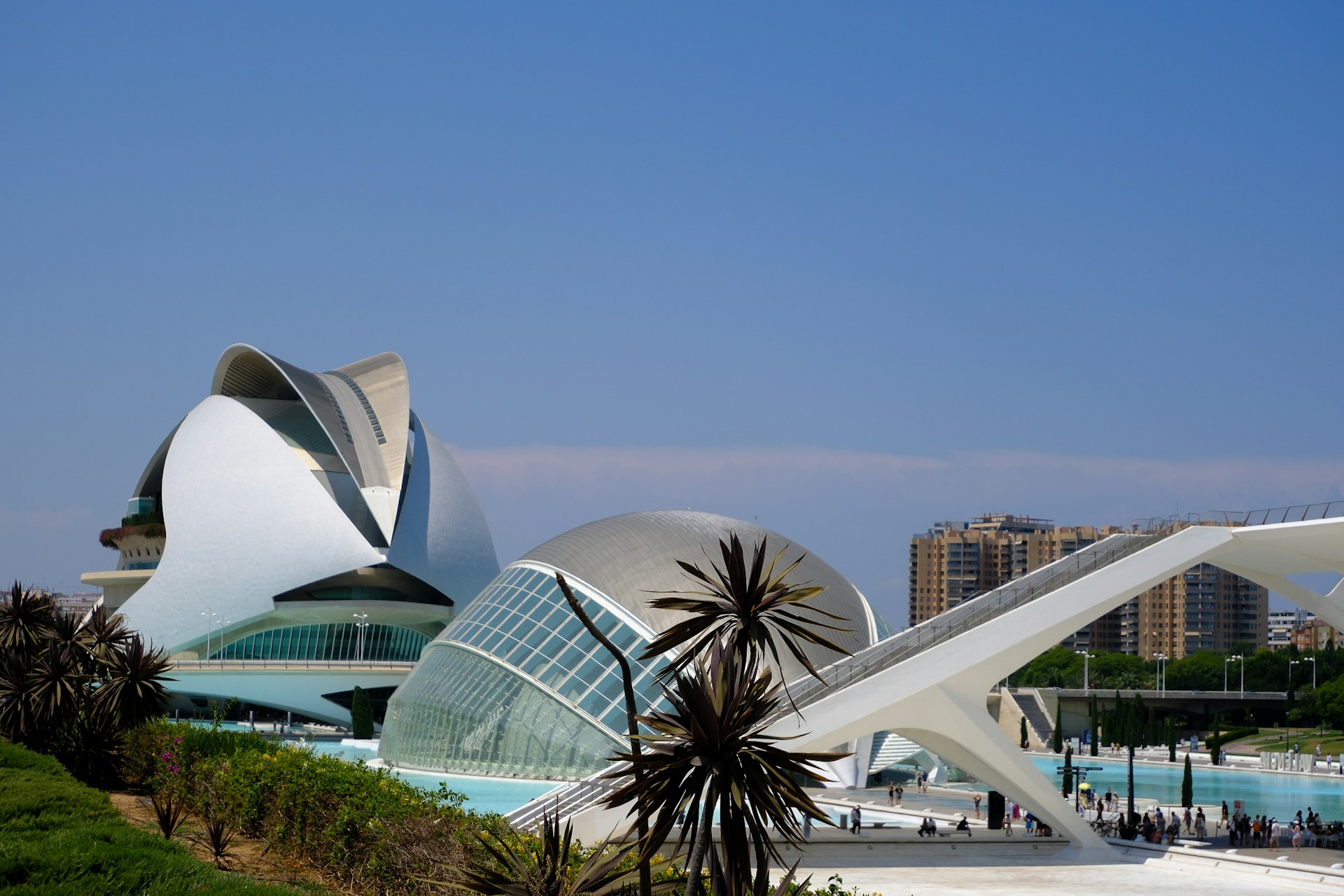
Located in the former riverbed of the Turia River, the project transformed an underutilized urban corridor into a futuristic cultural district that now attracts millions of visitors each year. The complex is composed of several iconic structures, including the L’Hemisfèric, the Museu de les Ciències Príncipe Felipe, the L’Oceanogràfic, the Palau de les Arts Reina Sofía, and the landscaped Umbracle.
Construction of the complex began in the 1990s as part of a broader effort to redefine the image of Valencia and position it as a global destination for culture, science, and contemporary architecture. The result is a dramatic ensemble of white concrete, glass, and reflective water pools that create a striking visual composition reminiscent of skeletal structures, marine organisms, and futuristic spacecraft.
More than just a collection of buildings, the City of Arts and Sciences represents a new model of urban cultural infrastructure. It combines museums, performance spaces, scientific education, and public landscapes into a unified architectural narrative. The complex demonstrates how visionary design can transform a city’s identity and become a symbol of innovation, tourism, and modern Spanish architecture.
City of Arts and Sciences in Numbers
220 m
The impressive length of the Príncipe Felipe Science Museum
110 m
The width of the Science Museum, designed to resemble a giant whale skeleton
100 m
The length of the ovoid roof on L’Hemisfèric (The Eye)
320 m
The total length of the L’Umbracle promenade and garden
350 000 m²
The total footprint of the entire complex, making it one of the largest cultural centers in the world
125 m
The height of the Assut de l’Or Bridge pylon – it is the tallest structure in Valencia
2 000 m
The entire urban area of the project in the former Turia River bed
58 000 m3
The massive volume of concrete used just for the Science Museum
8 000 m²
The amount of glass used in the Science Museum’s facade
42 mln l
The total volume of water in L’Oceanogràfic, the largest aquarium in Europe
35 m
The length of the famous shark tunnel, where visitors walk under the sea
4 million+
The average number of people who walk through the complex every year
55
The number of structural ribs that form the floating canopy of L’Umbracle
24 m
The diameter of the internal dome (the „pupil”) inside L’Hemisfèric
1996
The official start date of construction on this futuristic „city”
€1.2 bln
The estimated total cost of the project (nearly four times the original budget)
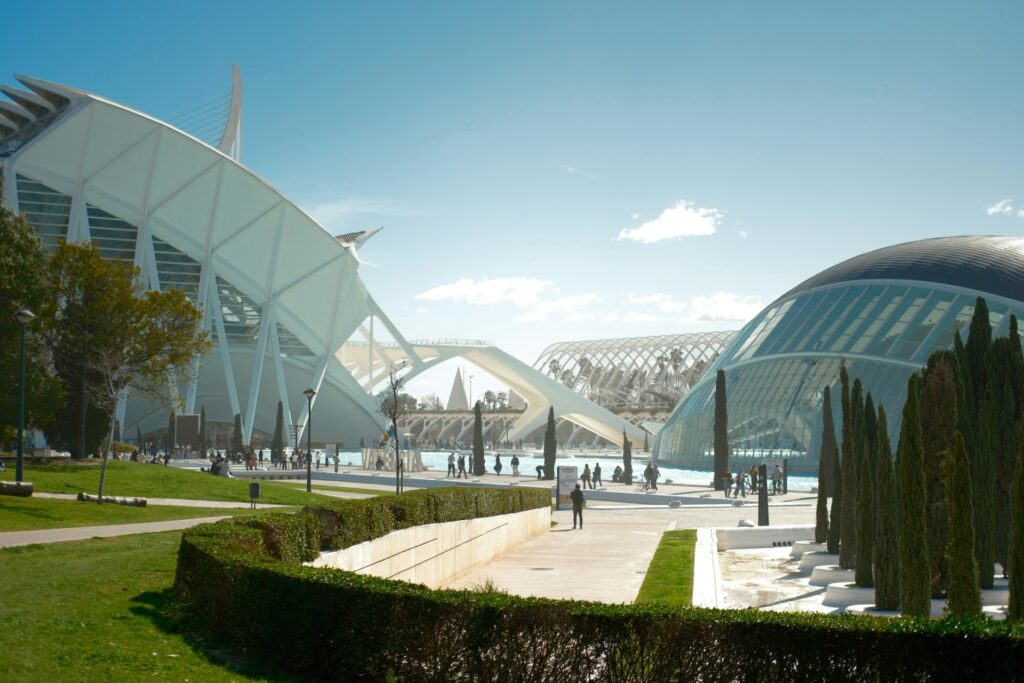
What’s most intriguing about the City of Arts and Sciences isn’t the scale of any single building, but the structural logic that allows multiple monumental forms to coexist within a unified urban composition. Designed primarily by Santiago Calatrava, the complex transforms the former riverbed of the Turia River into a continuous architectural landscape where science museums, an opera house, and one of Europe’s largest aquariums operate as interconnected cultural infrastructure. Reflective water basins, sweeping concrete shells, and skeletal steel structures redefine how public space can function within contemporary architecture, turning the complex into a futuristic civic environment rather than simply a collection of individual buildings.
Engineering and Structural Innovation
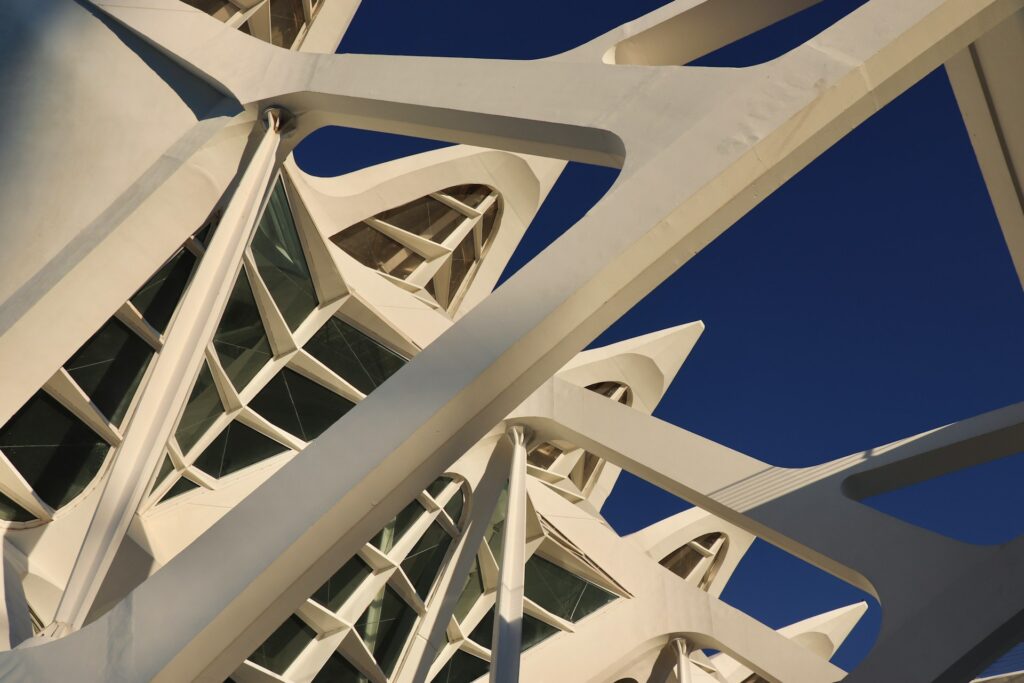
The engineering of the City of Arts and Sciences is defined by its combination of large-scale structural spans and sculptural geometry. The Museu de les Ciències Príncipe Felipe extends approximately 220 meters in length and 80 meters in width, creating one of the largest column-free exhibition spaces in Spain. Its structure relies on a repetitive steel rib system combined with reinforced concrete frames, forming a skeletal geometry that resembles the structure of a whale’s skeleton. The building contains roughly 26,000 m² of exhibition space, supported by a structural grid designed to distribute loads efficiently across long spans.
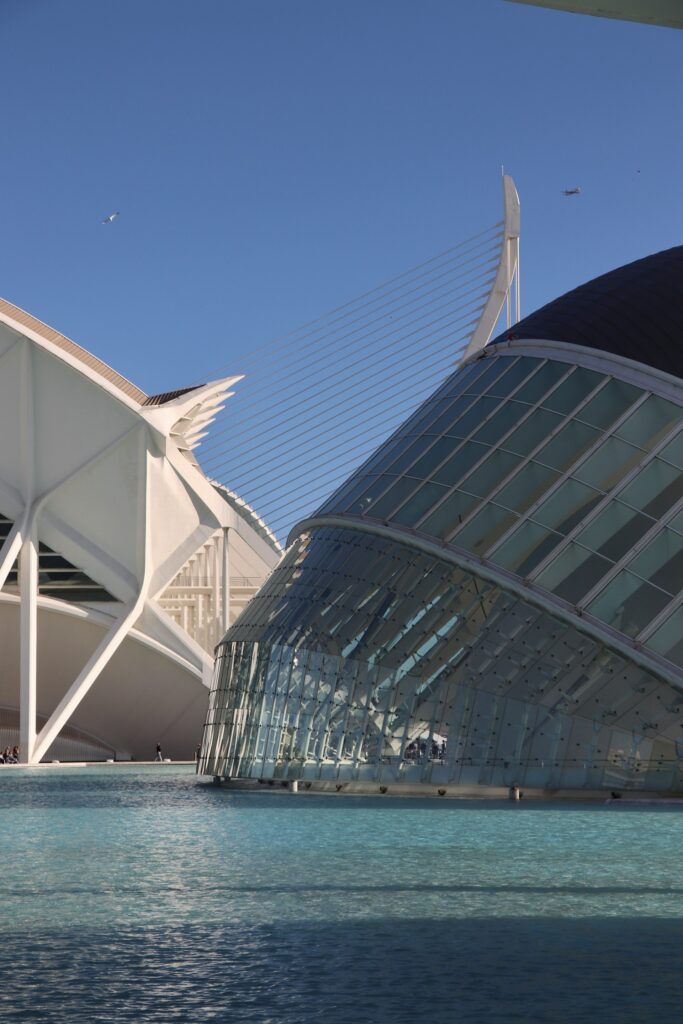
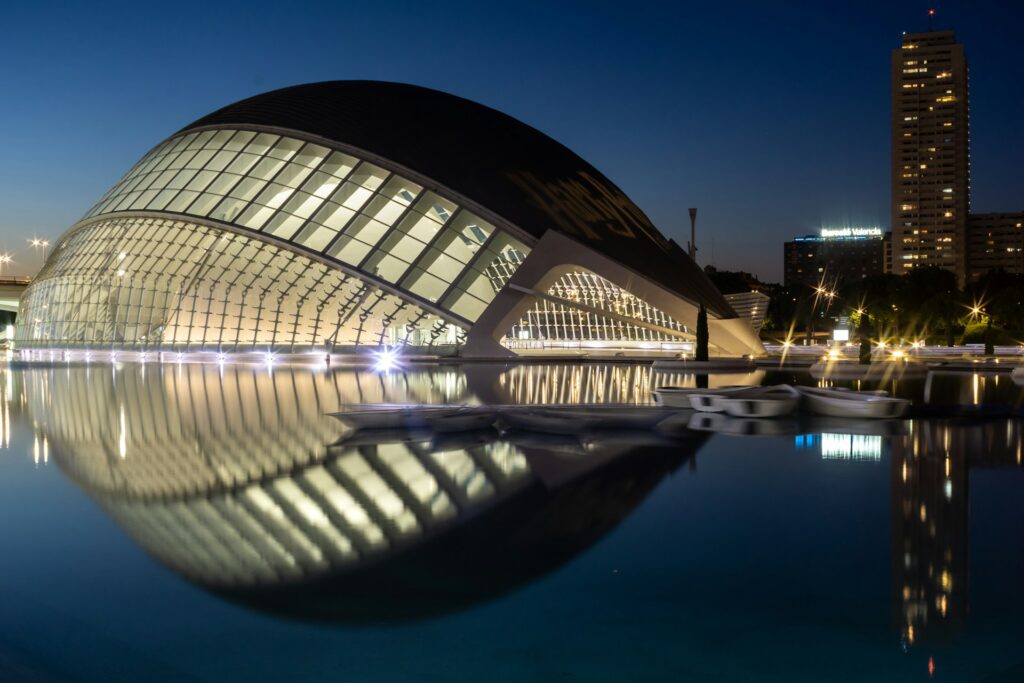
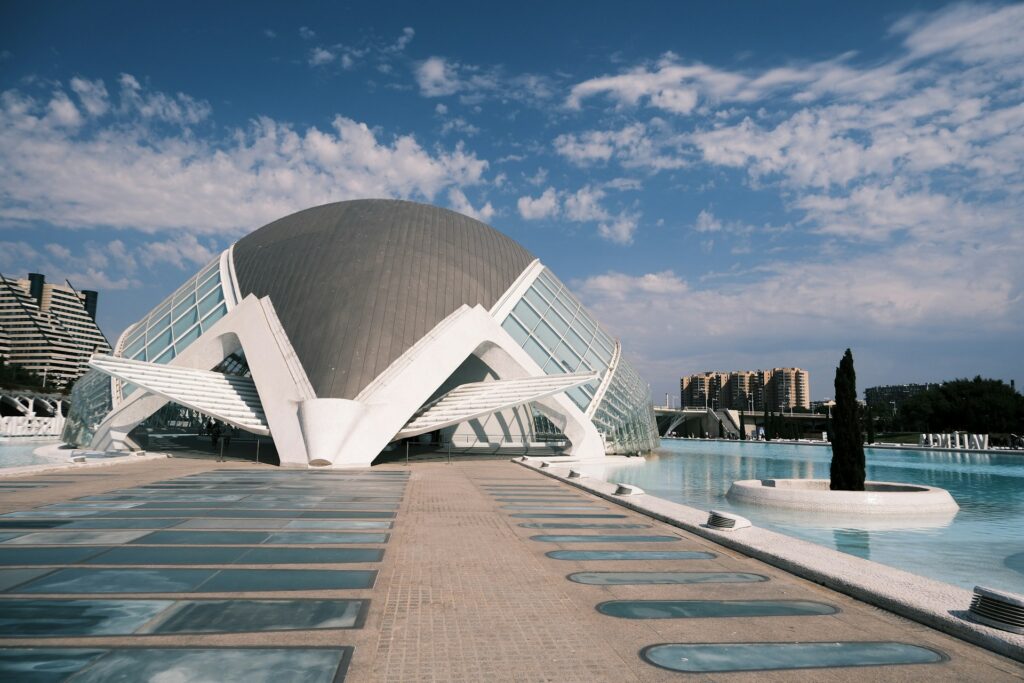
The planetarium and IMAX cinema L’Hemisfèric demonstrates another engineering approach based on kinetic architecture. The building measures about 110 meters in length and features a massive curved concrete shell that supports a 900 m² IMAX projection screen. The outer eyelid-like structure is composed of steel ribs and glass panels that can open and close, creating a dynamic façade system. This mechanism transforms the building into a kinetic architectural element, integrating engineering, movement, and symbolic design.
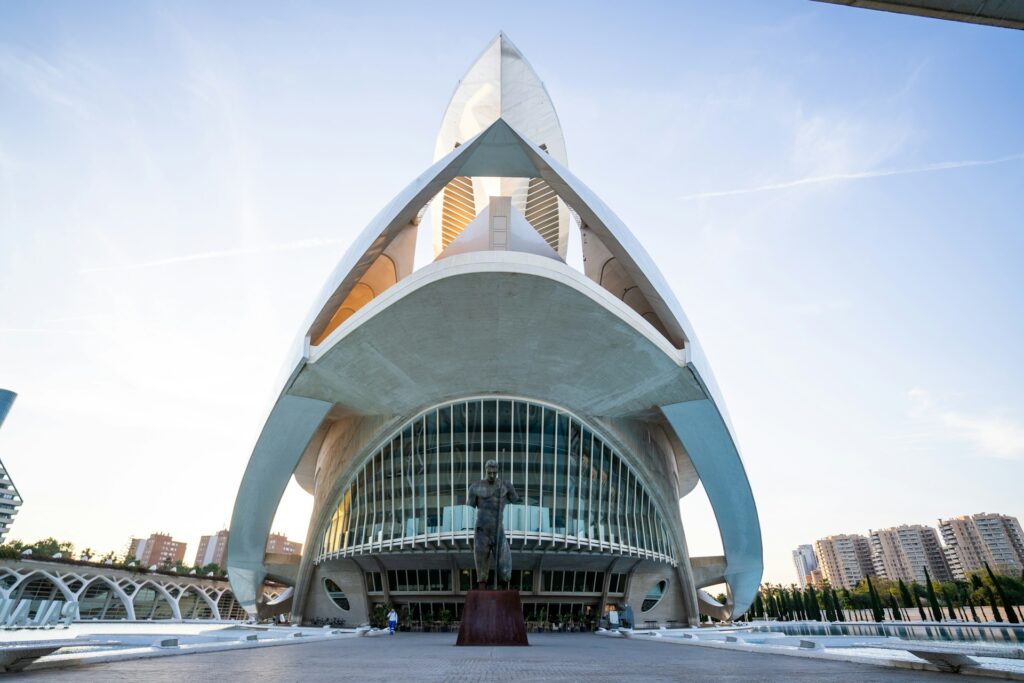
One of the most structurally complex buildings in the complex is the opera house Palau de les Arts Reina Sofía, which rises to approximately 75 meters in height. The building incorporates a large steel truss system supporting the iconic curved roof that spans more than 160 meters. The structure integrates several performance halls, including the main auditorium with 1,470 seats, requiring sophisticated acoustic engineering and vibration control systems. The roof shell itself weighs thousands of tons and is supported by a reinforced concrete core combined with external structural ribs.
Engineering complexity also reaches its peak in L’Oceanogràfic, the largest aquarium in Europe. The facility covers around 110,000 m² and contains tanks holding approximately 42 million litres of seawater. The structures supporting the aquatic habitats were designed using thin-shell concrete technology developed by Félix Candela, allowing the construction of large hyperbolic paraboloid roofs with minimal material thickness. These shells distribute structural forces efficiently while creating dramatic geometric forms that reflect both structural efficiency and architectural expression.
Economic Impact and Urban Development
The City of Arts and Sciences represents one of the largest public investments in cultural infrastructure in modern Spain. The total construction cost of the complex reached approximately €1.2 billion, financed mainly by the regional government of the Valencian Community. The project was developed over several stages between 1996 and 2009, transforming a previously underutilized section of the former Turia River riverbed into a major cultural and economic hub.
From an economic perspective, the complex quickly became one of the main tourism engines of Valencia. The site attracts approximately 4–5 million visitors every year, generating significant revenue from ticket sales, events, tourism services, and surrounding hospitality industries. Major attractions such as the L’Oceanogràfic alone receive more than 1.5 million visitors annually, making it one of the most visited aquariums in Europe and a key driver of tourism in the region.
The complex also had a measurable impact on urban development and real estate values. Since its opening, property prices and commercial activity in the surrounding districts have increased significantly, particularly in areas adjacent to the cultural park. The City of Arts and Sciences occupies roughly 350,000 m², and its development catalyzed new hotels, restaurants, and cultural institutions, reinforcing Valencia’s position as one of the most dynamic urban destinations on the Mediterranean coast.
Beyond direct tourism revenue, the complex strengthened the international brand of Valencia as a center of architecture, science, and innovation. Its iconic design by Santiago Calatrava turned the city into a global architectural landmark frequently featured in international media, films, and architectural publications. As a result, the City of Arts and Sciences functions not only as a cultural institution but also as a long-term economic asset that contributes to the city’s global visibility and regional economic growth.
Trivia
The Skeletal Inspiration
The Museu de les Ciències Príncipe Felipe was designed to resemble the skeleton of a prehistoric whale. Architect Santiago Calatrava used repetitive concrete ribs to create a sense of organic movement and structural rhythm. This design choice allows the massive building to feel light and airy despite its enormous weight.
The Living Eye
L’Hemisfèric is designed to look like a giant human eye opening toward the surrounding glass-bottom pools. The „eyelid” features a series of shutters that can actually open and close using a hydraulic system. This transformation symbolizes the „eye of wisdom” looking out over the city’s cultural landscape.
A Sunken Riverbed
The entire complex is built in the former bed of the Turia River, which was diverted after a catastrophic flood in 1957. Instead of building highways, the city decided to turn the empty space into a 9-kilometer-long green park. The City of Arts and Sciences serves as the futuristic crown jewel at the end of this urban garden.
The Trencadís Technique
Most of the curved surfaces are covered in millions of tiny white ceramic shards known as trencadís. This traditional Catalan mosaic technique allows the rigid concrete to follow complex, fluid curves smoothly. It also creates a shimmering effect that changes brightness depending on the angle of the sun.
Europe’s Largest Aquarium
L’Oceanogràfic is the largest complex of its kind in Europe, holding 42 million liters of water. It is divided into nine different towers that represent the world’s most significant marine ecosystems. Visitors can walk through a 35-meter underwater tunnel while sharks and rays swim directly overhead.
The Floating Opera House
The Palau de les Arts Reina Sofía is one of the tallest and most sophisticated opera houses in the world. Its most striking feature is a massive steel „feather” or „shell” that hangs over the building with very few support points. This metallic plume gives the structure the appearance of a futuristic ship sailing through the water.
A Natural Canopy
L’Umbracle is a massive open-air gallery and garden filled with plant species native to the Valencia region. It features 55 fixed arches and 55 floating arches that provide a rhythmic shade for the walkway below. Underneath this garden lies a hidden car park that can hold over 600 vehicles.
The Tallest Point
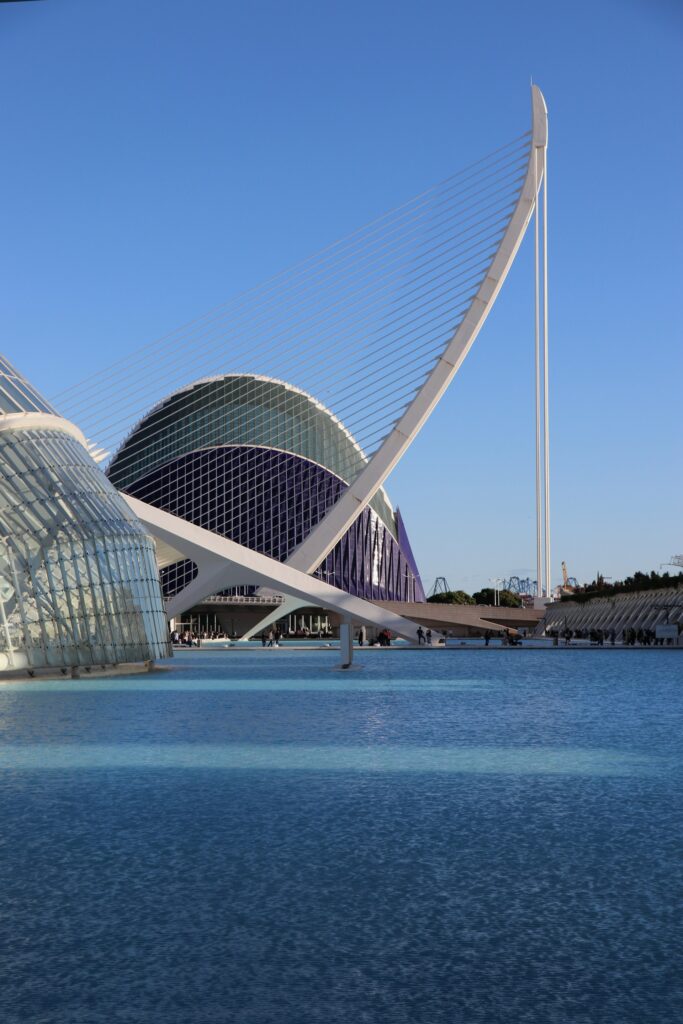
The Assut de l’Or Bridge, also designed by Calatrava, is a cable-stayed bridge that crosses the old riverbed. Its curved pylon reaches a height of 125 meters, making it the highest point in all of Valencia. Locals often refer to it as „the harp” because of the many white cables that support the road.
A Mirror of Water
The buildings are surrounded by 87,000 square meters of shallow, turquoise water pools. These pools aren’t just for aesthetics; they act as giant mirrors that reflect the white architecture and double its visual impact. On hot days, the evaporation from these pools also helps to slightly cool the microclimate of the complex.
The Golden Silhouette
The Agora is the newest addition to the complex, serving as a versatile space for concerts, tennis tournaments, and conventions. Its metallic purple and blue structure stands out sharply against the white concrete of the older buildings. It was designed to represent two interlaced hands or a blooming flower reaching for the sky.
Cinema in the Pupil
Inside the „pupil” of the Hemisfèric lies one of the most advanced projection rooms in the world. It features a massive concave screen that covers 900 square meters to provide an immersive IMAX experience. The dome’s geometry was specifically engineered to ensure perfect acoustics for the audience sitting inside.
A Global Movie Star
Because of its futuristic appearance, the complex has served as a filming location for numerous Hollywood productions. It famously stood in for a utopian city in the Disney film Tomorrowland and appeared in the sci-fi series Westworld. Walking through the site often feels like stepping onto a set from the twenty-second century.