
Where architecture, technology, and passion meet
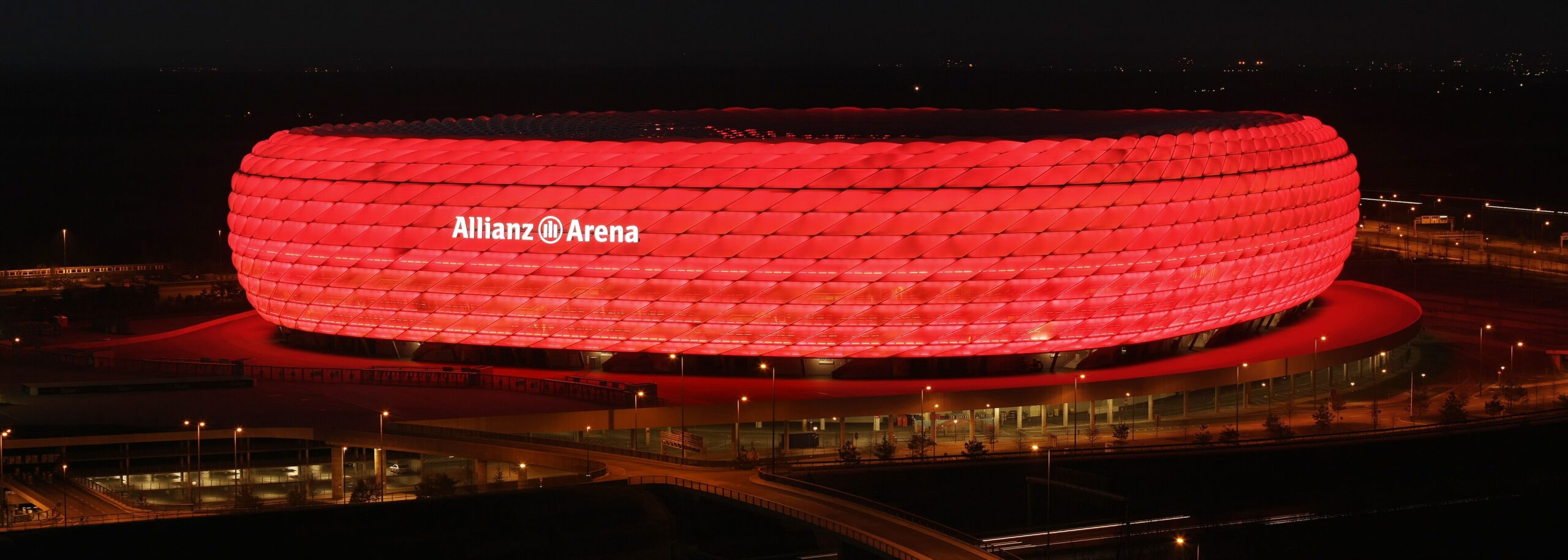
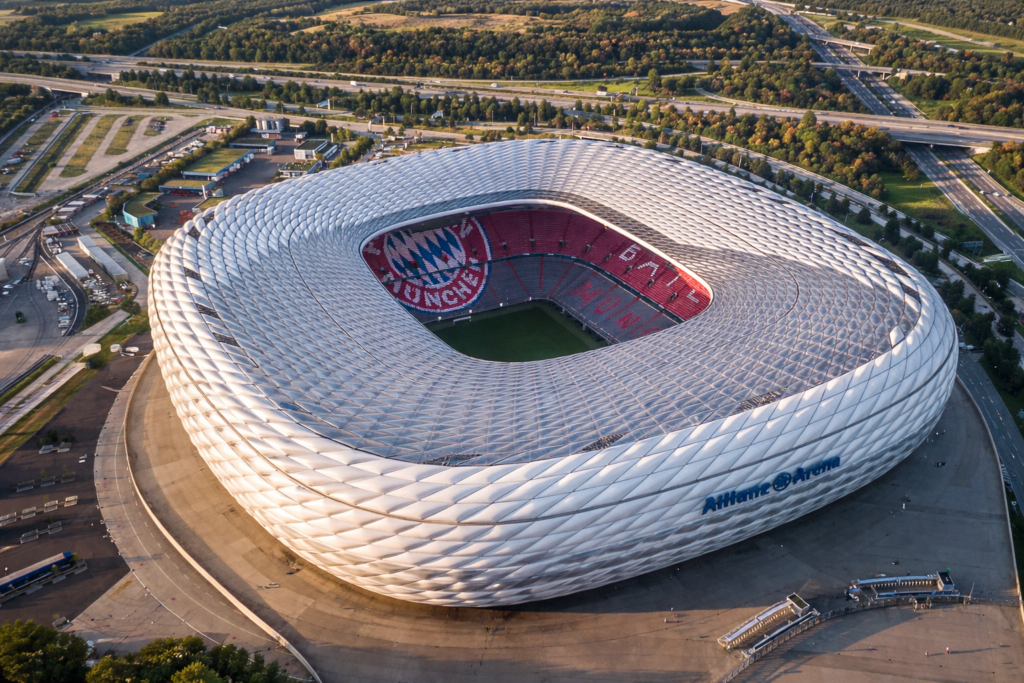
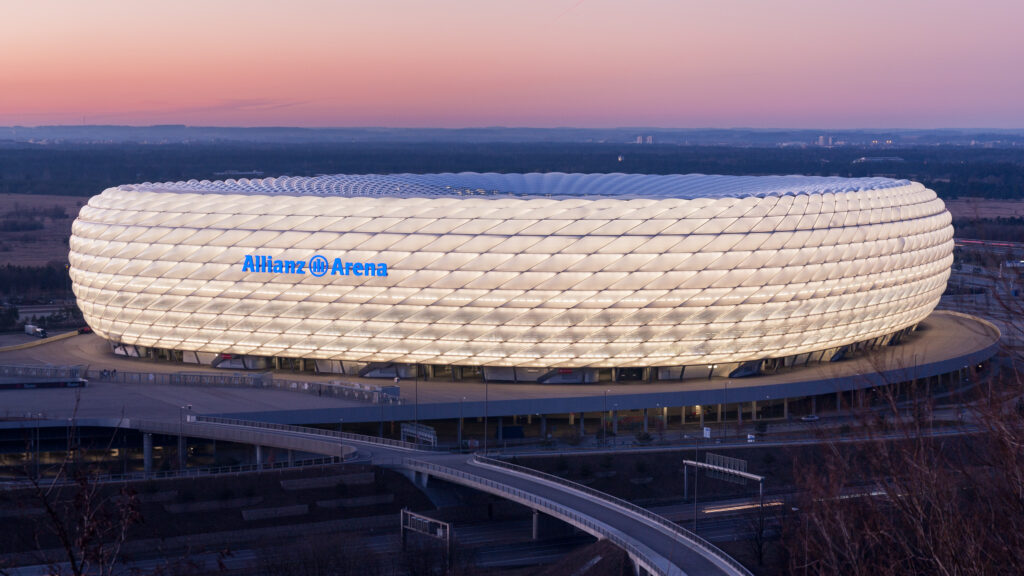
In the northern part of Munich, right by the A9 motorway, stands one of the most recognizable stadiums in the world – Allianz Arena. It is not only the home of FC Bayern Munich, but also an architectural showcase of modern Germany and a symbol of how stadium design has evolved in the 21st century.
Opened in 2005, just ahead of the 2006 FIFA World Cup, the arena was conceived as something far beyond a traditional football venue. The project was designed by the renowned Swiss architecture firm Herzog & de Meuron, known for blending functionality with bold, innovative aesthetics.
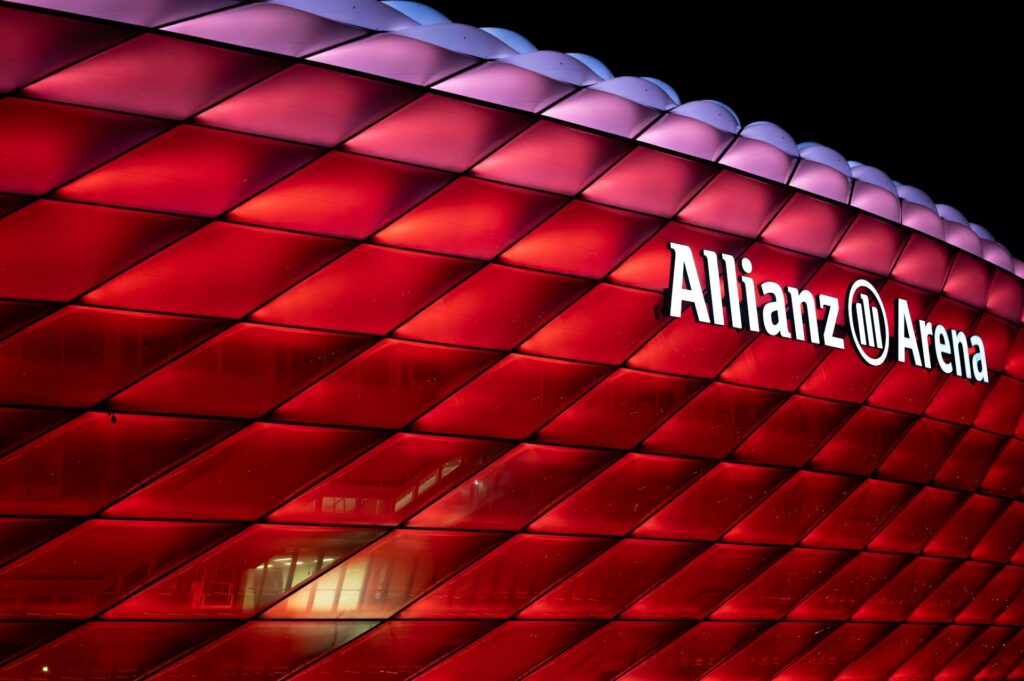
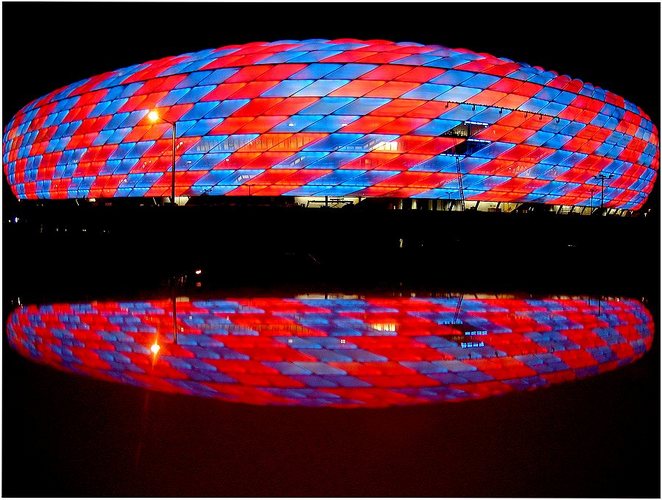
The stadium’s most distinctive feature is its façade, made up of over 2,800 ETFE air cushions. These panels can be illuminated in different colors, transforming the entire structure depending on the occasion—red for Bayern, blue (historically) for TSV 1860 Munich, and white for neutral events. This dynamic lighting system has earned the arena a reputation as one of the most futuristic stadiums ever built.
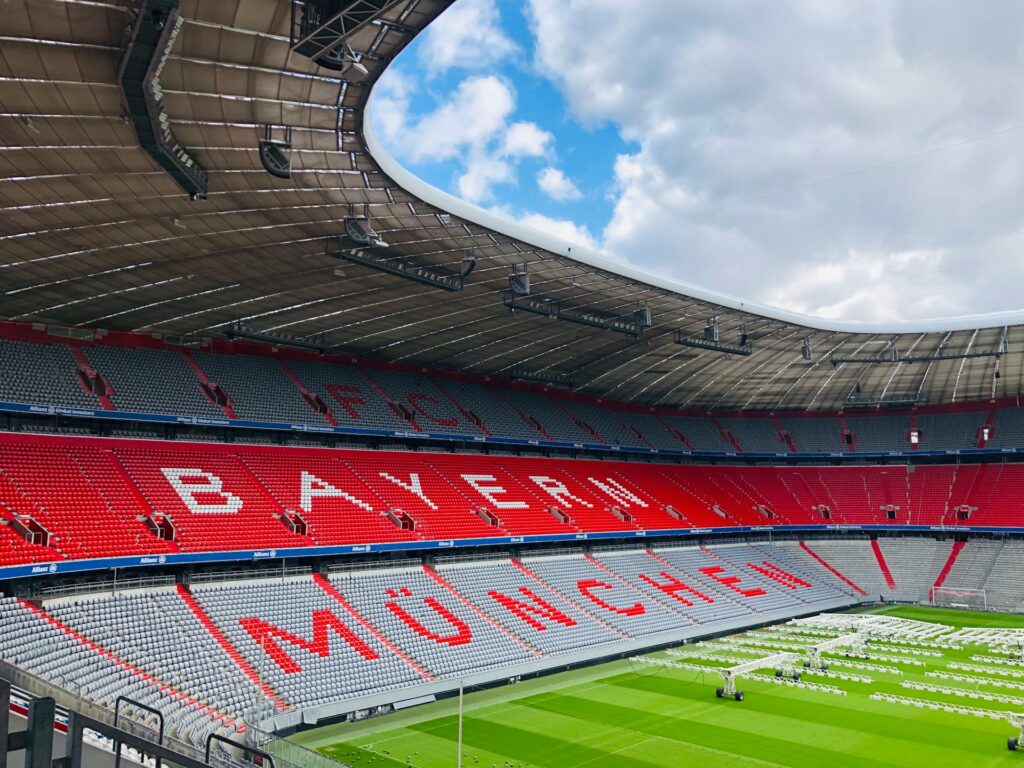
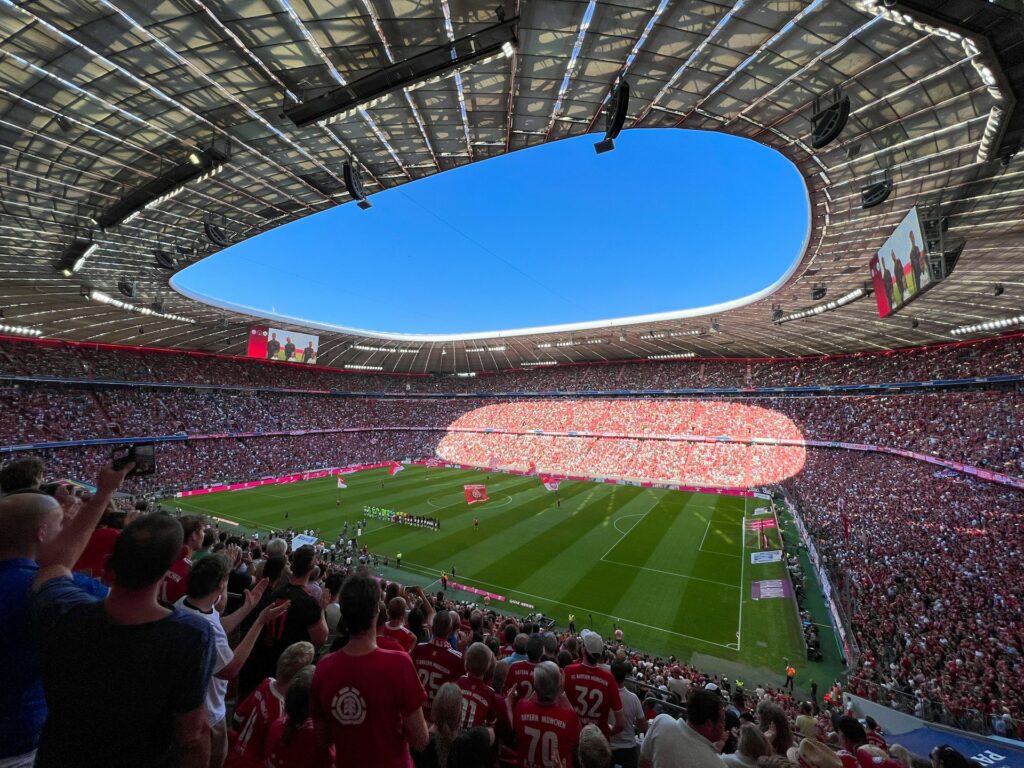
Allianz Arena has a capacity of around 75,000 spectators for domestic matches, slightly reduced for international games in line with UEFA regulations. Every seat is designed to offer excellent visibility, while the stadium’s infrastructure—from transport access to hospitality services—sets a benchmark for large-scale event organization.
The venue has hosted numerous historic moments, including matches during the 2006 World Cup and the final of the 2012 UEFA Champions League Final. Today, it remains not only a temple of football but also a major tourist attraction, drawing hundreds of thousands of visitors each year.
At Allianz Arena, cutting-edge technology meets the raw emotion of football fans, and architecture becomes part of the spectacle itself. This is not just a stadium—it’s an experience that begins long before the first whistle.
Allianz Arena in Numbers
2 784
This is the number of ETFE foil panels that make up the iconic facade. Each one can be illuminated independently
0.2 mm
The thickness of the ETFE foil. Despite being paper-thin, it is ultra-durable, self-cleaning, and incredibly light
50 m
The height of the stadium. It measures 227 meters in width and 258 meters in length
6 000 t
The weight of the steel roof construction alone
66 500 m²
The total surface area of the roof and facade, making it the largest structure of its kind in the world
75 024
Total capacity for Bundesliga matches (including standing room)
70 000
Maximum capacity for international matches (all-seater)
106 VIP lounges
These offer a total of 1,374 business seats for corporate guests
16 million
The number of variations possible for the facade lighting, thanks to the Philips LED system installed in 2014
8 000 m²
The playing field measures 105 m x 68 m. Beneath it lies a heating system featuring nearly 35 km of pipes
200 m²
The surface area of each of the two massive LED video walls mounted under the roof
750 HD screens
Distributed throughout the stadium so fans in line for food never miss a second of the action
21 000
The capacity of the nearby Fröttmaning U-Bahn station, designed to clear the crowd efficiently after a match
3 000 m²
The size of the FC Bayern Museum, the largest club museum in Germany, located inside the stadium
1 000 000
On average, this is the number of sausages sold at the stadium during a single season
€340 million
The total cost of building the stadium, which was completed in 2005
What’s most intriguing about Allianz Arena isn’t just its striking appearance, but the engineering logic behind its adaptive façade—an outer shell made of thousands of inflated ETFE panels that act as a responsive skin, capable of transforming the entire structure through light and color; rather than relying on height or sheer scale, the stadium redefines modern sports architecture by turning its envelope into a dynamic communication system where structure, identity, and atmosphere merge into a single, immersive experience.
Engineering and Construction of Allianz Arena
The engineering of Allianz Arena represents a milestone in contemporary stadium design, where structural clarity meets technological innovation. Designed by Herzog & de Meuron, the building was conceived not as a monolithic object, but as a highly coordinated system of independent yet interdependent elements. Its form—a softly inflated, continuous volume—required rethinking traditional load-bearing strategies, leading engineers to separate the primary structural system from the expressive outer оболочку, allowing each to perform its function efficiently without compromise.
At the core of the stadium lies a reinforced concrete substructure that supports the seating bowl and transfers loads into the ground with high stability. This is complemented by a steel roof structure spanning large distances over the stands, minimizing the need for internal columns and ensuring unobstructed views for spectators. The roof itself is supported by a system of radial trusses and tension elements, carefully calibrated to balance weight, wind forces, and dynamic loads generated during events. This combination of concrete and steel creates a hybrid system optimized for both strength and flexibility.
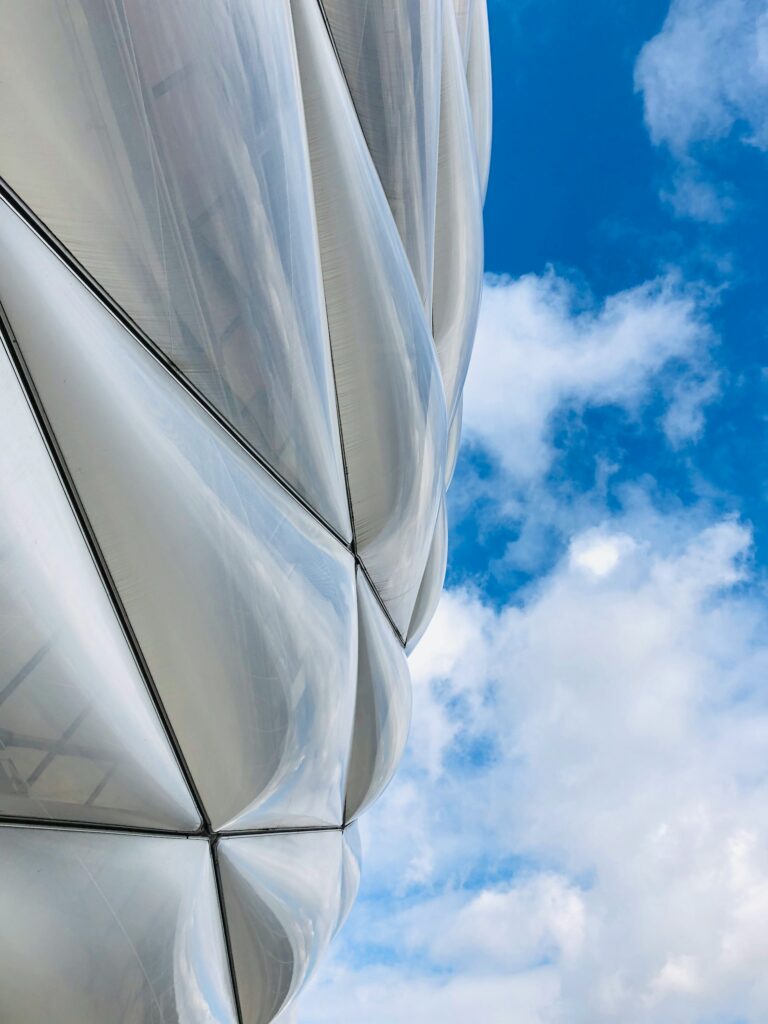
Perhaps the most revolutionary aspect of the arena is its façade, composed of over 2,800 ETFE (ethylene tetrafluoroethylene) air cushions. These lightweight panels are pneumatically inflated and mounted onto a secondary steel framework, drastically reducing the overall load compared to traditional cladding materials like glass. Each cushion is independently controlled and internally illuminated, allowing the façade to change color and intensity. From an engineering perspective, this system also improves thermal performance and reduces maintenance demands, while maintaining high resistance to weathering and UV radiation.
A critical challenge in the design was accommodating structural movement and environmental forces. Temperature fluctuations, wind pressure, and live loads from tens of thousands of spectators all influence how the building behaves. To address this, expansion joints and flexible connections were integrated throughout the structure, particularly between the façade and the main frame. The ETFE panels, in particular, are designed to absorb deformation without losing integrity, acting as a dynamic buffer between the interior and exterior environments.
Ultimately, Allianz Arena exemplifies how modern engineering can elevate architecture beyond static form. By combining advanced materials, efficient structural systems, and responsive façade technology, the stadium operates as a living structure—one that adapts, performs, and communicates. It stands as a benchmark for future large-scale venues, demonstrating that innovation in construction is not only about strength and durability, but also about creating buildings that engage with their users and surroundings in entirely new ways.
The Economics Behind Allianz Arena
The financial model of Allianz Arena reflects a carefully structured balance between high upfront investment and long-term revenue generation. The total construction cost of the stadium amounted to approximately €340 million, making it one of the most significant sports infrastructure investments in Germany at the time. Initially, the project was jointly financed by FC Bayern Munich and TSV 1860 Munich, who both intended to use the venue, alongside external bank financing. The economic viability of the project relied heavily on predictable matchday income, commercial partnerships, and naming rights.
A crucial component of the financing strategy was debt structuring and repayment. Loans taken to fund construction were planned to be repaid over a long-term period through steady revenue streams. However, a turning point came when Bayern Munich gradually bought out TSV 1860 Munich’s shares, becoming the sole owner of the stadium. This consolidation allowed for more efficient financial management and faster debt repayment. In fact, Bayern reportedly repaid a significant portion of the stadium-related debt years ahead of schedule, demonstrating strong financial discipline and the club’s commercial power.
Revenue generation at Allianz Arena extends far beyond ticket sales. Matchday income includes premium seating, VIP boxes, and hospitality services, all of which significantly increase per-visitor revenue. In addition, sponsorship deals—most notably the naming rights agreement with Allianz—provide a stable and substantial annual income stream. Retail operations, food and beverage sales, and stadium tours further diversify revenue sources, turning the venue into a year-round business asset rather than a single-purpose sports facility.
Another key factor in the arena’s financial success is its integration with infrastructure and accessibility. Large-scale parking facilities, efficient public transport links, and optimized crowd management systems ensure high attendance and smooth operations, directly impacting profitability. The stadium also benefits from hosting international events governed by UEFA, such as elite club competitions, which bring additional broadcasting and commercial revenues tied to global audiences.
Ultimately, Allianz Arena stands as a model of how modern stadiums can function as economically sustainable ecosystems. By combining strategic financing, diversified income streams, and strong brand partnerships, the project not only recovered its initial investment but continues to generate substantial long-term value. It illustrates that successful sports architecture today depends as much on financial engineering as it does on physical construction.
Trivia
The Color-Changing Exterior
The stadium was the first in the world to feature a full color-changing exterior. Its 2,784 diamond-shaped cushions can glow in millions of different colors and patterns. This technology allows the arena to match the colors of the teams playing or celebrate special holidays.
The ETFE Material
The „bubbles” on the facade are made of Ethylene Tetrafluoroethylene, which is only 0.2 mm thick. This material is incredibly lightweight and has a self-cleaning surface that stays clear when it rains. It also allows UV light to pass through, which helps the grass on the pitch grow naturally.
A Rapid Payoff
The construction of the stadium cost approximately €340 million and was financed through loans. Remarkably, FC Bayern Munich managed to pay off the entire debt 16 years earlier than originally planned. This financial feat was announced in 2014, making the club the sole owner of its home.
Europe’s Largest Parking Garage
The arena features a massive four-story parking structure with nearly 10,000 spaces. This makes it the largest parking garage attached to a football stadium in Europe. It was designed to ensure that the massive influx of fans can arrive and depart as smoothly as possible.
The Disappearing „Blue”
For many years, the stadium also served as the home ground for TSV 1860 Munich. When they played, the entire stadium would glow blue instead of Bayern’s iconic red. Since 1860 Munich moved out in 2017, the blue lighting has been retired to honor the club’s rivalry.
The Giant Video Walls
Inside the stadium, two massive LED video walls are mounted at the north and south ends. Each screen covers an area of roughly 200 square meters, providing crystal-clear replays for every fan. These screens are among the largest and most advanced in European sports venues.
A High-Tech Grass System
The pitch at the Allianz Arena is a hybrid system that combines natural grass with synthetic fibers. Below the surface, there is a complex heating system consisting of 35 kilometers of pipes to prevent freezing in winter. Specialized „grass lamps” are also used to provide artificial sunlight during the dark Munich months.
Culinary Logistics
The stadium operates 28 kiosks and several high-end restaurants to feed over 75,000 fans. On a typical match day, the staff serves more than one million beverages and tens of thousands of sausages. The efficiency of the service is managed by a dedicated stadium-only payment system to speed up queues.
The „Fröttmaning” Connection
The stadium is located on the outskirts of Munich near the Fröttmaning Heath. To transport fans, a dedicated subway station was upgraded to handle 21,000 passengers per hour. This infrastructure ensures that the stadium can be emptied of spectators in a very short amount of time.
The Museum Experience
The arena houses the FC Bayern Museum, which is the largest club museum in Germany. It covers over 3,000 square meters and tells the story of the club’s legendary success through interactive exhibits. Fans can see all the major trophies, including the Champions League and Bundesliga titles, in one place.
Safety and Air Pressure
Each of the air cushions on the facade is constantly monitored by a central computer system. In the event of heavy snowfall or wind, the internal air pressure of the cushions is automatically adjusted to maintain stability. This prevents the „bubbles” from bursting or collapsing under extreme Bavarian weather.
The Host of Champions
The Allianz Arena has hosted some of the most important games in football history, including the 2006 World Cup opener. It was also the site of the 2012 Champions League Final, famously known as „Finale dahoam.” The stadium is frequently selected for major UEFA events due to its elite five-star rating.