
How far could you go before steel and reinforced concrete appeared?
Farther than intuition suggests—far enough to touch the limits of what was physically possible without modern materials. Architecture based solely on stone, brick, and mortar lacked the safety margins known today. Any geometric error, any excess of ambition was immediately punished by gravity.
In this era, structure was not a hidden skeleton, but the building’s very form. The thickness of the walls, the curvature of the arch, and the proportions of the dome were not the result of aesthetic decisions but of necessity. Material imposed limits, and architecture learned to read them, not circumvent them.
Every great building before the age of steel is a record of a compromise between what was desired and what the material could bear. Monumentality was not a result of excess, but of precision. Scale did not result from lightness, but from mass—from accepting weight as the primary design tool.
It was only the arrival of steel and reinforced concrete that changed the rules of the game. The structure ceased to be visible, and architecture gained the ability to separate form from its load-bearing capacity. What had previously been a limit became a starting point.
This series returns to the moment just before this shift—to a world where architecture had advanced as far as it could, before it learned to defy gravity.
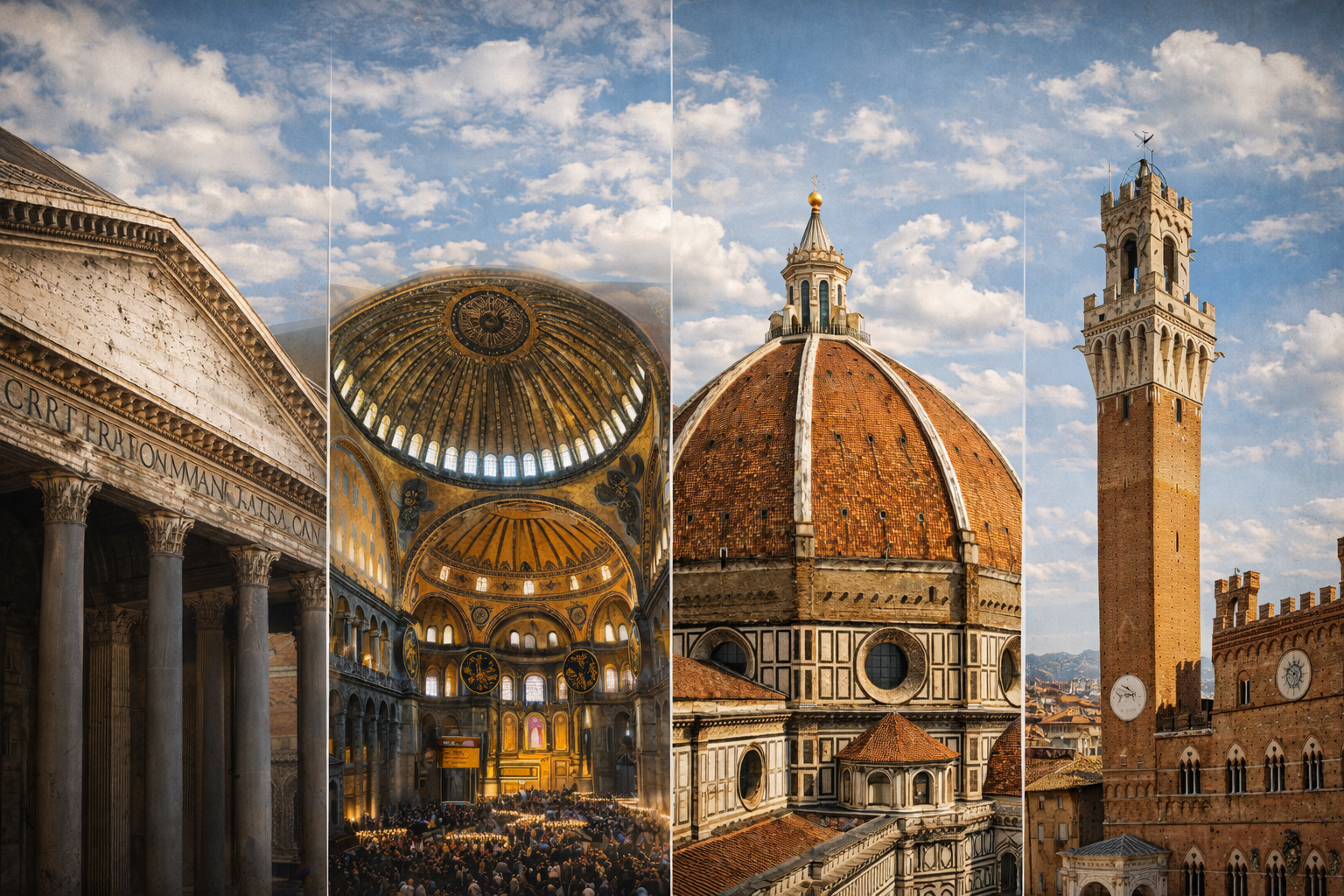
🏛️ Pantheon Rome
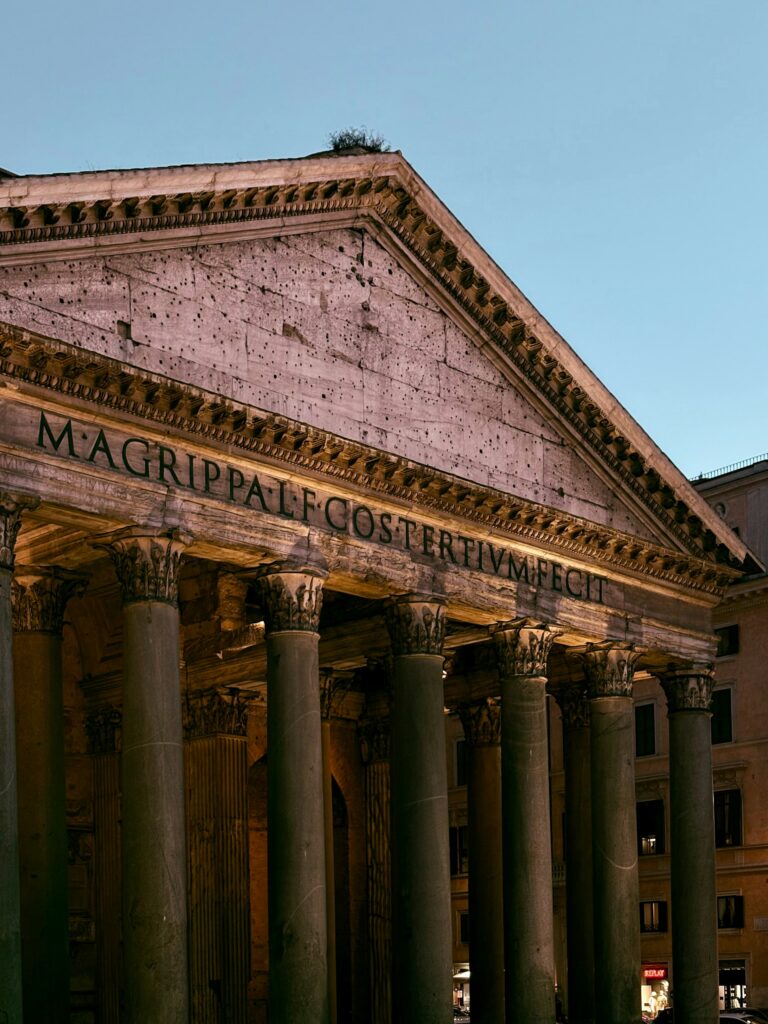
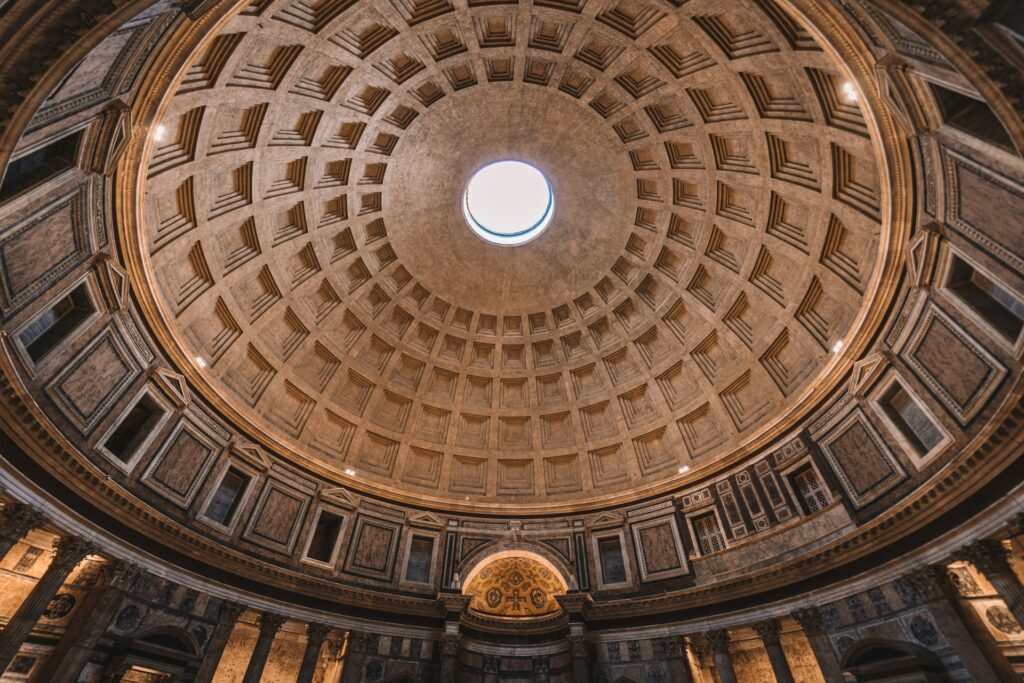
The Pantheon is a benchmark for everything that came later in massive architecture. Its dome, 43.3 meters in diameter and identical in height from floor to oculus, creates a perfect sphere inscribed within the interior—a geometric gesture that remains unprecedented to this day. The entire structure was built without reinforcement, steel, or calculations as we understand them today, relying solely on material expertise and structural intuition.
The structure’s stability stems from precisely controlled mass. The dome’s thickness at the base is approximately 6.4 meters, gradually decreasing upward to approximately 1.2 meters near the oculus. The Romans used concrete with variable density: heavy basalt and travertine at the base, lighter tuff above, and almost exclusively pumice in the upper reaches. This represents one of the earliest implementations of a material gradient strategy in construction.
The oculus, with a diameter of 8.8–9 meters, simultaneously serves as a symbolic center, a light source, and a key static element. Removing mass at the dome’s most critical point reduces tensile forces, which pose the greatest threat in masonry. Furthermore, the coffers—140 recesses arranged in five rings—are not decorative, but a deliberate weight-saving measure, reducing the vault’s mass by hundreds of tons.
The end result is the world’s largest unreinforced concrete dome, a span that remained unattainable for nearly 1,300 years. The Pantheon demonstrates that even in ancient times, architecture had reached the limits of pure mass and geometry. Everything that came after was an attempt to repeat—or circumvent—the same problem.
🕌 Hagia Sophia
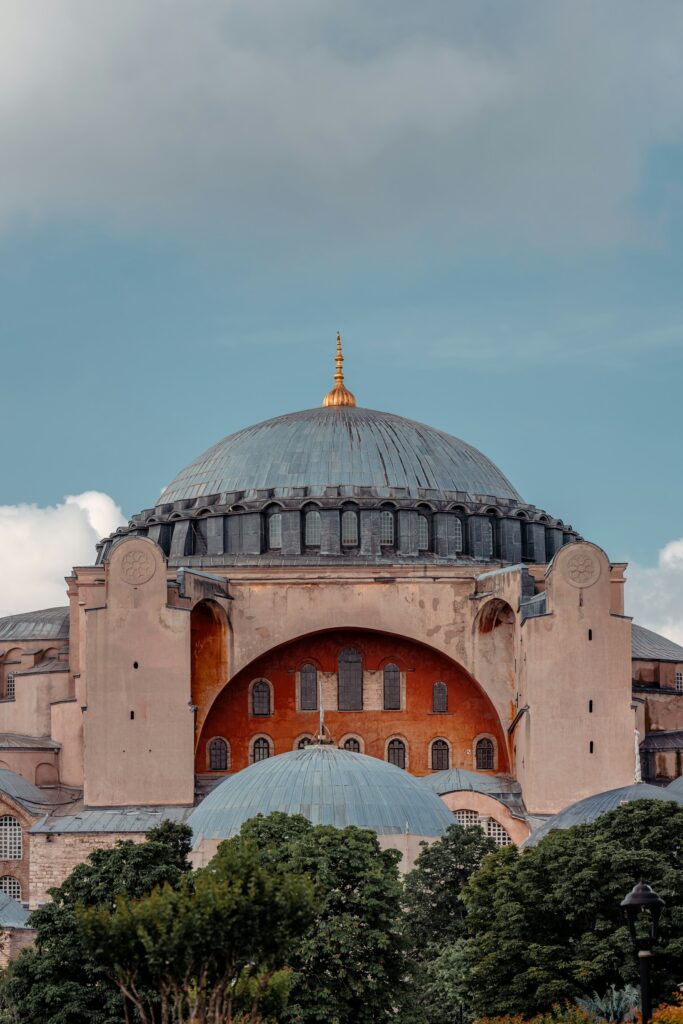
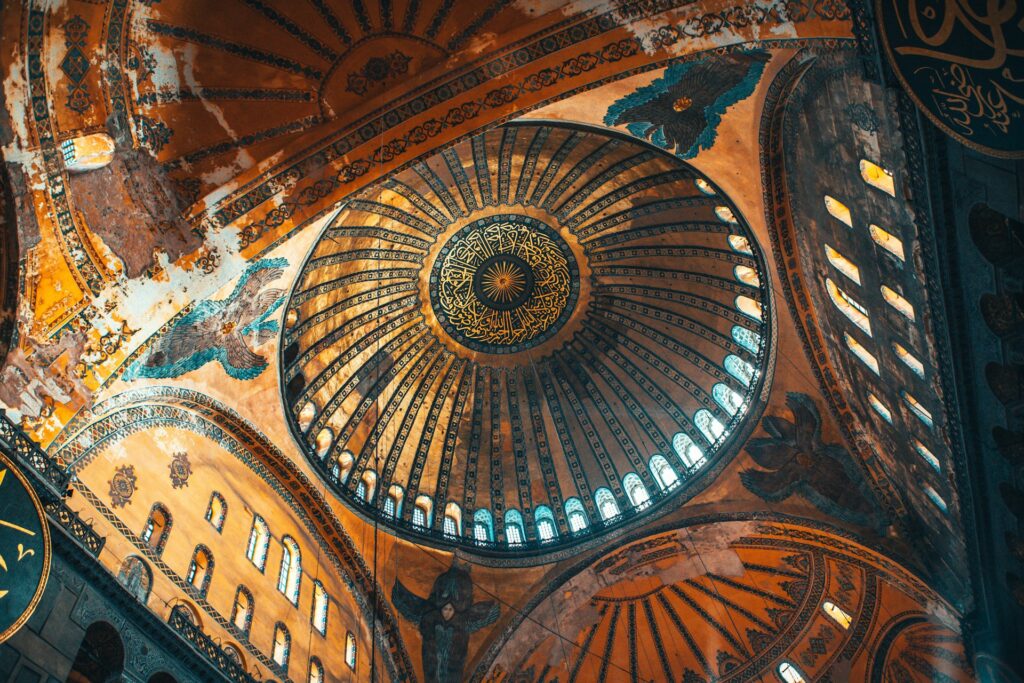
Hagia Sophia pushes the boundaries of massive architecture even further—and does so dangerously close to disaster. Its main dome, approximately 31–32 meters in diameter, rises nearly 55–56 meters above the floor and is supported by four massive pillars via pendentives. This was a radical solution in the 6th century: the dome does not rest on the walls but is suspended in space, transferring loads to specific points.
The original dome, completed in 537, had a flatter profile and almost immediately began to cause structural problems. After only 20 years, it partially collapsed due to earthquakes and excessive expansion forces. Rebuilt in 558 by Isidore the Younger, it was raised by approximately 6 meters, which reduced horizontal tensile forces but did not completely eliminate the problem.
The entire structure operates in a state of permanent tension. Arches, pendentives, and half-domes dissipate forces that the masonry, by its nature, cannot withstand in tension. Over the following centuries, Hagia Sophia required systematic reinforcement: massive buttresses were added, and the diameters of the pillars were gradually increased, accepting deformations rather than fighting them. To this day, the dome is not perfectly circular—its diameter varies by several dozen centimeters depending on its axis.
This is architecture operating on the edge of stability, its durability a result of constant adjustments, not initial perfection. Hagia Sophia demonstrates that without steel and reinforced concrete, there is no margin for error—only a thin line between balance and collapse. This is not a triumph of mass, but a record of a struggle with material that was never ultimately won.
⛪ Cathedral of Santa Maria del Fiore
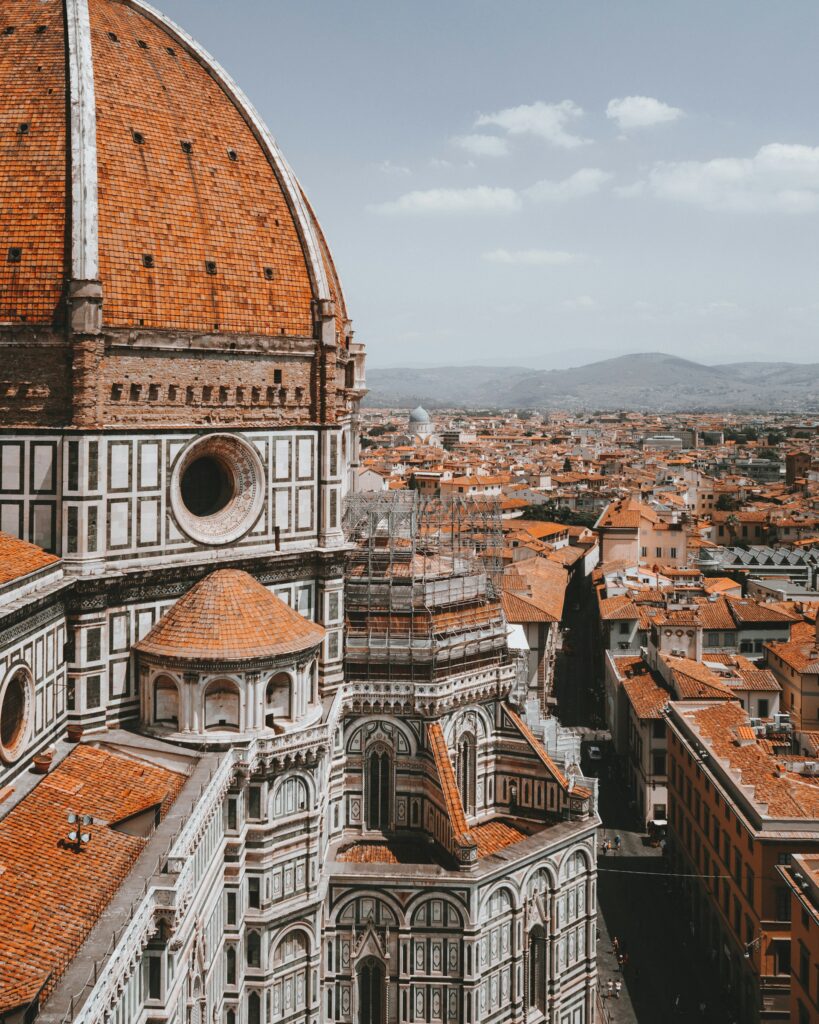
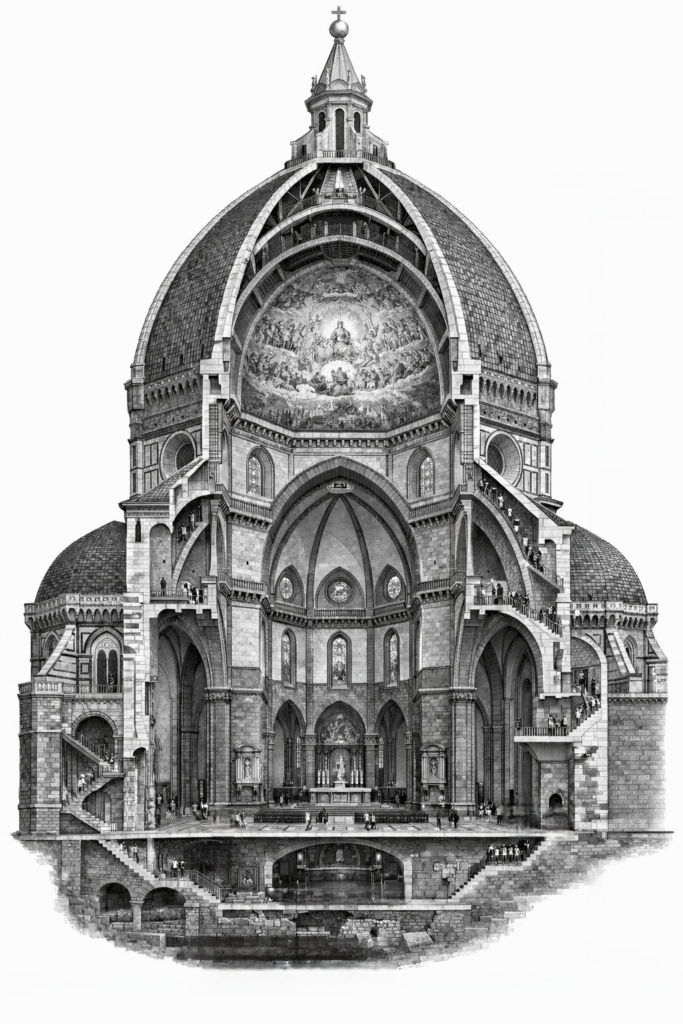
The Cathedral of Santa Maria del Fiore represents both the culmination and the limit of massive architecture. Its dome, designed by Brunelleschi, has a diameter of 45.5 meters, making it larger than the Pantheon’s, and rises to a height of approximately 114 meters above the piazza. It is the largest dome ever built without reinforcement, steel, and complete centering, based solely on the logic of masonry and geometry.
The construction problem was unprecedented. The tambour opening had a span that could not be covered by a traditional vault or a classical scaffolded dome—they would have required a wooden structure taller than most of the city. Brunelleschi responded with a double-shell system: an inner dome, approximately 2.25 meters thick at the base and less than 1 meter thick at the top, and an outer, thinner shell to protect the structure and absorb some of the wind loads.
A key element of stability was the herringbone pattern of bricks, which forced the masonry to self-lock during construction. The dome grew without full support, ring by ring, and horizontal expansion forces were controlled by a system of stone and wooden perimeter chains, acting as primary tension rings. Each of these rings has a cross-section measured in tens of centimeters and extends over 140 meters around its circumference.
The entire structure consists of over 4 million bricks, and its estimated weight is in the tens of thousands of tons. This is not an architecture of excess, but an architecture of absolute control. Every centimeter of thickness and every degree of curvature serves a structural function—there are no superfluous elements.
Santa Maria del Fiore represents the moment when massive architecture reached its peak. Beyond that, there was no room for scaling. Without steel and reinforced concrete, a larger dome or a higher structure supported by masonry could not be built. It is not only a Renaissance masterpiece, but also the point at which the era of the wall came to a definitive end.
🏰 Palazzo Pubblico
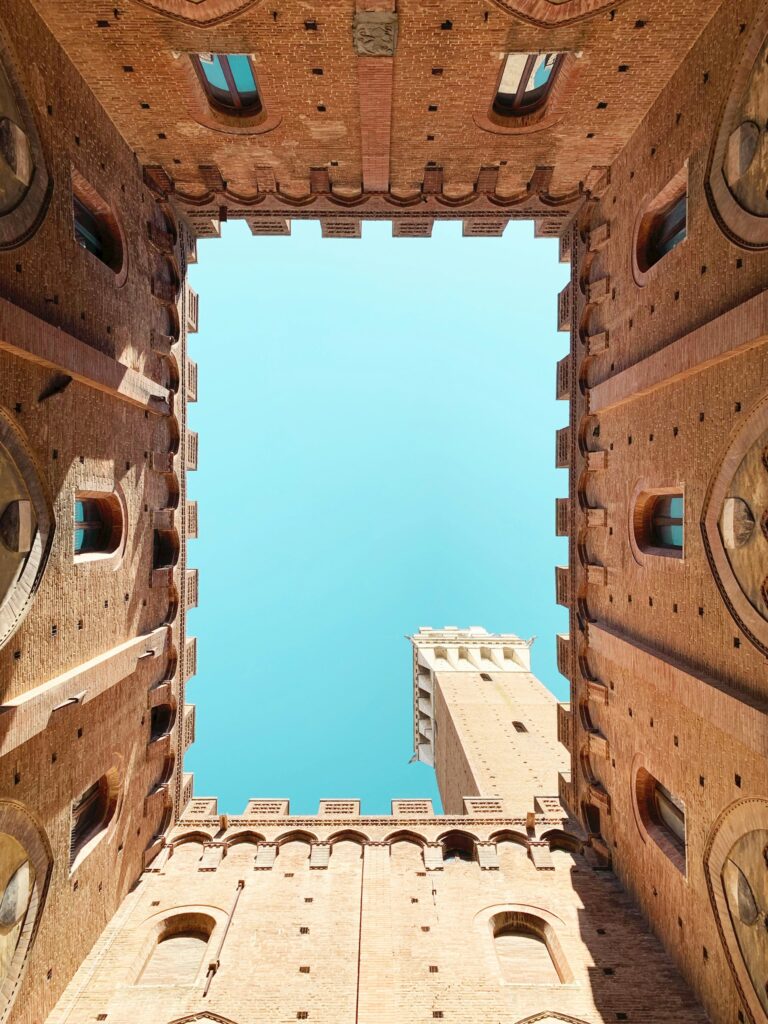
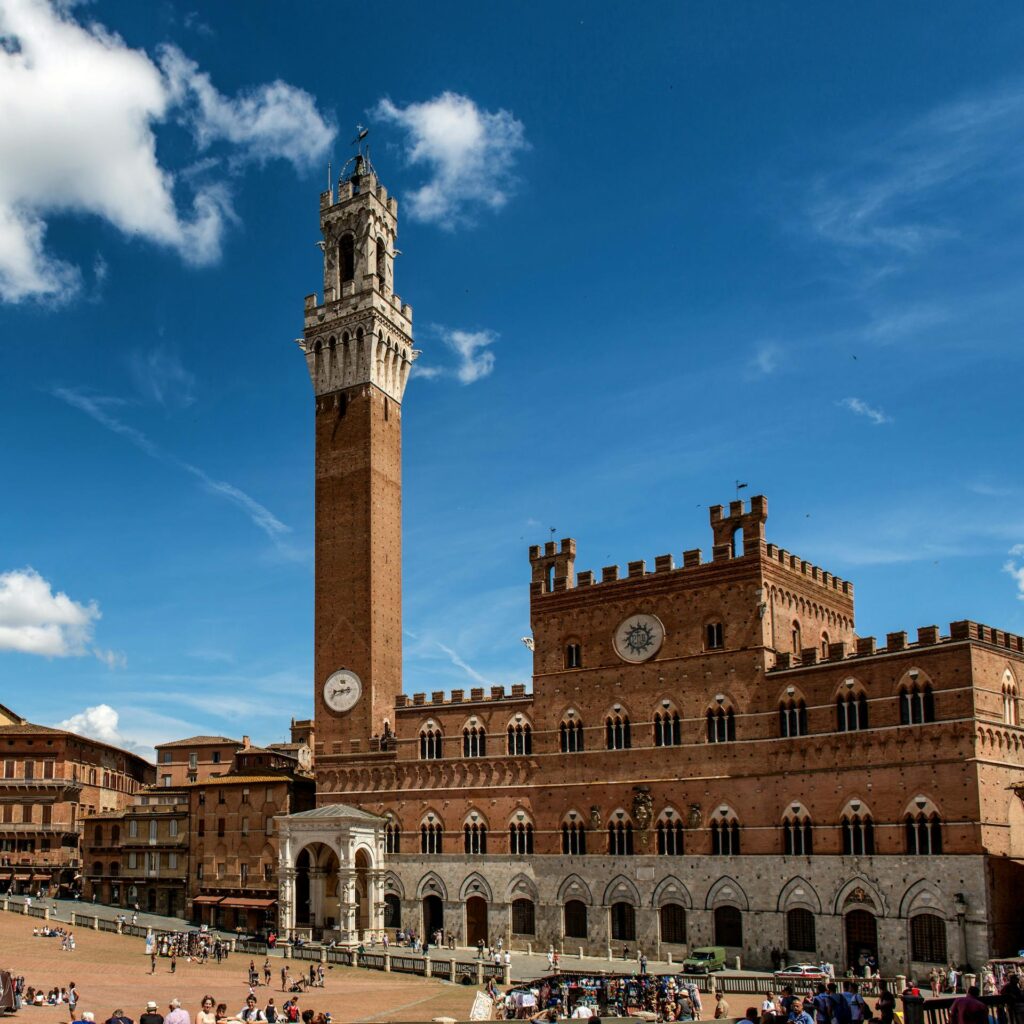
The Palazzo Pubblico in Siena shifts the narrative of „Before Steel” from the dome to the vertical. Its most distinctive feature is the Torre del Mangia—a brick tower approximately 102 meters high, built between 1338 and 1348 without an internal skeleton and without modern metal reinforcements. It is one of the tallest secular structures in medieval Europe constructed entirely of masonry.
The tower’s design is based on mass and proportion. At its base, its walls are over 3 meters thick, gradually tapering towards the top, reducing weight and the risk of buckling. The slenderness of the Torre del Mangia was a conscious decision—its height was intended to symbolically equal the cathedral’s bell tower, but could not exceed it, which imposed extreme structural requirements. Each meter of height meant increasing risk of instability.
The tower is not perfectly vertical. Historical measurements indicate a deviation of several dozen centimeters from the axis, resulting from ground settlement and the wall’s own weight. The lack of materials capable of absorbing tension meant that the structure had to accept deformations rather than resist them. Stability was achieved not through rigidity, but through controlled mass and tolerance for movement.
The Palazzo Pubblico as a whole covers an area of over 6,000 m², and its form was consciously subordinated to the tower, which served as a symbol of city power. This is secular architecture, but no less ambitious than the sacred megastructures of the era. Here, the wall becomes a political tool—a measure of the city’s power and independence.
The Torre del Mangia demonstrates another architectural limit for steel: not the maximum span, but the maximum height achievable without a framework. No further could be achieved without this new material. The vertical, like the dome, had reached its limit.