
Hagia Sophia: The Architecture That Redefined Space
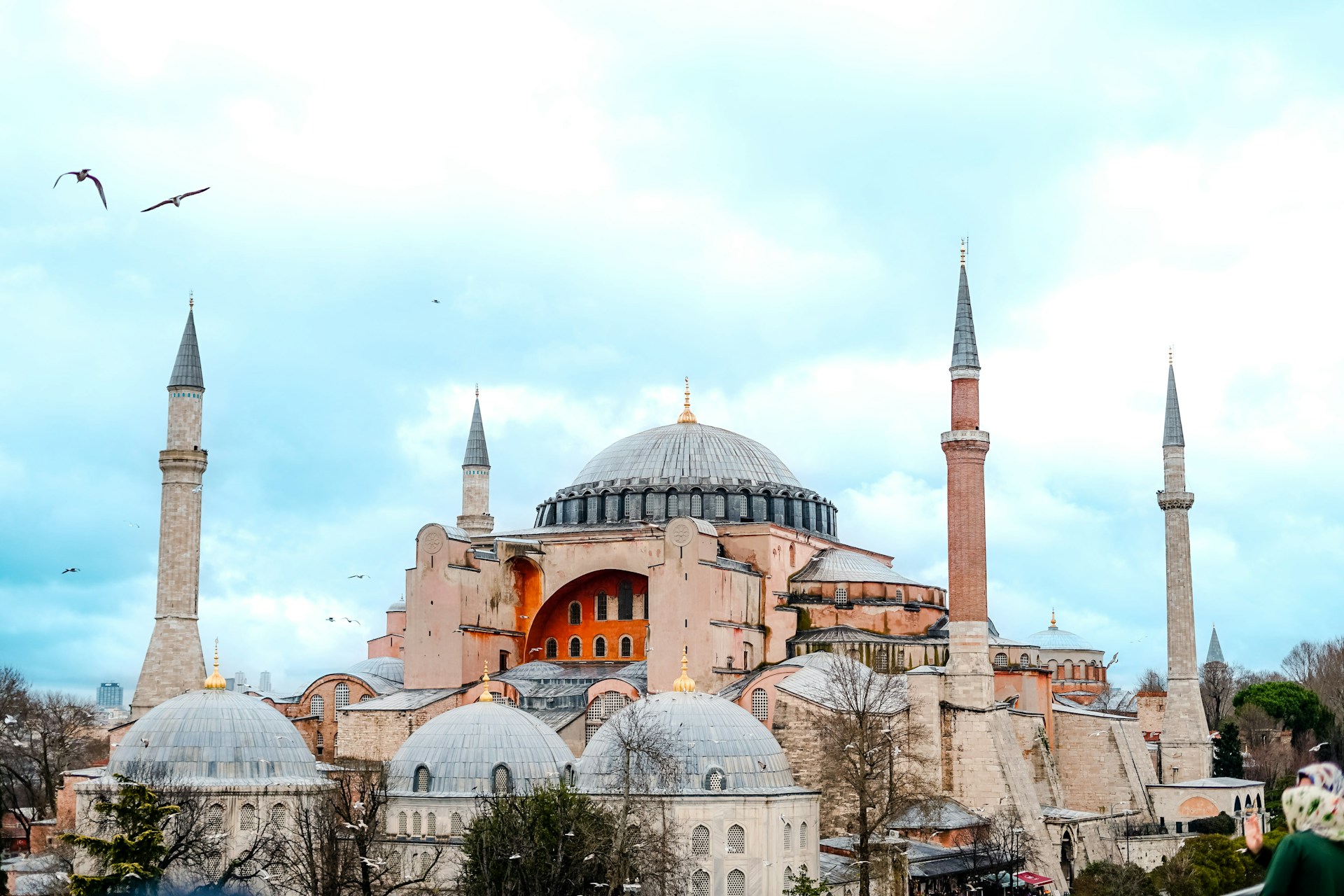
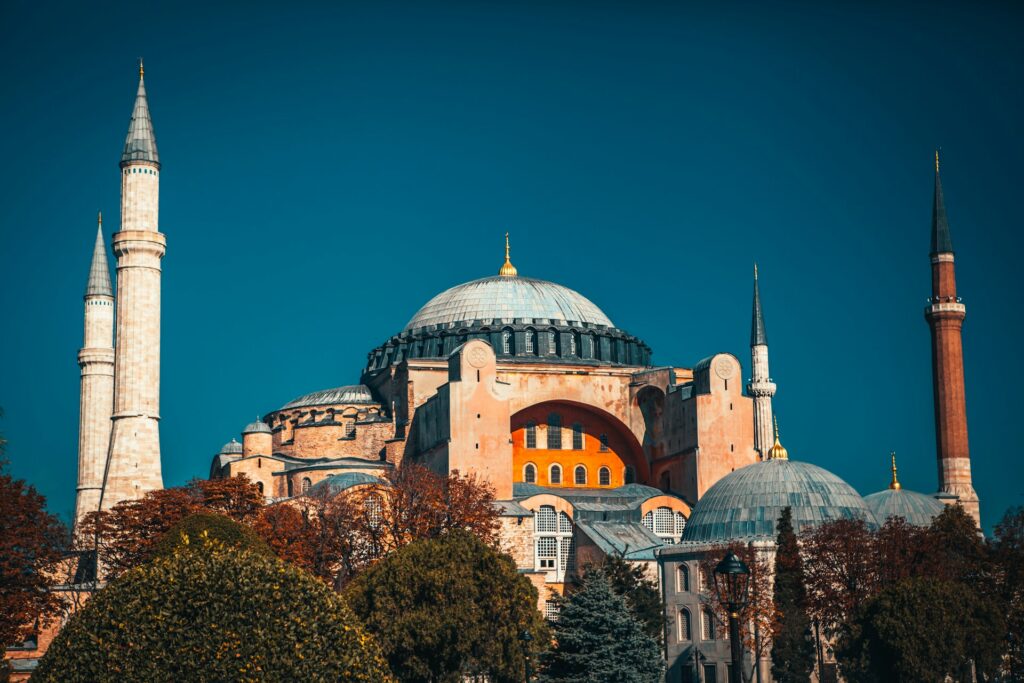
Hagia Sophia is not merely a monument or an icon of Istanbul — it marks a decisive turning point in the history of architecture, where scale, structure, and meaning were combined in a radically new way. Constructed between 532 and 537 as the principal church of the Byzantine Empire, it remained the largest enclosed interior space in the world for nearly a thousand years. Its importance, however, lies not in size alone, but in engineering audacity: no previous building had attempted to create such a vast, unified interior without a clear separation between structure and space.
The central dome of Hagia Sophia was an unprecedented structural experiment. Through the use of pendentives, the circular dome was seamlessly transferred onto a square plan below, establishing a continuous load path that would later define Byzantine, Islamic, and Renaissance sacred architecture. Crucially, the building was never structurally “perfect.” The dome collapsed, was rebuilt, raised, and reinforced after successive earthquakes. Hagia Sophia is therefore not a static masterpiece, but a living record of architectural problem-solving across centuries.
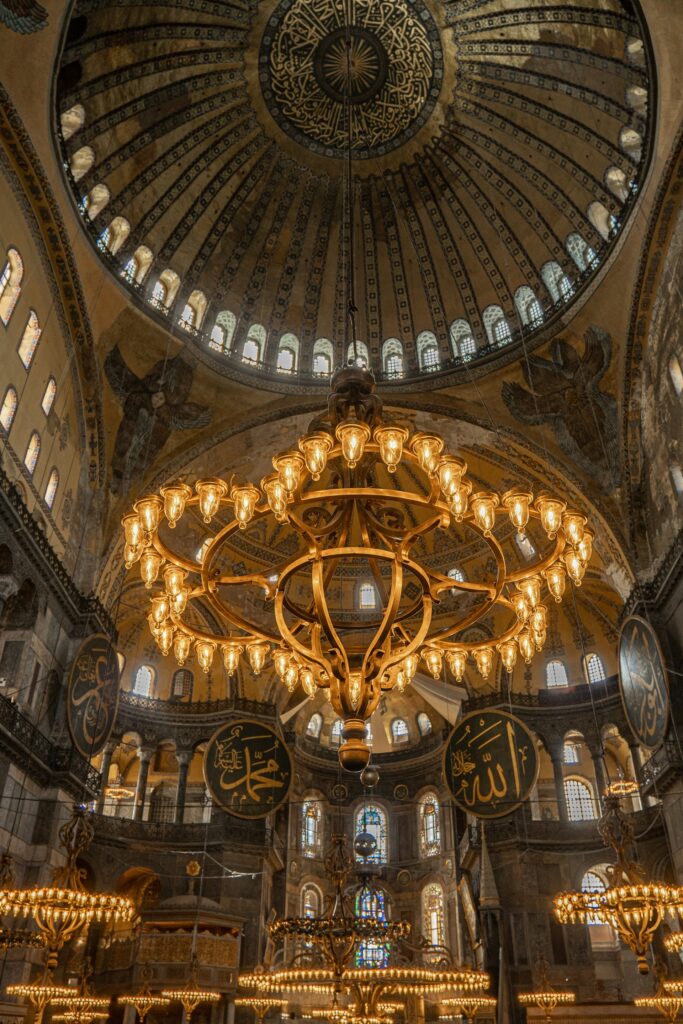
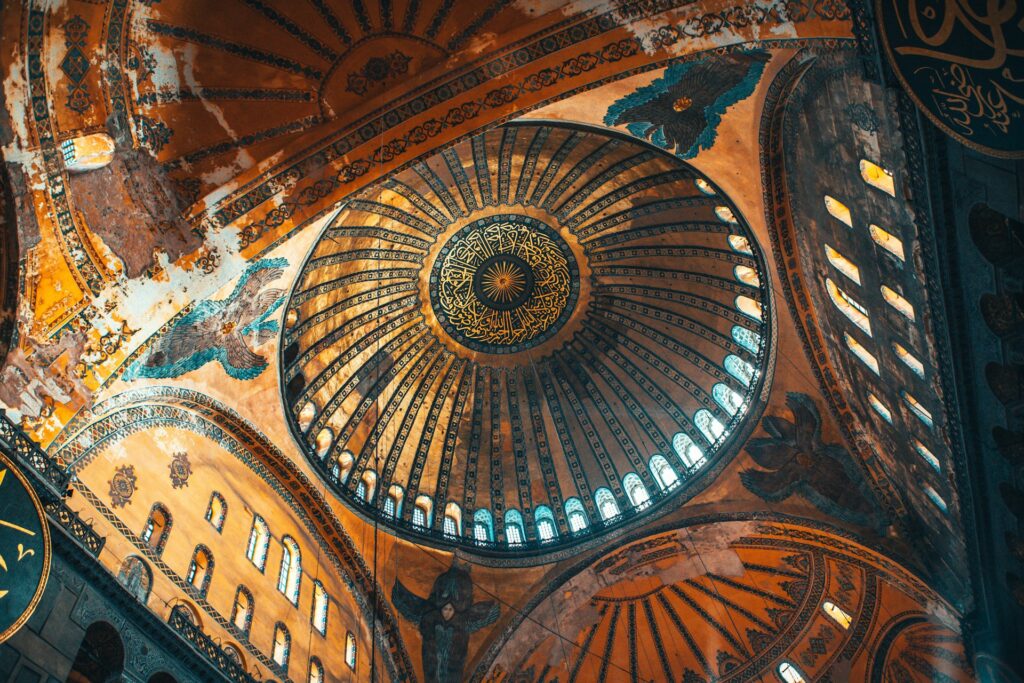
The interior was conceived as a spatial experience rather than a static composition. A ring of windows at the base of the dome dissolves its mass through light, making the structural boundaries difficult to perceive. Marble surfaces and mosaics function not as ornament, but as optical devices — reflecting light, amplifying spatial depth, and causing the architecture to shift with the time of day. This is a space meant to be inhabited and perceived, not simply observed.
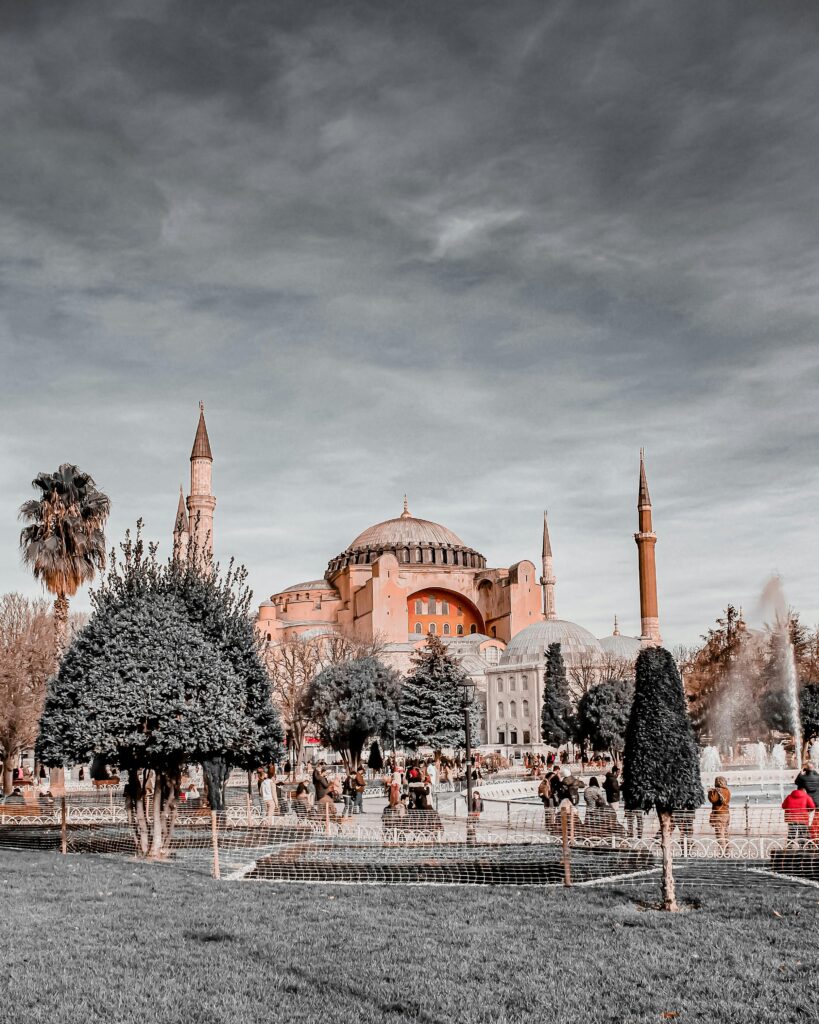
Equally significant is the building’s layered functional history. As a Christian basilica, a mosque, a museum, and once again a mosque, Hagia Sophia has been continuously reinterpreted without losing its underlying spatial logic. Minarets, the mihrab, and Islamic calligraphy did not replace the original architecture; they were inscribed onto it, creating a palimpsest of cultural and religious meaning. Few buildings demonstrate so clearly how a structure can absorb radical ideological change while preserving its architectural identity.
Hagia Sophia remains a fundamental reference point not because it is the oldest or the largest, but because it proves that architecture can transcend technological limits, symbolic systems, and cultural boundaries simultaneously. It stands as a foundation for centuries of monumental sacred architecture — and continues to shape how architects and engineers understand space, light, and structural ambition today.
Hagia Sophia in Numbers
532–537 AD
Construction period of the main structure (approx. 5 years, an absolutely exceptional pace for the 6th century)
55,6 m
Height from floor to top of dome
31,87 m
The diameter of the main dome. Interestingly, it is not a perfect circle (due to numerous repairs after earthquakes)
82 m × 73 m
Overall dimensions of the building’s foundations
1
one emperor – Justinian I personally financed and authorized the entire project
~6,000 m³
estimated volume of the dome itself
107
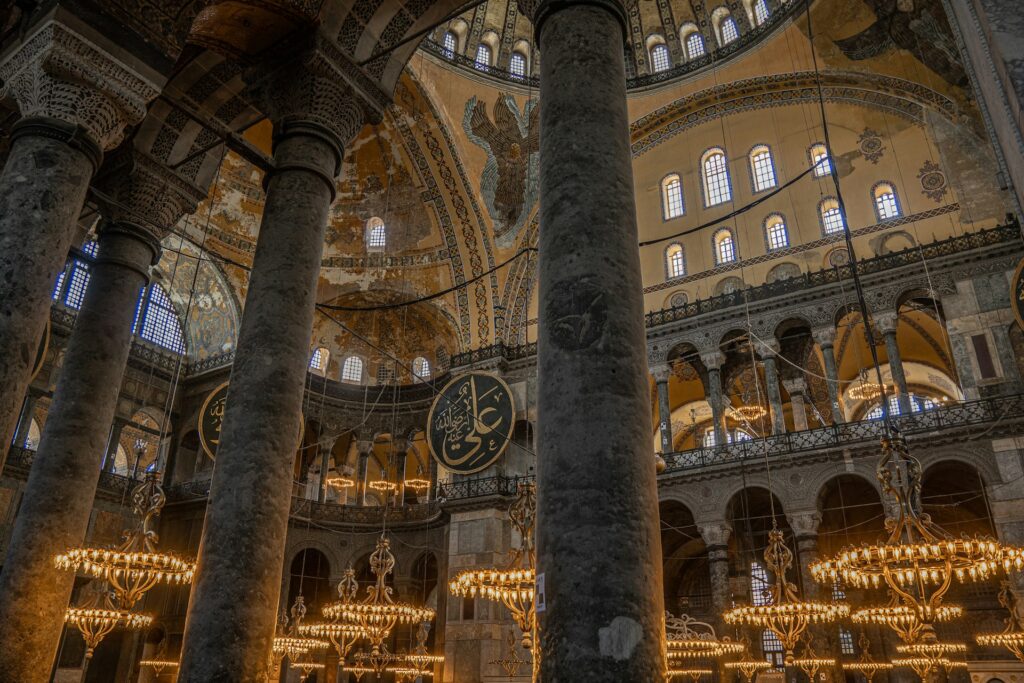
Number of columns inside the building (40 on the ground floor and 67 on the gallery level)
145 000 kg
total estimated construction cost according to Byzantine chroniclers (converted to the Roman pound libra)
3
Empires – Byzantine, Latin, and Ottoman rule over the building
10 000
That’s how many people worked on the construction at the same time, divided into two competing groups (5,000 people each)
4
Number of main pillars, each measuring 10x10m, support the dome weighing 2 000 tons
40 mln
Number of tourists who visited Hagia Sophia in the last 5 years
What makes Hagia Sophia truly extraordinary isn’t its dome alone, but the way its interior dissolves the boundary between structure and space. The building doesn’t simply contain a vast hall; it constructs an experience in which light, mass, and geometry merge into a single, continuous volume. Rather than guiding movement through axes or aisles, Hagia Sophia absorbs the visitor into a spatial field that feels both centralized and infinite, establishing one of the most radical and influential interior concepts ever realized in architectural history.
The Financial and Political Legacy of Hagia Sophia — Architecture Measured in Gold, Power, and Risk
Hagia Sophia stands as one of the most expensive and politically charged public projects of the pre-industrial world. When Emperor Justinian I announced the construction of a new Church of Holy Wisdom in 532 AD, Constantinople was still reeling from the Nika Revolt, an uprising that had killed tens of thousands and destroyed large sections of the city, nearly costing the emperor his throne. In this context, Hagia Sophia was not a purely religious undertaking—it was a calculated investment in restoring imperial authority through architecture.
The speed of construction alone was extraordinary. The building was completed in just 5 years (532–537), an almost unimaginable timeframe for a structure of this scale in the sixth century. Such velocity required uninterrupted funding and total mobilization of imperial resources. This was not a phased or incremental project; it was an all-at-once commitment backed directly by the imperial treasury, with no predefined upper spending limit.
According to later chroniclers, the cost of construction reached approximately 320,000 Roman pounds of gold, equivalent to roughly 145 metric tons of pure gold, depending on how the Roman libra is interpreted. Even at the lowest estimate, this amount would correspond to several billions of dollars at today’s gold prices. More importantly, in sixth-century terms, this sum likely represented multiple years of total imperial revenue, making Hagia Sophia one of the single most expensive public buildings ever erected in antiquity.
These costs were driven not only by scale but by what remained largely invisible. A substantial portion of the building’s footprint was not devoted to usable interior space, but to structure. The difference between the total built area and the main hall amounted to roughly 2,750 m², occupied by massive structural elements. Four colossal piers—each covering close to 100 m²—and a dense system of walls and buttressing absorbed enormous quantities of stone, mortar, and metal. In some areas, wall thickness exceeded 5 meters, serving no spatial or decorative function, but existing solely to stabilize the vast dome above. This “hidden architecture” consumed resources relentlessly, draining the imperial treasury day after day.
Logistics further inflated the cost. Materials were sourced from across the empire, often transported by sea. Most notable were the lightweight bricks used in the dome, reportedly up to five times lighter than conventional bricks of the period. Producing and transporting these specialized materials required a logistical operation comparable to the largest state projects of antiquity, adding another layer of financial strain.
The consequences for the Byzantine Empire were double-edged. On one hand, Hagia Sophia remained for nearly 900 years the largest Christian church in the world, serving as the spiritual and symbolic heart of the empire. It attracted pilgrims, diplomats, and chroniclers from across the known world, reinforcing Constantinople’s image as the center of Christian civilization and imperial power.
On the other hand, the price of this prestige was severe. Contemporary sources point to increased taxation, reductions in state subsidies, and prolonged fiscal tension in the years following the building’s completion. For an extended period, the imperial treasury struggled to rebuild reserves, limiting the state’s ability to fund the army and administration. Some historians argue that this financial exhaustion—exacerbated by Justinian’s broader monumental building program—contributed to the empire’s reduced resilience in the face of later military threats.
Hagia Sophia is therefore a paradox written in numbers. It was a building that may have undermined the economic stability of its own state, yet secured its creator an enduring place in history. Here, architecture transcended rational economics and became an instrument of power, ideology, and ambition—paid for in gold, time, and systemic risk, but rewarded with architectural immortality.
The Construction of Hagia Sophia — Engineering at the Limits of the Ancient World
Hagia Sophia, remains one of the most radical construction experiments in the history of architecture. Its creation was not merely a response to religious needs, but a deliberate demonstration of the technological, organizational, and political power of the Byzantine Empire. After the destruction of the previous basilica during the Nika Revolt, Emperor Justinian I did not seek reconstruction—he ordered the creation of a building meant to challenge existing notions of scale, weight, and structural logic.
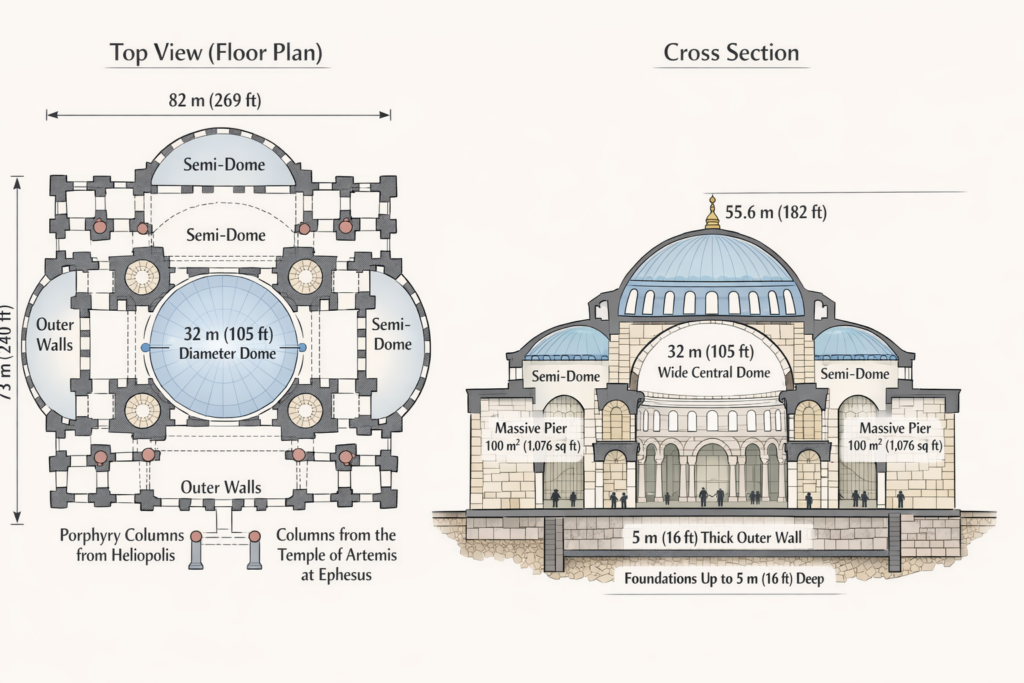
A decisive factor in this ambition was Justinian’s choice of designers. Instead of relying on traditional master builders, he entrusted the project to Anthemius of Tralles, a mathematician and geometer, and Isidore of Miletus, a physicist and theoretician of mechanics. This shift from craft-based knowledge to theoretical reasoning led to a structure founded on the revolutionary system of pendentives—spherical triangular elements that allowed a circular dome to rest upon a square base. The result was unprecedented: the main nave, measuring approximately 82 × 73 meters, formed one of the largest uninterrupted interior spaces of antiquity.
At the center of the design stood the great dome, with a diameter of about 32 meters, resting on a ring of 40 windows. These openings served both structural and optical purposes, reducing mass at the base of the dome while flooding the interior with light. The effect was striking: the dome appeared to hover above the space, an illusion famously described by contemporaries as being “suspended from heaven by a golden chain.” This visual lightness was not poetic accident, but the outcome of precise geometric calculation.
The logistical scale of the project rivaled that of a military campaign. Construction was completed in the extraordinary time of 5 years, 10 months, and 4 days, achievable only through the mobilization of resources from across the empire. Approximately 10,000 workers labored on the site each day, divided into two competing teams—north and south—to accelerate progress. At the same time, Justinian implemented an extensive system of spolia, or architectural reuse. Rather than waiting for new quarrying, finished elements were transported from famous ancient sanctuaries, including eight porphyry columns from Heliopolis and columns taken from the Temple of Artemis at Ephesus.
To reduce structural weight, the dome was built using porous bricks from the island of Rhodes, reportedly up to five times lighter than standard Roman bricks. Even so, the dome’s mass is estimated at around 2000 tons, necessitating a massive yet largely concealed structural system. The load is carried by four colossal piers, each occupying roughly 100 m², combined with exterior walls that in some areas reach 5 meters in thickness. These elements exist almost entirely for structural stability, counteracting the immense lateral forces generated by the dome.
This system was further reinforced by two semi-domes to the east and west, which gradually transfer loads down to lower parts of the building. Such cascading distribution of forces was a groundbreaking solution that significantly increased overall stability. Equally crucial were the binding materials. Byzantine mortar, composed of lime mixed with crushed brick, produced a flexible compound capable of slight movement. Unlike rigid masonry, this material allowed the structure to absorb seismic energy, enabling Hagia Sophia to survive repeated earthquakes over nearly 1,500 years.
The speed of construction, however, came at a cost. The original dome collapsed in 558 AD, only 21 years after completion. Its replacement—raised and structurally reinforced—proved far more resilient and has endured to the present day. In this sense, Hagia Sophia is not a single, static achievement, but the result of an iterative engineering process in which failure led directly to improvement.
The construction of Hagia Sophia rested on three fundamental pillars: an effectively unlimited budget, estimated at around 145 tons of gold; the application of theoretical knowledge by mathematicians and physicists rather than traditional craftsmen; and a relentless logistical system drawing on the full resources of the empire. The outcome is a building that remains one of the greatest achievements of late antique engineering—not merely a symbol of its era, but enduring proof that architecture can transcend the technological limits of its time.
Trivia
Built After a Civil War
Hagia Sophia was commissioned immediately after the Nika Revolt of 532, which left much of Constantinople in ruins. The uprising nearly dethroned Emperor Justinian I and killed tens of thousands of citizens. The church was conceived as a political reset button, not a routine religious project.
Mathematical Perfection in Mosaics
The interior was originally covered in over 30 million gold tesserae (mosaic tiles). These tiles were set at specific angles to reflect the candlelight and create a shimmering, divine atmosphere. Even the placement of the icons followed strict geometric ratios intended to inspire awe in the viewer.
Forty Windows as a Structural Tool
The 40 windows at the base of the dome were not purely decorative. They reduce the dome’s weight and weaken the visual perception of its mass. Light was used as a structural instrument as much as stone.
The First Dome Collapsed
The original dome collapsed in 558 AD, only 21 years after completion. Earthquakes and excessive horizontal thrust exposed weaknesses in the rushed design. The rebuilt dome was raised higher and structurally improved, becoming far more stable.
Architecture Built from Other Monuments
Many columns and marbles were taken from older pagan temples. Notable examples include porphyry columns from Heliopolis and elements from the Temple of Artemis at Ephesus. This reuse saved time while symbolically asserting Christian dominance over pagan antiquity.
Mortar That Bends, Not Breaks
The Byzantine mortar used lime mixed with crushed brick. This created a flexible material capable of absorbing seismic energy. It is one of the main reasons the building has survived multiple major earthquakes.
The 18-Ton Silver Altar
Historical records indicate that the original altar was made of a solid mixture of gold, silver, and precious stones. Estimates suggest that over 40,000 pounds (approx. 18 tons) of silver were used for the altar and the surrounding sanctuary decorations. Most of these treasures were looted during the Fourth Crusade in 1204.
Viking Graffiti
In the upper gallery, there is a piece of 9th-century runic graffiti carved into the marble balustrade. It was left by a Viking named Halvdan, who likely served in the Varangian Guard, the elite bodyguard of the Byzantine Emperor. This proves that Hagia Sophia was a global crossroads even in the early medieval period.
Nearly 900 Years as the World’s Largest Church
For almost nine centuries, Hagia Sophia was the largest Christian church in existence. No cathedral in Europe surpassed its scale until the late Middle Ages. It set a benchmark that remained unmatched for generations.
Converted Without Being Destroyed
After the Ottoman conquest in 1453, the building was converted into a mosque. Instead of demolishing Christian elements, many were covered or integrated. This decision preserved the structure far better than destruction would have.
From Mosque to Museum to Mosque Again
In 1934, Hagia Sophia became a museum by decree of Atatürk. In 2020, it was reconverted into a mosque. Few buildings in history have undergone such radical functional shifts while remaining structurally intact.
The Emperor’s Gate
The central door, known as the Imperial Gate, was reserved exclusively for the Emperor and his entourage. Legend says it was crafted from wood taken from Noah’s Ark, emphasizing the building’s role as a bridge between earth and heaven. It stands nearly 12 meters tall and was once plated with silver and gold.