
A Tower Reduced to Pure Ratio
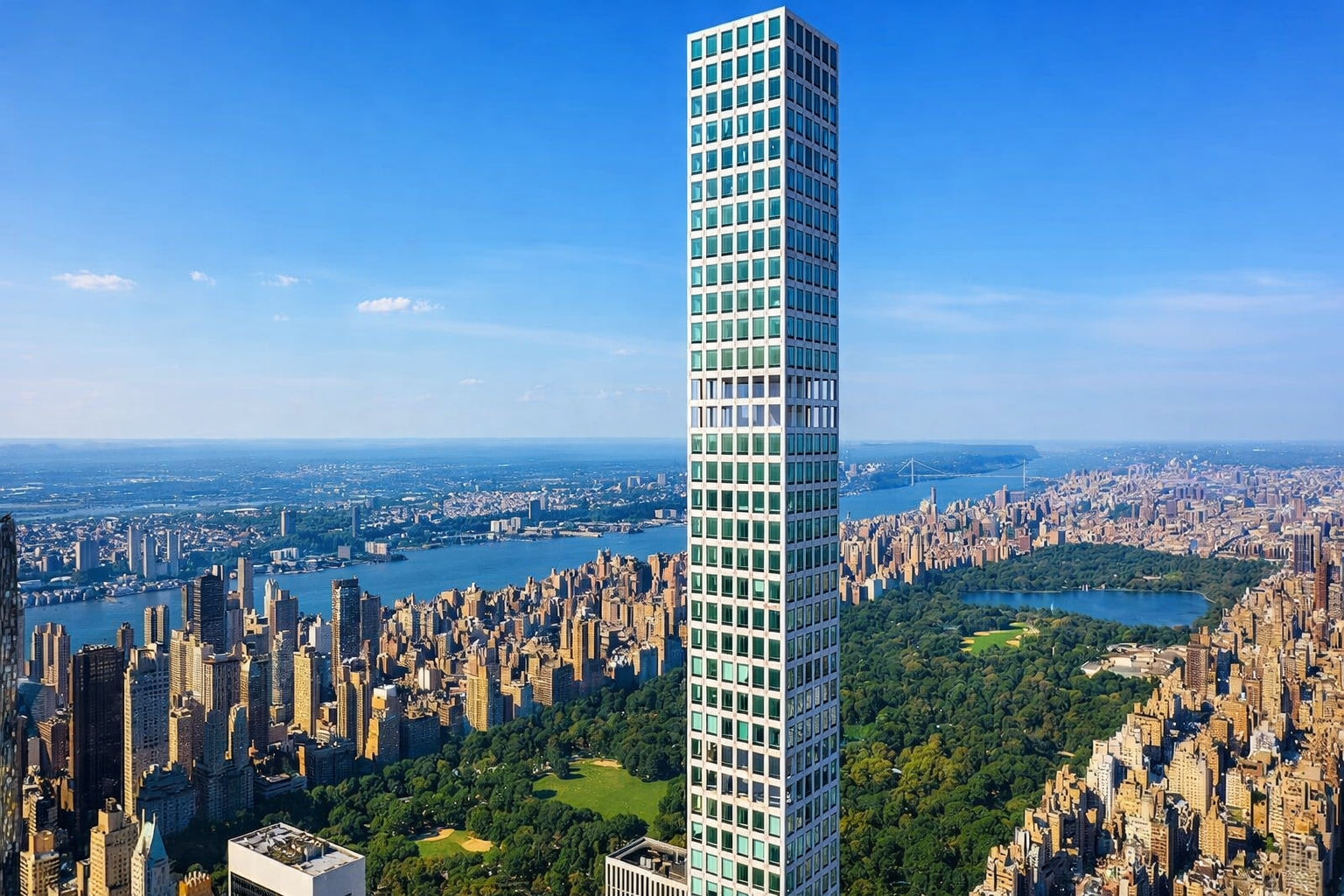
432 Park Avenue is a residential supertall in Midtown Manhattan that turns one of architecture’s oldest geometric figures—the square—into an extreme vertical proposition. Rising above Park Avenue with unusual calm, it appears almost abstract against the far denser texture of the city around it.
What makes the building important is not decorative richness but technical control. Its severe repetition, large square windows, and near-unbroken shaft are the visible result of a highly engineered effort to make an ultra-slender residential tower stable, marketable, and spatially luxurious at once.
Designed by Rafael Viñoly and developed by Macklowe Properties with CIM Group, the project belongs to the economics of Manhattan scarcity as much as to the formal history of skyscrapers. Height, privacy, air, and distance from the street are treated here as premium commodities organized with almost mathematical discipline.
The strongest analytical lens is therefore structural and economic at the same time. 432 Park Avenue is not simply tall; it is a building in which wind engineering, concrete technology, damping strategy, floor-height generosity, and luxury branding all reinforce one another with unusual directness.
Its apparent simplicity is misleading. Behind the silent façade lies a dense set of technical decisions about stiffness, porosity, comfort, and value creation, making the tower one of the clearest expressions of how twenty-first-century New York converts structural difficulty into luxury real estate.

432 Park Avenue in Numbers
1,396 ft
The tower’s architectural height above Park Avenue, placing it among Manhattan’s defining supertalls
426 m
The metric height generally used in technical discussions of the building’s supertall status
96
The story count used in official project materials for the tower’s full vertical stack
104 residences
The condominium inventory, unusually low for a tower of this height and central to its exclusivity
93 ft
The approximate width of the square tower plan, giving the building its famously narrow footprint
1:15
The approximate base-to-height slenderness ratio that made wind control a primary design problem
15′-6″
The floor-to-floor height that turns each apartment level into unusually tall residential volume
12′-6″
The finished ceiling height in residences, translating structural height into lived spatial luxury
10 ft × 10 ft
The insulated square windows that give the façade its immense, repetitive grid and each residence its framed views
30,000+ ft²
The completed amenity area, showing how a sparse residential tower still depends on a deep service program
75 ft
The length of the tower’s indoor pool, evidence that wellness space was treated as a core luxury asset
186 ft
How high above the street the pool sits, turning even recreation into an elevated urban experience
14,000 psi
The specified concrete strength in the lower structural levels, used to keep the tower both slender and stiff
70,000 yd³
The approximate quantity of concrete in the superstructure, underscoring how materially dense the “minimal” tower really is
12,500 tons
The approximate quantity of reinforcing steel used in the superstructure to lock stiffness into the concrete frame
2015
The completion year in which the tower entered the New York skyline as a fully realized residential supertall
What is most revealing about 432 Park Avenue is that its apparent simplicity is actually the visible residue of extreme calibration: a square plan, repetitive openings, mechanical voids, high-strength concrete, damping, and exceptional floor heights all had to work together to make a residential tower this slender feel structurally credible, spatially luxurious, and economically irresistible.

Engineering and Construction of 432 Park Avenue
The engineering of 432 Park Avenue begins with a contradiction: the building wants to read as a simple, almost mute vertical volume, yet its extreme height-to-width ratio makes it one of the most technically demanding residential towers of its generation. What appears serene from the street is in fact the product of a continuous campaign against wind, drift, acceleration, and inefficiency.
Slenderness as the governing problem
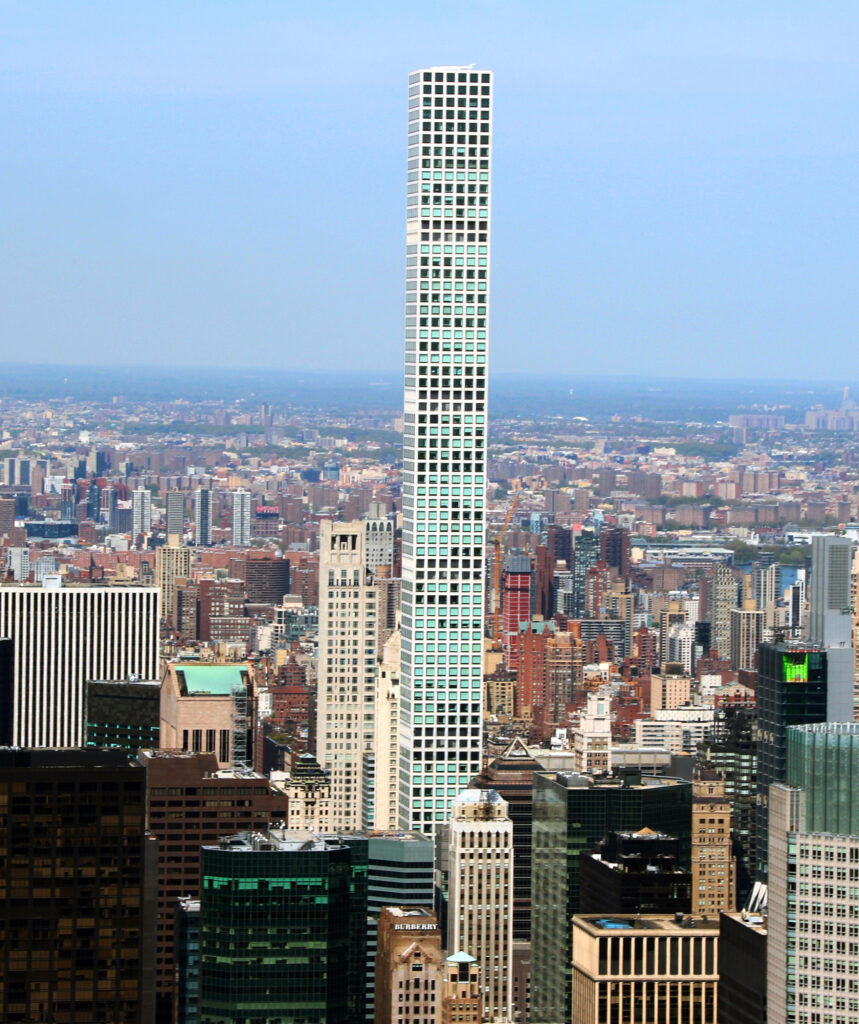
At roughly 1,396 feet tall and only about 93 feet wide, the tower operates at a slenderness ratio close to 1:15. That proportion is not an abstract statistic but the central engineering problem from which nearly every major structural decision follows.
A residential building at this scale cannot rely on the tolerance that an office tower might accept. Occupants sleep, dine, and remain still for long periods, so motion control, not merely gravity support, becomes fundamental to the project’s viability.
Core / perimeter / load path
The structural solution combines a robust reinforced-concrete core with a perimeter tubular frame of columns and deep spandrel beams. In engineering terms, the tower behaves as a tightly coordinated system in which the central core and outer frame share both gravity and lateral work rather than acting as separate elements.
That strategy makes two things possible at once: high stiffness against wind and column-free residential floors around the core. For luxury housing, this matters enormously, because uninterrupted perimeter space turns structural discipline directly into marketable views, room layouts, and full-floor or half-floor apartment configurations.
Porosity / wind / mechanical floors
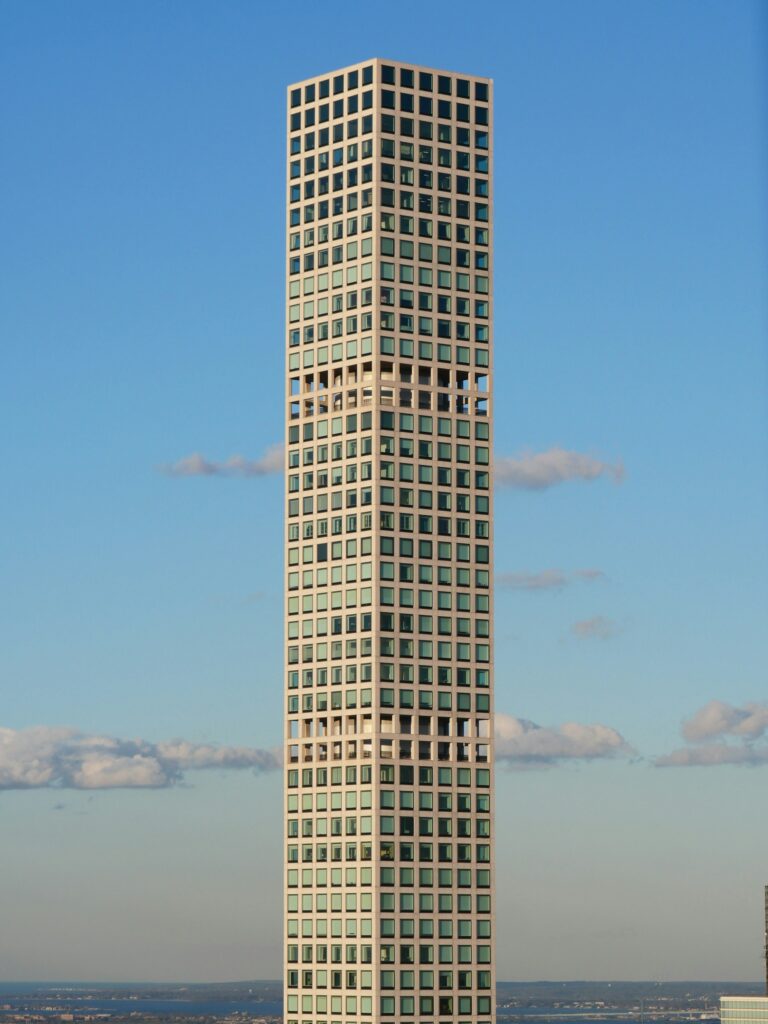
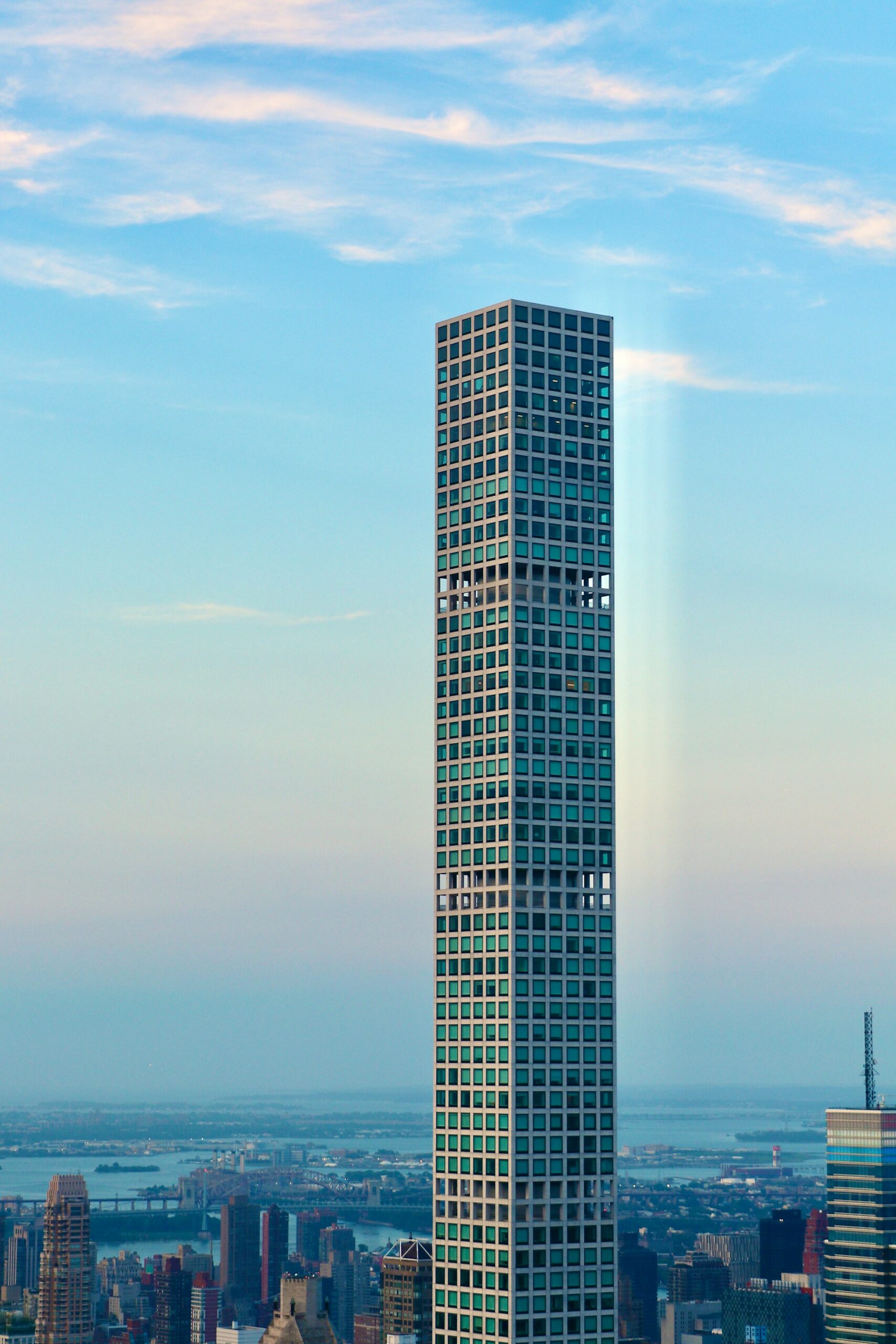
One of the tower’s least obvious but most important devices is its series of open mechanical levels. These double-height voids interrupt the shaft, allow air to move through the building, and help reduce some of the vortex effects that become increasingly severe on a tower this narrow.
Those openings are therefore not incidental service spaces hidden in an otherwise pure form. They are part of the aerodynamic logic of the design, proving that the façade’s repetitiveness is sustained not by denial of technical needs but by integrating them into the building’s rhythm.
Material strategy
The material system is equally demanding. The concrete in the lower structural zones reaches specified strengths of 14,000 psi and tapers to 10,000 psi higher in the building, while the superstructure required more than 70,000 cubic yards of concrete and approximately 12,500 tons of reinforcing steel.
That increase in strength was not simply an exercise in specification. It allowed the structural members to remain comparatively compact while also increasing stiffness, a critical dual objective in a tower whose elegance depends on restraint rather than bulk.
Repetition and façade logic
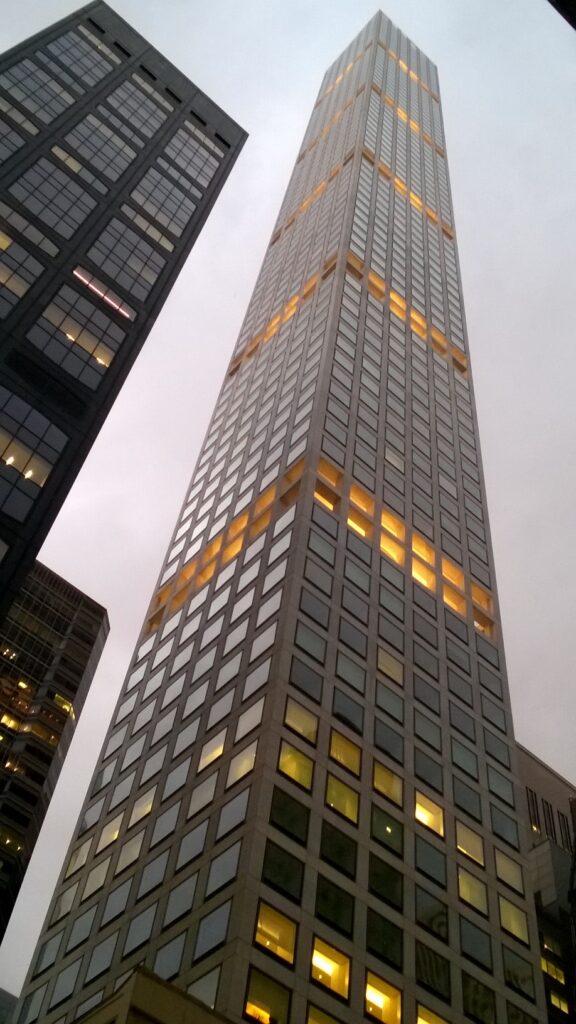
The façade expresses this discipline through a repetitive square grid with 10-foot-by-10-foot windows and a relentless cadence from floor to floor. The effect is monumental not because the tower is highly articulated, but because the same module is repeated with almost no visual relief.
That repetition performs several roles at once. It clarifies the structural order, gives every apartment unusually large framed apertures onto Manhattan, and makes the building legible from a distance as a single geometric idea rather than a stack of individualized residential floors.
Damping and residential comfort
The upper portion of the building also depends on tuned mass damping and other motion-control strategies to moderate wind-induced accelerations. In a tower of this type, comfort cannot be separated from structure: the success of the engineering is measured as much by what residents do not feel as by what the frame can theoretically resist.
Technical studies also indicate that the tower’s rigidity was enhanced by connecting the core to the perimeter frame at multiple levels and by adjusting mass distribution higher in the building. These are not headline-grabbing gestures, but they are the quiet mechanisms that make the tower habitable rather than merely possible.
Construction as precision rather than spectacle
What makes 432 Park Avenue especially instructive is that its construction problem was never about expressive complication. The challenge was the opposite: to make an unusually pure form survive contact with real forces, real materials, and real luxury expectations without losing the severity that defines its identity.
The result is a building that reads as if it were simple, when in fact it is structurally overdetermined at almost every level. Square plan, deep frame, strong core, open mechanical floors, tuned damping, and high-performance concrete all had to be coordinated so that the tower could remain visually calm while behaving like a highly tuned instrument.
432 Park Avenue is therefore best understood not as a minimalist object in the artistic sense, but as a tower in which minimization itself becomes an engineering achievement. Its clarity is the end product of resistance, calibration, and refinement.
Economics of 432 Park Avenue
The economic logic of 432 Park Avenue is inseparable from its formal logic. Developed by Macklowe Properties and CIM Group, the tower was conceived for a market in which altitude, privacy, exclusivity, and unobstructed views could be priced at a global luxury premium far beyond ordinary Manhattan residential practice.
Its numbers make that strategy clear. A 1,396-foot tower contains only 104 condominium residences, supported by more than 30,000 square feet of amenities and unusually large floor heights, which means the project trades density of value for density of units. This is not the economics of maximizing apartment count; it is the economics of manufacturing scarcity.
Many of the tower’s spatial luxuries are also economic devices. Column-free perimeter space, 10-foot-square windows, high ceilings, private elevator arrival, and carefully controlled inventory all transform engineering and layout into priceable distinctions within the ultra-prime market.
That market logic was reinforced by the wider culture of Billionaires’ Row, where buildings function not only as homes but as repositories of status and capital. Reports on the project’s sales trajectory emphasized both multi-hundred-million-dollar asking inventories and the speed with which the tower crossed major sales milestones, confirming that exclusivity itself was part of the product being sold.
In that sense, 432 Park Avenue is not simply a residential tower that happens to be very tall. It is a highly specific commercial instrument that converts structural daring, visual severity, and urban position into luxury value, showing how contemporary Manhattan real estate can make the engineering of restraint economically explosive.

Trivia
The Square Is the Point
Many supertalls rely on setbacks, crowns, or sculptural twists. 432 Park Avenue instead commits to the square almost obsessively, turning a simple figure into a skyline event. Its austerity is not lack of imagination but the project’s central intellectual wager.
Windows as Rooms
The 10-foot-square windows are so large that they change how interiors are perceived. They do not behave like ordinary openings punched into a wall. They act almost like inhabitable frames for the city.
The Pool Sits in the Sky
The pool is 75 feet long and set 186 feet above the ground. That means even one of the building’s most relaxing spaces is also part of its vertical spectacle. In 432 Park, wellness is inseparable from altitude.
Only 104 Homes
For a building this tall, 104 residences is remarkably sparse. That low count is not inefficiency by accident. It is the whole luxury proposition made numerical.
Ceiling Height Sells Silence
The 15-foot-6-inch floor-to-floor dimension is not only about visual drama. Greater vertical volume changes acoustics, light, and how rooms feel around very large windows. In this market, section is part of the sales strategy.
Six Elevators Are Enough
Ultra-luxury towers can slim down because they carry far fewer apartments per floor than conventional residential buildings. CTBUH research noted that 432 Park’s residential floors are served by only six elevators. Scarcity changes the core just as much as it changes the sales pitch.
The Tower Reads Like a Graph
From a distance, 432 Park often looks less like a traditional masonry skyscraper than like a plotted diagram. The regular grid makes every floor feel countable and every opening measurable. Few towers expose their internal order so bluntly.
Concrete, Not Steel, Leads
Many people assume a tower this tall must be a steel expression first. 432 Park is more revealing than that. Its identity depends heavily on high-strength reinforced concrete and the stiffness that material can deliver.
Views Start High
CTBUH commentary on the building noted that the first apartments commanding true premium views begin above roughly 300 feet. That is a reminder that height in Manhattan is not just engineering. It is also pricing logic.
The Amenities Stay Low
The tower’s common spaces are concentrated in its lower levels rather than scattered throughout the shaft. That keeps the upper reaches available for residences and views. Even the building’s program is organized by vertical real-estate value.
No Interior Columns
The residential floors outside the core are free of interior columns. That sounds like a planning convenience, but in a luxury tower it is also a sales advantage. Structure disappears so that space can read as continuous, panoramic, and expensive.
Simplicity Took Wind-Tunnel Work
The tower looks so obvious that it can seem inevitable. It was not. Repeated wind studies, damping strategies, porous mechanical floors, and stiffness adjustments were all needed to make the “simple” version of the tower the one that could actually stand.
Sources and References
This article draws on official condominium materials, architect documentation, CTBUH research papers, structural engineering analysis, and reputable market reporting concerning 432 Park Avenue and the wider economics of New York’s super-slender residential towers.
Referenced source groups include:
- 432 Park Avenue official residential and amenity information
- Rafael Viñoly Architects project documentation
- CTBUH papers on super-slender towers and New York luxury skyscrapers
- STRUCTURE Magazine analysis of 432 Park Avenue engineering
- developer and market reporting on sales, financing, and luxury-condo performance
- public offering-plan and real-estate disclosure materials
The article references data related to:
- height, story count, and residential inventory
- plan dimensions and slenderness ratio
- concrete strength, damping, and wind-control strategy
- floor-to-floor heights and 10-foot square windows
- amenities area, pool length, and wellness facilities
- structural system, perimeter frame, and column-free floors
- construction quantities such as concrete volume and reinforcing steel
- sales milestones, exclusivity, and luxury-market positioning
Some figures for 432 Park Avenue differ slightly between official marketing materials, engineering publications, and tall-building databases, especially where story counts, area conventions, or rounded quantities are presented for different technical purposes. For that reason, selected numbers in this article are described as approximate where appropriate.