
A Diagrid Body for the Financial City
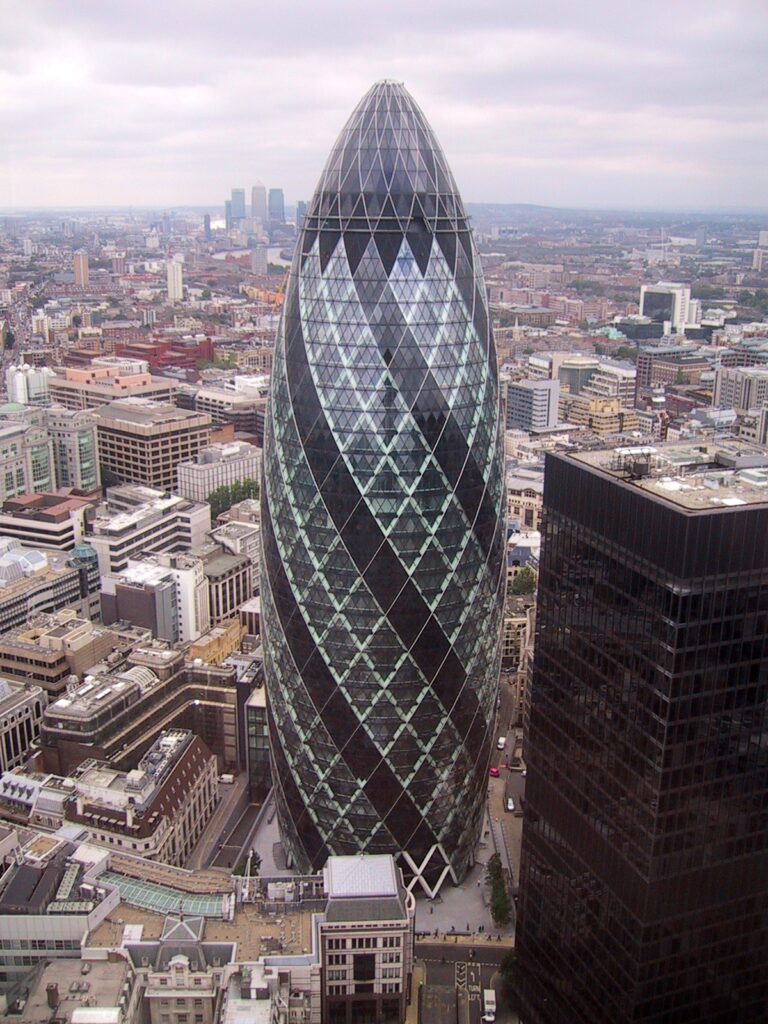
30 St Mary Axe is a 180-metre office tower in the City of London whose technical intelligence is inseparable from its public image. Better known as the Gherkin, it translated insurance-company headquarters into a new urban instrument: aerodynamic, triangulated, and unusually legible against the rectilinear grain of the Square Mile.
Its importance lies not merely in its silhouette. The tower condensed several late-twentieth-century ambitions—high-performance enclosure, mixed-mode ventilation, computational form-finding, column-free office plates, and an intensified ground-level public realm—into a building that became a reference point for London’s post-2000 skyline.
Designed by Foster + Partners for Swiss Re, with structural engineering by Arup and construction by Skanska, the building replaced the damaged Baltic Exchange site and opened a new chapter in the City’s architectural politics. It was not a neutral insertion: it made environmental performance and corporate visibility part of the same argument.
The strongest analytical lens is therefore structural-environmental rather than purely formal. 30 St Mary Axe is a tower where the circular plan, tapered profile, spiralling atria, double-skin façade, and external diagrid work together as one system, even when later commercial operation moderated some of the original mixed-mode ambitions.
Its apparent smoothness is deceptive. Behind the familiar glass skin lies a disciplined negotiation among wind, daylight, floor-plate efficiency, fire protection, façade geometry, elevator logistics, and urban symbolism, making it one of the most instructive European office towers of the early twenty-first century.
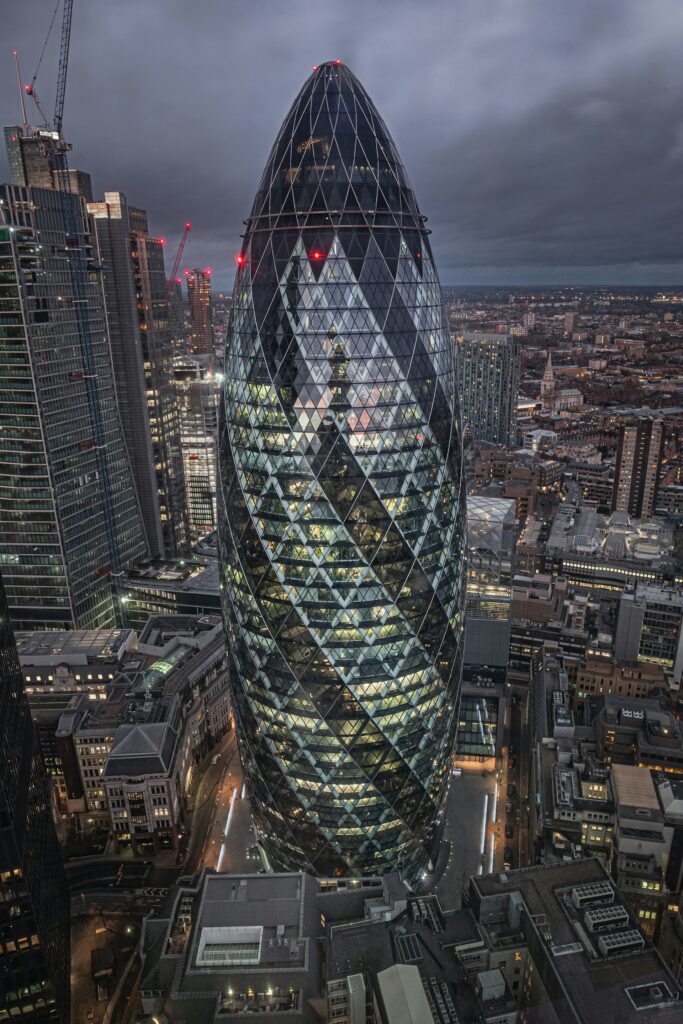
30 St Mary Axe in Numbers
591 ft
The approximate height of the tower above the City of London, equivalent to 180 metres
180 m
The metric height most commonly cited in official and technical descriptions of the building
41
The widely cited floor count, including the upper levels that shape the tower’s public identity
46,400 m² net
The net office area stated by Foster + Partners, supported by retail and social spaces at lower and upper levels
64,500 m²
The broader project area commonly cited in architectural databases for the completed office building
5°
The rotation of successive floor plates, generating the spiralling atria that act as social and ventilation spaces
24,000 m²
The approximate area of external glass used in the façade, according to Skanska’s project data
6 atria
The triangular vertical voids formed between radiating floor fingers, functioning as daylight and air chimneys
4,000 occupants
The approximate workplace population capacity cited by the contractor for the completed tower
378 people
The maximum lift-transport capacity at one time, a reminder that vertical circulation is a core engineering problem
6 m/s
The lift speed cited in contractor data for moving people through the 180-metre building
35 km+
The approximate length of steel used in the project, demonstrating the density behind the apparently seamless envelope
1 curved glass piece
The lens at the top is commonly noted as the only curved glass element in a façade that otherwise appears continuously rounded
2003
The completion year of the building, before its public opening in 2004
2004
The year in which the building opened and won the RIBA Stirling Prize
£138 million
The construction-cost figure most often cited for the project, excluding wider land and transactional values
30 St Mary Axe is most revealing when treated not as a novelty object but as a synthetic environmental machine. Its form is a consequence of several interacting constraints: the need to put a large office programme on a sensitive City site, reduce wind discomfort at street level, admit daylight deep into work areas, and give a corporate headquarters a civic image without resorting to historicist language.
Engineering and Construction of 30 St Mary Axe
The engineering of 30 St Mary Axe begins with an unusual proposition: the building’s perimeter should not simply enclose office space but participate directly in structure, ventilation, identity, and urban comfort. The tower’s circular plan and tapered profile are therefore not cosmetic gestures; they are devices for reducing the penalties normally associated with a tall commercial block on a tight urban site.
Form as environmental control
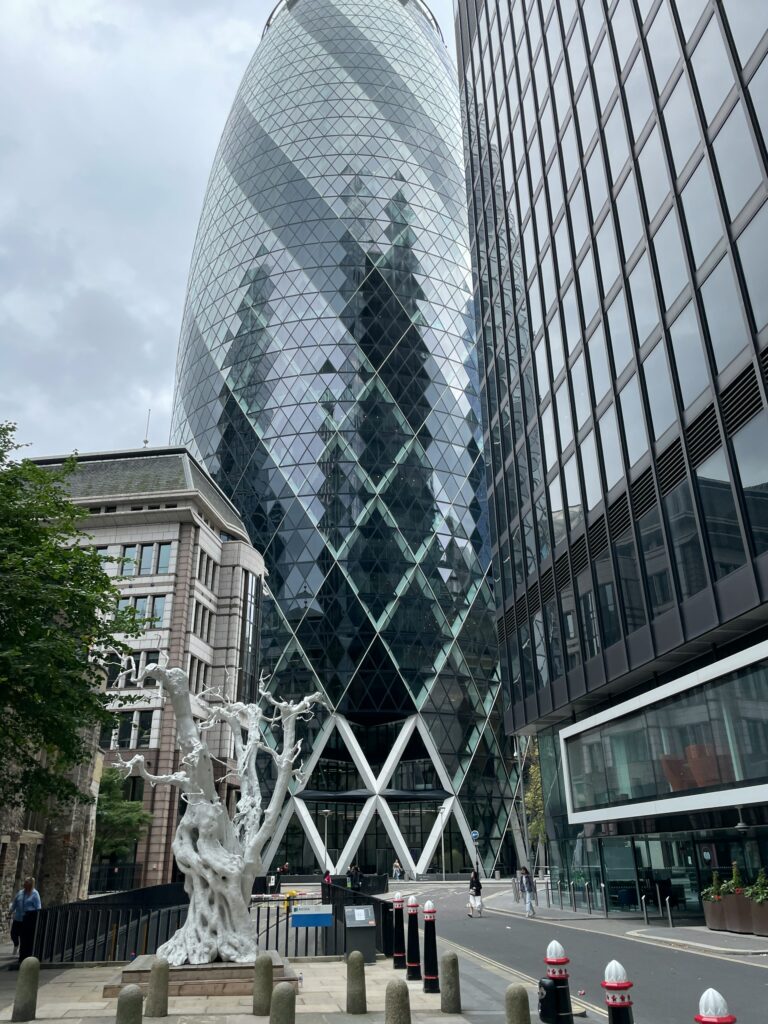
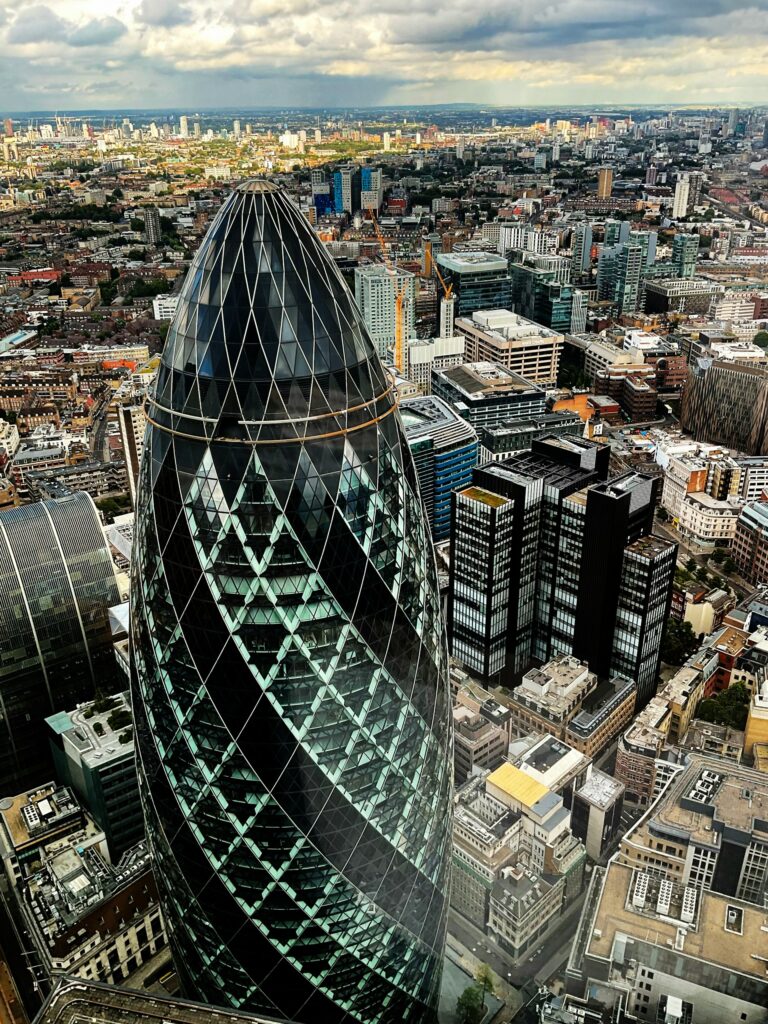
Compared with a rectilinear tower of similar volume, the rounded and tapered geometry reduces downdrafts and wind turbulence at pedestrian level. This matters in the City of London, where narrow streets and dense blocks can transform a tall building into a harsh wind machine. The Gherkin’s body is shaped to soften those effects while also appearing slimmer at the base, preserving more usable public realm around the entrance.
The same geometry produces pressure differences around the envelope. In the original environmental concept, those differences could be exploited to help draw air through the building. Thus the tower’s silhouette is not only an image for the skyline; it is part of a climatic strategy that links aerodynamic modelling, façade openings, and the social spaces between office fingers.
Diagrid / core / load path
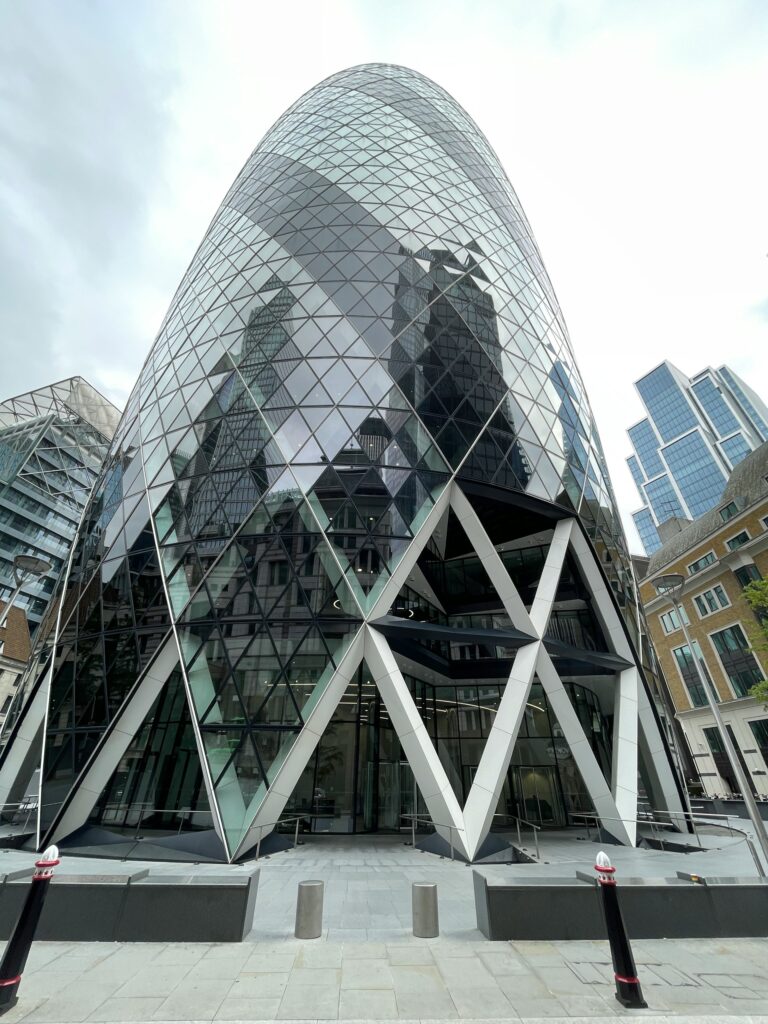
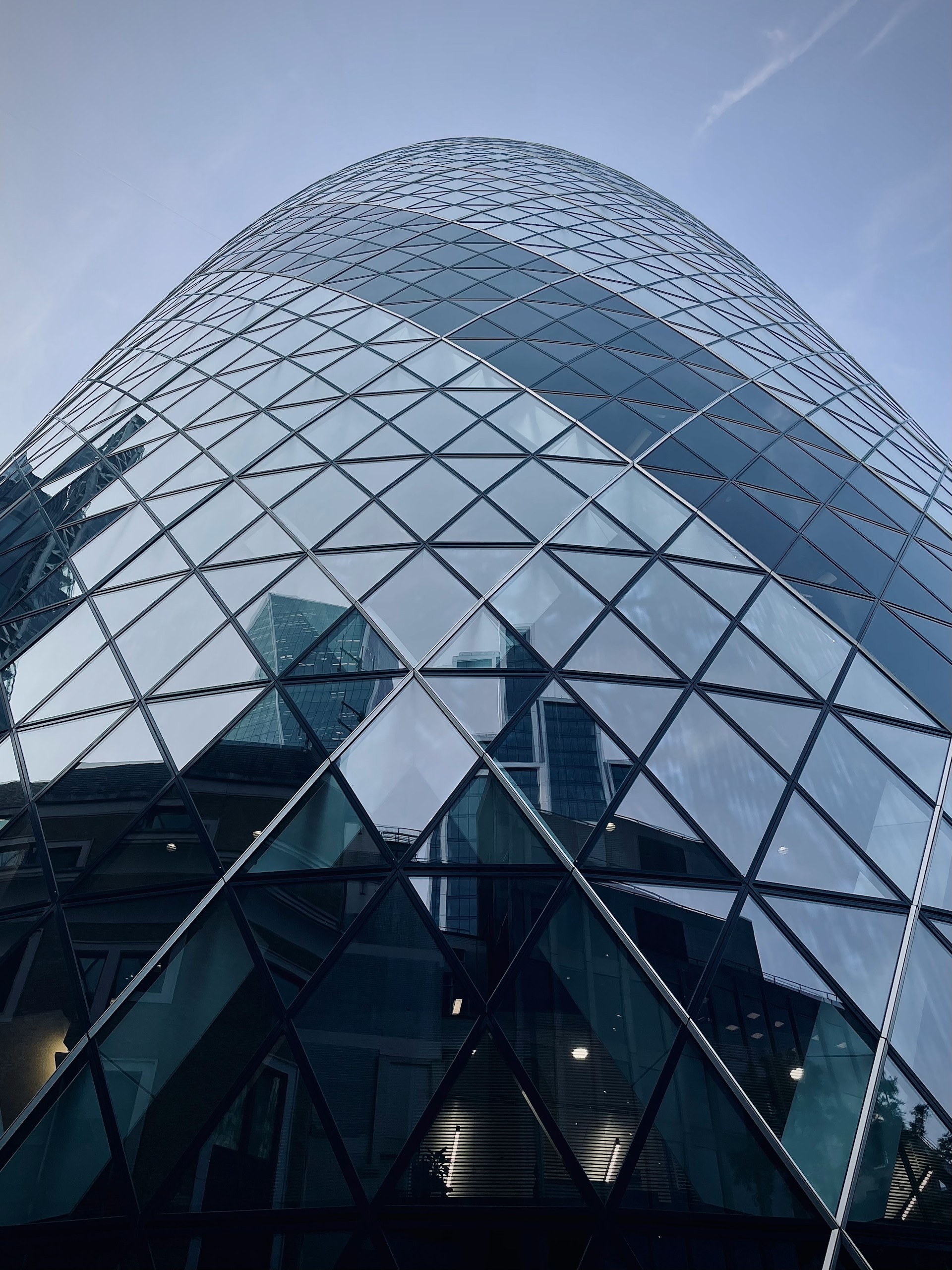
The structural system is centred on a steel diagrid around the perimeter working with the building’s core and composite floor structure. The diagonals form a stiff external tube that resists wind loads efficiently, reducing the need for a dense forest of perimeter columns and allowing office floors to read as open, flexible commercial space.
This externalized load path is critical to the building’s architectural effect. Because the diagrid is both structure and façade order, the envelope looks like a continuous diamond lattice rather than a stack of independent floors. The result is a tower in which structural logic becomes the primary ornamental system, although the detailing deliberately smooths and abstracts the true mechanics.
Rotated floors and spiralling atria
Each floor is organized around a central core with radiating floor plates, and the plates rotate by about five degrees from one level to the next. This rotation generates six vertical atria in the form of spiralling triangular voids. These voids are not leftover space; they are the building’s internal environmental and social infrastructure.
The atria admit daylight, create informal breakout areas, and were intended to function as the building’s lungs. Air could be drawn through opening panels in the façade and distributed through these vertical spaces, reducing reliance on conventional air-conditioning under suitable conditions. Even where day-to-day operation became more conservative, the spatial intelligence of the atria remains central to the tower’s architecture.
Façade and double-skin performance
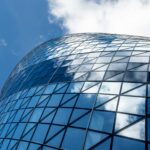
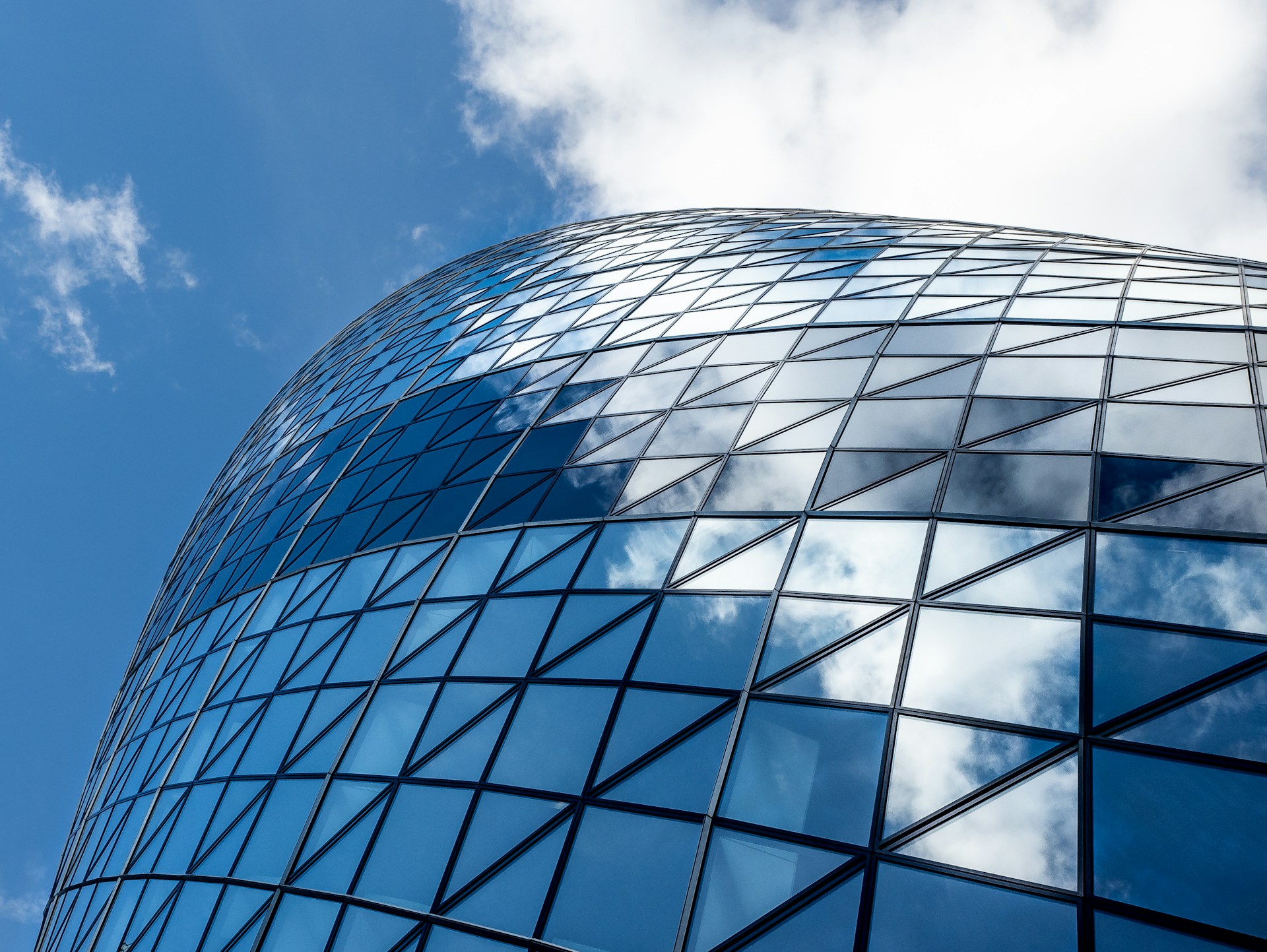
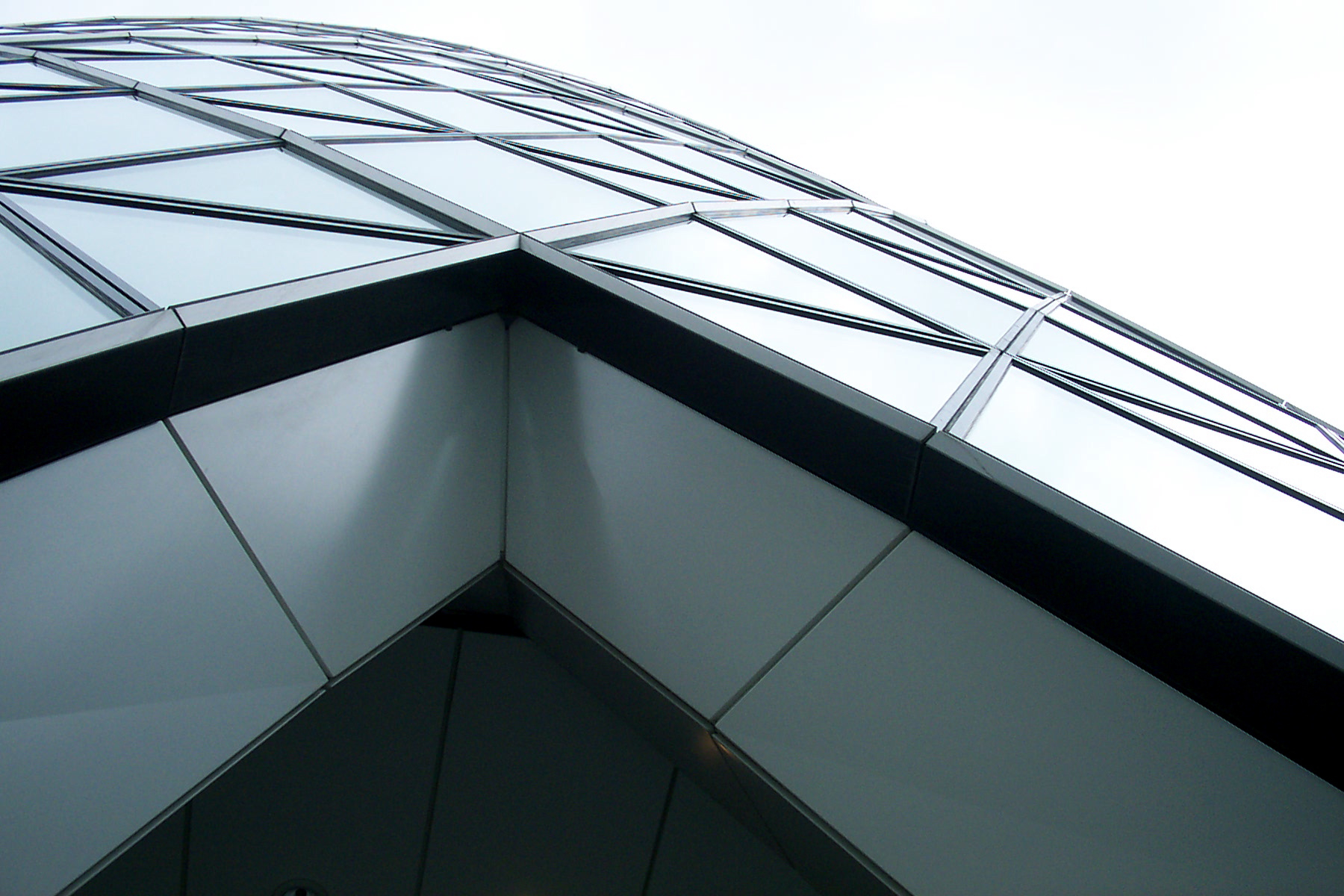
The outer envelope combines a double-glazed skin with the visual rhythm of the diagrid, while an inner layer defines the office environment. This produces a zone where structure, environmental moderation, and visual perception overlap. From outside, the tower appears almost continuously curved, although Skanska notes that only the top lens is actually curved glass.
That fact is technically revealing. The sense of curvature is generated through geometry, faceting, and pattern rather than through an expensive façade of continuously curved panels. The building’s smoothness is therefore an optical and constructive achievement: a round-looking tower assembled from disciplined planar components.
Fire protection, perception, and structural disguise
One of the subtler achievements of 30 St Mary Axe is that it makes heavy structural work appear light. The diagrid members require fire protection and enclosure, yet their visible profiles are shaped and aligned with façade mullions so that the viewer reads a refined diamond pattern rather than a bulky set of braced frames.
Harvard Design Magazine’s analysis is useful here because it shows how the building partly conceals its own mechanics. Floor plates, hoops, diagonals, glazing divisions, and casings are coordinated so that the eye cannot easily distinguish what is carrying load, what is subdividing glass, and what is masking fire protection. The tower’s technological image is thus produced by both expression and concealment.
Construction in a constrained urban site
Building the tower required careful coordination in one of London’s busiest financial districts. Skanska describes extensive use of 3D modelling for structure, cladding, and services, allowing components to be planned before arrival on site. In a confined City plot, construction logistics become part of engineering: the sequence, delivery, lifting, and tolerances are as consequential as the structural concept.
The project was delivered in under three years and within the framework of high sustainability standards for its period. That speed is not incidental. The tower’s repetition of diagrid modules, façade panels, and coordinated services allowed an unusually complex form to be converted into a manageable construction process.
Performance and the limits of the ecological claim
30 St Mary Axe was widely promoted as London’s first ecological tall building and as a tower expected to use substantially less energy than conventional air-conditioned offices. The claim rested on natural ventilation, daylight penetration, reduced cooling loads, and the environmental intelligence of the atria.
Yet the building also demonstrates the tension between architectural ambition and commercial occupation. Mixed-mode systems require user acceptance, operational discipline, and a leasing culture willing to tolerate environmental variability. The Gherkin’s long-term significance is not that every environmental promise operated exactly as imagined, but that it made environmental engineering visible as a central architectural problem in the City.
30 St Mary Axe is therefore best understood as a building where structure, façade, urban wind, workplace planning, and corporate branding were solved together. It is not simply a rounded office tower. It is a carefully tuned envelope in which the external lattice, the rotating plans, and the public image of ecological sophistication become one architectural argument.
Economics of 30 St Mary Axe
The economics of 30 St Mary Axe begin with a damaged and symbolically charged site. The former Baltic Exchange and Chamber of Shipping had been severely damaged in the 1992 IRA bombing, and the eventual Swiss Re project had to convert a difficult urban legacy into a commercially viable headquarters and investment asset.
The tower’s financial logic depended on making a non-standard building commercially legible. Its column-free office plates, strong skyline identity, ground-level shops and cafés, and high-level club room all helped translate engineering complexity into rental and reputational value. The building was not merely accommodation; it was a corporate address designed to concentrate visibility.
The commonly cited construction cost of about £138 million should be read against the later investment story. In 2007, Swiss Re sold the building in a transaction reported at roughly £600 million, widely described at the time as a record for a UK office building. That spread between construction cost and asset value helps explain why architectural distinctiveness can become financial infrastructure in a global city.
At the same time, the tower’s economics are not separable from risk. A distinctive form can create branding power, but it also increases dependence on specialized façade maintenance, technical management, and tenant confidence. 30 St Mary Axe succeeded because its architectural identity remained desirable after the novelty period, allowing the object to function as both office space and a tradable landmark.
In that sense, the Gherkin is a case study in how London’s financial core learned to monetize architectural singularity. It did not simply provide floors for office workers; it transformed environmental rhetoric, skyline recognition, and technical daring into long-term urban capital.
Trivia
The Nickname Won
The official address is 30 St Mary Axe, and the building was developed as the Swiss Re headquarters. Yet “the Gherkin” became the name Londoners actually use. Few corporate towers have been so thoroughly renamed by public imagination.
Only One Curved Pane
The tower looks smoothly rounded, but Skanska notes that there is only one curved piece of glass: the lens at the top. The rest of the curved effect is produced by faceted geometry and the disciplined rhythm of the cladding.
Every Floor Turns
Each typical floor rotates about five degrees from the one below. That small geometric shift is enough to generate the spiralling atria that make the building work spatially and environmentally.
The Building Has Lungs
The atria were often described as the tower’s lungs. They distribute air, light, and social space through the plan, turning environmental engineering into a recognizable architectural metaphor.
Archaeology Interrupted Modernity
During site work, archaeologists found the body of a young Roman buried between roughly 350 and 400 AD. The discovery is a reminder that even the most futuristic City tower stands inside a much older ground.
Lifts Are Part of the Story
At one time, the building’s lifts can move a cited maximum of 378 people at speeds up to 6 metres per second. In a 180-metre office tower, circulation is not a background service; it is a major performance system.
The Base Is Deliberately Slim
The tower narrows toward the ground not only for visual elegance but to give more space back to the street. The public plaza is part of the architectural strategy, not an afterthought.
Diagrid Became the Image
The exterior diamond pattern is not applied decoration. It grows from the diagonally braced structural envelope, making engineering the building’s most memorable visual language.
An Ecological Claim With Complications
The Gherkin was celebrated as an ecological skyscraper, but the realities of commercial operation complicated the pure mixed-mode story. That tension makes the building more interesting, not less.
The Skyline Changed After It
The Gherkin helped normalize a new generation of expressive towers in the City of London. Later neighbours could be taller or stranger, but 30 St Mary Axe made the skyline’s transformation publicly legible.
A Club Room Above the City
The upper club room gives a 360-degree panorama across London. It turns the corporate tower into an elevated viewing instrument, even if access is far more controlled than in a public observation deck.
Diamonds Hide the Floors
From outside, it is surprisingly difficult to read where every floor plate sits. The diagrid, mullions, hoops, and glazing rhythm camouflage the tower’s internal stacking.
Sources and References
This article draws on the MATKA-1-1 Gutenberg structure supplied for the site, official Foster + Partners project documentation, Skanska contractor material, architectural database entries, critical architectural analysis, and reputable reporting on the building’s finance and environmental claims.
Referenced source groups include:
- Foster + Partners, The Gherkin — official project page, no publication date stated, https://www.fosterandpartners.com/projects/the-gherkin/. Material checked: 16.04.2026.
- Skanska, 30 St Mary Axe, London — project overview, last updated 16.08.2017, https://www.skanska.pl/en-us/offer/projects/57248/30-St-Mary-Axe%2C-London. Material checked: 16.04.2026.
- ArchDaily / Paula Pintos, 30 St Mary Axe Tower / Foster + Partners, published 12.11.2019, https://www.archdaily.com/928285/30-st-mary-axe-tower-foster-plus-partners. Material checked: 16.04.2026.
- Harvard Design Magazine, 30 St. Mary Axe, no publication date stated on page, https://www.harvarddesignmagazine.org/articles/30-st-mary-axe/. Material checked: 16.04.2026.
- EU Mies Awards, 30 St Mary Axe, Swiss Re Headquarters, no publication date stated on page, https://eumiesawards.com/heritageobject/30-st-mary-axe-swiss-re-headquarters/. Material checked: 16.04.2026.
- Jonathan Massey, Risk Design, Grey Room, issue 54, 2014, https://www.greyroom.org/issues/54/10/risk-design. Material checked: 16.04.2026.
The article references data related to:
- height, floor count, completion and opening period
- net office area, broader building area, workplace capacity and public programme
- diagrid structure, central core, composite floor structure and column-free office plates
- rotated floor geometry, six atria, daylighting and ventilation strategy
- façade area, glass geometry, double-skin envelope and the single curved lens
- construction logistics, 3D modelling, confined-site coordination and contractor delivery
- construction cost, later sale value and the investment logic of landmark office buildings
- urban wind, pedestrian comfort, public plaza and the building’s role in reshaping the City skyline
Some figures for 30 St Mary Axe differ slightly between official project pages, contractor material, award databases, architectural media and tall-building summaries, especially where floor count, total area, net lettable office space or cost conventions are used for different purposes. For that reason, selected numbers in this article are described as approximate where appropriate.