
A Vertical City in a Porcelain Silhouette
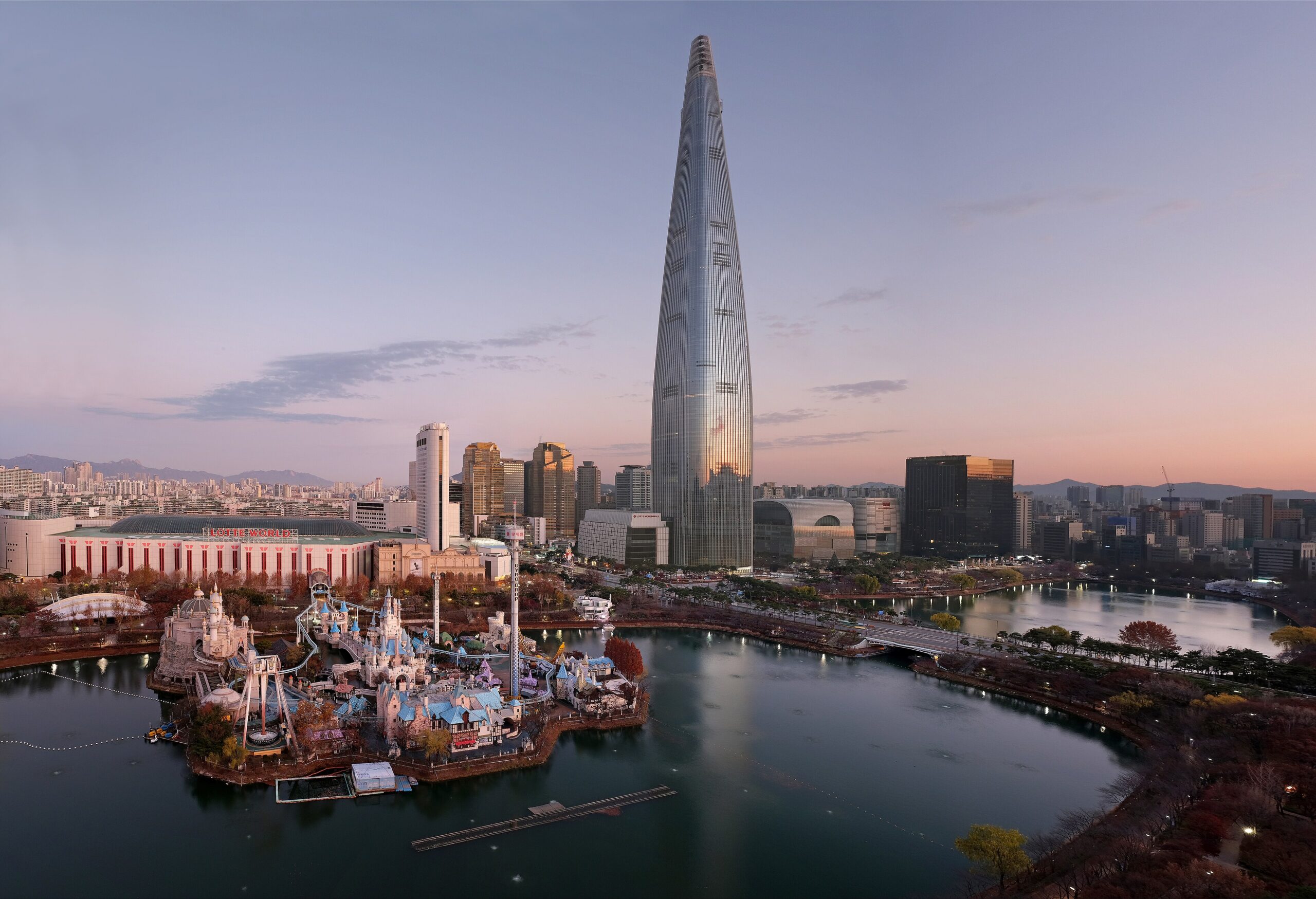
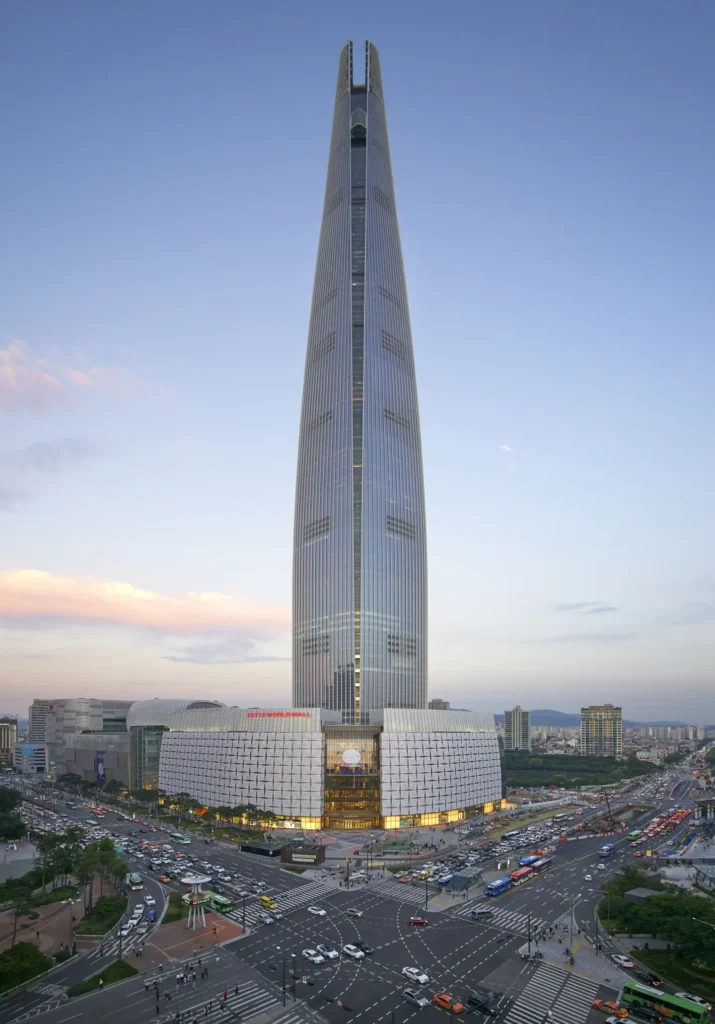
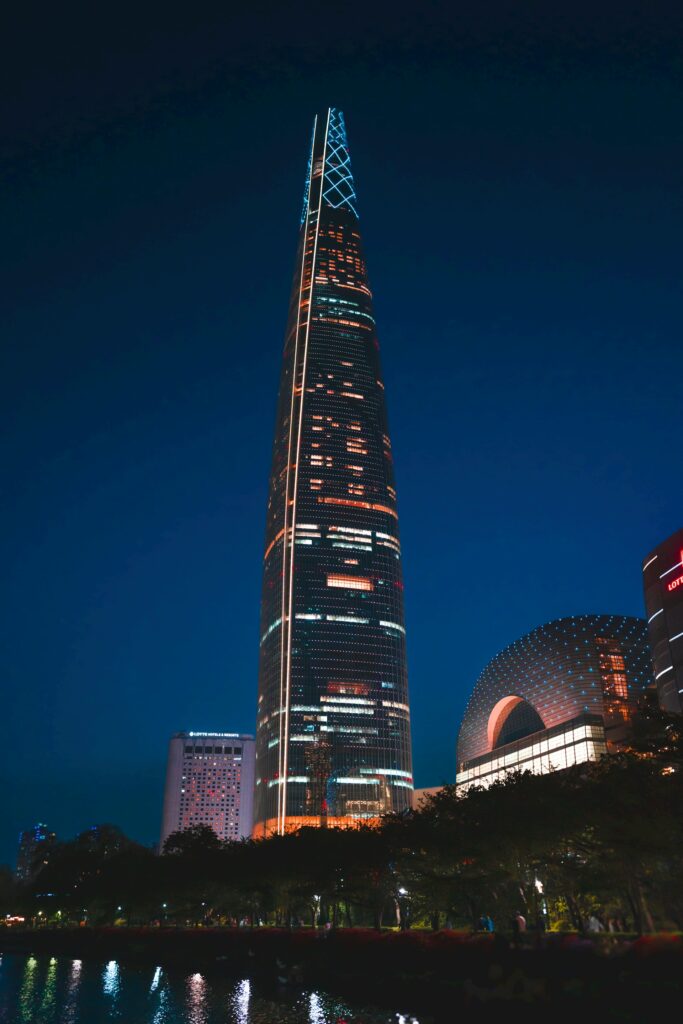
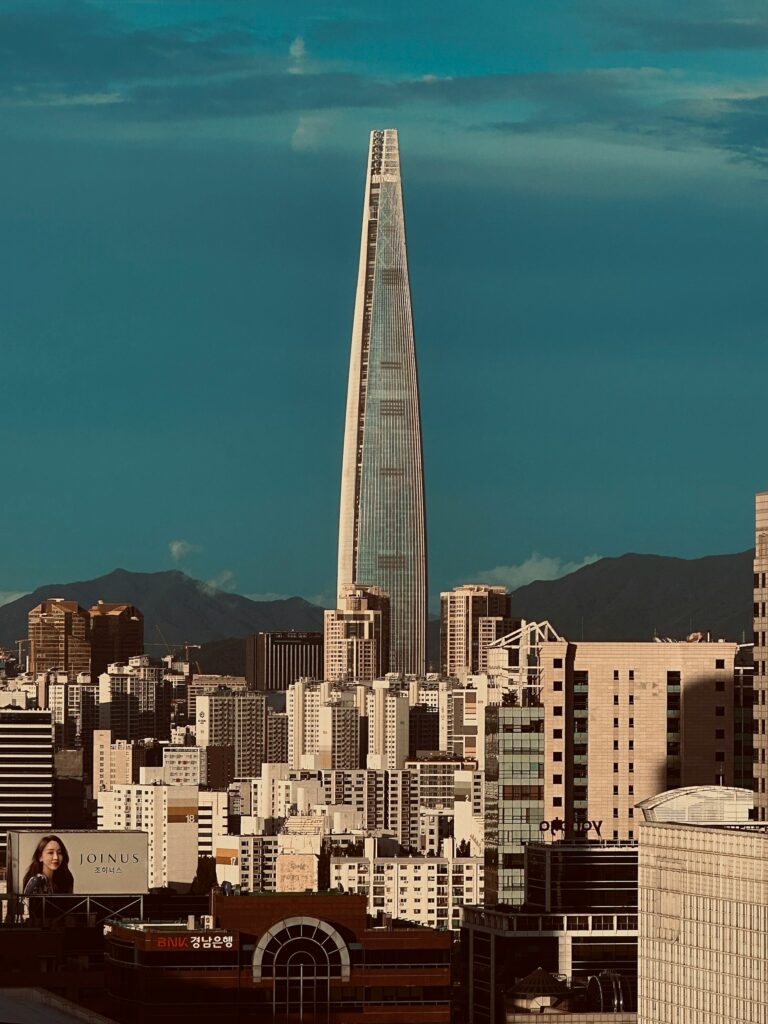
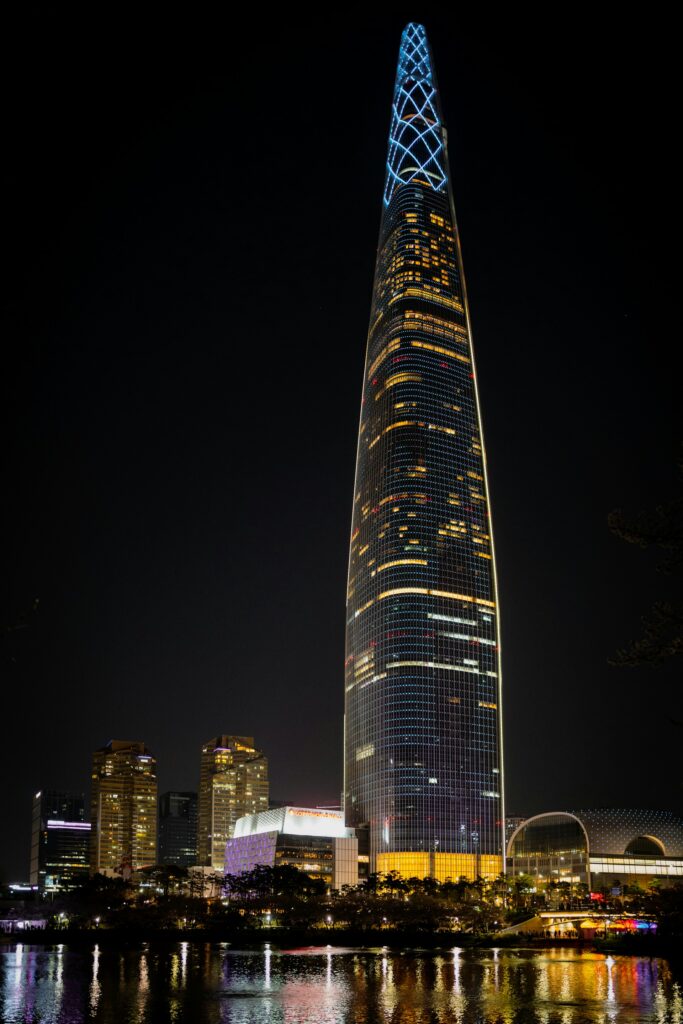
Lotte World Tower in Seoul is not only the tallest building in South Korea but also the country’s first true supertall, a 123-story mixed-use tower that rises above the Jamsil district at the edge of Seokchon Lake and the Han River corridor.
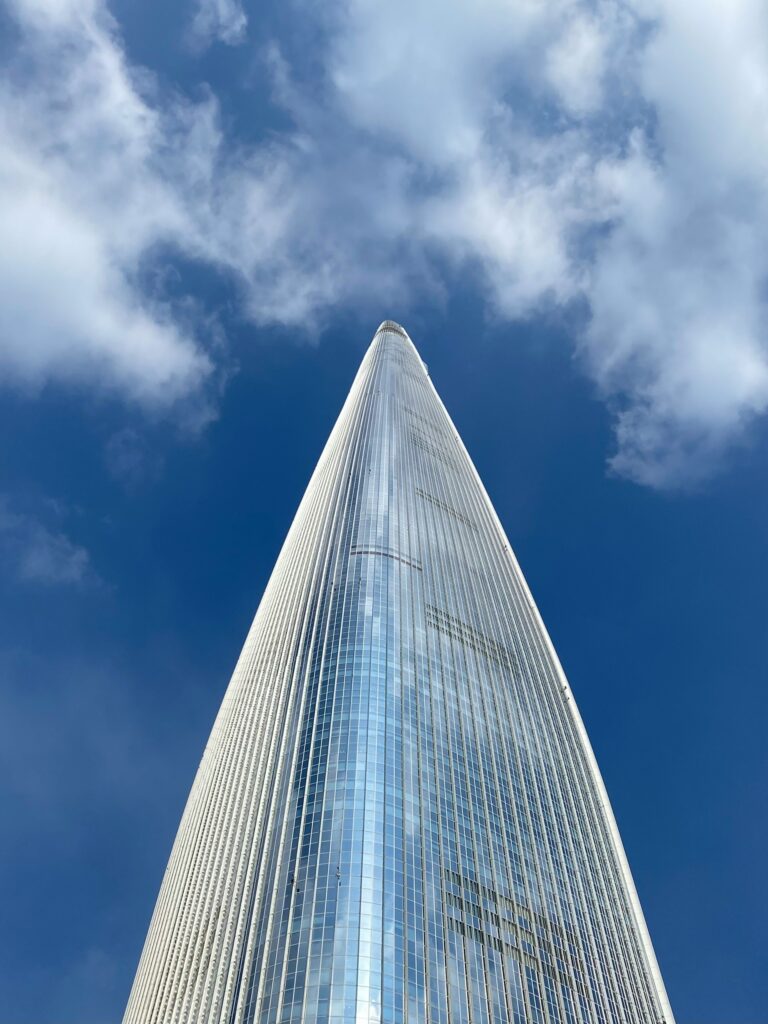
Designed by Kohn Pedersen Fox, the tower avoids the aggressive fragmentation common in many global supertalls. Its taper is continuous, its outline almost vessel-like, and its pale glazed skin draws on the formal memory of Korean ceramics, porcelain, and calligraphy rather than on overtly technological imagery.
What makes the project especially revealing is that it behaves less like a single office skyscraper than like a vertical urban section. Retail, offices, hotel functions, residences, observation spaces, and tourist infrastructure are stacked into one continuous system, forcing architecture, structure, transport, and operations to work at metropolitan intensity.
The tower’s engineering is equally deliberate. A concrete core, eight perimeter megacolumns, and a sequence of outriggers and belt trusses organize the load path of an exceptionally tall and slender form, while long-span perimeter framing and carefully shaped corners reconcile structural stiffness with the building’s soft curvature.
Its economic meaning is inseparable from its form. Backed by LOTTE as a landmark investment of national scale, the tower was conceived not merely as rentable area but as a tourism engine, brand device, and mixed-use anchor for a wider commercial district that includes the adjoining mall and entertainment program.
The long delay before construction also matters. For years, height restrictions linked to nearby military flight paths turned the project into a test of state approval, corporate ambition, and urban symbolism, which means the finished tower is best understood not only as a feat of design, but as a built record of Seoul’s political, commercial, and architectural transformation.
Lotte World Tower in Numbers
555.7 m
Height to tip, placing the tower among the tallest completed buildings anywhere in the world
554.5 m
The architectural height formally recognized by CTBUH in global tall-building rankings
497.6 m
The height of the highest occupied floor and of the observatory zone near the summit
123 floors
The number of above-ground stories in Korea’s first building to rise beyond 100 floors
6 levels
Major basement floors below grade, accommodating the deep infrastructural base required by the tower and the larger complex
304,081 m²
The tower gross floor area within the footprint of the skyscraper itself, excluding the adjoining podium and mall structures
58 elevators
The total number of elevator cars required to make a mixed-use tower of this height operational
10 m/s
The top elevator speed, essential to keeping travel times within a usable range in a tower of this scale
260 rooms
The number of hotel rooms counted within the tower’s mixed-use vertical program
₩4.2 trillion
The business expenditure LOTTE associates with the World Tower and Mall development as a whole
26,500 pyeong
The area LOTTE cites for the wider World Tower and Mall complex rather than for the tower alone
117–123
The range of floors occupied by Seoul Sky, the public observatory sequence at the top of the tower
541 m
The height of the Sky Bridge Tour, one of the most extreme public experiences built into any skyscraper
2017
The year the tower formally entered completion and public operation as Seoul’s first supertall landmark
2010
The year main construction began after the long approval process over height and flight-path constraints
1995
The year the first major plan for a supertall tower in Jamsil was advanced before years of delay and redesign
What is most revealing about Lotte World Tower is that its extraordinary height is not expressed through aggression but through control: a soft tapered figure, deeply disciplined structure, and tightly mixed vertical program turn a politically delayed skyscraper into a carefully engineered instrument of national branding, urban concentration, and cultural abstraction.
Engineering and Construction of Lotte World Tower
The engineering of Lotte World Tower begins with a challenge shared by many supertalls but resolved here with unusual discipline: how to make an extremely tall mixed-use building structurally efficient, aerodynamically stable, and spatially legible without sacrificing the smooth taper and cultural restraint that define its architectural identity.
Primary structural system
The tower’s principal gravity and lateral system is organized around eight perimeter concrete megacolumns, a reinforced concrete core, and a series of outriggers and belt trusses. This arrangement is typical of very tall buildings in broad outline, but in Lotte World Tower it is tuned to a form that narrows continuously and therefore demands a structural logic capable of adapting to changing floor plates without losing stiffness.
The result is a tower whose apparent simplicity masks a highly managed load path. The megacolumns carry enormous gravity loads at the perimeter, the core stabilizes the vertical section, and the outrigger system couples the two so the whole building behaves as one coordinated structural body rather than as an isolated core wrapped by rentable floor area.
Lateral resistance and load transfer
LERA’s published project information makes clear that the lateral and gravity systems are intertwined. Outriggers and belt trusses are placed at mechanical, refuge, sky lobby, and hotel amenity levels, which means the tower’s structural thickening is absorbed into programmatic breaks rather than exposed as an arbitrary engineering interruption.
That is important because the tower contains long perimeter spans as well as curved corners. LERA notes office and officetel floors with spans of up to 24.5 meters between megacolumns, while corner zones cantilever roughly 14 meters beyond them. In other words, structural efficiency had to be reconciled with both plan flexibility and a geometrically soft exterior.
Aerodynamics and taper
The tapered silhouette is not only an aesthetic gesture. In tall-building terms, a smooth reduction in section helps moderate wind effects while avoiding the abrupt setbacks and fragmented crowns that often produce a more visibly assembled tower. Lotte World Tower therefore uses form itself as part of its environmental and structural response.
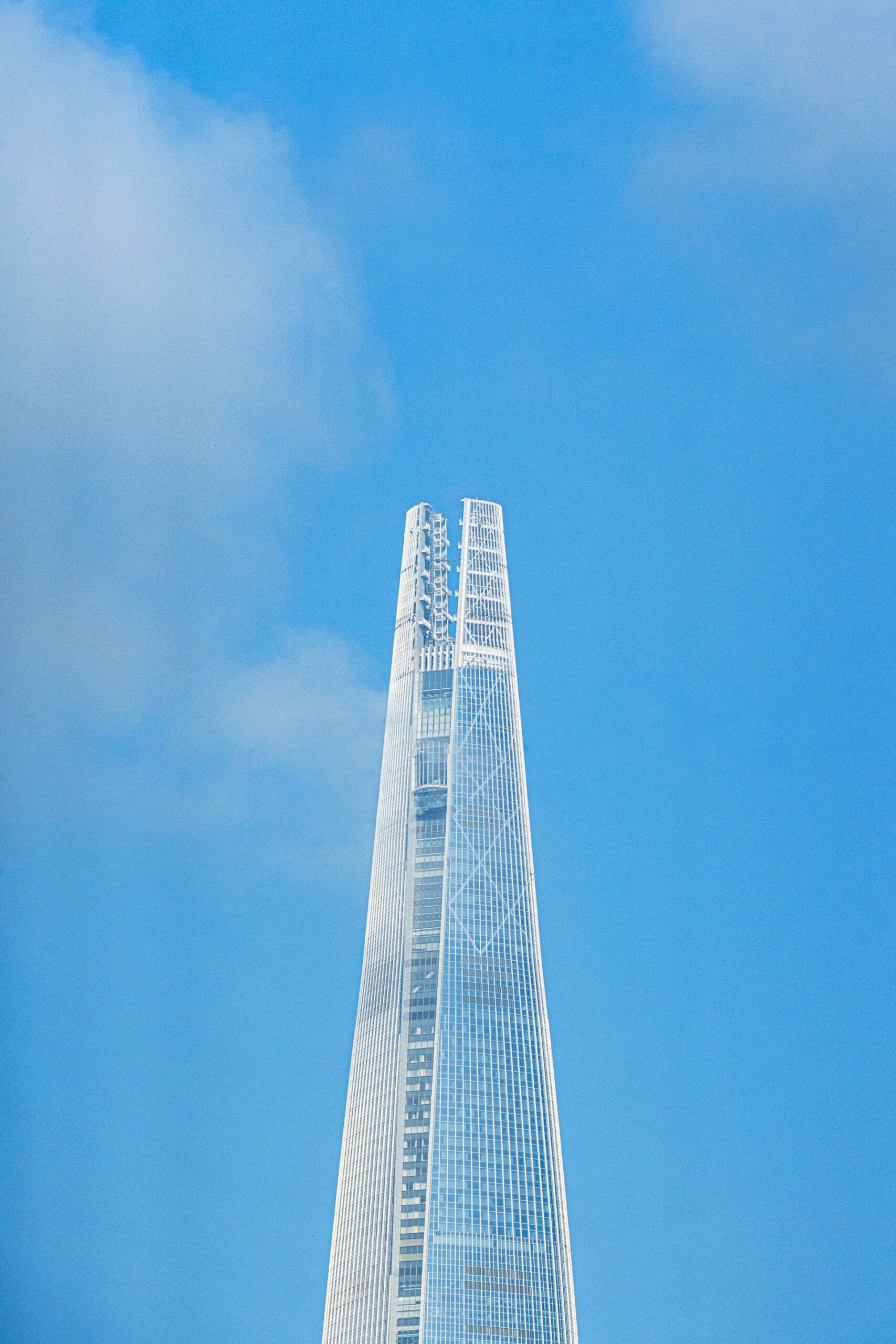
That decision also affects how the building meets the skyline. The tower does not terminate in a heavy cap or flamboyant crown; instead it narrows into a controlled lantern-like upper section. This gives the project an unusual combination of monumentality and calm, as if the skyscraper had been drawn as a single continuous stroke rather than pieced together from stacked episodes.
Foundation and concrete logistics
At this height, the tower is as much an exercise in substructure and materials management as in visible architecture. CTBUH classifies it as a concrete-steel composite building, which reflects the way high-strength concrete and steel work together in the main structural elements and transfer systems.
The use of a concrete core and concrete megacolumns is especially significant in the Seoul context, where stiffness, mass, and constructability had to be balanced against program density and long-term performance. The tower’s visible smoothness therefore rests on a heavy and deeply coordinated structural discipline rather than on lightweight visual effect.
Façade and cultural abstraction
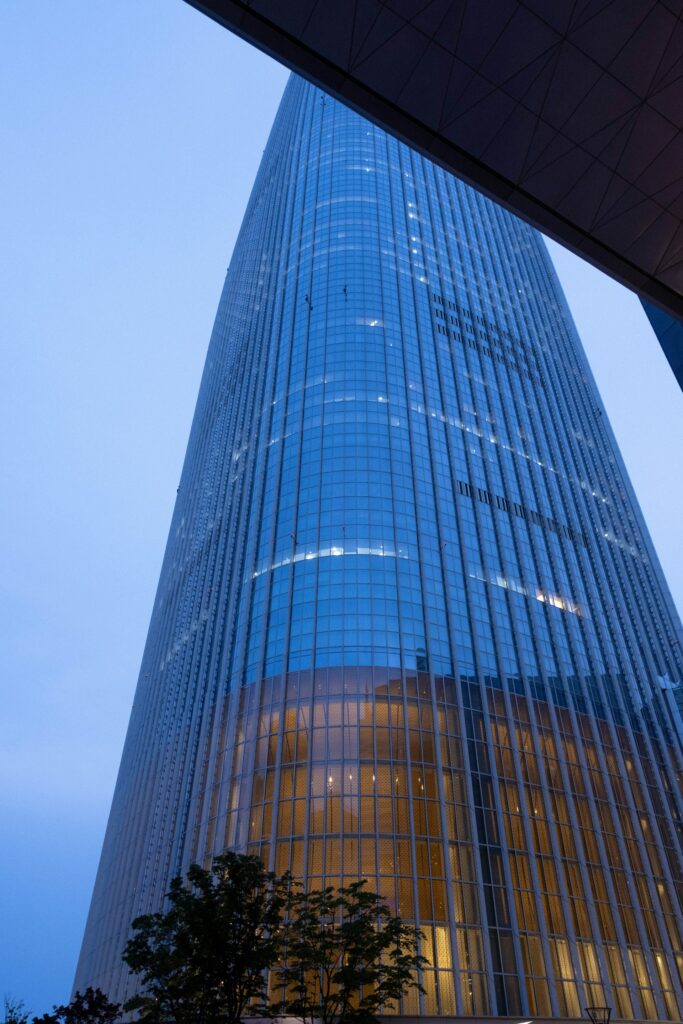
KPF’s own description emphasizes the importance of Korean ceramics, porcelain, and calligraphy to the design. That influence is not applied as ornament in the literal sense. It operates instead through curvature, tonal restraint, and the uninterrupted vertical sweep of the envelope, giving the façade a cultural reference that remains abstract and architecturally controlled.
The façade therefore performs two tasks at once. Technically, it encloses a complex mixed-use tower whose geometry changes as it rises; formally, it suppresses that complexity into a single legible figure. Few supertalls are so intent on making high-rise construction appear continuous rather than segmented.
Vertical transport and mixed-use section
The building’s 58 elevators and high-speed lift system are part of the engineering argument, not merely a service layer. In a tower that mixes offices, hotel functions, residences, and a public observatory, circulation must separate users while preserving overall efficiency. The skyscraper works because vertical transport is treated as a fundamental design problem rather than as a late-stage technical insertion.
That logic is reinforced by the stacking of special transfer and lobby levels within the section. Structural zones, mechanical layers, refuge floors, and circulation nodes are carefully coordinated, allowing the tower to function as a vertical district rather than as a single-tenant office slab stretched upward.
In this respect, Lotte World Tower is less about pure height than about managed complexity. Its achievement lies in converting many incompatible demands—mixed program, cultural symbolism, structural stiffness, aerodynamic behavior, long spans, public access, and skyline presence—into one coherent envelope.
That coherence is why the building still feels singular despite the density of systems inside it. The skyscraper does not advertise its mechanics, yet nearly every aspect of its form is inseparable from them.
Architecturally, the tower’s restraint is its most difficult accomplishment. The higher it rises, the less it relies on visual noise, which is precisely what makes the engineering underlying it so consequential.
Seen that way, Lotte World Tower is not simply a record-setting object. It is a carefully compressed agreement between structure, infrastructure, culture, and urban image, expressed through an unusually disciplined supertall form.
Ecomonics of Lotte World Tower
The economics of Lotte World Tower are inseparable from the scale and structure of LOTTE itself. This was never a speculative tower in the narrow sense. It was conceived as a flagship asset backed by a major Korean conglomerate, capable of operating simultaneously as real estate, tourism infrastructure, corporate branding, and district-level value creation.
The nearly ₩4.2 trillion expenditure associated by LOTTE with the World Tower and Mall project indicates the ambition of that model. The investment did not target a single revenue stream. Instead, it distributed risk and return across retail, offices, hospitality, premium residential uses, observation-ticket income, food and beverage, and the wider attraction economy generated by the site.
This diversification matters because very tall buildings are expensive not only to build but also to operate and sustain. Lotte World Tower reduces that vulnerability by functioning as part of a much larger commercial ecosystem. The adjoining mall, entertainment program, direct transit connectivity, and tourist destination logic all help transform the tower from a costly skyline object into a continually monetized urban platform.
The project also creates value through scarcity and status. Height alone does not guarantee economic success, but in this case height was converted into premium positioning: the tallest building in Korea, a high-altitude luxury hotel, elite branded residences, and a public observatory packaged as a national-scale experience. The tower therefore monetizes vertical distinction at multiple market levels at once.
At the same time, the tower’s long approval history shows that economics here was always political. The eventual realization of the project depended on state consent, airspace negotiation, and the symbolic legitimacy of allowing a private conglomerate to insert a supertall landmark into Seoul’s skyline. Its financial logic is thus best understood as a fusion of property development, tourism strategy, and institutional power rather than as a conventional office-led skyscraper pro forma.
Trivia
The Project Waited for the Sky
The tower was delayed for years because of military flight-path concerns linked to nearby Seoul Airport. That means its height was never only an architectural question. It was also a test of how far a private landmark could reshape state-controlled airspace.
Cherry Blossoms Changed the Setting
Because the tower rises beside Seokchon Lake, it became tied almost immediately to Seoul’s spring cherry blossom culture. Photographs of the building are often inseparable from the seasonal landscape below it. Few supertalls are so strongly identified with a civic festival scene at their base.
The Shape Comes from Porcelain
KPF did not present the tower as a pure exercise in globalized high-rise engineering. The design language was tied explicitly to Korean ceramics, porcelain, and calligraphic flow. That is why the building reads less like a jagged megastructure and more like an elongated vessel.
A Seam Points Toward the Old City
Early KPF descriptions noted a vertical seam running through the tower’s form. It was not just a compositional line. It was intended as a gesture toward Seoul’s historic center, giving a very new skyscraper a directional relationship to the older city.
The Sky Bridge Is Higher Than Many Towers
At 541 meters, the Sky Bridge Tour sits above the full height of many famous skyscrapers. That makes it more than a viewing platform. It is a carefully packaged adrenaline product inserted into the economics of the building itself.
It Was Korea’s First 100-Story Building
That threshold carried symbolic force in South Korea well beyond the technical achievement. The tower was read as proof that Seoul had entered a different tall-building era. In that sense, the number of floors was always part of the project’s public meaning.
The Hotel Lives in the Upper Air
Signiel occupies upper levels of the tower rather than a low-rise annex. That changes the economics and experience of the building at once. Hospitality becomes part of the skyscraper’s premium altitude rather than something merely attached to it.
The Mall Opened Before the Tower
LOTTE World Mall opened in 2014, several years before the tower’s full opening in 2017. That sequencing mattered because the wider commercial ecosystem began operating before the skyscraper was finished. The tower therefore emerged into a district already being rehearsed as a destination.
The Observatory Is a Full Sequence
Seoul Sky is not just one deck at one level. It unfolds across floors 117 to 123 with viewing, terrace, lounge, and visitor functions stacked vertically. Even public tourism at the top of the tower is organized like a miniature building inside the building.
The Tower Was Always a Brand Device
Its scale made it a real estate project, but its visibility made it something larger for LOTTE. The tower condensed retail, tourism, luxury hospitality, and corporate image into one object. That is why its commercial logic was always broader than leasing alone.
The Site Had Been Reserved for Decades
The land in Jamsil had long been held for a major Lotte landmark project before the tower was finally realized. That long reservation made the building feel inevitable and controversial at the same time. By the time it opened, it embodied decades of accumulated expectation.
Its Public Role Starts at the Top
Many supertalls reserve their best altitude for private tenants only. Lotte World Tower does the opposite by making its uppermost levels a public destination. That choice helps explain why the building operates as a national attraction as much as a piece of premium real estate.
Sources and References
This article draws on CTBUH building data, official LOTTE materials, KPF and LERA project documentation, Seoul Sky information, and widely cited public reporting concerning the tower’s approval history, construction, mixed-use program, and development logic.
Referenced source groups include:
- CTBUH Skyscraper Center building data
- KPF Architects project materials
- LERA structural engineering information
- LOTTE and LOTTE Property & Development official information
- Seoul Sky and official facility information
- public reporting on approval history, construction, and investment scale
The article references data related to:
- height to tip, architectural height, and occupied height
- above-ground and below-ground floor counts
- tower gross floor area and elevator data
- hotel rooms and mixed-use stacking
- Seoul Sky floors and Sky Bridge Tour height
- construction timeline and opening chronology
- investment scale and development area
- the tower’s structural system, cultural references, and approval history
Some figures in very large mixed-use supertall developments differ slightly between public sources, especially where values are rounded, where podium and tower areas are distinguished differently, or where opening and completion dates are described by separate milestones. For that reason, selected numbers in this article are described as approximate where appropriate.