
A Stadium Built as Landscape, Screen, and Stage
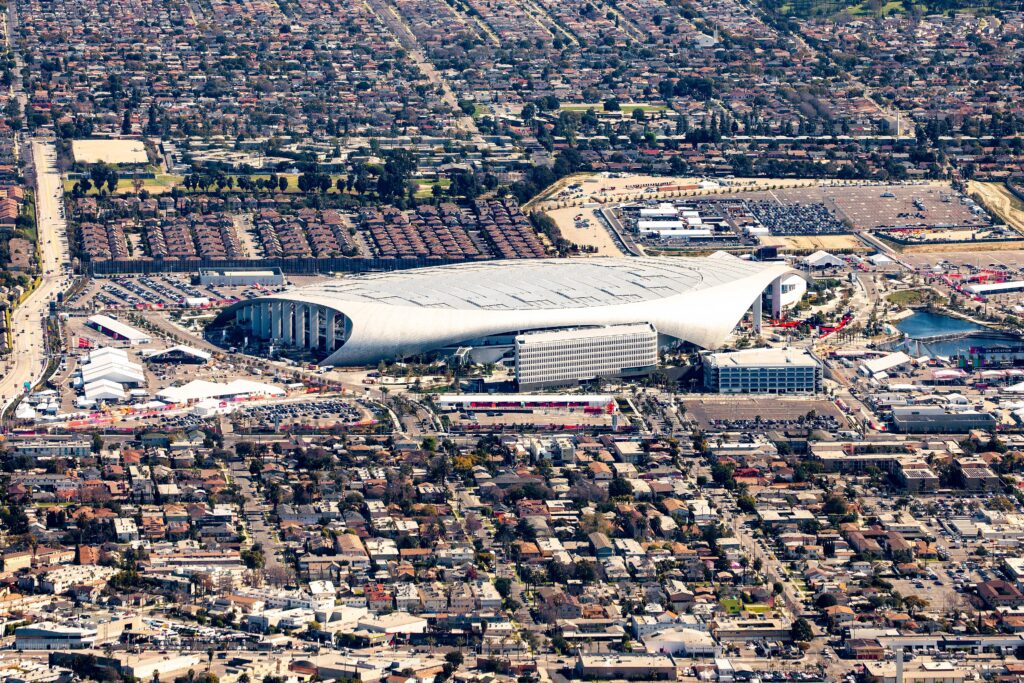
SoFi Stadium in Inglewood is not simply a venue for American football. It is a vast engineered environment where architecture, media technology, and urban redevelopment are fused into one continuous project. Few contemporary stadiums feel so deliberately designed to operate at the scale of an entire district rather than as a single object.
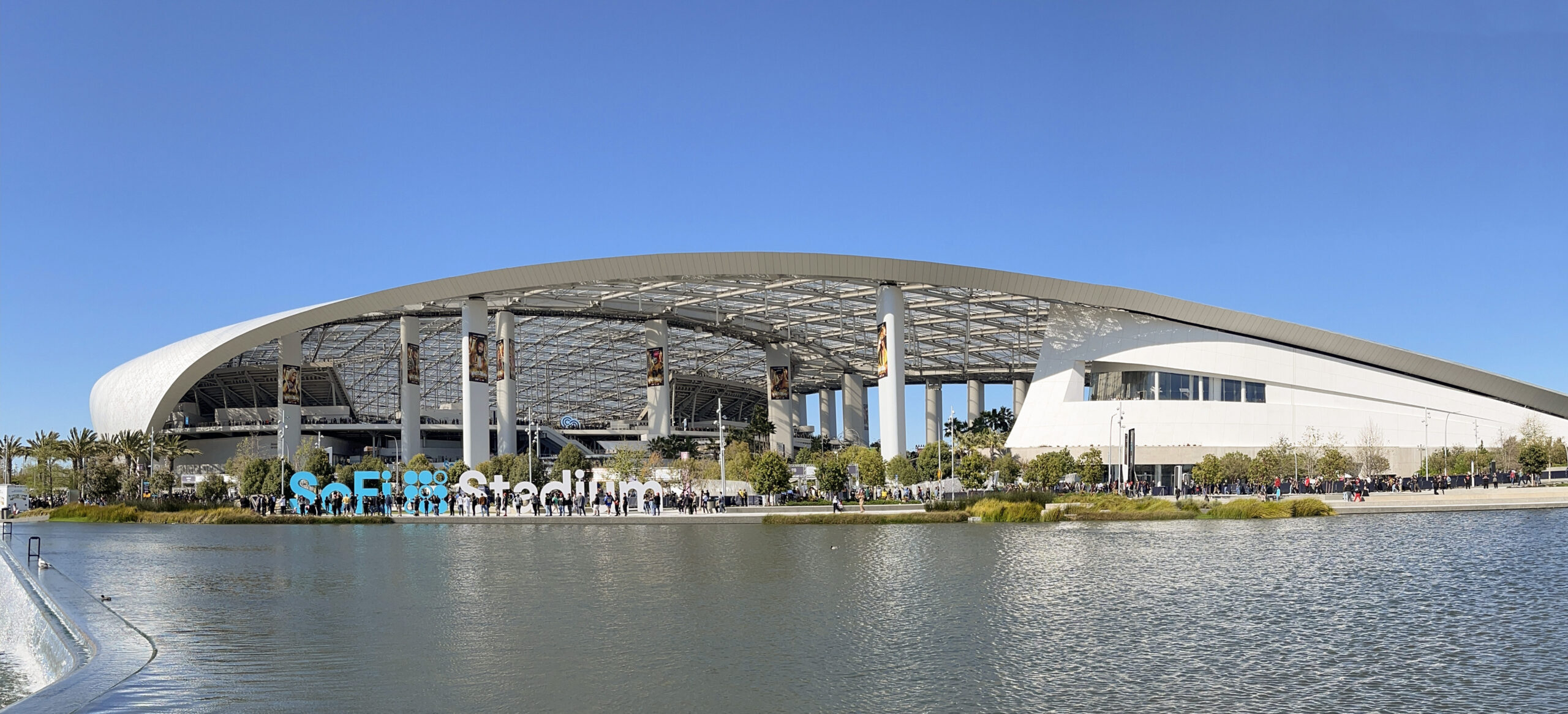
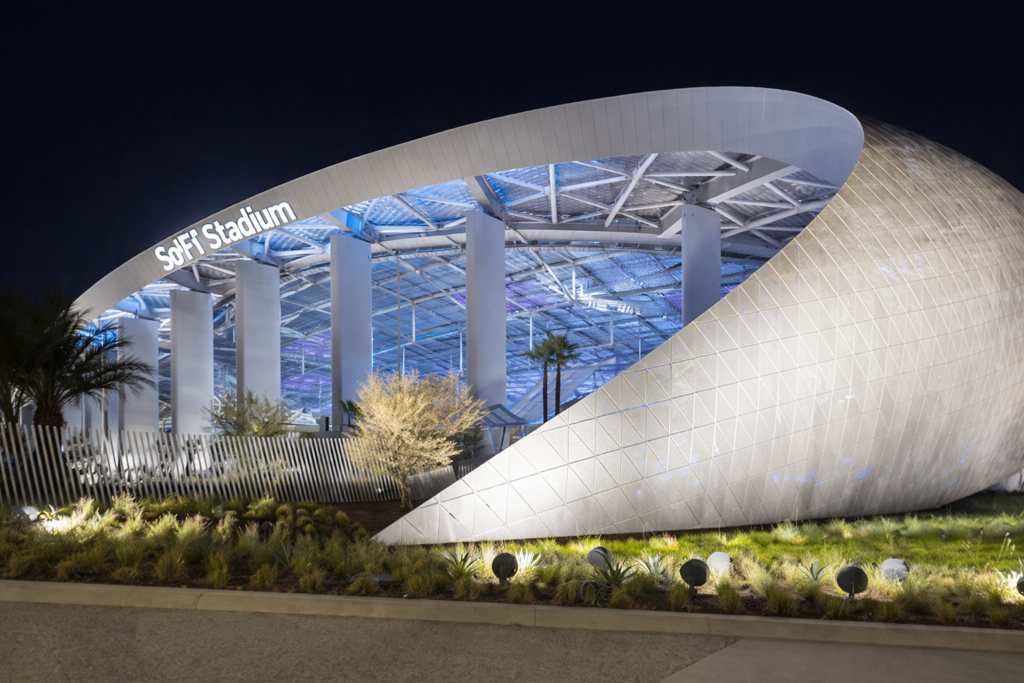
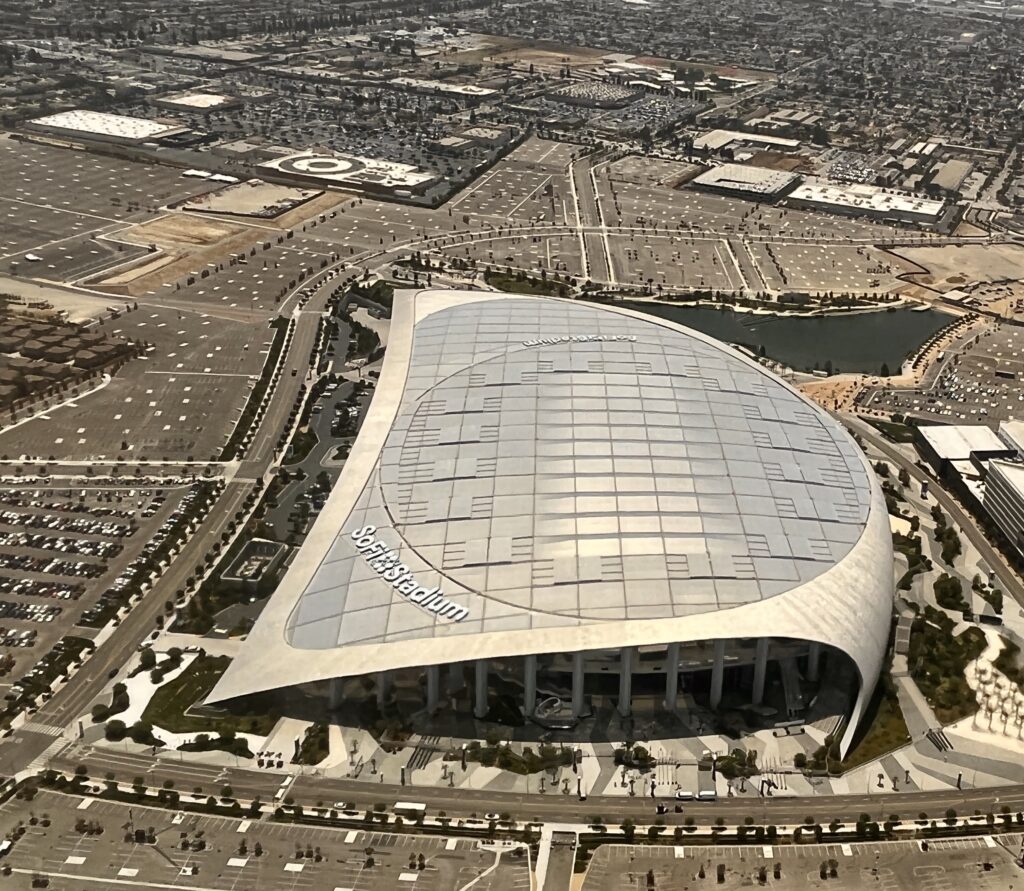
Its form is immediately distinctive: a giant, softly curving roof canopy floating over a stadium bowl that sinks deep into the ground. That move was not merely aesthetic. It allowed the project to respect strict height limits created by the nearby flight paths of Los Angeles International Airport while still achieving the volume required for one of the most ambitious sports buildings ever completed.
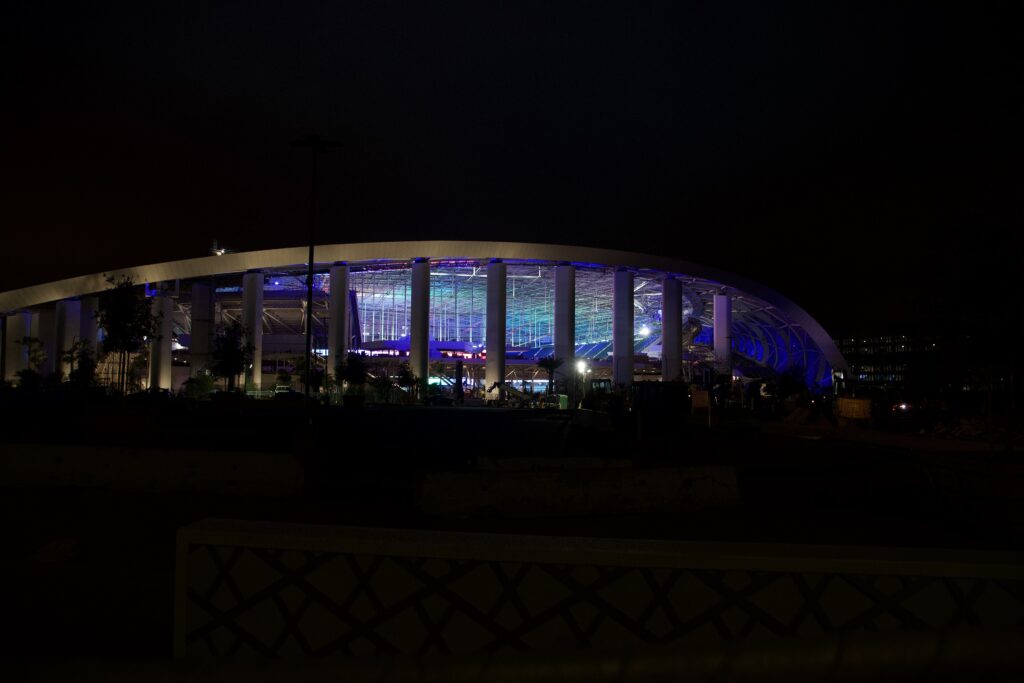
Designed by HKS, SoFi Stadium rejects the old opposition between dome and open-air arena. It is roofed, but not enclosed in the conventional sense. The building admits breezes, daylight, and the visual atmosphere of Southern California, producing an indoor-outdoor condition that feels uniquely tuned to climate rather than imported from colder stadium typologies.
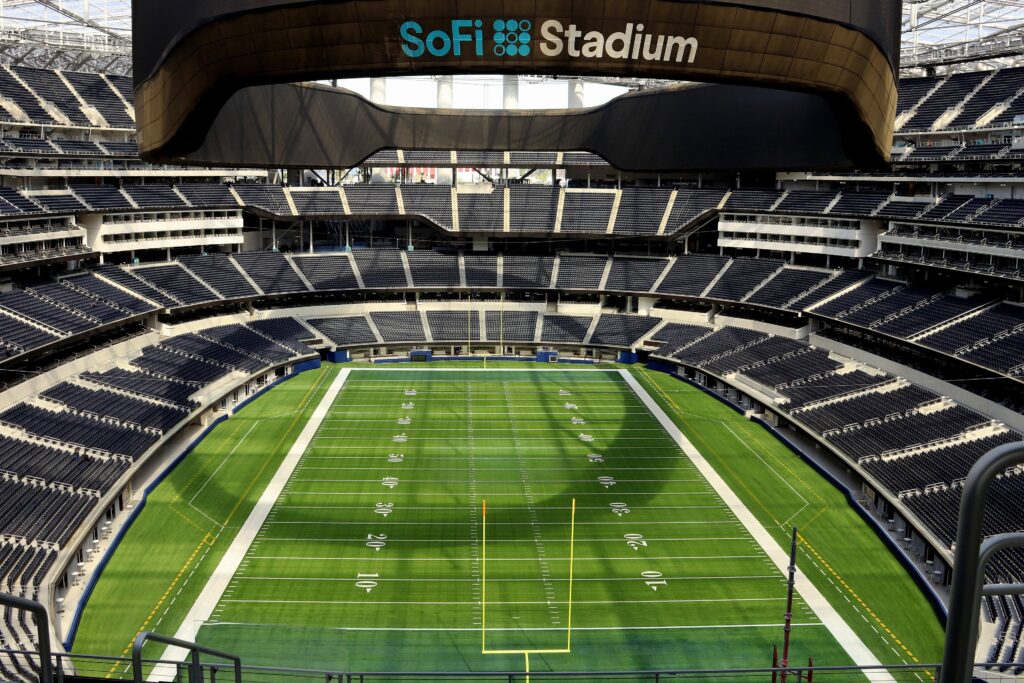
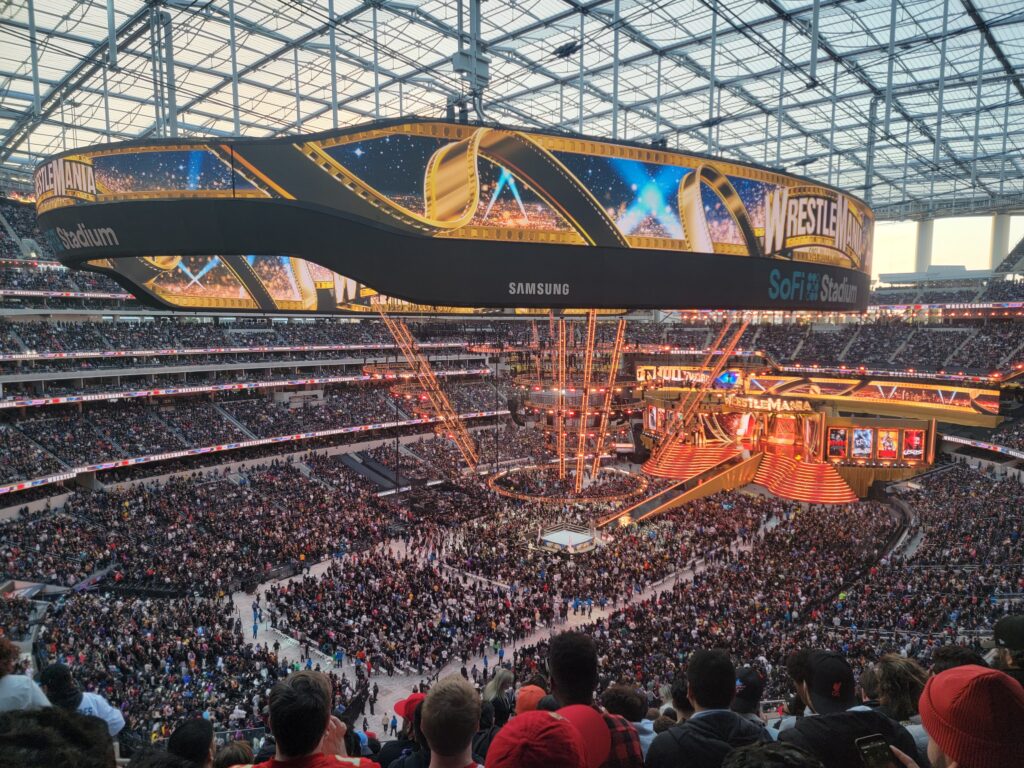
Inside, the most dramatic object is not the seating bowl but the suspended oval video board, the colossal dual-sided oculus that turns the stadium into an immersive media chamber. It does more than display content. It reorganizes how spectators orient themselves, how events are staged, and how the architecture is experienced from almost every seat.
Scale is central to the project’s identity. The stadium sits within the broader Hollywood Park redevelopment and functions as both landmark and economic engine. NFL games, global concerts, championship events, premium hospitality, sponsorship programs, and year-round entertainment all feed into a business model in which the building behaves less like a seasonal arena and more like an infrastructure platform.
What makes SoFi Stadium compelling is not only its size or cost, but the precision with which those dimensions are organized. Earthworks, structural steel, ETFE roofing, acoustics, digital systems, circulation, and finance all operate together. The result is a building that feels at once monumental and highly optimized—an engineered spectacle calibrated for twenty-first-century Los Angeles.
SoFi Stadium in Numbers
298 acres
The wider Hollywood Park site into which SoFi Stadium was integrated as the district’s centerpiece
70,240
The standard NFL seating capacity before the building expands for championship games and concerts
100,000
Approximate maximum crowd size when the seating bowl is expanded for the biggest international events
3.1 million ft²
Approximate built area of the stadium itself, making it one of the largest sports venues ever realized
1 million ft²
The approximate area of the translucent canopy that shelters the stadium bowl, plaza, and adjacent venue spaces
100 ft
Roughly how far the deepest parts of the seating bowl descend below grade to satisfy the airport height restrictions
260 suites
One of the deepest premium inventories in global stadium design, central to the venue’s revenue logic
13,000 premium seats
Clubs, suites, and hospitality positions that transform the building into a high-value entertainment asset
2.2 acres
The size of the suspended double-sided video board, one of the most ambitious media devices ever installed in a stadium
80 million
Approximate pixel count of the oculus board, turning the interior into a digital landscape as much as a sports venue
2020
The opening year of the stadium after one of the most complex and expensive construction campaigns in sports architecture
2 NFL teams
The Rams and Chargers share the building, making SoFi Stadium a rare dual-tenant home at the highest level of sport
6,000
Approximate capacity of the adjacent YouTube Theater, part of the same entertainment ecosystem beneath the canopy
2022
The year SoFi Stadium hosted Super Bowl LVI, confirming its status almost immediately as a championship venue
2028
The Los Angeles Olympic year in which the complex is expected to play a central role in the global presentation of the city
$5+ billion
The approximate cost that made SoFi Stadium one of the most expensive sports buildings ever developed
What is most intriguing about SoFi Stadium is that its greatest architectural move is not vertical but subterranean: by sinking the immense bowl deep below grade and stretching a vast ETFE canopy above it, the project transforms a severe regulatory constraint into a defining spatial idea, creating a building that feels simultaneously buried, floating, open to the climate, and fully optimized for spectacle, media, and economics.
Engineering and Construction of SoFi Stadium
The engineering of SoFi Stadium begins with a paradox: a venue of extraordinary size had to remain low enough to sit beneath the heavily trafficked flight paths serving Los Angeles International Airport. Rather than treating that restriction as a limitation, the project turned it into its governing design principle.
Below-grade engineering
Large portions of the seating bowl were excavated roughly 100 feet below grade, allowing the stadium to achieve monumental capacity while keeping its visible mass lower than that of a conventional above-ground venue of similar scale.
That move transformed the project into a major earthworks and substructure operation before the architecture above grade could fully emerge. In technical terms, SoFi Stadium begins as much with the ground as with the roof.
Geotechnics / waterproofing / seismic logic
Excavation at this depth required careful geotechnical coordination, retaining strategies, waterproofing logic, phased structural sequencing, and the organization of circulation within a deeply integrated below-grade system.
In a region where seismic performance is never secondary, the reinforced concrete retaining structures and substructure had to create a stable and resilient base from which the upper steel systems could rise.
Architectural meaning of the technical move
What makes this especially compelling is that the stadium’s defining architectural gesture is not vertical but subterranean. The bowl does not simply sit on the land; it is embedded into it.
That decision is central to the building’s identity, because it converts a regulatory constraint into a spatial advantage. Instead of producing a diminished object, the excavation allows the project to feel simultaneously massive, controlled, and unusually integrated with the site.
Roof system / canopy
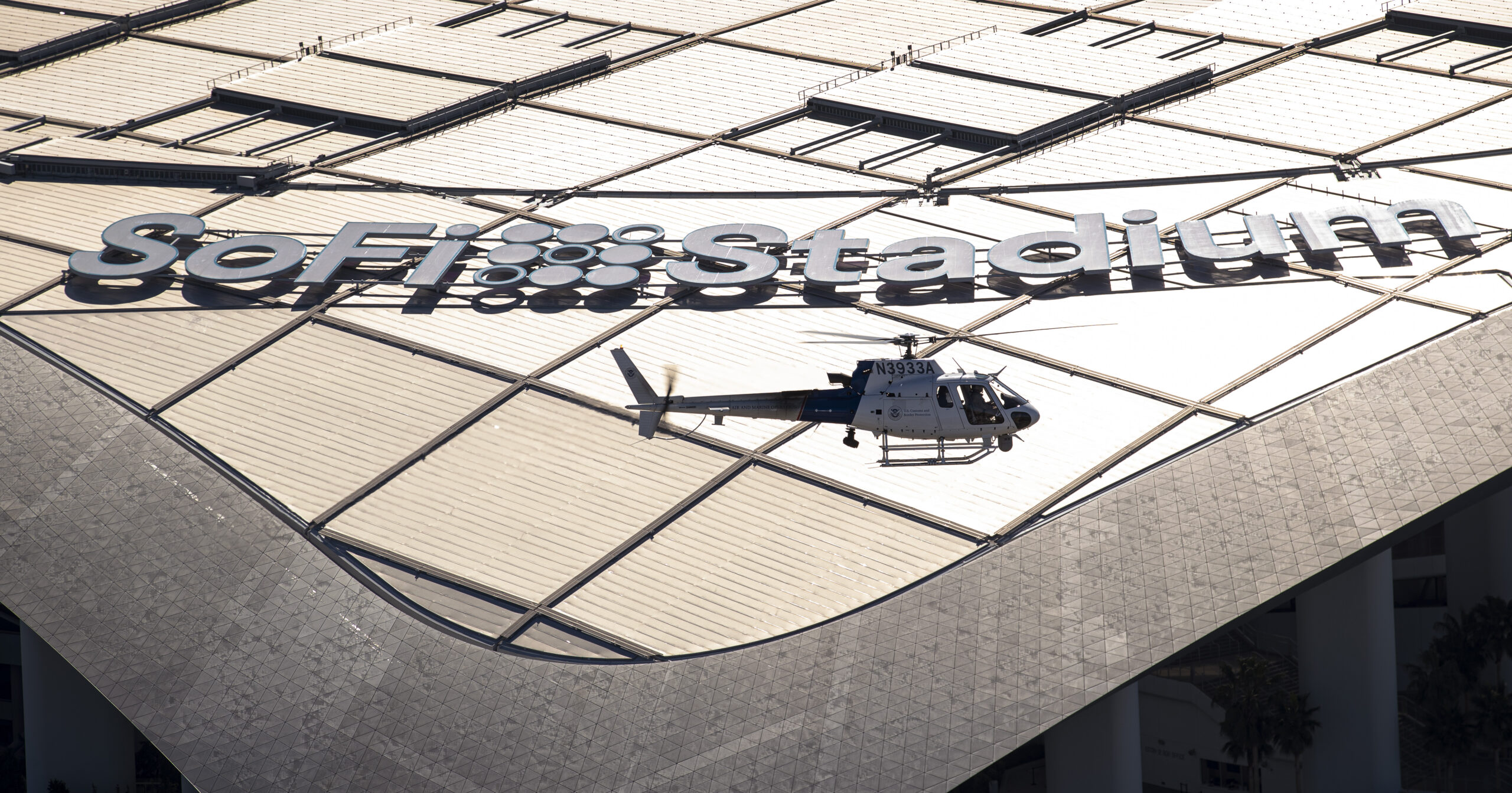
Above that base, the stadium’s signature canopy operates not merely as a roof but as a long-span structural and environmental system. Its role is both technical and atmospheric: it shelters the bowl and adjacent public areas, filters daylight, moderates exposure, and gives the complex its distinctive floating profile.
The canopy is therefore better understood as an engineered field of structure, enclosure, and climate control rather than as a conventional overhead cover.
ETFE logic
Its ETFE skin is especially important to that logic. Because ETFE is significantly lighter than many traditional enclosure materials, it allows the roof system to maintain a lighter visual and structural presence while still delivering protection, translucency, and environmental performance.
This helps create the calibrated indoor-outdoor condition that defines SoFi Stadium. The building is roofed but not fully sealed, enclosed yet open at its perimeter, monumental yet still responsive to the light, air, and atmosphere of Southern California.
Oculus as technical object
One of the most demanding technical components within this system is the suspended oval video board, often described as the oculus. It is not simply an added screen, but one of the project’s primary engineered objects.
Because it hangs from the roof structure rather than rising from the field or seating bowl, its size, weight, maintenance access requirements, and visual centrality had to be resolved as part of the building’s fundamental structural logic.
Oculus as spatial device
Its importance is not only technical but spatial. The board reorganizes the interior by acting as a luminous architectural ring around which the spectator experience is oriented.
Sightlines, suspension strategy, servicing, and coordination with the roof all had to be treated as part of one integrated system. In that sense, the media infrastructure at SoFi is not applied to the building after the fact; it is embedded within the architecture from the beginning.
This level of integration is what ultimately defines the project. Contemporary stadium engineering is no longer only about spanning a seating bowl and covering spectators. At SoFi Stadium, the building had to reconcile excavation, seismic resilience, long-span steel structure, environmental enclosure, digital media systems, acoustics, crowd movement, and event logistics within one continuous framework.
It is engineered less as a single object than as a layered system of ground, structure, enclosure, media, and performance. The result is a stadium that behaves less like a traditional arena and more like a precisely coordinated platform for sport, entertainment, and media production.
Ecomonics of SoFi Stadium
Because SoFi Stadium is a young project, its second story is less about layered history and more about financial ambition, development strategy, and ownership scale. Backed by Stan Kroenke and tied to the larger Hollywood Park redevelopment, the stadium was conceived not as an isolated venue but as the economic heart of a mixed-use district. That framing helps explain its unprecedented cost: the project was designed to generate value across sport, entertainment, real estate, and branding all at once.
The final price, commonly described as more than $5 billion, places SoFi Stadium in a category almost of its own within sports construction. Such a figure reflects not only the complexity of the building but also the premium ambition of the development model behind it. The stadium had to function as a long-term asset capable of hosting NFL games, championship events, concerts, corporate hospitality, and global media moments at a level few competitors can match.
Revenue generation is therefore embedded directly into the architecture. Premium seating, suites, club zones, naming rights, sponsorship platforms, adjacent entertainment venues, and year-round programming all support a financial structure far more diversified than the old ticket-driven stadium economy. Even the digital infrastructure—from the oculus board to broadcast-ready production capacity—contributes to monetization by enhancing premium experiences and global event value.
The dual-tenant arrangement with the Rams and Chargers further strengthens the business logic. Two NFL franchises sharing the same venue increases the number of major home dates while also amplifying media visibility, sponsorship relevance, and hospitality utilization. When that calendar is supplemented by concerts, college football, international events, and special-event bookings, the stadium becomes an almost continuously active revenue machine rather than a building that sits dormant between sports seasons.
In that sense, SoFi Stadium is not only an architectural object but a financial instrument shaped in steel, concrete, ETFE, and pixels. Its long-term importance lies in how clearly it expresses the contemporary economics of landmark sports development: enormous upfront capital, integrated district planning, diversified premium income, and global-event positioning. It shows that in the twenty-first century, the success of major stadium architecture depends as much on development strategy as on structural ingenuity.
Trivia
Below the Flight Path
One of the stadium’s defining shapes comes from aviation, not football. Because of the airport approach paths nearby, the project could not simply rise upward like a conventional mega-stadium. The solution was to dig deeply into the ground and turn a limitation into the building’s most memorable spatial idea.
The Open-Air Illusion
Visitors often describe SoFi as both indoor and outdoor at once. The vast canopy shelters the crowd, but the building remains open enough to preserve breeze, light, and the feeling of Los Angeles weather. That ambiguity is not accidental; it is one of the project’s most sophisticated climatic achievements.
The Oculus as Architecture
The giant oval board is so large that it changes how people understand the room. Spectators do not merely look at a screen; they inhabit an interior organized around a luminous suspended ring. In SoFi Stadium, media is no longer added to architecture—it becomes one of the main architectural events.
Built on a Racetrack Site
Before Hollywood Park became a stadium district, the site was known for horse racing. That history makes the scale of transformation even more striking. A landscape once associated with speed and spectacle was reimagined as a new kind of urban entertainment machine.
Two Teams, One Identity
Very few major stadiums are asked to serve two NFL franchises equally. At SoFi, branding, operations, and atmosphere had to be adaptable enough for both the Rams and the Chargers. That duality makes the building less a fixed home and more a high-performance platform that can shift its identity from event to event.
A Stadium Meant for Cameras
SoFi was designed in an era when architecture must perform flawlessly on television, social media, and broadcast graphics. The roof’s curves, the field bowl, and the suspended board all create images that read instantly from a distance. In that sense, the stadium was built not only for people in seats but also for audiences watching through screens worldwide.
The Shared Canopy
The roof does not cover only the main stadium. It extends over plazas and neighboring entertainment uses, making the canopy a district-scale device rather than a simple sports roof. That gesture helps explain why the complex feels less like a single building and more like a miniature urban environment.
The Host of Global Spectacle
SoFi reached the top tier of event hosting almost immediately after opening. Super Bowl LVI arrived in only its second season, and the venue has remained central to major football and entertainment calendars ever since. Few stadiums establish that level of event prestige so quickly.
Concert Acoustics Were a Design Problem
Stadiums often look impressive but sound difficult. SoFi had to satisfy not only NFL requirements but also the expectations of blockbuster touring productions. That need shaped technical decisions in sound reinforcement, enclosure strategy, and event flexibility from the beginning.
The Board Never Touches the Field
The famous oculus seems to hover impossibly over the action. That impression matters because the board had to remain visually dominant without interrupting sightlines or field operations. Its suspension makes it feel less like equipment and more like a floating architectural ring.
The Weather Strategy Is Local
SoFi would make less sense in a cold continental climate. Its openness works because Los Angeles allows a softer environmental boundary between inside and outside. The building is therefore not only iconic but also deeply regional in how it responds to light, air, and sun.
The Theater Next Door Matters
YouTube Theater is more than an accessory venue. It helps extend the commercial life of the district beyond NFL scheduling and makes the canopy-covered complex active on many more nights of the year. That is a small detail with large economic consequences.
Sources and References
This article draws on official project materials, architectural documentation, development information, and widely cited public data concerning SoFi Stadium, Hollywood Park, and related major-event planning.
Referenced source groups include:
- SoFi Stadium official information
- HKS Architects project materials
- Hollywood Park official development information
- NFL and Super Bowl records
- LA28 Olympic planning information
- industry and public reporting on stadium engineering, construction, and cost
The article references data related to:
- seating capacity and event expansion
- premium seats and suites
- construction cost and project scale
- below-grade excavation strategy
- ETFE canopy and environmental design
- the suspended double-sided oculus board
- Super Bowl and Olympic-event relevance
- the stadium’s economic role within the wider district
Some figures in large contemporary sports developments differ slightly between public sources, especially where values are rounded, updated over time, or presented for different event modes. For that reason, selected numbers in this article are described as approximate where appropriate.