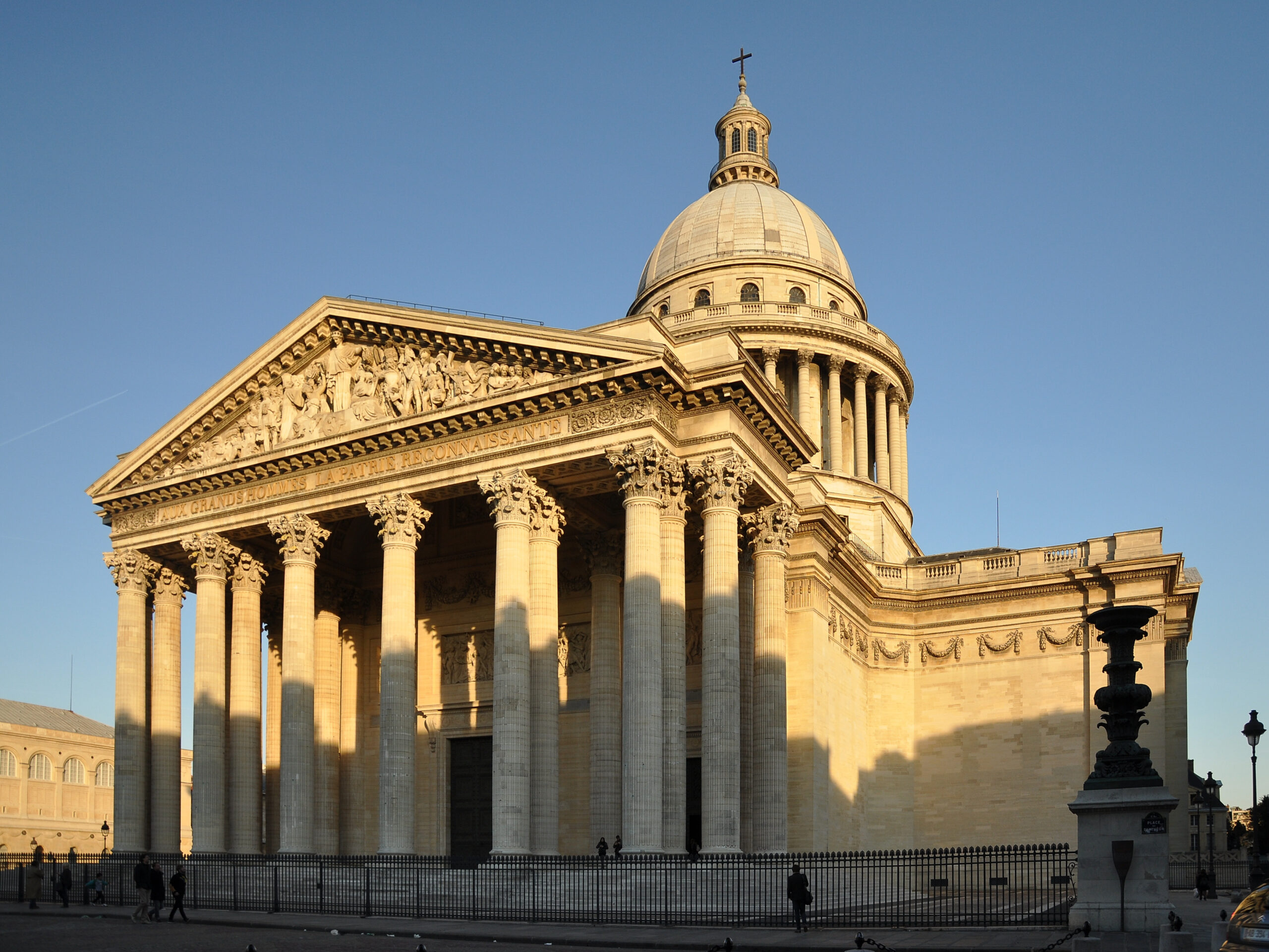

The Panthéon in Paris – History, Architecture, and Cultural Significance of France’s Iconic Monument
Rising prominently above the Parisian skyline, the Panthéon is far more than an architectural landmark—it is a physical narrative of France’s history, ideology, and ambition. Commissioned in the 18th century by King Louis XV as a church dedicated to Saint Geneviève, the structure was designed by Jacques-Germain Soufflot to rival the grandeur of classical antiquity while showcasing the engineering innovation of its time. However, the French Revolution transformed its purpose, converting it into a secular temple dedicated to the memory of the nation’s greatest citizens.
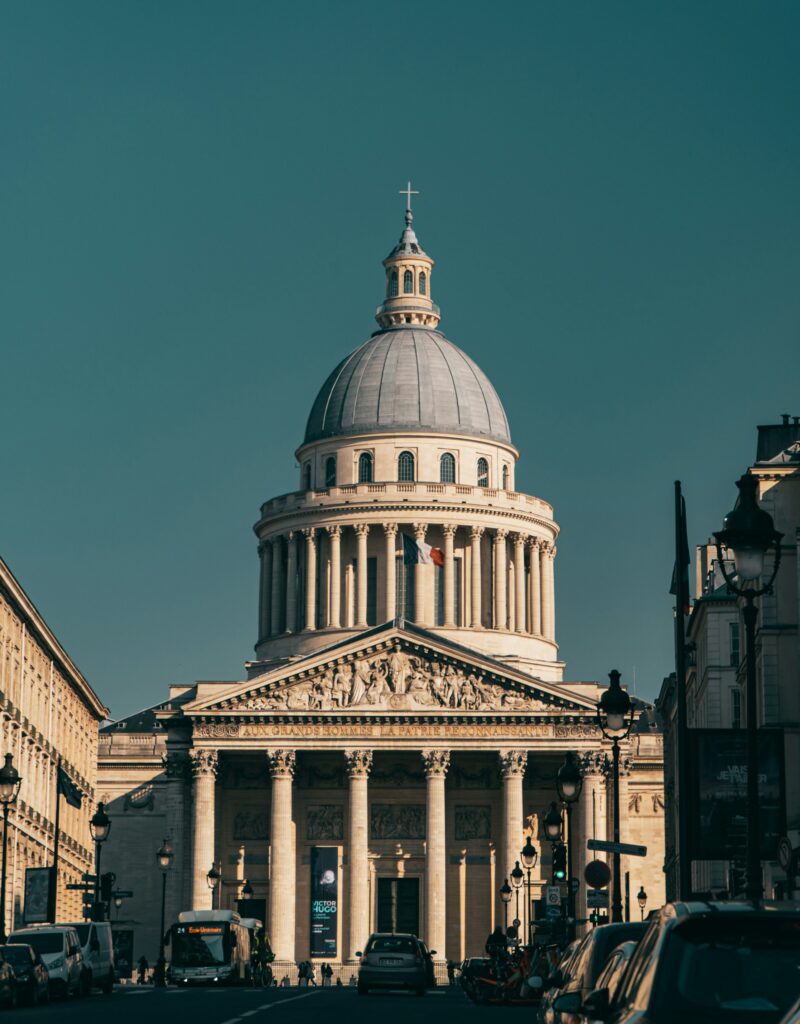
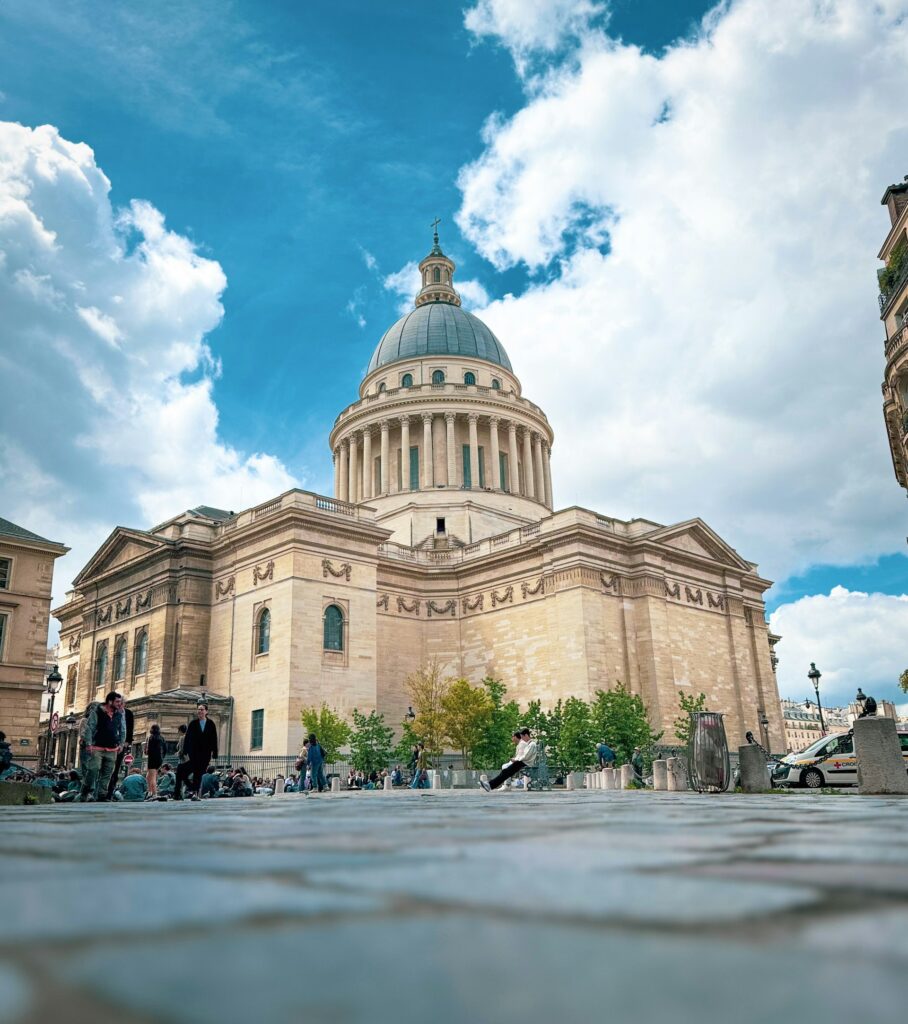
The building’s design represents a remarkable fusion of classical inspiration and structural daring. Its imposing dome, reminiscent of St. Peter’s Basilica in Rome, rests on an intricate system that pushed the limits of contemporary engineering. The Panthéon’s clean lines, harmonious proportions, and monumental scale embody Enlightenment ideals of reason, order, and clarity—principles that shaped both its aesthetic and symbolic meaning.
Over the centuries, the Panthéon has shifted between religious and secular roles, mirroring the evolving identity of France itself. Today, it serves as a mausoleum housing the remains of distinguished figures such as Voltaire, Rousseau, Victor Hugo, and Marie Curie, making it a space where history, memory, and national pride converge. This duality—between sacred and civic, past and present—continues to define the Panthéon as one of Paris’s most compelling and meaningful landmarks.
The Panthéon in Paris in Numbers
83 m
The total height of the building, making it one of the most dominant landmarks on the Left Bank of the Seine
110 m
The total length of the building (for context: longer than a regulation football pitch)
22
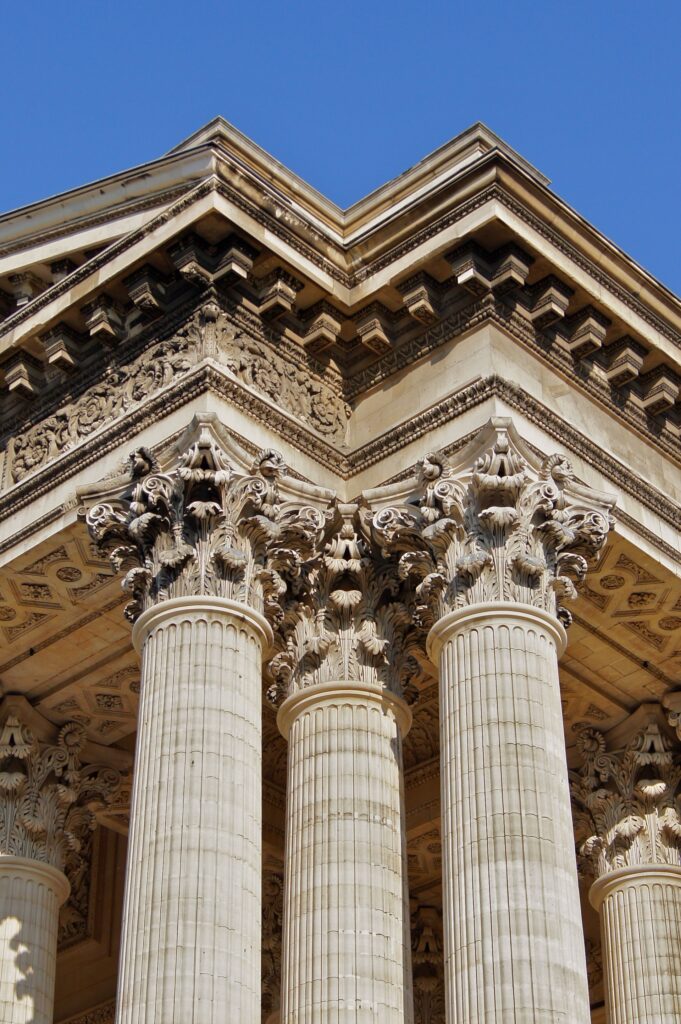
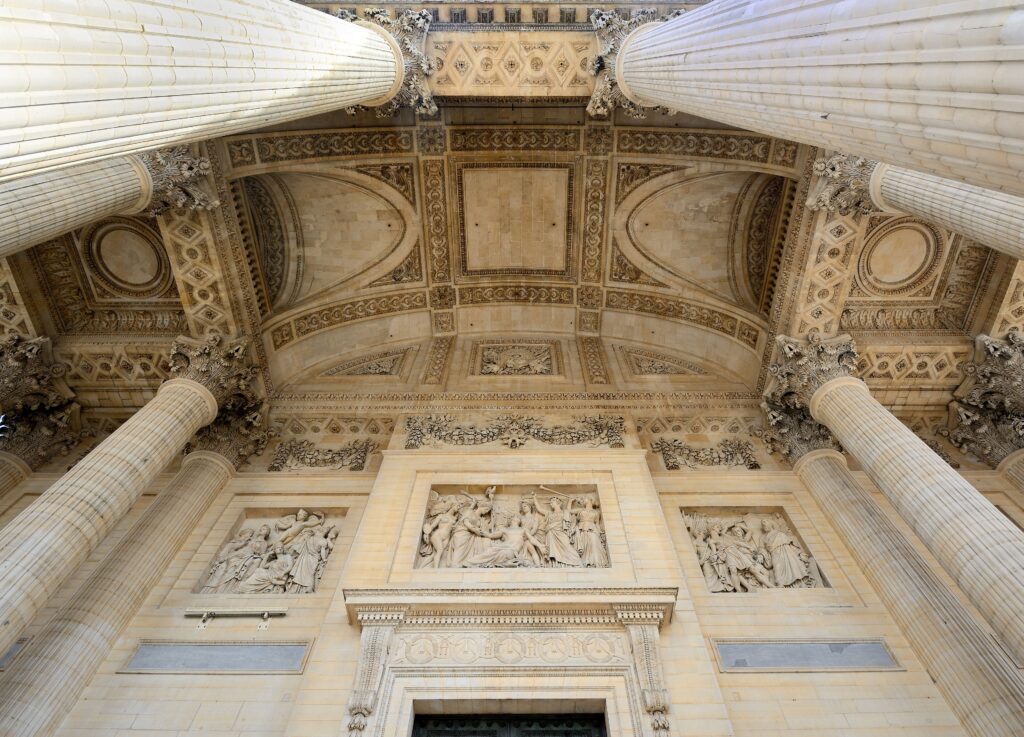
The number of massive Corinthian columns supporting the front portico, modeled after the Roman Pantheon
19 m
The height of each front column. They are so tall that an adult human looks like a LEGO figure standing next to them
84 m
The width of the Panthéon measured at the transept
3 domes
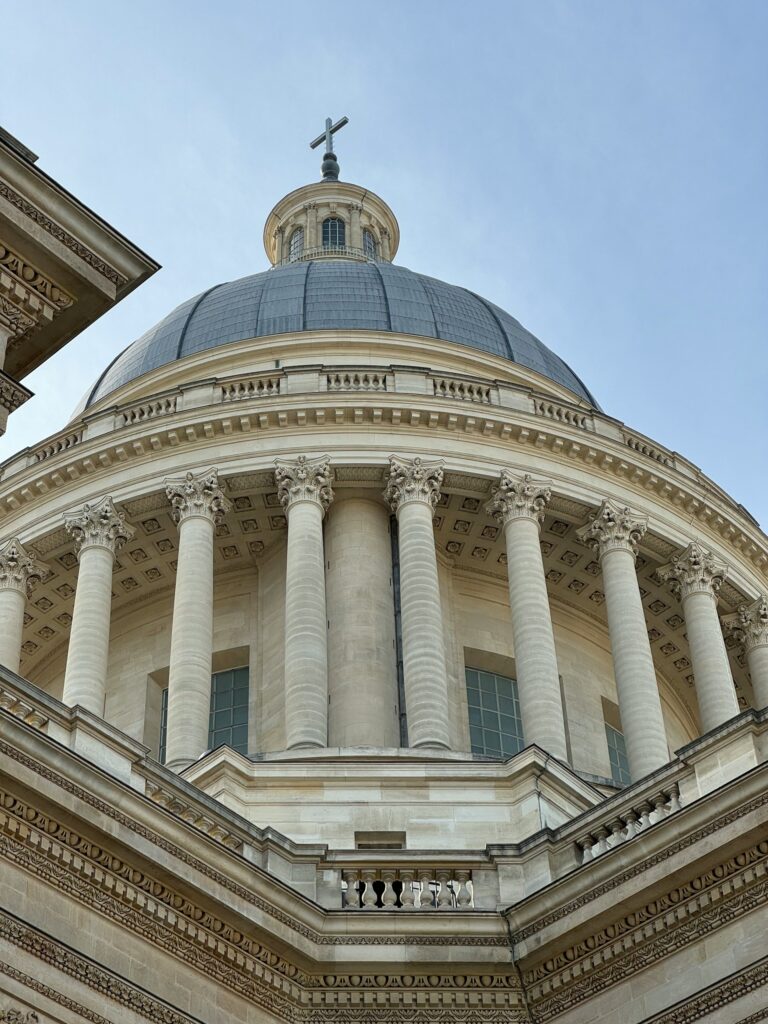
The Panthéon does not have one dome, but three, nested inside each other (the outer stone, the middle brick, and the inner frescoed dome) for stability and visual impact
1758
The year construction began under King Louis XV, who promised to build the Church of St. Genevieve after recovering from a serious illness
32 years
ow long it took to complete the building, finishing in 1790 during the peak of the French Revolution
81
The current number of people commemorated in the crypts (as of early 2026). This number grows slowly, as „pantheonization” is a personal decision made by the President of France
1995
The landmark year when Marie Skłodowska-Curie became the first woman buried in the Panthéon for her own scientific merits
42
The number of windows originally in the building. The architect, Soufflot, wanted a „light-filled church,” but many were later walled up to create a more solemn, tomb-like atmosphere
52
The total number of columns inside the main nave supporting the vaulted ceilings
67 m
The length of the steel wire from which the famous Foucault’s Pendulum is suspended (originally installed in 1851)
28 kg
The weight of the gilded brass ball that proves the Earth rotates on its axis
16,5 s
The time it takes for one full oscillation (the period) of the pendulum in the Panthéon
15 million livres
The estimated cost of construction in the 18th century, an astronomical sum that nearly bankrupted the royal treasury
What makes the Panthéon truly compelling is not its scale alone, but the structural ingenuity behind its seemingly classical form. Beneath its calm neoclassical exterior lies an advanced system of slender supports, concealed iron reinforcements, and a pioneering triple-shell dome that balances lightness with stability. Designed to merge the spatial clarity of antiquity with the daring of Gothic construction, the building redefines how monumental architecture can achieve both elegance and structural efficiency, transforming stone into a precise expression of Enlightenment rationality.
The History of Panthéon in Paris
The history of the Panthéon in Paris is deeply intertwined with the political, religious, and cultural transformations of France. Originally conceived in the mid-18th century, the building was commissioned by King Louis XV as a gesture of gratitude after recovering from a serious illness. He vowed to dedicate a grand church to Saint Geneviève, the patron saint of Paris. The project was entrusted to architect Jacques-Germain Soufflot, who envisioned a structure that would rival the great monuments of antiquity while showcasing modern engineering techniques.
Construction began in 1758, but progress was slow due to financial difficulties and the complexity of the design. Soufflot sought to combine the lightness of Gothic architecture with the purity and symmetry of classical forms, an ambitious approach that pushed the limits of contemporary building technology. By the time of Soufflot’s death in 1780, the structure was nearing completion, but it would not be fully finished until 1790—just as France was entering one of the most turbulent periods in its history.
The French Revolution dramatically altered the fate of the building. Instead of serving as a church, it was secularized and transformed into a mausoleum dedicated to the “great men” of the nation. Renamed the Panthéon, it became a symbol of revolutionary ideals, celebrating reason, citizenship, and national unity. The inscription added to its façade—“Aux grands hommes, la patrie reconnaissante” (“To great men, the grateful nation”)—reflected this new purpose.
Throughout the 19th century, the building’s function shifted repeatedly as political regimes changed. Under Napoleon Bonaparte, it briefly returned to religious use, only to be secularized again later. These oscillations between church and civic monument mirrored the ongoing struggle in France between monarchy, empire, and republic. Each regime sought to redefine the Panthéon according to its own ideological vision, making the building a powerful symbol of national identity and political change.
By the late 19th century, the Panthéon was definitively established as a secular mausoleum. It became the final resting place of many of France’s most influential figures, including Voltaire, Jean-Jacques Rousseau, Victor Hugo, and Marie Curie. Today, it stands not only as an architectural landmark but also as a living testament to the nation’s history, embodying centuries of transformation, conflict, and cultural achievement.
A Neoclassical Vision Reinforced by Structural Innovation
The architecture of the Panthéon in Paris represents a remarkable synthesis of classical aesthetics and groundbreaking engineering. Designed by Jacques-Germain Soufflot in the 18th century, the building was intended to rival the grandeur of ancient Roman monuments while incorporating the structural lightness associated with Gothic cathedrals. This ambitious combination resulted in a design that was both visually harmonious and technically daring, pushing the limits of architectural knowledge at the time.
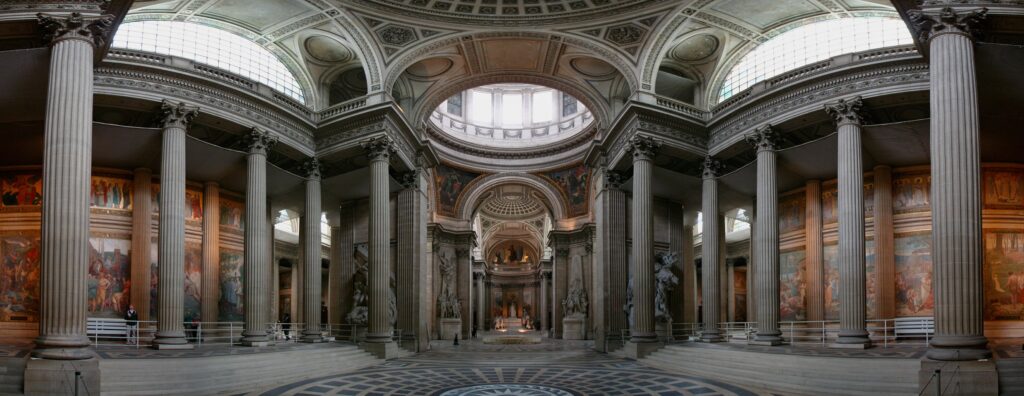
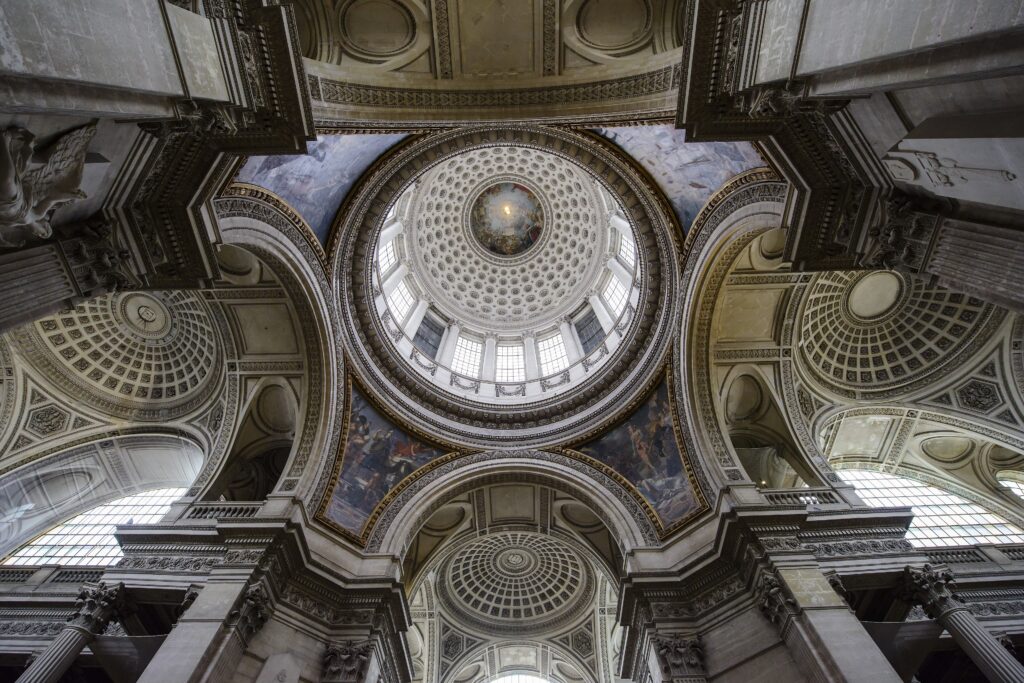
At the heart of the Panthéon’s design lies its Greek cross plan, a symmetrical layout that emphasizes balance and clarity—key principles of neoclassical architecture. The structure is defined by its massive Corinthian columns, a grand portico inspired by ancient temples, and a dominant central dome rising above the crossing. The dome itself, one of the most striking features of the building, consists of a triple-shell structure—an innovative solution that enhances both stability and visual depth. This layered system allows the dome to appear lighter and more elegant from the interior while maintaining the strength required to support its immense weight.
From an engineering perspective, Soufflot’s approach was revolutionary. He aimed to reduce the mass of the structure without compromising its integrity, using slender supports and concealed reinforcement techniques. Iron reinforcements were incorporated into the stone framework—an advanced method for the period—helping to counteract lateral forces and prevent structural failure. Despite these innovations, the building faced challenges, particularly with the stability of its piers and dome, leading to later modifications and reinforcements by other architects.
Light also plays a crucial role in the architectural experience of the Panthéon. Large windows and the carefully calculated openings in the dome allow natural light to filter into the interior, emphasizing the geometry of the space and enhancing its monumental character. This interplay between light and structure reflects Enlightenment ideals, where reason and clarity were expressed not only through form but also through the atmosphere of the space.
Ultimately, the Panthéon stands as a pioneering achievement in both architecture and engineering. It bridges the gap between tradition and innovation, combining classical inspiration with experimental construction techniques. The result is a building that not only defines the Parisian skyline but also marks a key moment in the evolution of modern structural design.
Trivia
The Original Vow
King Louis XV promised to replace the ruined Abbey of St Genevieve if he recovered from a near-fatal illness. After his recovery, he commissioned the architect Jacques-Germain Soufflot to build this massive monument. However, the King died before seeing the project reach even the halfway point of construction.
A Weighty Foundation
The building is constructed on a massive scale and weighs approximately 100,000 tons. To support this immense pressure, the architect had to reinforce the soil and use a complex system of hidden iron bars. This technique was revolutionary for the 18th century but caused significant structural cracking early on.
The Mirror of Politics
The Panthéon has switched between being a church and a secular mausoleum several times throughout history. Each time the government changed from a Monarchy to a Republic or Empire, the religious symbols were either added or removed. It finally settled as a secular „Temple of Fame” during the funeral of Victor Hugo.
Marie Curie’s Eternal Rest
Marie Curie was the first woman to be honored in the Panthéon based on her own scientific merits in 1995. Because her body and research papers were highly radioactive, her coffin is actually lined with 1.2 millimeters of lead. This ensures that visitors are protected from radiation while paying their respects.
The Whispering Dome
The triple-dome structure creates unique acoustic properties similar to those found in St. Paul’s Cathedral in London. Sound travels along the curved surfaces, allowing people on opposite sides of the dome to hear each other clearly. This architectural trick was unintended but remains a favorite detail for curious tourists.
Victor Hugo’s Massive Funeral
When the famous author Victor Hugo died in 1885, his funeral procession was one of the largest in French history. Over two million people lined the streets of Paris to watch his coffin be transported to the Panthéon. This event was so significant that it permanently turned the building into a secular monument.
The Pendulum Proof
In 1851, physicist Léon Foucault hung a heavy brass ball from the dome to demonstrate the rotation of the Earth. As the pendulum swung, it appeared to change direction, but it was actually the floor of the Panthéon moving beneath it. A working replica of this famous device still swings in the center of the building today.
A View from the Top
Visitors can climb the steep stairs to the exterior colonnade of the dome for a panoramic view of Paris. From this height, you can see landmarks like the Eiffel Tower and Notre-Dame from a unique 360-degree perspective. It is considered one of the best „hidden” viewpoints in the entire city.
The Missing Windows
The original design by Soufflot featured many more large windows to fill the interior with natural light. After his death, his successors blocked many of them to make the building look more like a somber Roman temple. This change was meant to emphasize the „eternal” and „serious” nature of a national tomb.
The Empty Crypts
Despite its massive size, the Panthéon’s crypt is not entirely full and still has plenty of space for future heroes. Admission is a rare honor, and the decision is made exclusively by the President of the Republic. Currently, there are dozens of empty vaults waiting for the next great figures of France.
Braille’s Final Home
Louis Braille, the inventor of the reading system for the blind, was moved to the Panthéon on the 100th anniversary of his death. Interestingly, his hands were left in his original village of Coupvray as a symbolic gesture to his hometown. The rest of his body rests among the greatest thinkers of the nation.
The Iron Reinforcements
The Panthéon was one of the first major buildings to use a „reinforced” stone technique using thousands of iron cramps. While this allowed for elegant, thin pillars, it eventually caused problems when the iron began to rust and expand. Recent restoration projects have focused on replacing this iron to prevent the stone from shattering.