
A Postmodern Icon That Marked Frankfurt’s Rise as Europe’s Financial Capital
In the heart of Frankfurt stands a skyscraper that symbolized Germany’s economic resurgence after reunification — the Messeturm. Completed in 1990, this 256.5-meter tower was not only the tallest building in Europe at the time of its inauguration, but also a bold architectural statement that reintroduced ornament, symbolism, and historical reference into high-rise design.
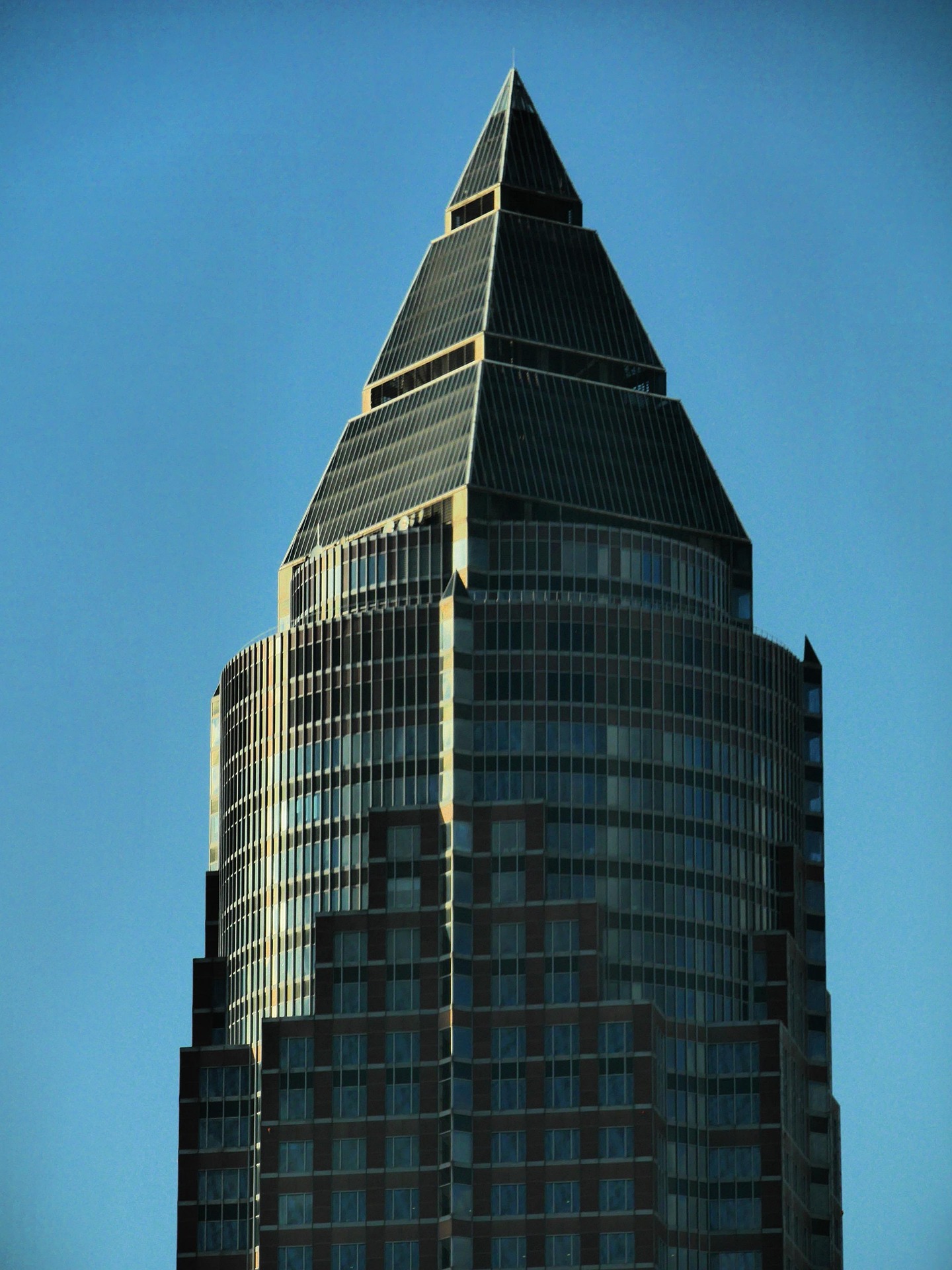
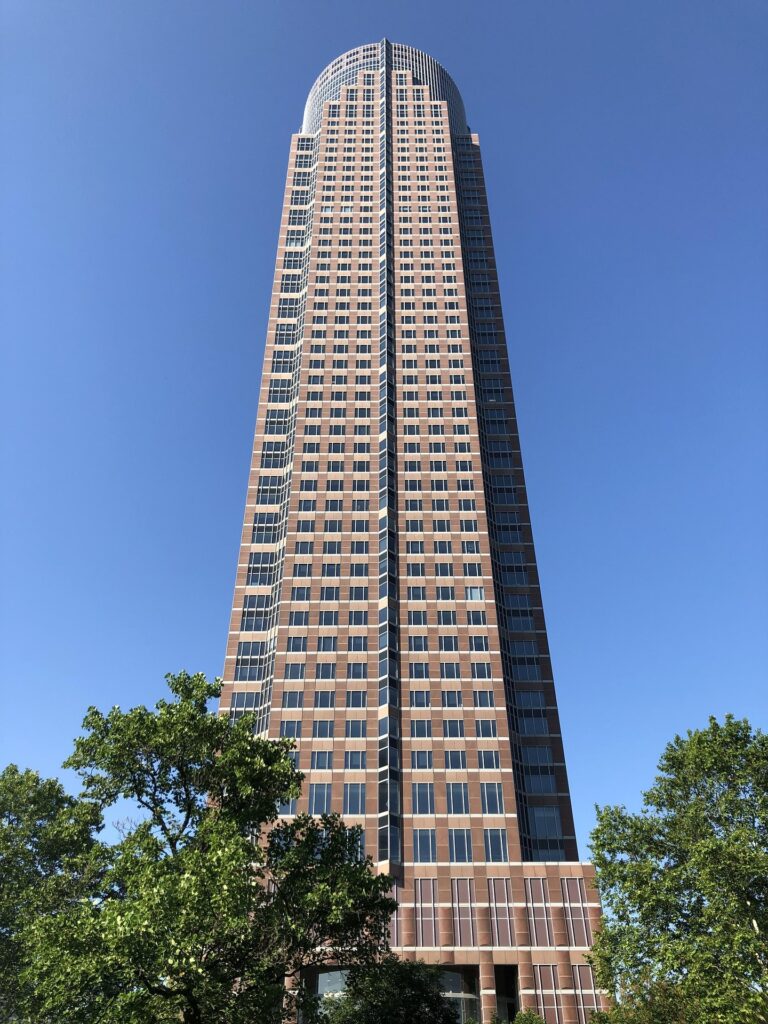
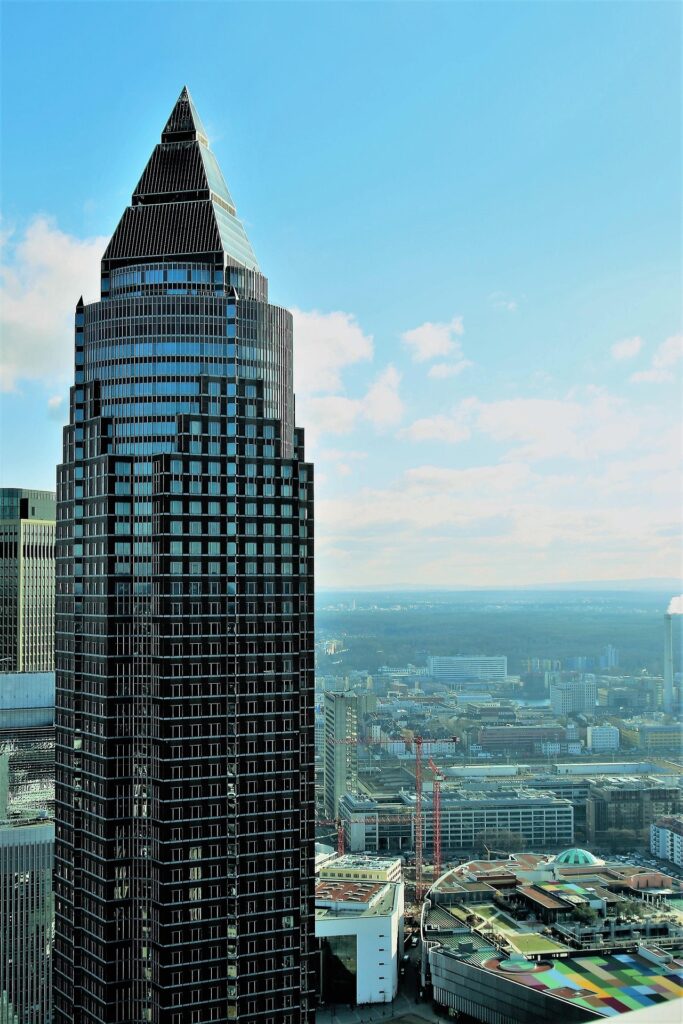
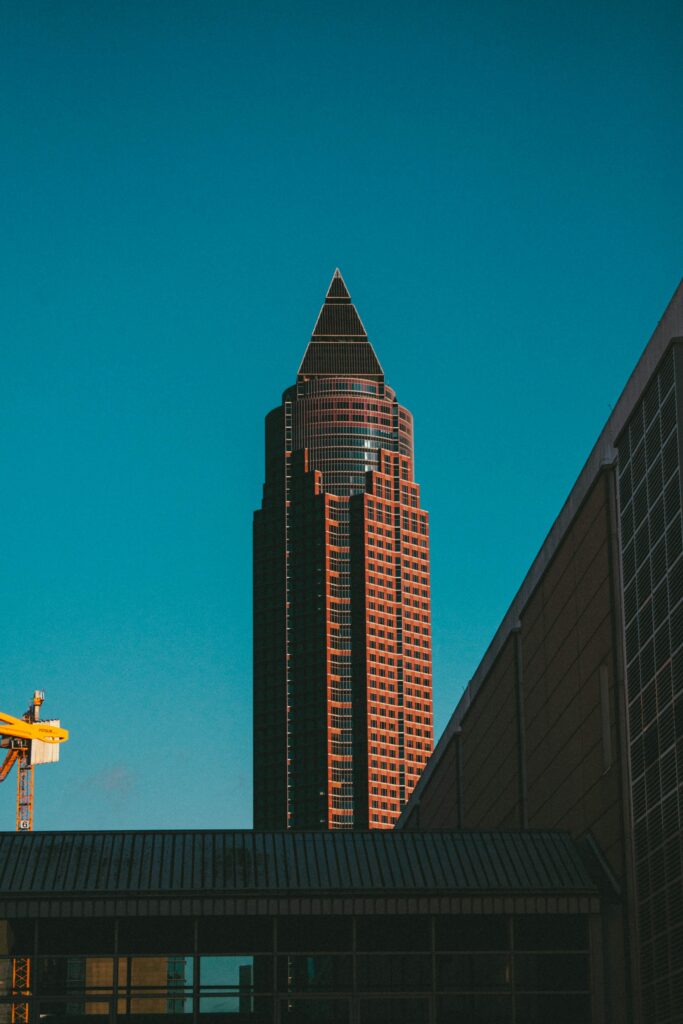
Designed by renowned architect Helmut Jahn, Messeturm broke away from the purely functional glass boxes of late modernism. Its form — a sleek granite-clad shaft crowned by a striking pyramid — deliberately references classical proportions while translating them into the language of late 20th-century skyscraper engineering. The pyramid top, often compared to an Egyptian obelisk or Art Deco crown, gives the building a recognizable silhouette within Frankfurt’s financial district.
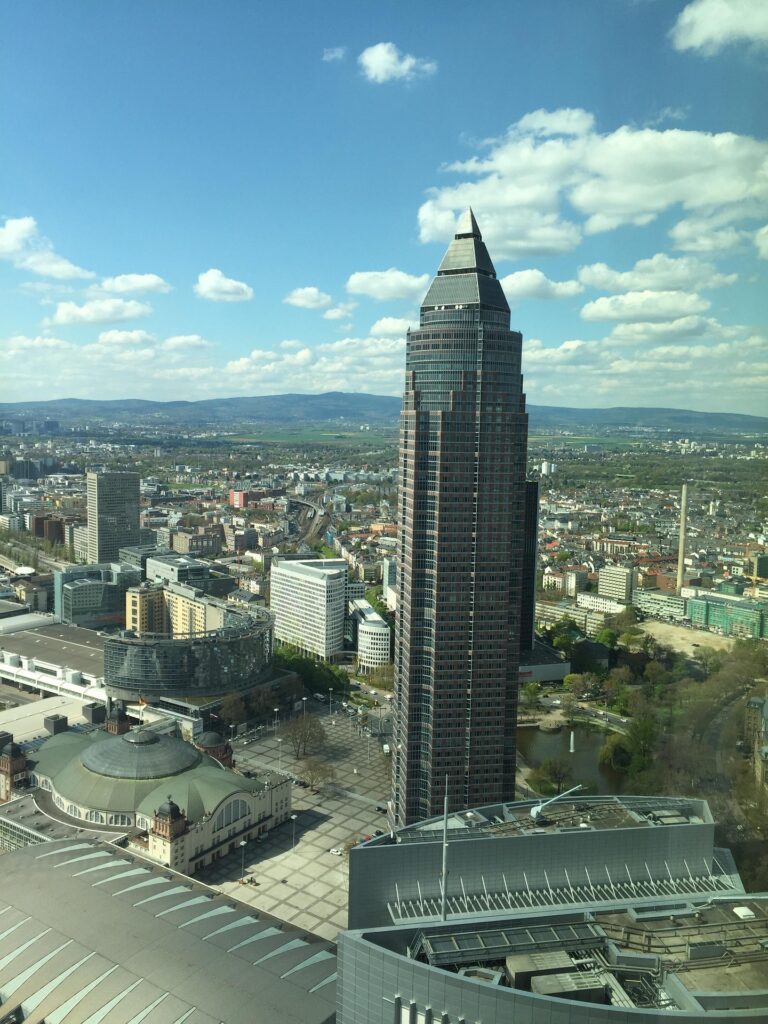
Strategically located near the Frankfurt Trade Fair complex (Messe Frankfurt), the tower played a pivotal role in reinforcing the city’s identity as “Mainhattan” — a European financial hub blending American-style verticality with German precision. At the moment of its completion, Messeturm signaled that Frankfurt was ready to compete with global financial centers such as London and New York, not only economically but architecturally.
More than three decades later, Messeturm remains one of the most photographed elements of Frankfurt’s skyline. It represents a transitional moment in skyscraper history — when postmodernism briefly challenged minimalism and reintroduced narrative, symbolism, and historical memory into corporate architecture.
This is not just a tall building. It is a statement about power, identity, and the ambitions of a reunified Germany at the dawn of a new European era.
Messeturm in Numbers
256.5 m
The total height of the building
2nd
Its current rank as the tallest building in Germany (surpassed only by the Commerzbank Tower)
7 years
The duration it held the title of the „Tallest Building in Europe” (from 1990 to 1997)
63
The total number of floors above ground
61 711 m²
Office space
36.3 m
The height of the distinct pyramid that sits atop the tower
25 months
The remarkably short time it took to build the tower
188 000 t
The approximate total weight of the massive structurenumber of hotel rooms at the time of opening
1 202
The number of steps in the staircase, used for the „Skyrun” stair-climbing competition
4 000
The estimated number of people who work in the building daily
41 × 41 m
Typic floor plan
€100 000 000
The approximate cost of the major „Messeturm 2.0” renovation completed around 2020
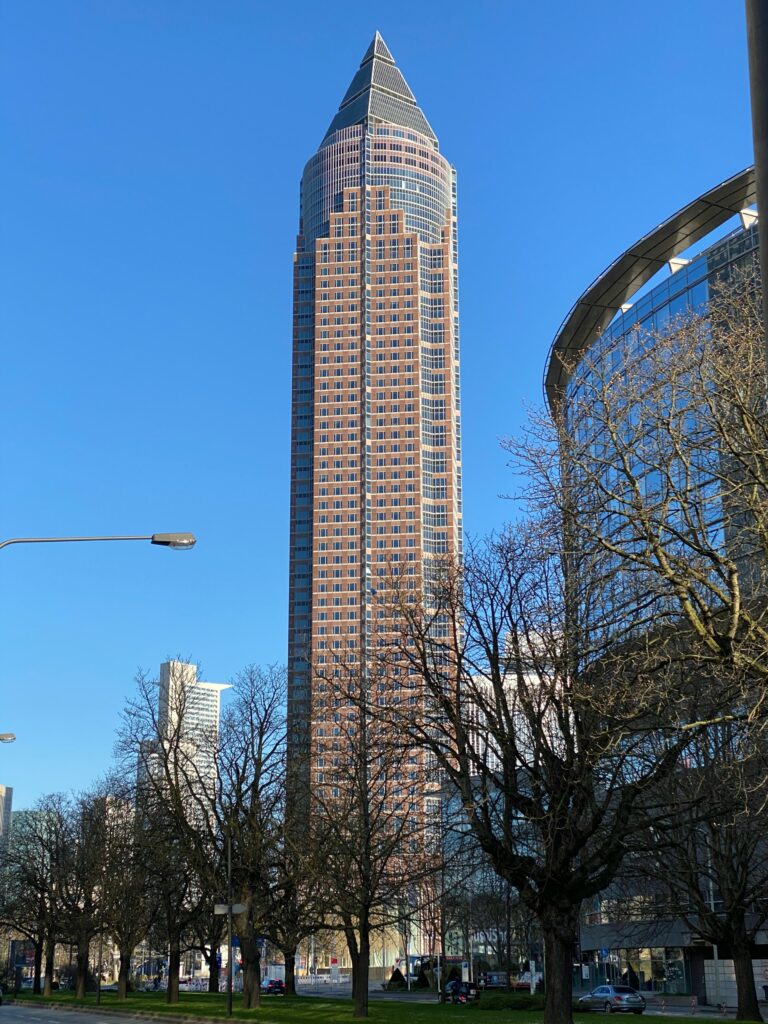
What’s most compelling about Messeturm is not merely its 256.5-metre height, but the structural clarity behind its composition. The tower is organized into four distinct architectural segments — base, shaft, lantern, and pyramid — each expressed externally and reinforced internally through a rigid reinforced-concrete core system that stabilizes the slender vertical mass against wind loads. Rather than relying on spectacle, Messeturm demonstrates how proportion, load distribution, and geometric reduction can create symbolic power. Its 36-metre steel pyramid is not an applied ornament but the logical culmination of the building’s tapering structural rhythm, transforming the skyline of Frankfurt into a disciplined, postmodern statement about hierarchy, stability, and financial ambition.
Structural Engineering of Messeturm
The structural system of Messeturm is based on a reinforced concrete core combined with perimeter columns, forming a rigid tube-like configuration capable of resisting significant lateral wind loads. At 256.5 meters, wind forces — not gravity — become the governing structural challenge. The central core acts as the primary stabilizing spine of the building, housing elevators and service shafts while functioning as a massive vertical cantilever anchored deep into Frankfurt’s subsoil. This system ensures both torsional stiffness and overall stability, limiting sway to acceptable comfort levels for occupants.
The tower’s proportions are not accidental; they are structurally strategic. The square floor plate (approximately 41 × 41 meters) provides geometric efficiency and even load distribution. As the building rises, subtle setbacks and the transition into the lantern and pyramid reduce wind pressure and vortex shedding effects. This gradual volumetric reduction improves aerodynamic performance while reinforcing the architectural hierarchy. The structural grid remains consistent, allowing loads to transfer cleanly downward through columns into the foundation system.
The most distinctive structural element is the 36-meter steel pyramid crown. While visually symbolic, it is engineered as a lightweight steel framework designed to minimize additional top mass. Its reduced weight is critical, as excessive mass at the top of a skyscraper amplifies lateral movement. Instead of acting as a heavy cap, the pyramid functions as a controlled termination of the vertical load path, maintaining structural balance while completing the tower’s postmodern silhouette.
Financial Impact and Economic Context of Messeturm
The development of Messeturm was a calculated financial statement at a pivotal moment in German history. Completed in 1990 — the year of German reunification — the tower symbolized renewed economic confidence and Frankfurt’s ambition to position itself as continental Europe’s leading financial hub. With an estimated construction cost of approximately 500 million Deutsche Marks, the project was not merely a real estate venture but a macroeconomic signal: Frankfurt was ready to compete with London and New York in the global capital market.
Strategically located next to the Frankfurt Trade Fair complex, the tower increased the commercial attractiveness of the surrounding district. By concentrating premium office space in a high-profile landmark building, developers were able to command top-tier rents relative to the late-1980s German market. The project contributed to a broader rise in land values across the Messe and Westend areas, reinforcing Frankfurt’s transformation into “Mainhattan.” The building effectively functioned as a value multiplier — enhancing investor confidence and strengthening the city’s position as headquarters territory for banks, legal firms, and financial institutions.
Over time, Messeturm proved financially resilient. Despite cyclical downturns in European office markets, its iconic status and central location helped maintain high occupancy rates compared to generic office stock. As one of the early skyline-defining skyscrapers in Frankfurt, it established a benchmark for prestige-driven office development in Germany. In economic terms, Messeturm was less about speculative excess and more about long-term urban capital formation — a vertical asset designed to anchor Frankfurt’s financial identity for decades.
Trivia
The „Pencil” Nickname
The Messeturm is widely known among locals by the affectionate nickname „The Pencil” (Bleistift). This name comes from its distinct slender shape and the sharp pyramid that sits at the very top. It has become one of the most iconic and easily identifiable silhouettes in the entire German skyline.
A Dedicated Zip Code
The building is so massive and houses so many businesses that it was granted its own unique postal code, 60308. This is a rare honor in Germany, usually reserved for large institutions or entire city districts. It serves as a testament to the tower’s status as a „city within a city.”
The Hammering Man
Right outside the entrance stands a giant moving sculpture known as the „Hammering Man,” created by artist Jonathan Borofsky. The black motorized figure continuously moves its arm to symbolize the dignity of labor and the working class. It is one of several similar statues located in major cities around the world.
Record-Breaking Speed
Construction of the Messeturm was incredibly fast, with workers completing one entire floor every four days on average. The entire skyscraper was finished in just 25 months, which was a remarkable engineering feat for the late 1980s. This efficiency allowed the tower to open its doors to tenants exactly on schedule in 1990.
Brazilian Granite Facade
The exterior of the tower is not made of simple concrete, but is instead clad in polished red granite imported from Brazil. This high-quality stone gives the building a warm, reddish glow that changes depending on the sunlight. It provides a striking visual contrast to the many glass-and-steel skyscrapers that surround it.
The Pyramid’s Secret
The 36.3-meter-tall pyramid at the top is not just an architectural ornament for the skyline. It actually houses the building’s complex technical equipment, including cooling towers and elevator machinery. By hiding these functional elements inside the pyramid, the architect maintained the tower’s clean and elegant aesthetic.
The Skyrun Challenge
Every year, the Messeturm hosts the „Skyrun Frankfurt,” a grueling stair-climbing race for professional athletes and firemen. Participants must sprint up 1,202 individual steps to reach the finish line on the 61st floor. It is considered one of the most prestigious and difficult vertical marathons in the world.
A Former European King
Upon its completion in 1990, the Messeturm took the title of the tallest building in all of Europe. It held this prestigious record for seven years until the nearby Commerzbank Tower surpassed it in 1997. Despite losing the top spot, it remains a dominant symbol of Frankfurt’s financial power.
The Lobby’s Transformation
A massive renovation completed in 2020 transformed the building’s base with an 18-meter-high glass facade. This project replaced the original dark entrance with a bright, transparent lobby that invites natural light into the ground floor. The goal was to make the private office tower feel more integrated into the surrounding urban space.
Foundation Strength
To support its 188,000-ton weight, the tower sits on a massive reinforced concrete foundation slab that is 6 meters thick. This deep „raft” foundation ensures the building remains perfectly stable in the soft soil of the Frankfurt basin. It is an invisible but vital part of the skyscraper’s structural integrity.
Helmut Jahn’s Legacy
The building was designed by the famous German-American architect Helmut Jahn, who was known for his „High-Tech” style. Jahn blended postmodern geometry with traditional materials like stone to create a timeless design. His work on the Messeturm helped redefine the modern European skyscraper for the late 20th century.
Strategic Location
The tower’s name literally translates to „Fair Tower,” referring to its location at the entrance of the Frankfurt Trade Fair grounds. It serves as a gateway for the millions of visitors who attend international trade fairs like the Book Fair or the Auto Show. Because of this, it is often the first landmark global business travelers see when arriving in the city.