
Lotus flower in Ho Chi Minh City
At the turn of the 2000s, Ho Chi Minh City was undergoing an intense transformation. The former Saigon, previously associated with low-rise colonial architecture and chaotic growth in the 1990s, began consciously forging a new identity as Southeast Asia’s financial metropolis. The Bitexco Financial Tower was created as a manifestation of this ambition—not just as an office tower, but as a symbol of modernity, capital, and the country’s aspirations after decades of economic isolation.
The investor was the Vietnamese Bitexco Group, so the project had national significance from the outset, not just commercial: the goal was to demonstrate that local capital could deliver a global-scale project.
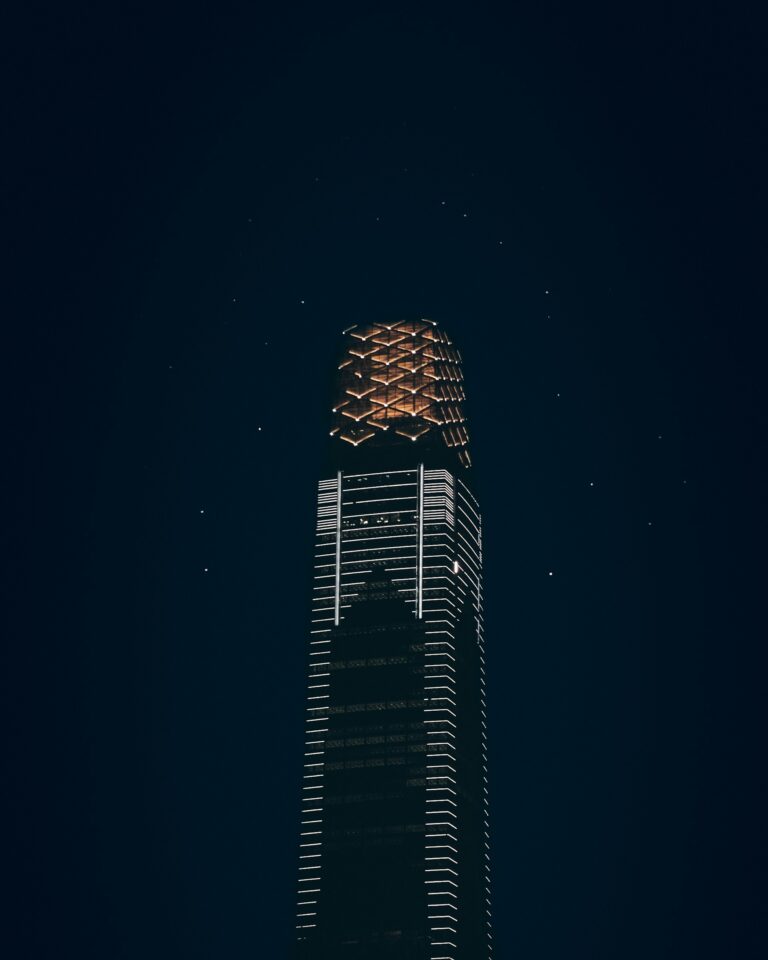
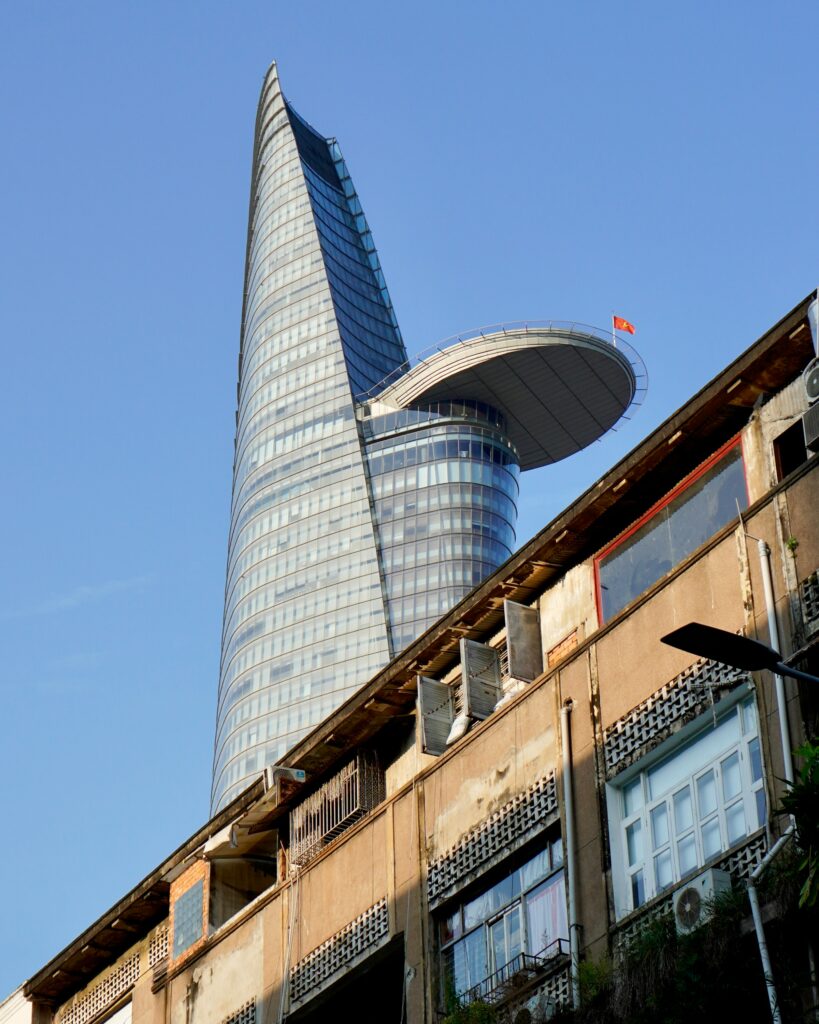
The concept’s author, Carlos Zapata, rejected the classic “glass needle” model that dominates global high-rise architecture. Instead, he proposed a form inspired by the lotus bud—one of Vietnam’s most important cultural symbols. The lotus flower grows from murky water, symbolizing rebirth, purity, and growth, combining tradition with spirituality. In the tower’s architecture, this translates into a smoothly tapering silhouette without aggressive curves, a soft, organic façade line, and a lack of a sharp finial, where the building “closes” like a bud rather than exploding upward. This is a conscious departure from the iconography of dominance known from the towers in Dubai or Shanghai. Bitexco doesn’t shout with height; it tells a story.
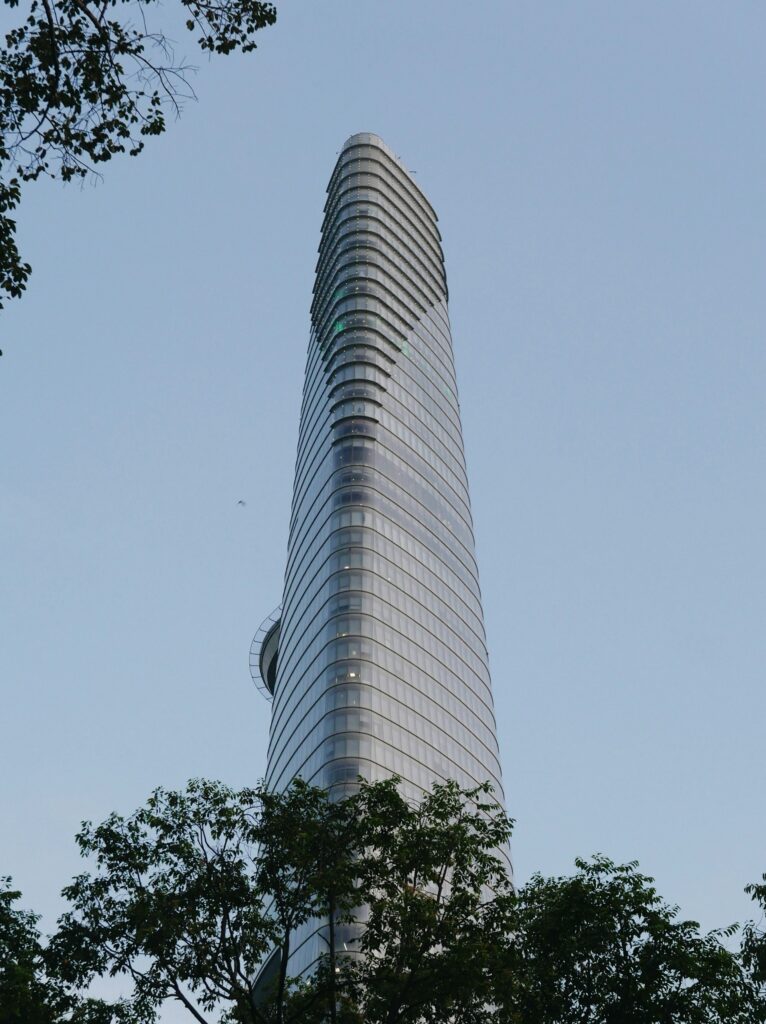
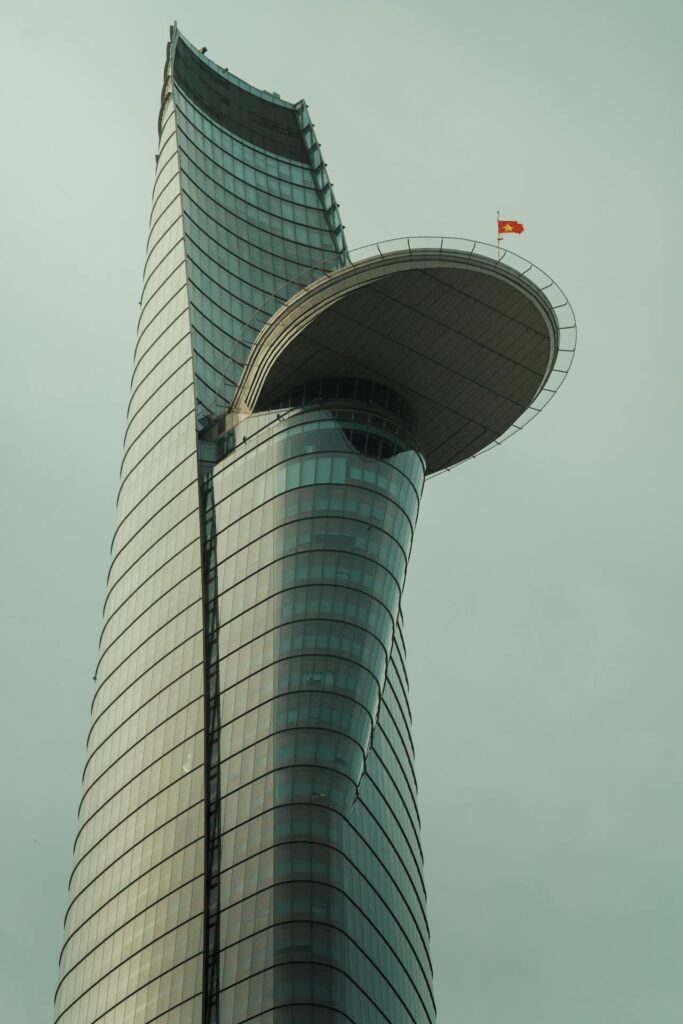
Bitexco Financial Tower in Numbers
262,5 m
Total Height
68
Floors
191 m
Helipad Height
16
Elevators
~114 000 m²
Flor Area
40 m
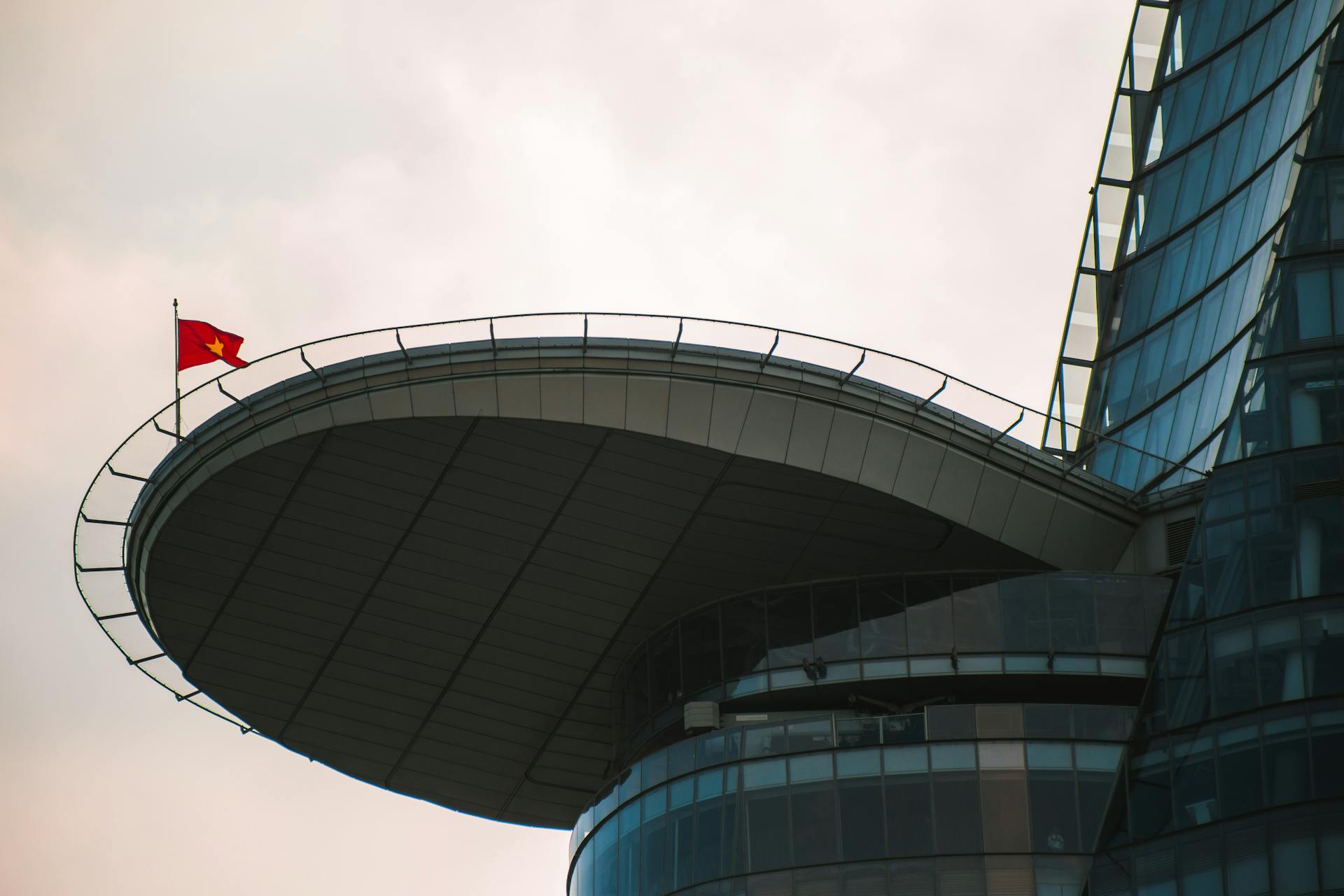
Total length of the landing field, 22 m, including the “outside” structures
250 t
Weight of the landing site’s steel structure
270 mln USD
Total costs
4 000
High-strength bolts used to secure the helipad’s steel frame
+2000 motorbikes
The capacity of the underground parking, reflecting the unique transportation culture of Ho Chi Minh City
0
identical floors – Due to the “lotus bud” shape, every floor plate has a unique dimension; no two floors are exactly the same
6 000
The number of individual glass panes used for the curved curtain wall
From the outside it’s a lotus bud frozen mid-bloom — inside, every floor slightly changes its geometry, and one 40-meter steel “petal” hangs 191 meters above Saigon’s streets.
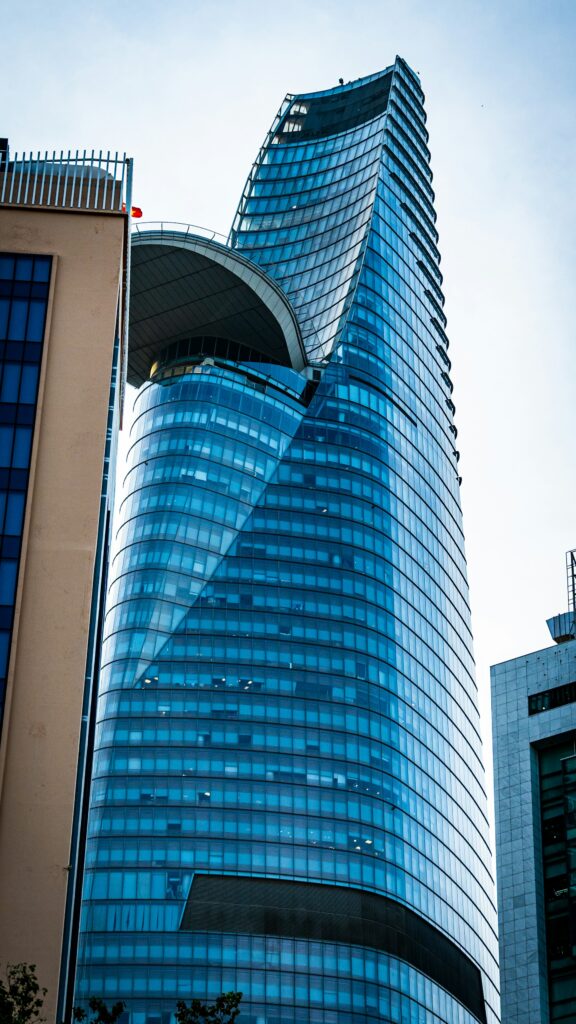
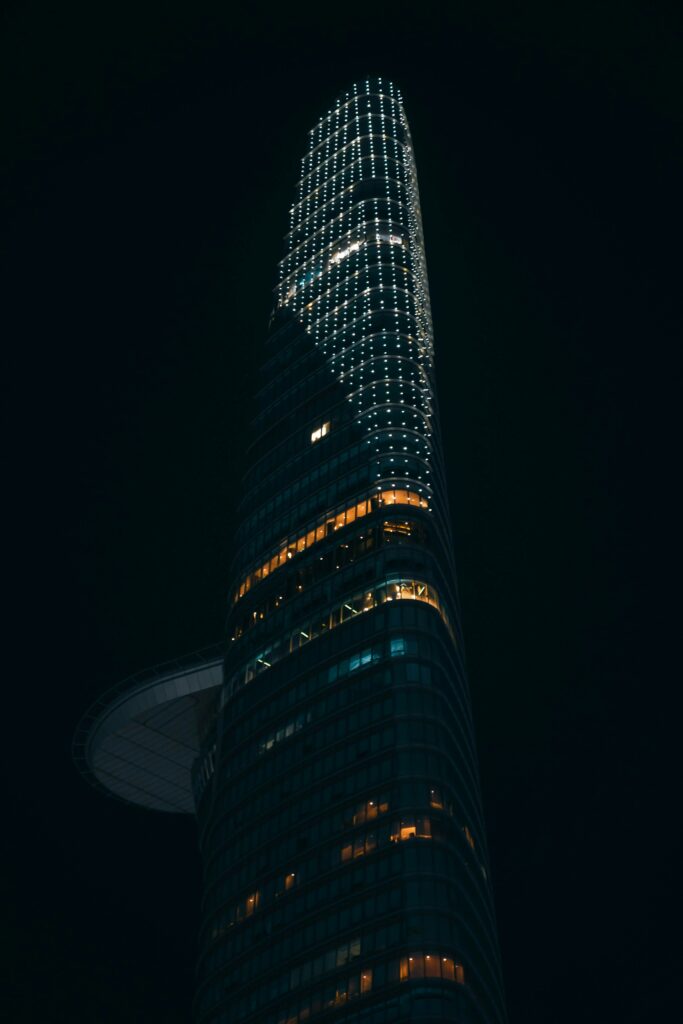
Bitexco Financial Tower: The Vertical Catalyst of Vietnam’s Economic Renaissance
The Bitexco Financial Tower stands as a monumental milestone in Vietnam’s economic transformation, serving as tangible proof of the nation’s shift from an agrarian economy toward a modern hub of services and finance. The realization of this $270 million project in the heart of Ho Chi Minh City sent a powerful signal to global investors that the region was ready to host Class A capital and multinational corporations. The building does not merely function as an office space; it acts as a catalyst for land value appreciation in District 1, attracting prestigious brands and generating thousands of high-specialty jobs and tourism opportunities. Its economic efficiency, measured by 37,000 square meters of office space, has allowed the city to compete with metropolises like Bangkok or Kuala Lumpur, cementing Vietnam’s image as the “new Asian tiger.”
The tower’s significance to the urban landscape of Ho Chi Minh City extends far beyond its physical height, as it has fundamentally redefined the visual identity of the former Saigon. The architecture, inspired by the lotus bud—Vietnam’s national flower—blends modern engineering with deep cultural symbolism, making the structure a globally recognized icon. The building has become a central landmark around which business and social life gravitate, with its distinctive silhouette and cantilevered helipad dominating the skyline as a reminder of the nation’s ambitions. Thanks to the Saigon Skydeck observation platform, the tower has become an essential fixture on the tourist map, directly contributing to the city’s revenue through the service and entertainment sectors.
In a broader national context, the Bitexco Financial Tower is a symbol of Vietnam’s “Doi Moi” or renovation policy, which initiated the country’s opening to the world in the late 20th century. As the first building in the country to surpass the 250-meter height threshold, it broke a psychological barrier for the local construction and development sectors. The success of this investment proved that local firms, such as the Bitexco Group, are capable of delivering world-class projects by collaborating with leading international architects and engineers. The tower is not just a construction of steel and glass, but a monument to Vietnam’s determination to modernize and secure a prominent position in the global supply chain and economic diplomacy.
The tower’s economy is closely tied to its multi-functionality, allowing for revenue diversification and resilience against market fluctuations. The combination of luxury retail spaces, high-end restaurants, and premier offices creates a self-sustaining ecosystem that pulses with life around the clock, stimulating local consumption. By possessing such an advanced facility, Vietnam gained a platform for hosting international business summits and conferences, which strengthens the nation’s soft power. Therefore, the Bitexco Financial Tower remains not only a vertical pioneer but, above all, a strategic national asset that initiated a new era in Southeast Asian high-rise construction and permanently altered the international perception of the Vietnamese economy.
Trivia
Inspiration from a national symbol
The lotus bud inspiration isn’t an afterthought—it was the starting point for the entire architectural concept. In Vietnamese culture, the lotus symbolizes rebirth and growth despite difficult circumstances, aptly reflecting the country’s post-20th-century history.
A unique facade system
In most skyscrapers, the glass panels are repetitive, which simplifies production and assembly. At Bitexco, the building’s rounded shape, resembling a lotus bud, causes it to simultaneously narrow and expand. This makes almost every one of the 6,000 panels unique.
Helipad as an engineering challenge
The iconic 52nd-floor helipad extends 22 meters beyond the building’s footprint and is supported by a complex system of cantilevers. The landing structure weighs over 250 tons and was installed at a height of approximately 191 meters, which in itself was a high-risk engineering operation. It’s one of those details that the user perceives as “effect” without realizing the scale of the technical effort.
Lightning fast elevators
The building boasts one of the fastest elevator systems in the region, traveling at 7 meters per second. This allows tourists and office workers to reach the observation deck from ground level in less than 35 seconds.
Foundations driven deep into the ground
Due to the soft ground near the Saigon River, the tower’s foundations rest on hundreds of piles driven more than 80 meters deep. This ensures the structure’s stability even during severe tropical storms and torrential monsoons.
The unique Saigon Skydeck viewpoint
The Saigon Skydeck, on the 49th floor, serves as a city orientation platform, not just a tourist attraction. For many residents, it’s the only place from which they can see the city’s chaotic structure as a coherent whole.
The Underground World of Motorcycles
Beneath the building, three levels of parking can accommodate over 2,000 motorcycles, a crucial requirement in Ho Chi Minh City, the city with the highest number of motorcycles per capita. It’s a prime example of a modern building adapting to local lifestyles.
District 1
The building stands in District 1, the city’s historic heart, adjacent to much lower, colonial buildings. This contrast makes the tower act as a vertical sign of a new era, visible from almost every point in the city center.