
Stadio Giuseppe Meazza (San Siro): The Brutalist Cathedral of Calcio
“La Scala del Calcio” — the Opera House of football — is how Italians describe the legendary Stadio Giuseppe Meazza. But this is not just a stadium in Milan; it is a monumental stage where architecture, rivalry, and identity collide. Rising from a quiet residential district in the San Siro neighborhood, the structure feels less like a sports venue and more like a concrete manifesto visible from miles away.
What makes San Siro unique in world football is its divided soul. Two historic and fiercely opposed clubs — AC Milan and Inter Milan — share the same home, the same pitch, and the same stands. Few stadiums in Europe embody such an intense urban and cultural split, where the Derby della Madonnina transforms architecture into a battleground of color and sound.
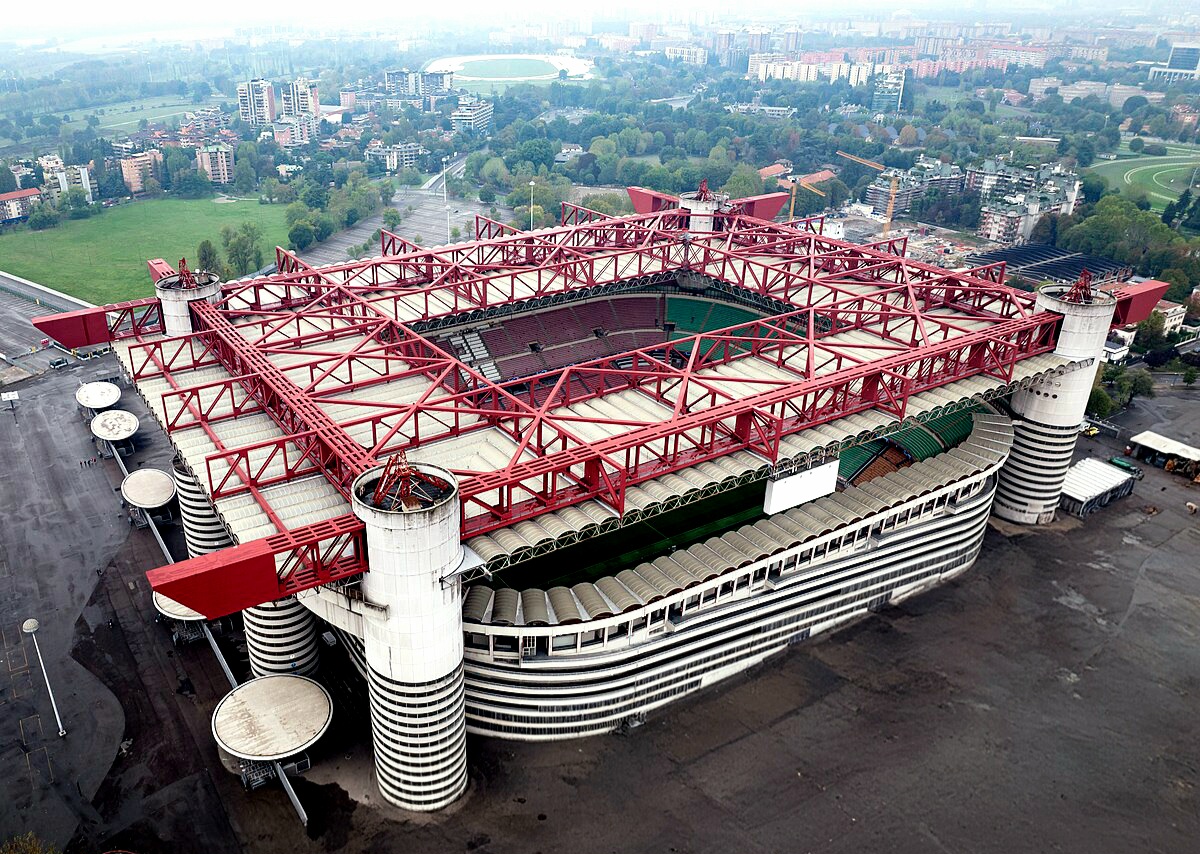
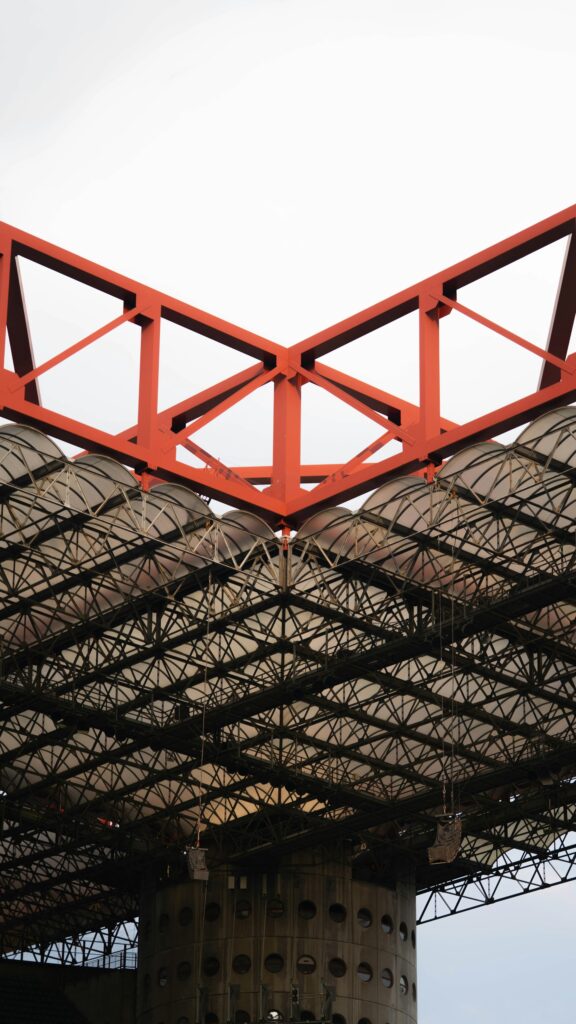
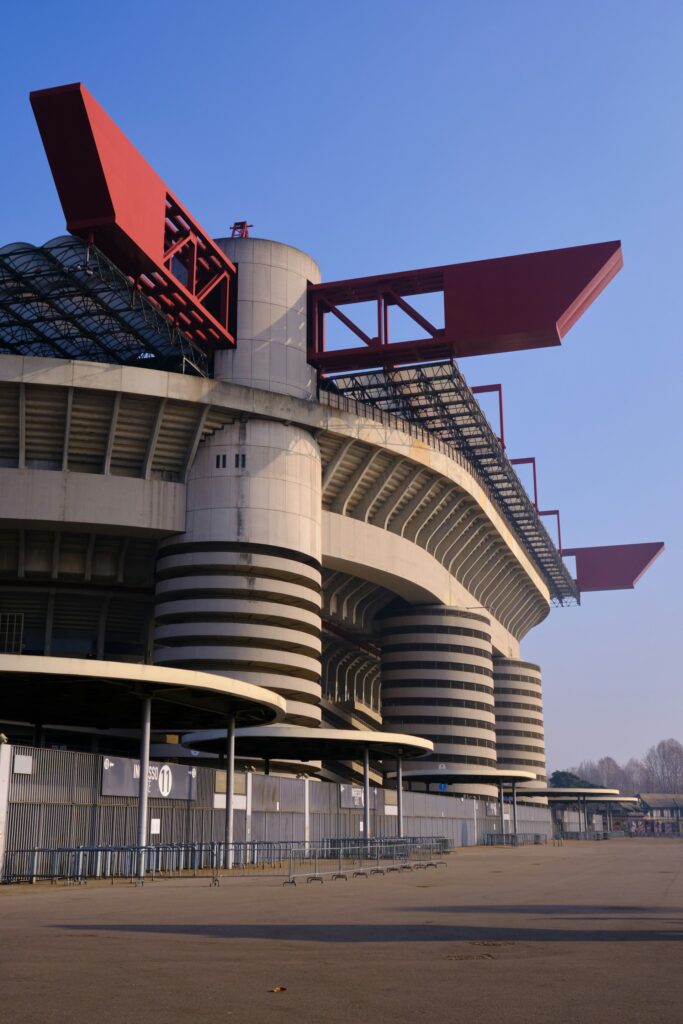
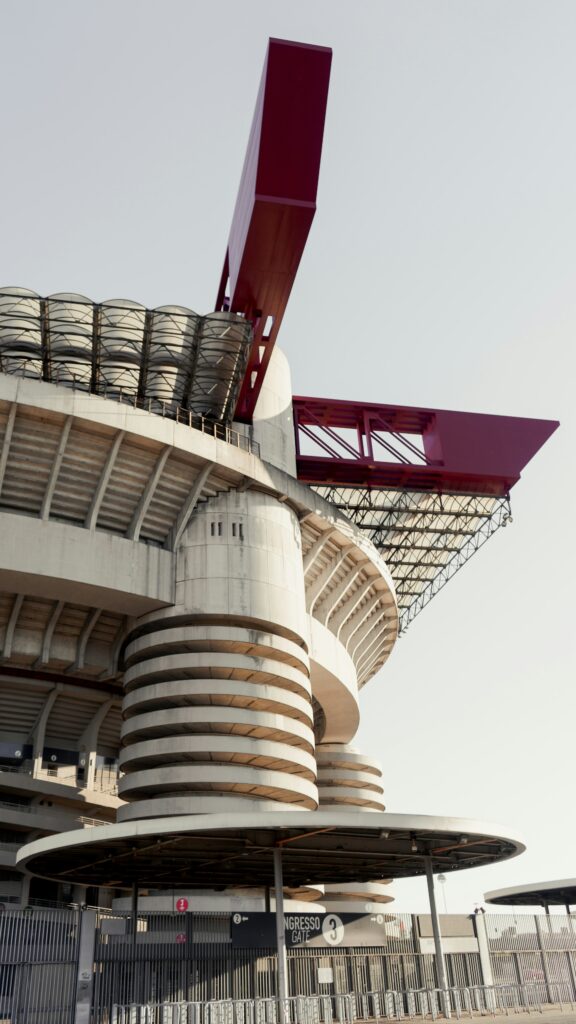
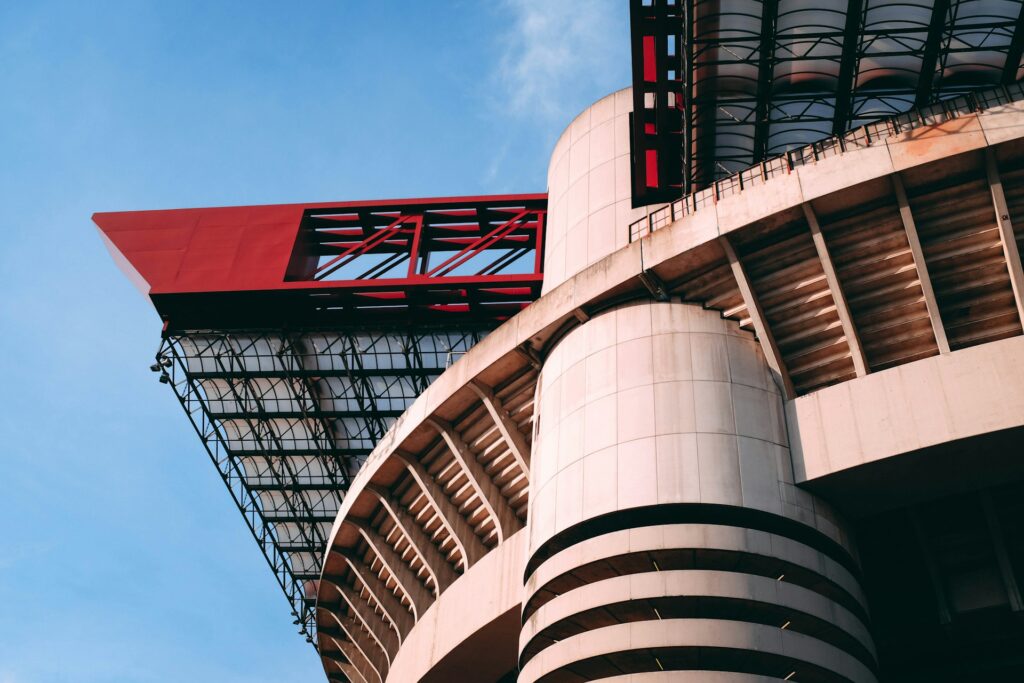
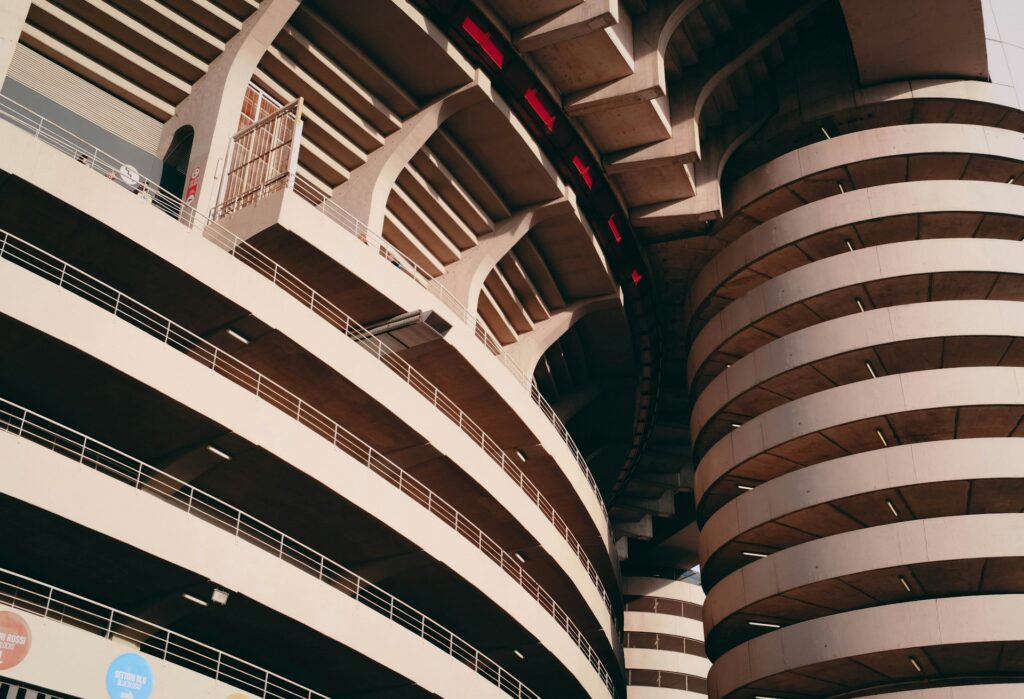
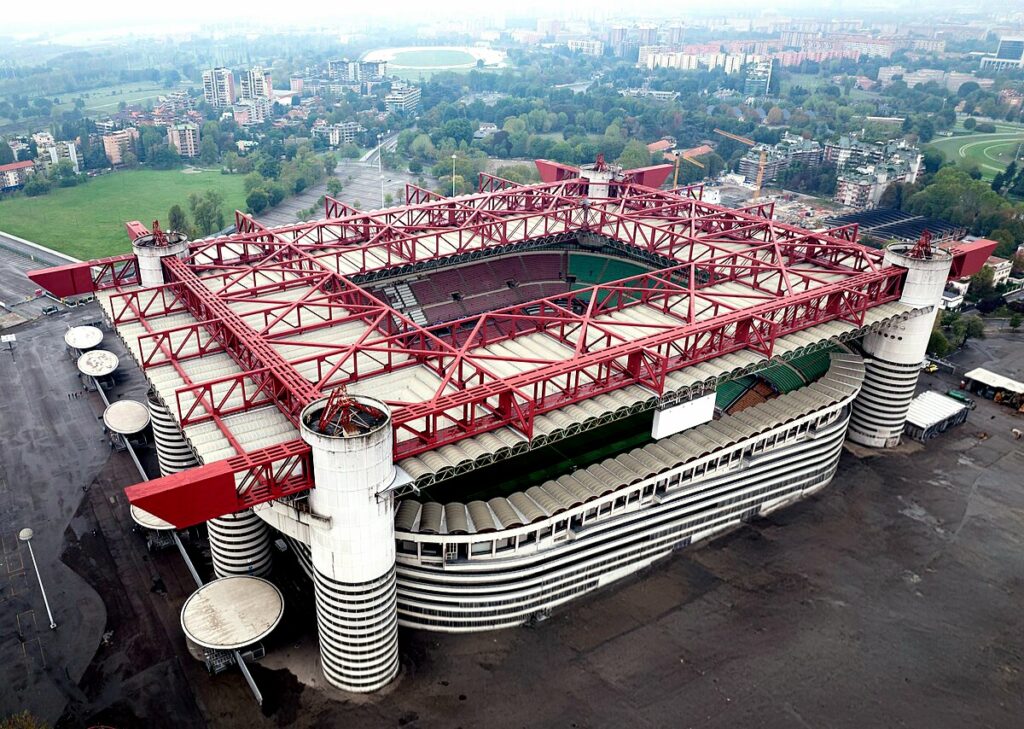
Visually, the stadium dominates its surroundings with unapologetic force. Massive exposed concrete, cylindrical support towers, and spiraling ramps define its brutalist character. The protruding red steel roof trusses cut across the skyline like industrial scaffolding, giving the entire structure the appearance of a spacecraft suspended above the neighborhood.
San Siro is therefore more than a football stadium — it is an icon of brutalist architecture and a physical symbol of Milan’s internal duality. It represents passion and conflict, permanence and transformation, engineering and emotion. In a city known for fashion and elegance, Stadio Giuseppe Meazza stands as raw, monumental proof that football, too, has its cathedral.
Stadio Giuseppe Meazza (San Siro) in Numbers: Verified Engineering Facts and Structural Specifications
75 817
Total official seating capacity (making it the largest stadium in Italy)
300
Hotel towers forming the main structure
244
Number of dedicated seats provided for wheelchair users
223
Number of dedicated seats for journalists in the press box area
60 m
The height at which the massive roof structure is suspended above the ground
256 m
Length of the main steel girders supporting the roof over the long stands
11
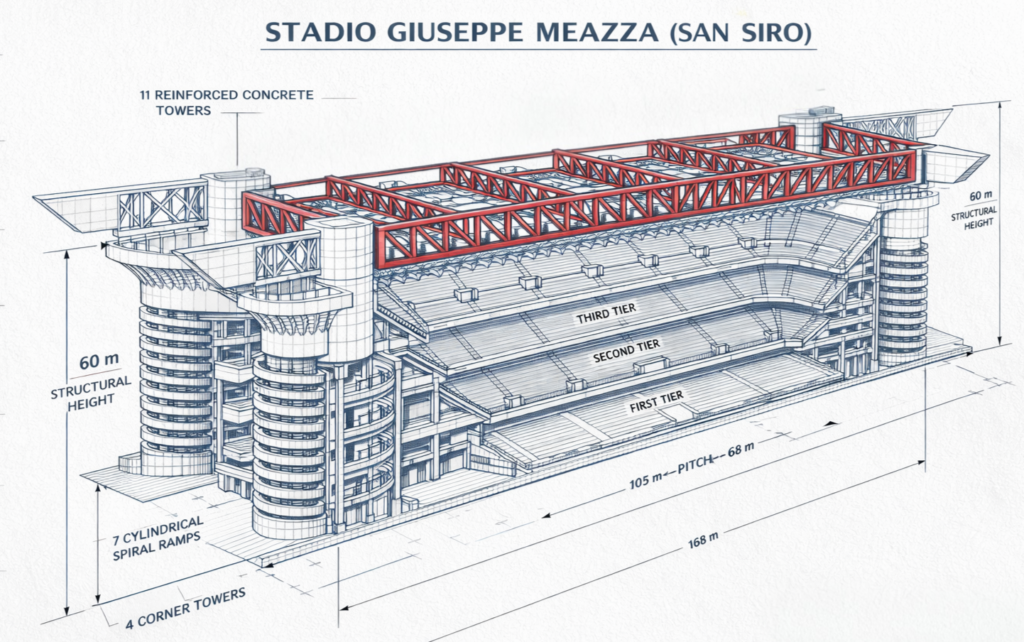
Reinforced concrete towers (4 corner + 7 intermediate)
3
Number of tiers (rings). The third ring was added specifically for the 1990 FIFA World Cup
3 600 lux
Total power and intensity of the stadium’s floodlighting system
11 000 t
Total weight of the roof’s steel structure
355 000 m²
Total surface area occupied by the entire stadium and sports complex
37 degrees
The steepness (incline) of the third-tier stands, offering one of the most vertical perspectives in world football
125 000
All-time record attendance set in 1956 during the Italy vs. Brazil match
5 000 000
Total construction cost in 1926 (in Italian lire), funded by AC Milan’s president, Piero Pirelli
197 mln €
Recent valuation of the stadium and surrounding land (as of 2025/2026 discussions)
€1,2 bln
Estimated investment cost for “The Cathedral,” the proposed new stadium to replace or stand alongside the current one
Key Questions About Stadio Giuseppe Meazza (San Siro)
Why is San Siro called “La Scala del Calcio”?
Explain the cultural connection to Teatro alla Scala and how the stadium became football’s equivalent of an opera house — a monumental stage for historic European finals and the Derby della Madonnina.
Why do AC Milan and Inter share the same stadium?
Describe the unique situation where AC Milan and Inter Milan have shared the venue since 1947, turning one building into a symbol of rivalry and urban division.
What makes San Siro architecturally unique?
Highlight its brutalist identity: exposed reinforced concrete, 11 structural towers, spiral ramps, and the red steel roof trusses added before the 1990 World Cup.
How has San Siro evolved structurally since 1926?
Outline the three major phases: original 1926 build, 1955 second tier expansion, and 1987–1990 third ring and full roof modernization.
What’s most intriguing about Stadio Giuseppe Meazza isn’t its capacity, but the structural clarity that makes its engineering fully visible. Eleven reinforced-concrete towers anchor three concentric tiers, externalizing circulation through exposed spiral ramps while carrying the loads of the upper ring and steel roof.
San Siro does not hide its structure behind glass or façade — it turns it into identity. Massive concrete cylinders and projecting red trusses frame the skyline like an industrial monument, transforming a residential district into a stage of rivalry. Here, architecture is not background to football; it is the mechanism that amplifies it.
Engineering and Structural System — Stadio Giuseppe Meazza
The original 1926 structure was conceived as a reinforced concrete bowl designed for 35,000 spectators, completed in just 13 months. The pitch measures 105 × 68 meters, conforming to FIFA standards, while the early structural grid focused on steep sightlines rather than multi-use flexibility. Even at this stage, the engineering logic prioritized proximity and load efficiency over ornament.
The 1955 expansion introduced the second ring, increasing capacity to approximately 85,000 spectators. This phase required significant reinforcement of the vertical load-bearing system, integrating new concrete frames with the original structure. The stadium’s mass and load distribution were recalculated to accommodate tens of thousands of additional live loads concentrated in the upper tiers.
Between 1987 and 1990, the most radical structural transformation occurred: the addition of the third tier and full roof coverage. The system is supported by 11 reinforced-concrete towers (4 corner towers and 7 intermediate cylindrical towers), rising to approximately 60 meters in height. These towers act as vertical circulation cores and primary structural anchors for the steel roof trusses.
Today, the stadium operates with a certified all-seater capacity of 75,817 under UEFA Category 4 standards. The roof structure spans roughly 200 meters across the bowl, providing near-total spectator coverage while transferring loads through the external tower system. San Siro’s engineering is deliberately exposed — its structure is not concealed but expressed, turning reinforced concrete and steel into architectural identity.
Economics, Revenue and Financial Impact — Stadio Giuseppe Meazza
The Pirelli Private Investment (1926) The story of San Siro began as a private financial venture rather than a public project. Piero Pirelli, the president of AC Milan and heir to the Pirelli tire empire, personally funded the construction with 5 million Italian lire. At the time, this was a massive sum for a privately owned sports facility. However, the burden of maintenance costs during the Great Depression led the club to sell the stadium to the City of Milan (Comune di Milano) in 1935 for a fraction of its replacement value. Since then, the stadium has remained a municipal asset, with the clubs acting as tenants rather than owners.
The Italia ’90 Mega-Project The most significant financial turning point occurred ahead of the 1990 FIFA World Cup. The Italian government and the city invested approximately $60 million (equivalent to over €150 million today) to add the third tier and the iconic roof. This expansion was notorious for budget overruns, a common theme in Italian public works of that era. Despite the high cost, the investment transformed San Siro from a traditional stadium into an architectural landmark, allowing for a massive increase in ticket inventory and the introduction of the first modern hospitality areas.
Current Revenue & Rental Agreement Today, the financial relationship between the city and the clubs is governed by a long-term lease. AC Milan and Inter Milan together pay an annual rent of approximately €8.5 million to €10 million to the City of Milan. While matchday revenues for high-profile Champions League matches can exceed €5 million to €9 million for a single night, both clubs argue that the stadium’s aging infrastructure limits their financial growth. Compared to modern stadiums like the Tottenham Hotspur Stadium or the Allianz Arena, San Siro lacks the premium VIP boxes and year-round commercial spaces that generate diversified income.
The €1.2 Billion Future: “The Cathedral” The financial future of the San Siro area is currently tied to a massive €1.2 billion redevelopment project known as “The Cathedral.” This investment would cover the construction of a new, state-of-the-art stadium and the transformation of the current San Siro site into a multi-use commercial and park district. The financial logic is simple: a new stadium would allow the clubs to double their matchday revenue and secure lucrative naming rights deals, which are currently restricted by the stadium’s municipal ownership and historical status.
Trivia
The Name Dispute
The stadium is officially named Stadio Giuseppe Meazza to honor a legendary player who starred for Inter. However, AC Milan fans often prefer the original name, San Siro, which refers to the district where it stands. This duality remains one of the most famous naming quirks in world football.
The Shared Home
San Siro is one of the few elite stadiums globally shared by two massive rivals, AC Milan and Inter Milan. The two clubs have split the rent and the pitch since Inter moved in back in 1947. This arrangement creates a massive logistical challenge for groundskeepers during busy league weeks.
The Iron Giant
The massive steel roof added for the 1990 World Cup weighs a staggering 11,000 tons. This structure is significantly heavier than the entire iron frame of the Eiffel Tower in Paris. It remains a masterpiece of late 20th-century sports engineering.
The Eleven Towers
The cylindrical towers surrounding the stadium are not just for show; they are structural necessities. They support the entire weight of the third tier and the roof without touching the original 1926 structure. These towers also house the iconic spiral ramps that fans use to reach the top.
The Cathedral of Football
The stadium is frequently nicknamed “La Scala del Calcio,” a nod to Milan’s world-famous opera house. This title reflects the prestige and the operatic drama that takes place within its concrete walls. Every professional player considers walking out of its tunnel a career milestone.
Reggae History
In 1980, San Siro hosted its first-ever major musical concert featuring the legendary Bob Marley. Over 80,000 people packed the stands, setting a record for a musical event in Italy at that time. This historic night proved the stadium could function as a premier global entertainment hub.
Sunlight Struggles
Because of the steep stands and the massive roof, the pitch rarely receives enough direct natural sunlight. For years, the grass had to be replaced multiple times per season at a massive cost. Today, a high-tech hybrid grass system and 24/7 grow lights are used to solve this issue.
Boxing in the Arena
Surprisingly, the football pitch once transformed into a massive outdoor boxing ring in 1960. Duilio Loi fought Carlos Ortiz for the world title in front of an incredible crowd of spectators. It remains one of the most unique and successful non-football sporting events in the stadium’s history.
Rapid Construction
The original version of the stadium was built in a remarkably short period of just over thirteen months. It was a private project funded by AC Milan’s president to create a dedicated “pure” football ground. Unlike other Italian stadiums of that era, it was built without an athletics track.
The Dizzying Third Ring
The third tier was added specifically for the 1990 World Cup to maximize capacity for the tournament. It is famous for its incredibly steep incline, providing fans with a bird’s-eye view of the pitch. This addition gave the stadium its distinctive “spaceship” silhouette that defines the Milanese skyline.
The First Museum
San Siro was the first stadium in Italy to open an internal museum dedicated to the history of its resident clubs. It features an extensive collection of original jerseys, trophies, and rare memorabilia from both Milan and Inter. The museum has since become one of the most visited tourist spots in the city.
The Uncertain Future
Despite its iconic status, there are ongoing plans to build a new, modern facility called “The Cathedral.” The current structure faces potential demolition or a massive repurposing to make room for new commercial zones. Preservationists and fans worldwide are currently fighting to save the historic concrete giant.