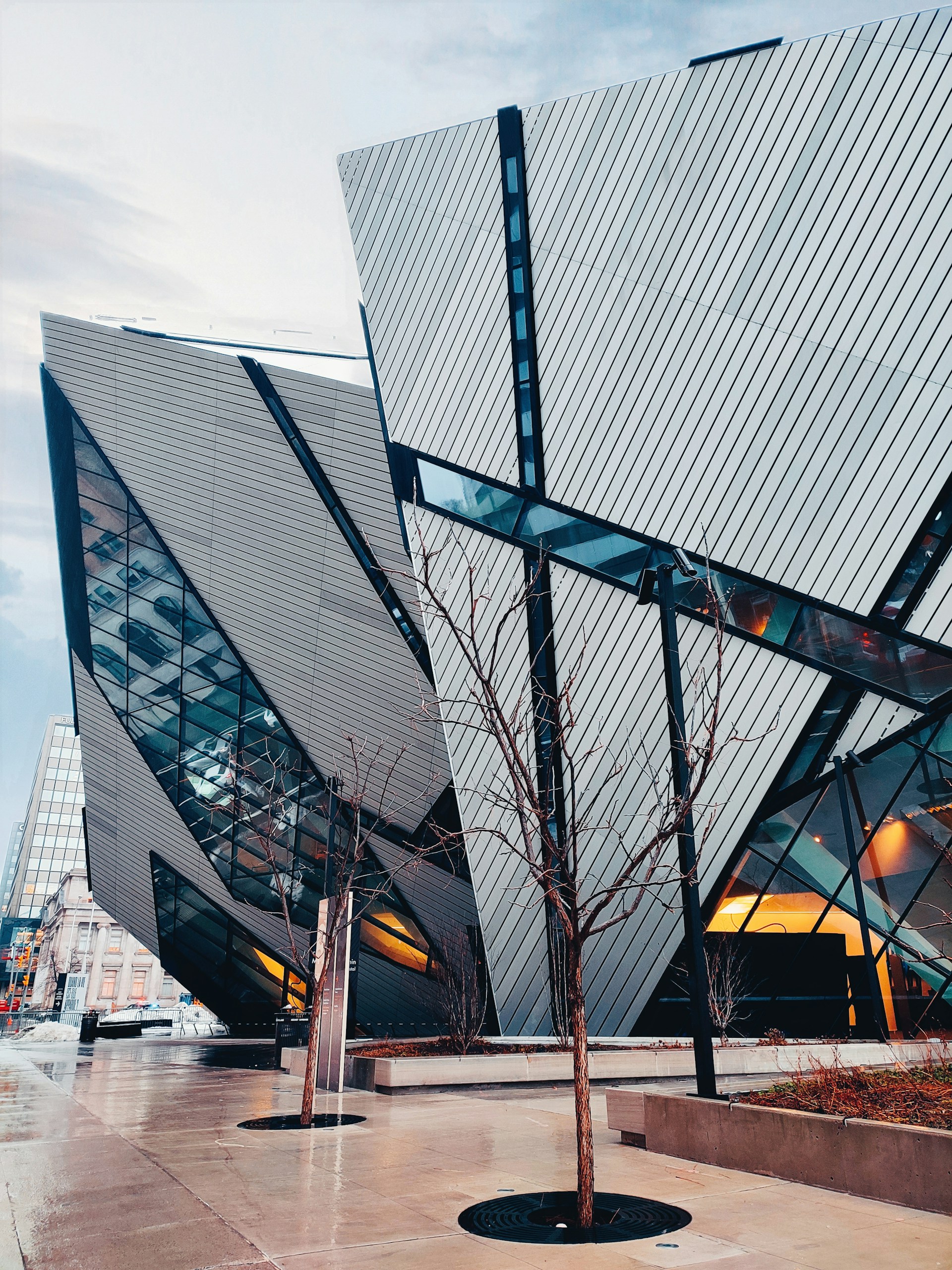

A museum where historic masonry collides with deconstructivist geometry — redefining how cities expand their cultural institutions
The Royal Ontario Museum (ROM) in Toronto is not merely a container of artifacts — it is itself an artifact of architectural evolution. Located at the edge of Queen’s Park in the heart of the city, the museum represents more than a century of expansion, ambition, and debate about what cultural architecture should look like in the 21st century.
Founded in 1914, the ROM began as a dignified, symmetrical structure in the Neo-Romanesque style — solid, institutional, and intentionally timeless. For decades, it functioned as a traditional encyclopedic museum, growing steadily in both collection and influence. Today, it houses over 13 million objects spanning natural history, world cultures, and art, making it one of the largest museums in North America.
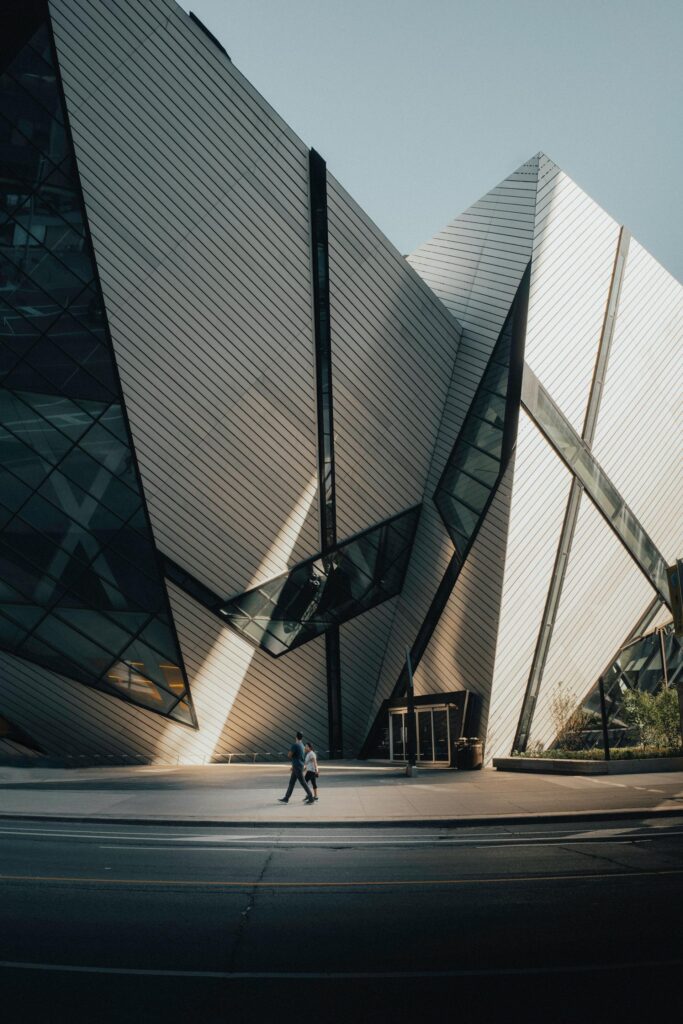
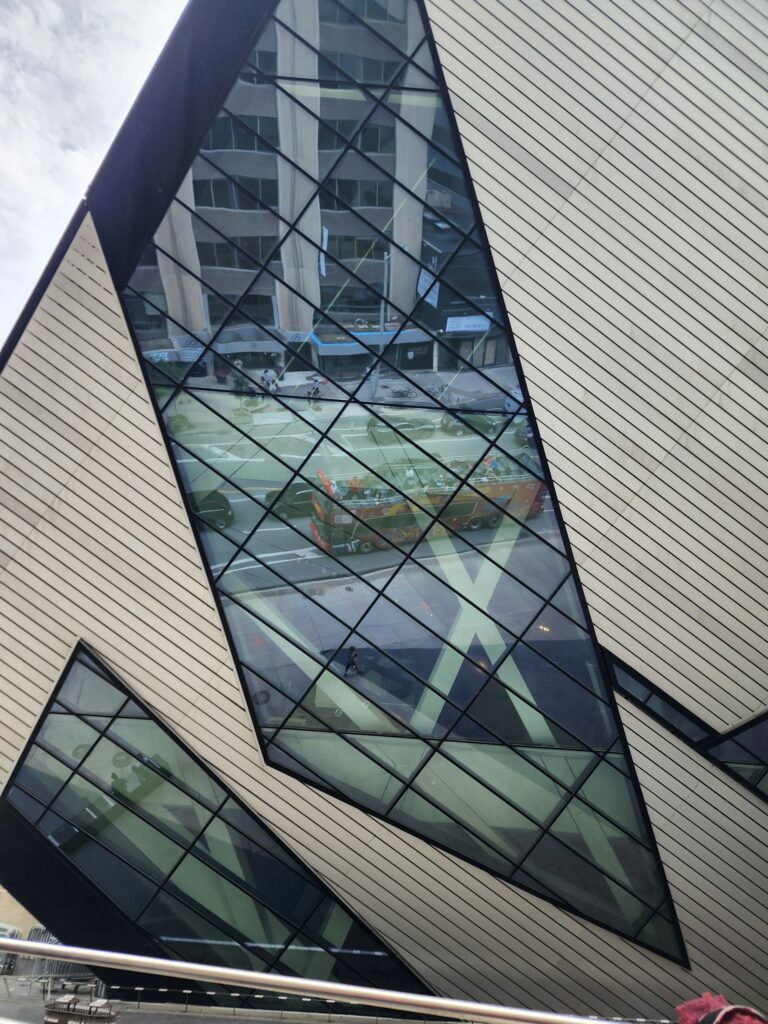
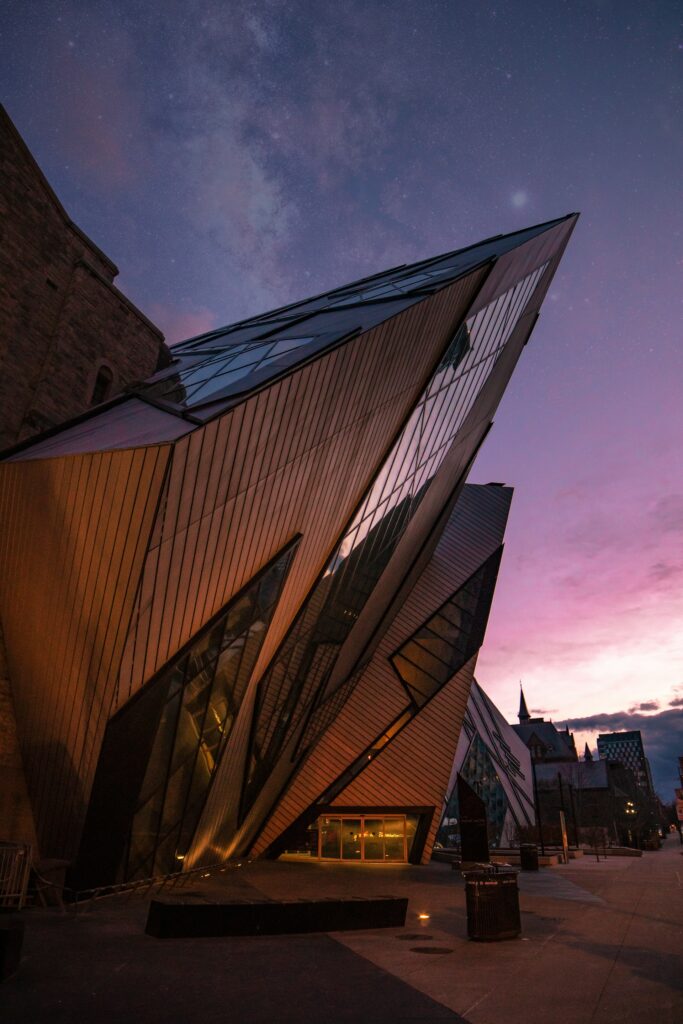
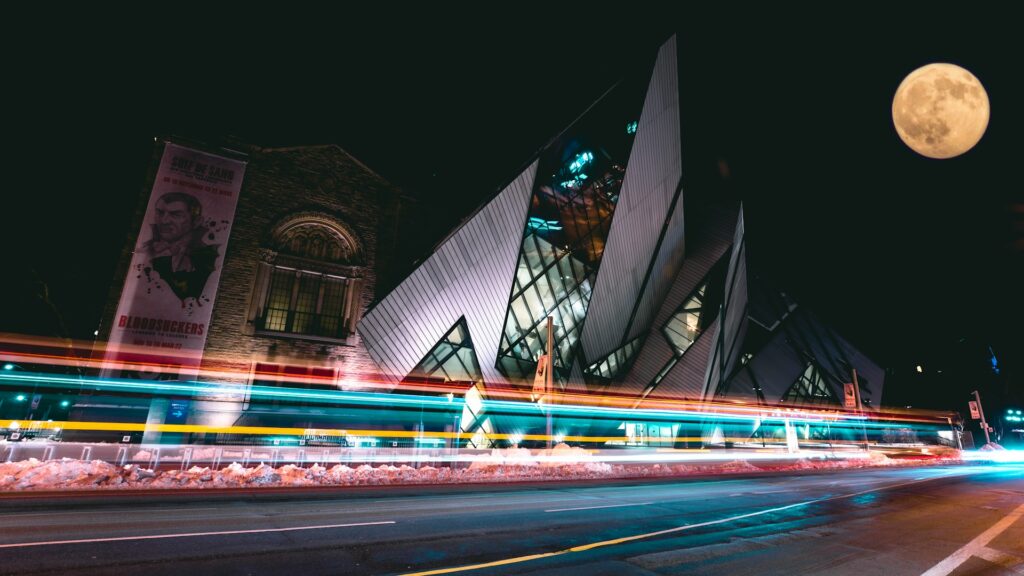
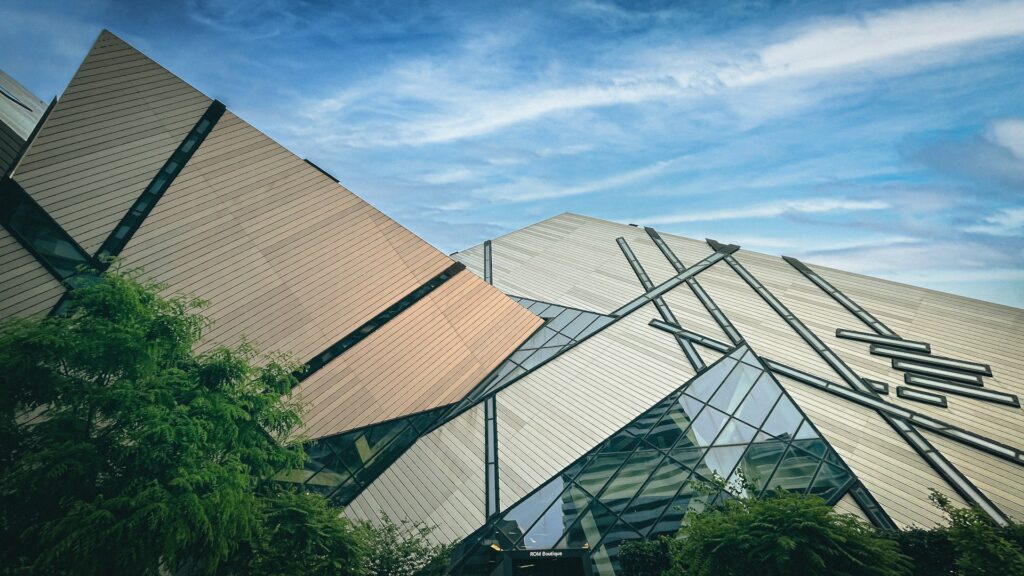
But what transformed the Royal Ontario Museum from a respected institution into a global architectural conversation piece was its radical 2007 expansion: the Michael Lee-Chin Crystal. Designed by architect Daniel Libeskind, the addition ruptured the orthogonal calm of the original building with angular aluminum and glass volumes that seem to explode outward into the city. It is an intervention that rejects quiet continuity in favor of tension — between old and new, masonry and metal, symmetry and fragmentation.
This deliberate architectural collision sparked international debate. Was it visionary or disruptive? Contextual or confrontational? Regardless of perspective, the Crystal redefined the museum’s identity and repositioned it within Toronto’s rapidly evolving skyline. The Royal Ontario Museum became not just a place to view history, but a case study in how institutions adapt to contemporary urban and cultural pressures.
Today, the ROM stands as a layered structure — part heritage monument, part deconstructivist sculpture — reflecting both the permanence of knowledge and the instability of architectural trends. It is a building that forces visitors to engage with space before they even step inside.
If museums traditionally preserve the past, the Royal Ontario Museum demonstrates how architecture can project an institution boldly into the future.
Royal Ontario Museum in Numbers
13 000 000+
The total number of objects and specimens in the museum’s collections
1912
The year the museum was formally established (it opened to the public in 1914)
1 350 000
The average number of visitors the ROM welcomes annually (pre-2020 peak)
1st
Its rank as the largest museum in Canada and one of the largest in North America
19 880 m²
Total gallery space
40
The number of separate galleries and exhibition spaces
3 500
The amount of structural steel, in tons, used to build the Crystal
25%
The percentage of the Crystal’s exterior that is glass (the rest is brushed aluminum)
27
The length in meters of “Gordo,” the Barosaurus. He is the largest dinosaur skeleton on permanent display in Canada
4 500 000 000
The age in years of the oldest item in the museum (the Tagish Lake meteorite)
3
major architectural phases – 1914, 1933, 2007
$270 000 000
The cost (in CAD) of the “Renaissance ROM” renovation project, which included the famous Michael Lee-Chin Crystal
What’s most intriguing about the Royal Ontario Museum isn’t its size, but the structural precision that allows the angular volumes of the Michael Lee-Chin Crystal to intersect with a century-old masonry building without destabilizing it. Rather than extending the museum conventionally, the design fractures its edge into sharply inclined steel-and-glass prisms that redistribute loads through an irregular yet carefully engineered frame, all while preserving the integrity of the original 1914 structure. The result is not about vertical dominance, but about calculated tension — a deliberate architectural collision that transforms the museum into an urban landmark and redefines how cultural institutions project identity into the city.
Engineering Fragmentation: Structure, Geometry, and Urban Integration
The architectural concept of the Michael Lee-Chin Crystal, designed by Daniel Libeskind, is rooted in controlled fragmentation. Rather than treating the expansion as a subordinate wing, Libeskind conceived it as five interlocking prismatic volumes that appear to collide with the historic masonry structure. This deliberate tension between old and new rejects seamless continuity in favor of contrast. The geometry is not decorative — it drives spatial organization, circulation, and structural behavior, forcing visitors to experience architecture as movement through angled planes rather than neutral rectangular rooms.
From an engineering perspective, the challenge was stabilizing an asymmetrical steel frame wrapped in aluminum and glass while connecting it to a load-bearing early-20th-century building. The Crystal’s irregular form required a complex network of steel trusses and nodes, each digitally modeled to calculate precise force distribution. Because many walls are inclined rather than vertical, gravity loads do not travel in predictable straight lines, demanding advanced structural analysis and custom-fabricated components. The façade itself functions as a lightweight enclosure system, balancing transparency with thermal performance in Toronto’s extreme climate conditions.
Equally significant is the urban engineering logic of the project. Built on a constrained site along Bloor Street, the addition had to expand gallery space without disrupting surrounding infrastructure or overwhelming the historic context. The Crystal redefines the museum’s threshold condition: its sharp edges project outward, creating a dynamic public interface that blurs the boundary between sidewalk and institution. In this way, the project demonstrates that contemporary cultural architecture is not only about form-making, but about negotiating structural risk, historical preservation, and urban identity simultaneously.
From Provincial Collection to Global Cultural Institution
The Royal Ontario Museum was founded in 1914, during a period when Toronto was emerging as a serious academic and cultural center. Established through a partnership with the University of Toronto and the provincial government, the museum initially focused on natural history, archaeology, and world cultures. Its original Neo-Romanesque building reflected early 20th-century institutional confidence — symmetrical, monumental, and intentionally timeless. From the beginning, the museum was conceived not just as a display space, but as a research institution serving the entire province of Ontario.
During the 20th century, the ROM expanded both physically and intellectually. Major additions in the 1930s and later decades mirrored the growing scale of its collections. Field expeditions, academic partnerships, and global acquisitions steadily transformed it into one of North America’s most comprehensive encyclopedic museums. By mid-century, it had developed internationally respected departments in paleontology, mineralogy, Asian art, and Near Eastern archaeology, positioning Toronto within global scholarly networks.
One of the museum’s defining strengths lies in its natural history collections. The dinosaur galleries, featuring towering mounted skeletons and rare fossil specimens, remain among its most visited attractions. The ROM houses extensive paleontological material from Canada’s fossil-rich regions, particularly Alberta, making it a key institution for research on prehistoric life. Its mineral and gem collection — including large crystals, meteorites, and rare specimens — further reinforces its scientific identity.
Equally significant are its cultural and artistic collections, which span ancient civilizations and contemporary global cultures. From Egyptian mummies and classical antiquities to East Asian temple art and Indigenous Canadian artifacts, the museum presents over 13 million objects and specimens. This breadth reflects a 20th-century encyclopedic model of collecting — ambitious, sometimes controversial, but undeniably comprehensive. Today, the ROM continues to reinterpret these holdings through updated curatorial narratives, ensuring that its historic collections remain relevant within contemporary cultural discourse.
Trivia
The Crystal’s Controversy
When the Michael Lee-Chin Crystal was unveiled in 2007, it sparked an intense public debate in Toronto. Many residents felt the sharp, geometric aluminum and glass structure clashed horribly with the original 1914 neo-Romanesque architecture. Today, however, it has become one of the most recognized and iconic silhouettes on the city’s skyline.
The Tallest Resident
The museum is home to “Gordo,” an incredibly impressive 27-meter-long Barosaurus skeleton. He is the largest dinosaur on permanent display in Canada, towering over the gallery floor. Standing beneath him, visitors can truly appreciate the sheer scale of these prehistoric giants.
A Fragile Treasure
The museum houses the world’s largest collection of artifacts from the tomb of the Egyptian priest Amenemhat. These items offer an intimate glimpse into daily life and funerary rituals from over 3,000 years ago. It is considered a cornerstone of the museum’s extensive Ancient Egypt gallery.
The Meteorite Collection
The ROM possesses one of the finest meteorite collections in the world, including the famous Tagish Lake meteorite. This space rock fell to Earth in 2000 and is considered a “pristine” sample, providing vital clues about the origins of our solar system. Researchers flock to the museum specifically to study these ancient extraterrestrial materials.
Architectural Contrast
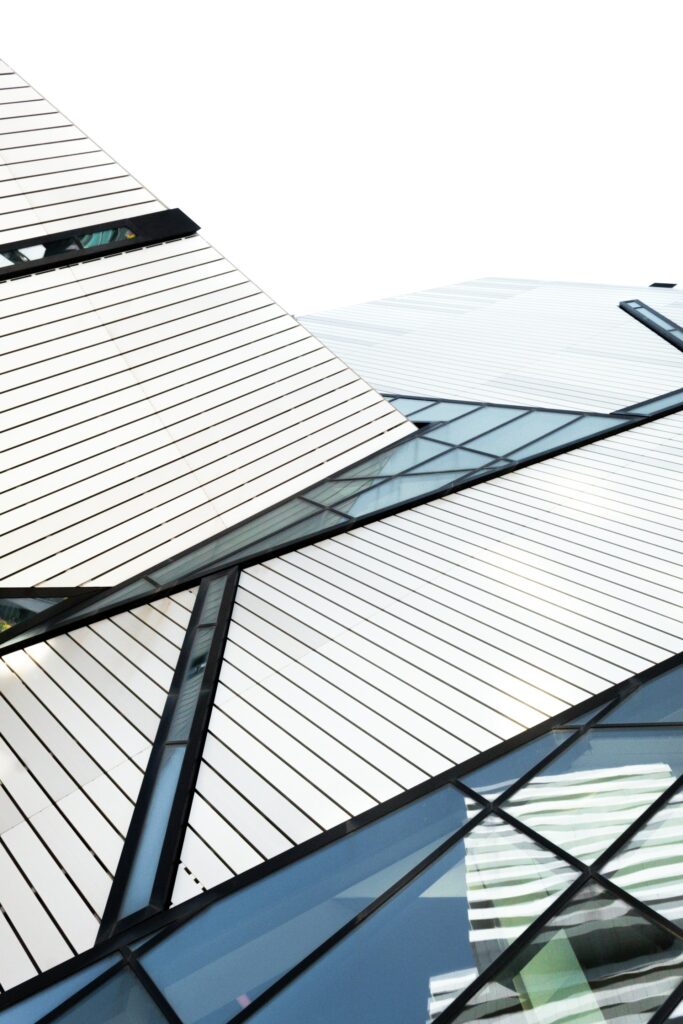
The original heritage building is constructed from credit valley stone, giving it a classic, heavy appearance. By contrast, the newer Crystal addition is clad in brushed aluminum and glass, creating a deliberate visual tension. Walking from the old wing into the new wing feels like traveling through time.
Bat Cave Legacy
The ROM is famous for its long-standing “Bat Cave” exhibit, which has been a staple for school children for generations. It features a painstakingly detailed replica of the St. Clair Cave in Jamaica, complete with over 3,000 model bats. It remains one of the most beloved and immersive experiences in the museum’s history.
Global Research Hub
Beyond being a public display space, the ROM is a massive research institute with a global footprint. Its curators and scientists travel to remote corners of the world to conduct fieldwork, from the deserts of Mongolia to the deep oceans. These expeditions constantly feed new discoveries directly back into the gallery exhibits.
Imperial Splendor
The museum holds a magnificent collection of Chinese imperial artifacts, including stunning textiles and ceramics. Among these is a rare and beautifully preserved set of ritual bronzes dating back thousands of years. It is widely regarded as one of the best collections of Chinese art outside of Asia.
The Natural History Scope
The museum’s biology department houses millions of specimens, ranging from tiny insects to massive whale skeletons. This vast archive serves as an essential reference library for scientists studying biodiversity and climate change. It proves that the museum is as much about the living world as it is about history.
Underground Connections
The museum is directly connected to the Toronto subway system via the Museum Station. The station itself was renovated to reflect the museum’s architecture, featuring pillars designed to look like artifacts from different cultures. It provides a seamless transition from the busy city streets into the quiet halls of history.
Indigenous Recognition
The ROM has made a concerted effort to deepen its relationships with Indigenous communities across Canada. This has led to galleries that feature contemporary Indigenous art displayed alongside ancient cultural objects. These spaces act as a platform for storytelling and dialogue rather than just passive viewing.
Rare Gemstones
The Canadian Mining Hall of Fame is essentially housed within the museum, reflecting the country’s deep ties to geology. The Earth Sciences gallery showcases a breathtaking array of rare minerals and gemstones, some of which are unique to Canada. It is a glittering reminder of the geological treasures hidden beneath the earth’s surface.