
The Geometric Heart of Rome: The Pantheon
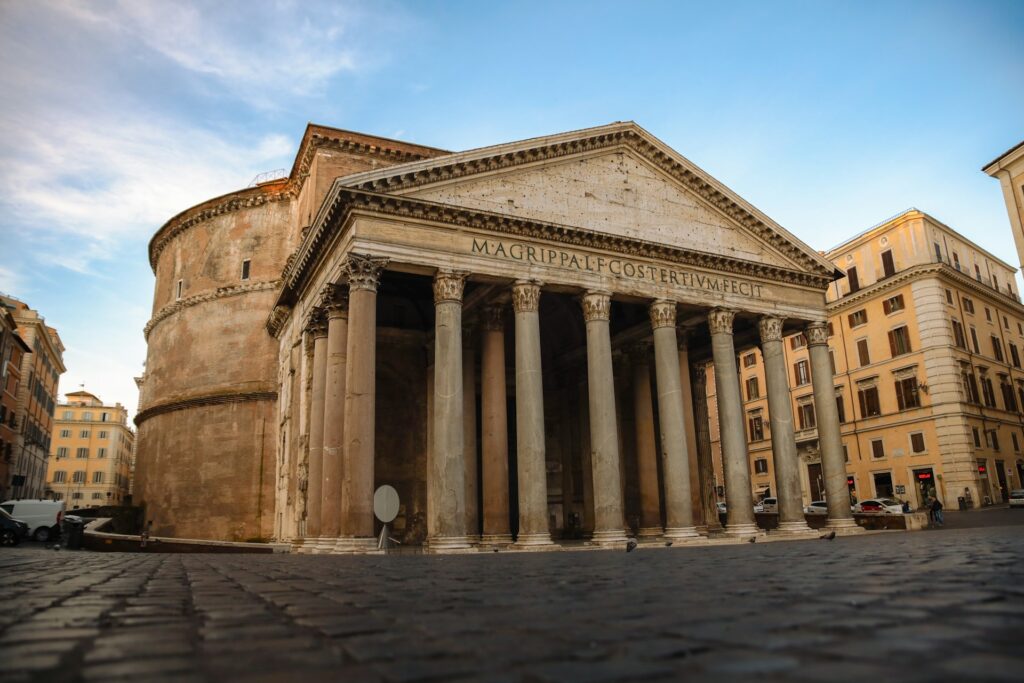
The Pantheon in Rome is one of the rare buildings in history that does not belong to a single era. It is ancient, medieval, Renaissance, and modern at the same time — not because it was rebuilt, but because its logic never became obsolete. empire Whiles collapsed and construction techniques were forgotten, the Pantheon remained structurally untouched, continuing to function exactly as its builders intended nearly two millennia ago.
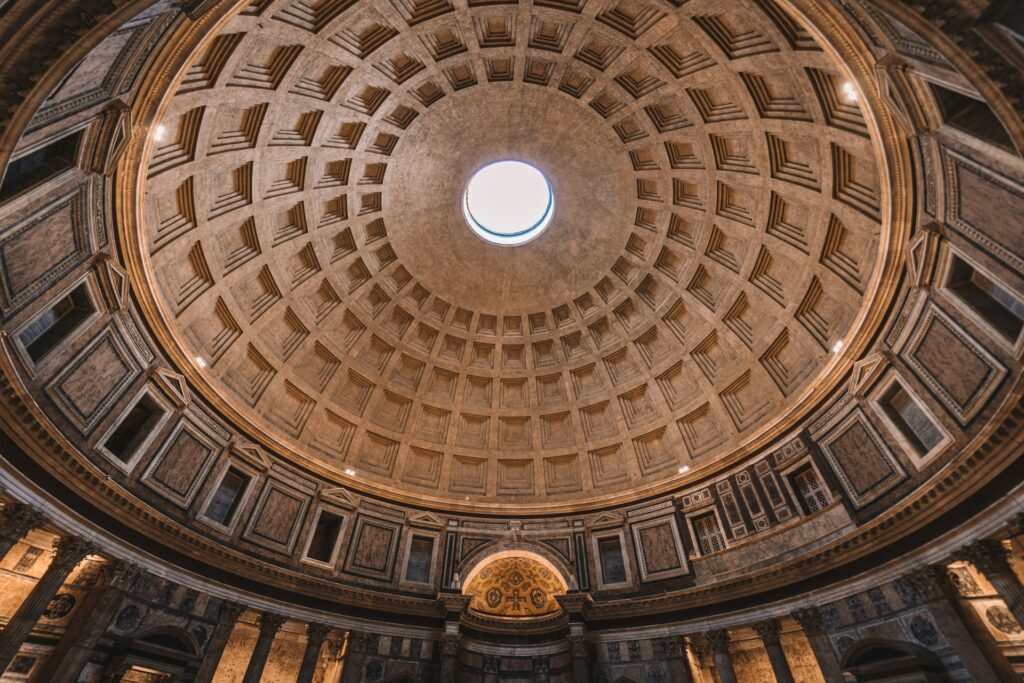
What makes the Pantheon exceptional is not decoration, scale, or symbolism alone, but the radical clarity of its idea. The building is conceived as a complete geometric system: a perfect sphere inserted into a cylinder, intersected by a single circular opening to the sky. Architecture here is reduced to fundamental relationships — diameter equals height, mass follows gravity, light becomes material. Nothing is accidental, and nothing is hidden.
Unlike most ancient monuments, the Pantheon does not tell a story through reliefs or statues. It communicates through numbers, proportions, and physics. Its concrete dome, still the largest unreinforced concrete dome ever built, is not a feat of brute force but of precise material intelligence.
The interior space is cosmic rather than monumental. Standing inside, the visitor is not confronted by the building but absorbed by it. The oculus acts simultaneously as sun, clock, compass, and symbolic connection between earth and sky. Time, weather, and movement are allowed inside, turning architecture into a living system rather than a static object.
In the context of architectural history, the Pantheon is not a predecessor — it is a benchmark. Brunelleschi studied it before designing the dome of Florence Cathedral. Michelangelo considered it a work beyond human capability. Even today, engineers analyze it not to imitate its form, but to understand how such a structure could exist at all.
This is not a building that impresses through excess.
It convinces through inevitability.
The Pantheon in Numbers
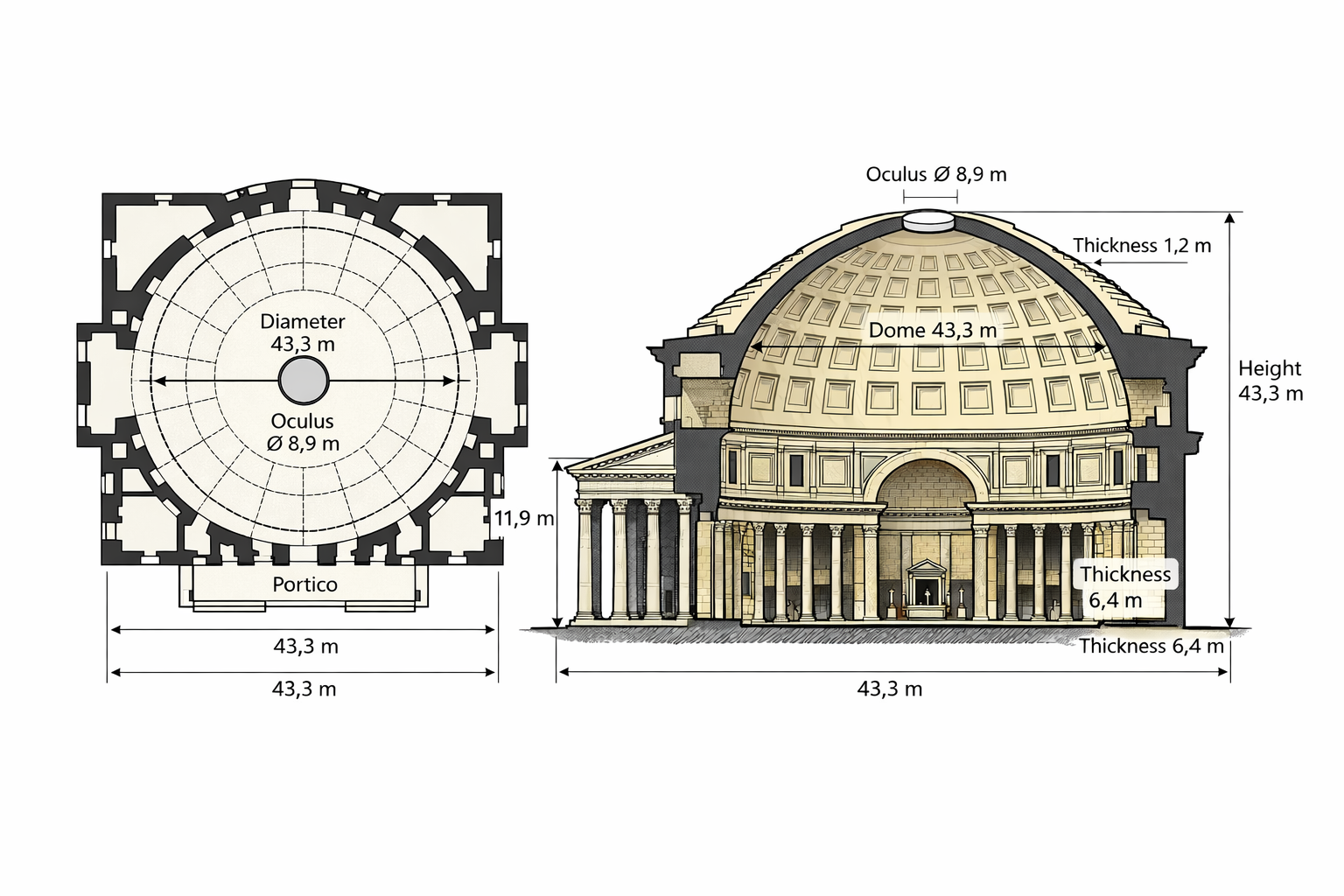
43,30 m
Internal diameter of the rotunda and Internal height
0 %
Reinforcement
8,92 m
Diameter of the oculus
140
Number of coffers in the dome
60 t
The weight of each of the 16 Corinthian columns
1,20 m
Thickness of the dome at the oculus
4 000 km
The approximate distance Corinthian columns traveled
7
Layers of Concrete
What’s most intriguing about this building isn’t its size or age, but the absolute precision of its geometry.
The Pantheon doesn’t occupy space as much as it contains it — a perfect sphere inscribed within a cylinder, where architecture becomes a physical model of the cosmos, turning light, gravity, and proportion into a single, timeless idea.
The structural phenomenon of the Pantheon in Rome
The Pantheon, built in its present form during the reign of Emperor Hadrian around 125 CE, is not only the best-preserved monument of ancient Rome but, above all, one of the greatest engineering feats in human history. Its durability is not the result of chance or excess material, but the result of precise design decisions that remain the subject of analysis by architects and engineers to this day.
Analyzing the structure of the Pantheon, one can distinguish ten key structural aspects that, together, ensured the building survived for almost two millennia without reinforcement or load-bearing reconstruction.
The first and fundamental element is the composition of Roman concrete. The use of volcanic ash, or pozolana, endowed the material with unique chemical properties. Upon contact with water, microcracks undergo a mineralization process, resulting in a phenomenon now known as “self-healing concrete.” This not only prevents the structure from weakening over time but also locally restores its integrity.
The second key solution is the weight differentiation of the materials in the dome. The Romans used concrete with variable densities – from heavy stone aggregates at the base to lightweight pumice at the top. This material gradient significantly reduces the loads acting on the lower sections of the structure while maintaining adequate compressive strength.
Another element of weight reduction is the dome’s coffers. Their number – 140 – is not accidental. These geometric recesses are not merely aesthetic, but allow for the removal of hundreds of tons of unnecessary concrete from areas that do not bear crucial loads.
The fourth aspect is the smoothly varying thickness of the dome. From approximately 6.4 meters at the base to a mere 1.2 meters at the oculus, the thickness gradually decreases. The lack of abrupt changes in cross-section eliminates stress concentrations and ensures a uniform flow of forces.
The central oculus, with a diameter of nearly 9 meters, serves a much more important function than simply serving as a light source. Structurally, it eliminates the most vulnerable point of the dome – its crown – where tensile stresses could arise. Thus, it acts as a natural “safety valve” for the structure.
The enormous cylindrical rotunda, with walls up to 6 meters thick, provides a continuous buttress for the dome. It absorbs horizontal expansion forces and directs them safely to the foundations. Niches and chapels are carved into its interior, without interrupting the main load-bearing path.
A system of brick-built load-bearing arches is concealed within the rotunda’s walls. Although invisible to the user, they act as an internal skeleton, distributing the dome’s weight across eight main load-bearing zones.
The foundations themselves are another example of engineering precision. Constructed as a massive concrete ring, approximately 4.5 meters deep, they act as a stabilizing raft on the soft soil of the Campus Martius, preventing uneven settlement of the building.
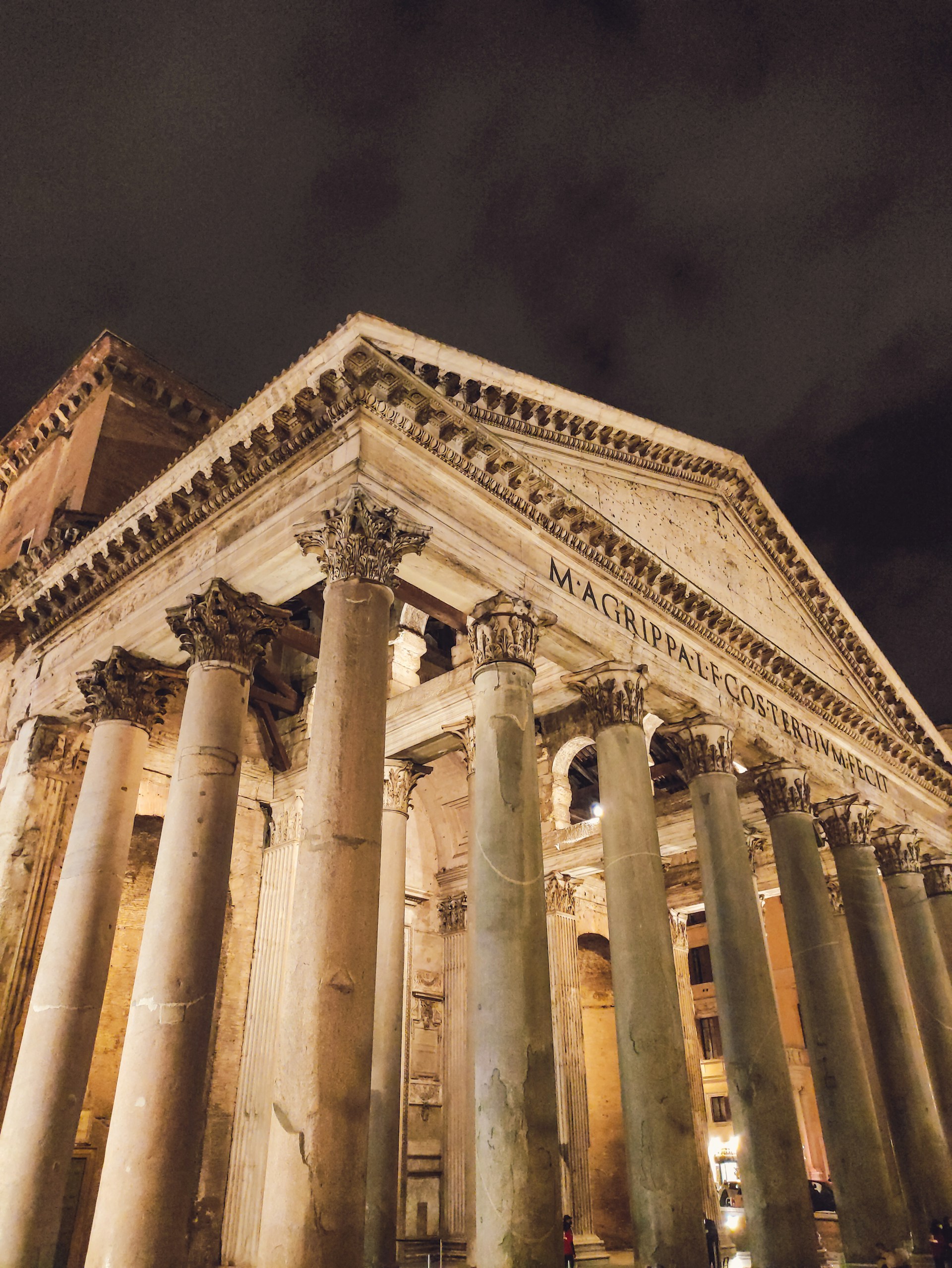
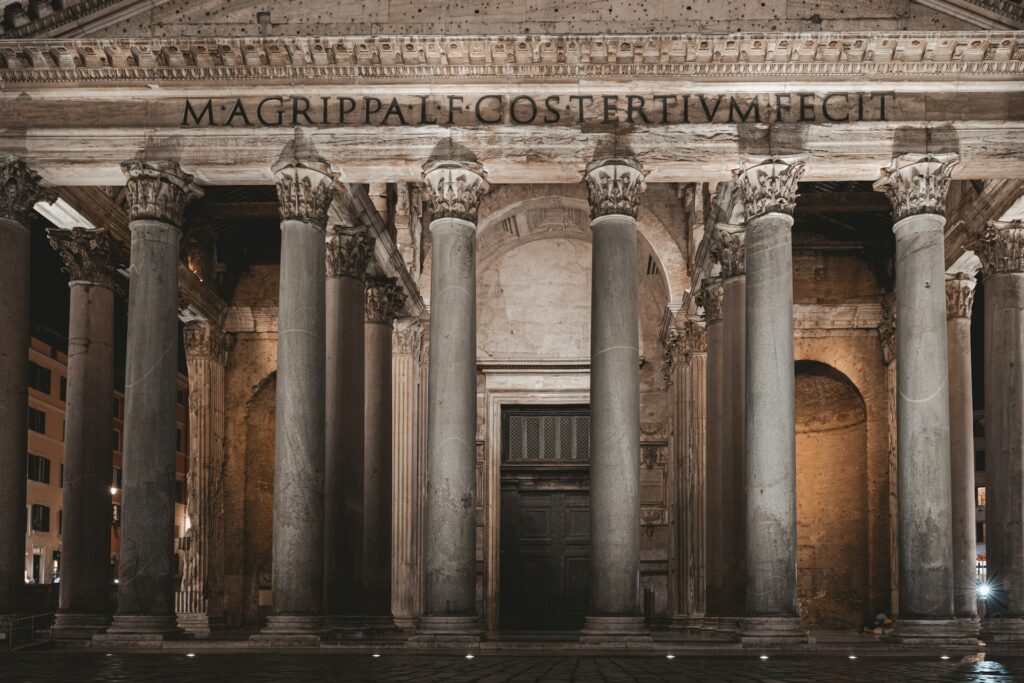
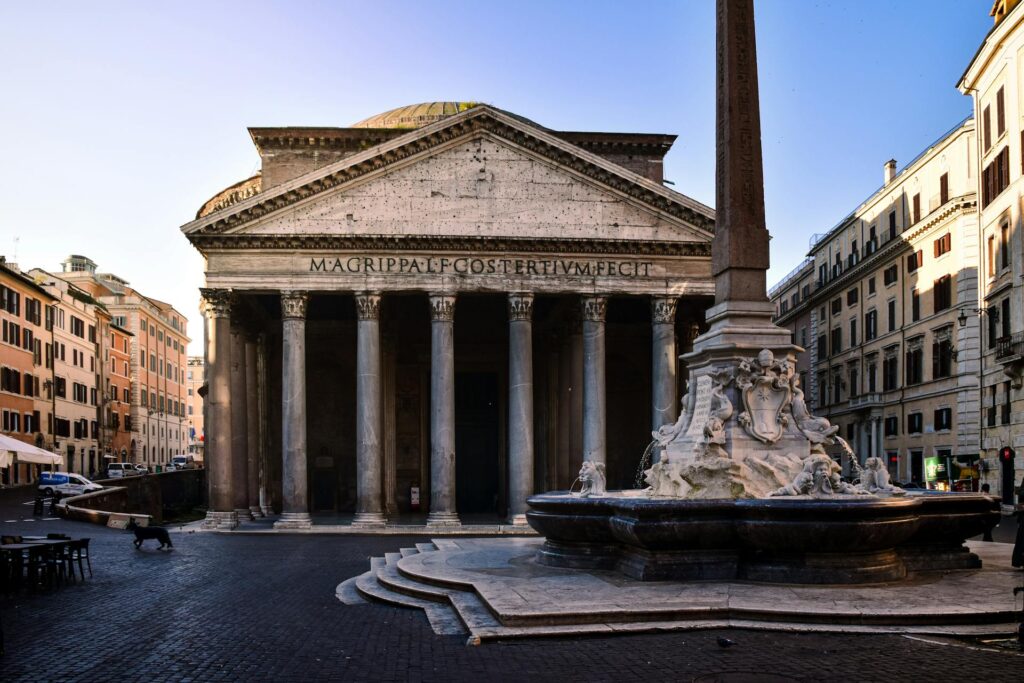
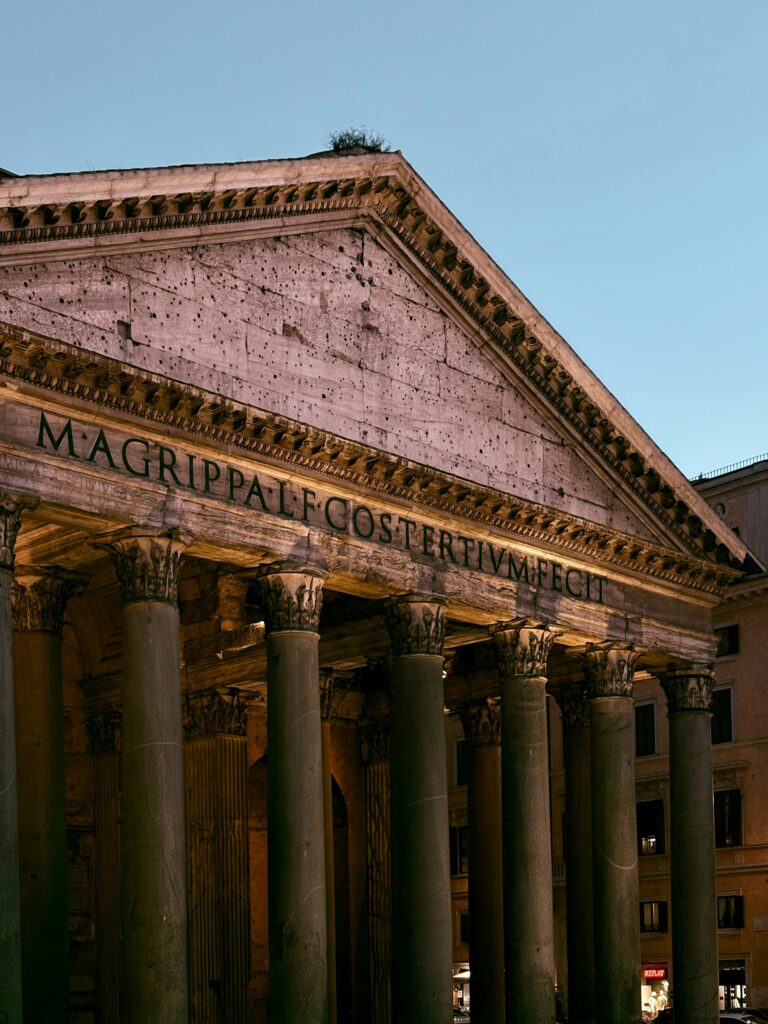
An interesting design feature is the entrance portico, which, despite its visual connection, is structurally independent of the rotunda. The mismatched columns, some 3 meters shorter than the original design, are likely the result of logistical problems during transport from Egypt. Each weighs approximately 60 tons and was constructed as a single monolith.
The final, often overlooked element is the original bronze door. Despite its enormous weight, it was so precisely balanced that it can be opened without significant force. Combined with the natural air circulation and floor drainage system—with 22 hidden drains—these demonstrate the complex approach the Romans took to building functionality.
Trivia
The Inscription Mystery
Although the current structure was built by Emperor Hadrian, the facade bears the name of Marcus Agrippa. In a rare act of imperial modesty, Hadrian chose to honor the builder of the original temple that had burned down on the same site years earlier.
Survival Through Faith
The Pantheon avoided being dismantled for building materials because it was converted into a church in 609 AD. Byzantine Emperor Phocas gifted the temple to Pope Boniface IV, a move that effectively protected the ancient structure from destruction.
The Great Bronze Looting
In 1627, Pope Urban VIII (of the Barberini family) stripped the bronze plating from the portico ceiling to melt it down for cannons and the canopy in St. Peter’s Basilica. This sparked the famous Roman saying: “What the barbarians didn’t do, the Barberini did.”
The Rain of Roses
Every year on Pentecost Sunday, a spectacular tradition takes place inside the temple. Firemen climb to the top of the dome and drop thousands of red rose petals through the oculus, symbolizing the descent of the Holy Spirit.
A Temple for All Gods
The name comes from the Greek words pan (all) and theos (gods). It was originally intended as a sanctuary for all Olympian deities, reflecting the religious diversity and universal power of the Roman Empire.
A model for Renaissance architects
Filippo Brunelleschi studied the Pantheon before designing the dome of Florence Cathedral. Michelangelo famously described it as “the work of angels, not of men.”
The Lost Golden Roof
In antiquity, the exterior of the dome was not bare concrete but sparkled in the sun, covered in gilded bronze tiles. These tiles were looted in the 7th century by Emperor Constans II, who intended to take them to Constantinople, though they were ultimately stolen by pirates.
The interior was interpreted as a model of the cosmos.
The seven niches were associated with the seven known celestial bodies of antiquity. The dome symbolized the heavens, while the floor represented the earth.