A Wall That Carries Power — Brick Structure, Stone Skin, and the Arithmetic of Scale
The Palace of Culture and Science is a building that does not try to please. It does not engage in dialogue with the city—it organizes it. Its scale does not result from urban planning, but from the arithmetic of power: height, mass, and repetition. It is architecture that does not use detail, but numbers as a tool of domination.
Designed as a gift, functioning as a symbol, the Palace of Culture is one of the few buildings in Europe whose political, social, and spatial significance can be described almost exclusively through technical parameters.
The building was constructed between 1952 and 1955 according to a design by Lev Rudnev as an export model of a socialist realist skyscraper—a hybrid of American high-rise typology and Soviet monumentality. The form is based on the principle of gradual recessing of the structure, known from Moscow’s “Seven Sisters,” but has been scaled down to fit the center of a European capital.
The palace is not a skyscraper in the classical sense. It is a vertical city: a conglomerate of halls, theaters, institutions, offices, and technical infrastructure, enclosed in a single, redundant structure.
The most interesting thing about the Palace of Culture is not how it looks, but how it functions on a city scale. Its proportions are not based on human perspective – they are calculated for visibility from kilometers away. Every detail of the façade is subordinated to repetition: the window as a module, the storey as a unit, the height as a message.
It is a building that does not age stylistically because it was never fashionable. Its durability stems from excess: material, structure, meaning.
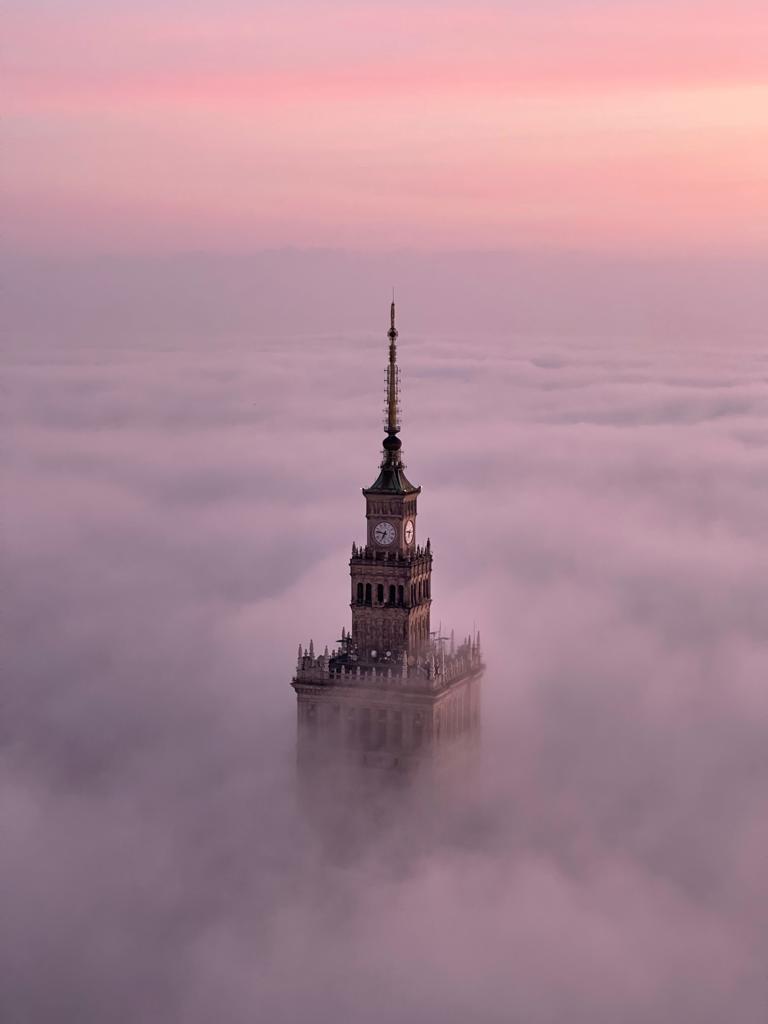
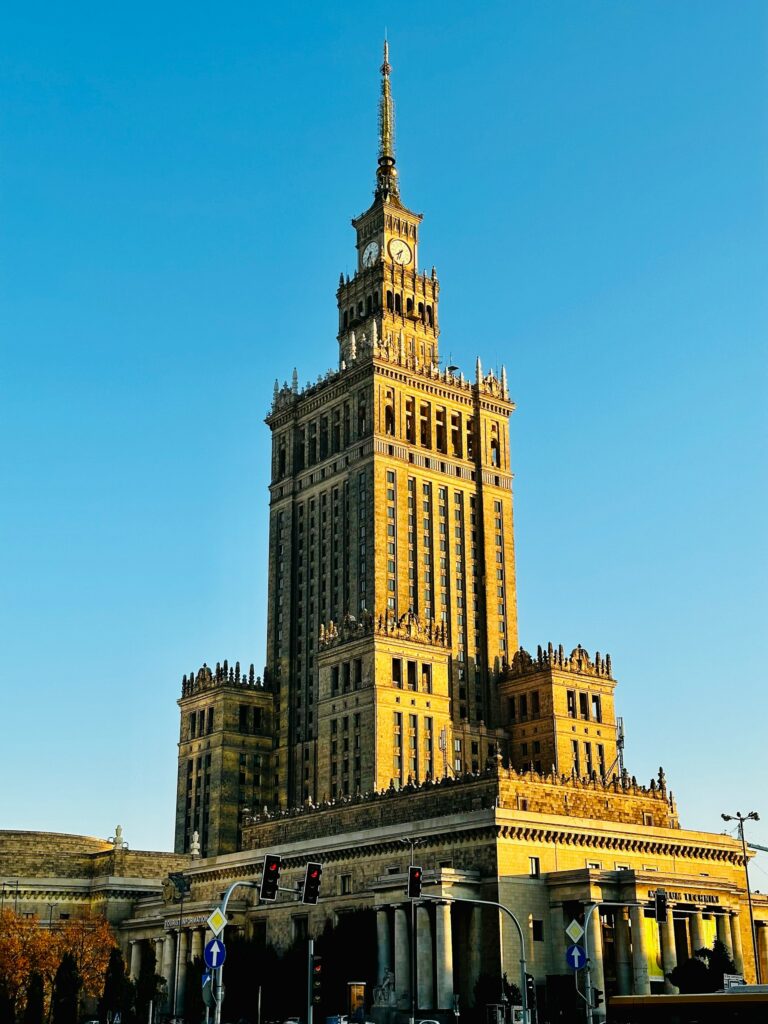
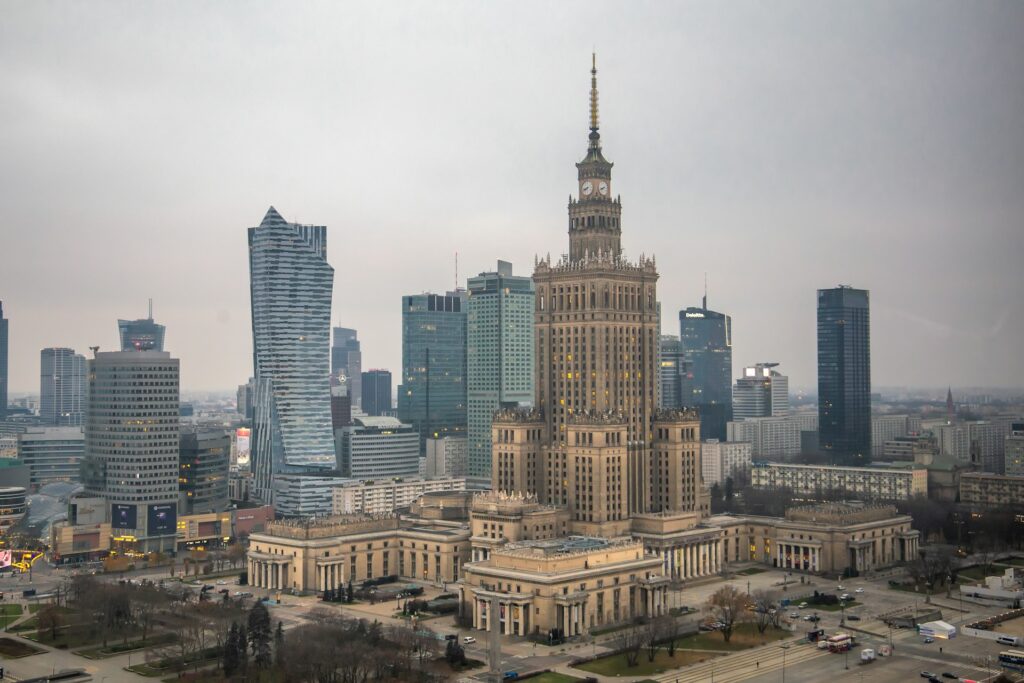
Palace of Culture and Science in Numbers
230 m
Total height including the spire
46,63 m
Height of the spire
550
The number of sculptures and architectural details decorating the facade and interiors
3 288
Number of rooms inside the building
1 100 000 m³
Total volume of the building
1175
That’s how many days the construction lasted (from May 2, 1952 to July 21, 1955)
40 mln
Number of bricks used for construction
~7 000 m²
Total façade glazing area
~75,000 m²
Approximate total area of ceramic and stone façade panels
42
Number of levels
26 000 t
Weight of the steel structure (frame)
1 177 days
The total span of time it took to finish this colossus
What’s most intriguing about this building isn’t its height, but the structural wall system that allows a 1950s masonry-and-concrete giant to behave like a single, unified mass. The Palace of Culture and Science turns load-bearing brick walls and a non-structural stone and ceramic skin into an instrument of scale, using thickness, repetition, and weight to impose order on the city rather than respond to it.
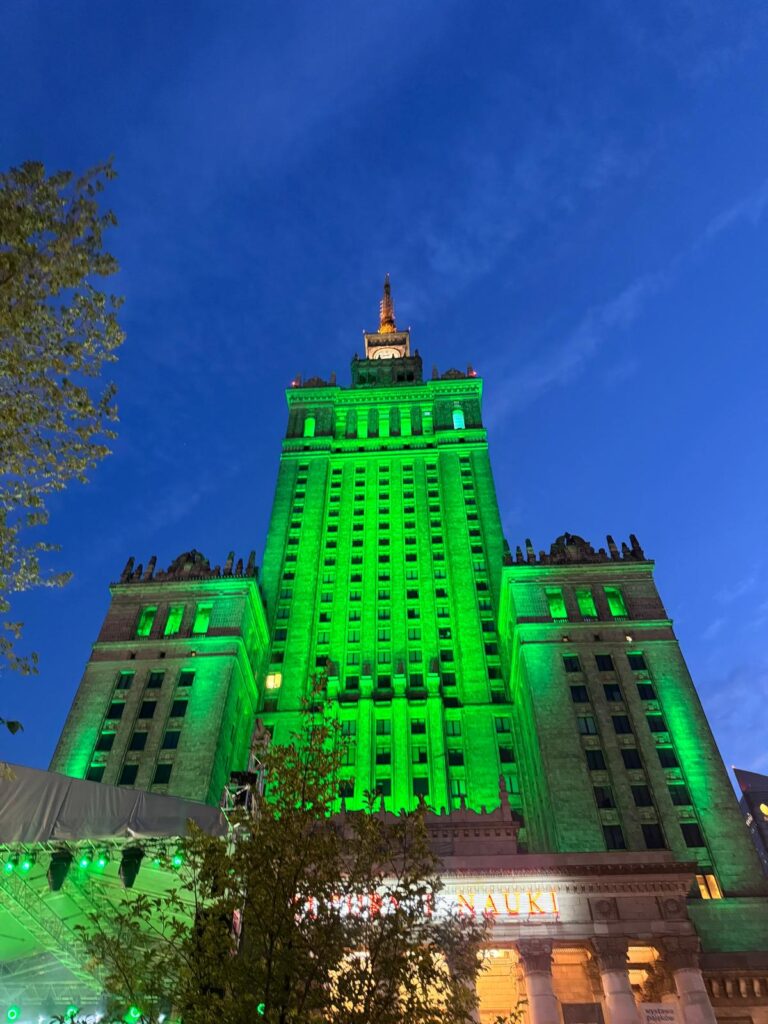
A Hybrid Structure of Steel, Brick, and Mass
The Palace of Culture and Science in Warsaw, built between 1952 and 1955, is most often interpreted through the prism of ideology, symbolism, and dominance of the city’s skyline. Yet, from a civil engineering perspective, it is one of the most complex and consistently designed structures in post-war Europe. Its logic stems not from a single system, but from a precisely designed hybrid: a steel skeleton, massive brick masonry, and reinforced concrete elements that unite the entire structure into a single, heavy structural entity.
The starting point was to combat Warsaw’s soil—layered, waterlogged, and prone to uneven settlement. Instead of resorting to aggressive piling, the designers opted for a more conservative yet remarkably effective solution: a massive, monolithic foundation slab, locally reaching a thickness of approximately three meters. The foundation doesn’t so much “anchor” the building to the ground as it disperses its enormous weight over the largest possible surface area. As a result, the entire structure behaves as a single, cohesive block, resistant to traffic vibrations, the impact of the subway system, and long-term settlement processes.
Although the Palace appears to be a heavy, stone structure, the key to achieving a height of over 230 meters was the steel support frame. Approximately 26,000 tons of steel were used, assembled on-site using techniques characteristic of the first half of the 20th century: riveting and welding. The arrangement of steel columns and beams creates a dense, regular grid, closer to the American school of skyscrapers than to European masonry tradition. It is this frame that absorbs horizontal loads, primarily wind pressure, and allows the tower to perform controlled, minimal movements in its upper sections.
What distinguishes the Palace of Culture and Science from modern skyscrapers is the way this steel frame is filled. Instead of lightweight curtain walls, brickwork made of approximately forty million bricks was used. In the lower sections, the walls exceed a meter in thickness, approaching the scale of defensive architecture in places. The brickwork plays no decorative or secondary role here. From an engineering perspective, it increases the inertia of the entire system, stabilizes the steel frame, provides excellent acoustic and thermal insulation, and provides natural fire protection for the steel elements. As a result, the building behaves not like a classic lightweight high-rise, but rather as a loaded mass stabilizing the structure from within.
The Palace’s exterior is often mistakenly interpreted as a load-bearing element. In reality, the façade is completely non-structural and functions as an independent “skin” separated from the supporting wall by an air gap. This solution, today associated with ventilated façades, was ahead of its time in the 1950s. The ground floor features massive sandstone, resistant to mechanical damage and intensive use, giving the building a monumental, almost fortress-like character. The upper levels of the façade are clad in prefabricated ceramic sintered bricks, also known as architectural faience. These hollow elements are significantly lighter than solid stone, yet visually imitate it. Attached to the supporting wall with steel anchors, they reduced the weight of the façade at great heights and allowed for the aesthetic coherence of the entire structure.
All these decisions contribute to a structure that, even at the time of completion, was anachronistic. While the world was moving toward lightweight curtain walls and maximum material efficiency, the Palace of Culture and Science opted for excess, mass, and durability. It is this engineering “surplus” that causes the building to age like stone architecture – through maintenance and repairs, not through technological obsolescence. The Palace of Culture and Science does not negotiate with gravity or time. It absorbs them.
Trivia
Stalin’s Gift
Officially, the building was a “gift from the Soviet nation to the Polish nation,” though Poland had to cover parts of the infrastructure and housing costs for the workers. Lev Rudnev, the lead architect, traveled across Poland to incorporate elements of Polish Renaissance and Baroque into the design. The result is a hybrid of Socialist Realism with Polish attics and decorative details.
Initial Height
The building was originally intended to be much shorter, but Polish urban planners “encouraged” the Soviet designers to increase the tower’s height during a meeting over the architectural model. Legend has it that as the Soviet engineer stood by the model, the Poles shouted “higher!”, wanting the building to dominate the skyline. Eventually, the spire reached 230 meters, outclassing everything in the region.
Friendship Housing Estate
A special estate of wooden houses was built in Warsaw’s Jelonki district specifically for the thousands of Soviet workers. After construction ended, the estate became a housing area for students and continues to function today as a unique open-air museum of wooden architecture. It was the heart of the social life for the Palace’s builders.
Accident Chronicles
During construction, 16 Soviet workers officially lost their lives (Poles also died, but there is no official data) and were buried at the Orthodox Cemetery in Wola. Numerous urban legends about bodies being bricked into the foundations have circulated, though they are not supported by any documentation. Despite the frantic pace, the construction was monitored for safety on a scale rarely seen at that time.
Demolition Proposals
After 1989, there were frequent calls to demolish the Palace as a symbol of Soviet domination. Proposals included turning the site into a park or cutting the building into pieces to be sold as souvenirs. Ultimately, the building was entered into the register of monuments in 2007, permanently ending discussions about its deconstruction.
Underground Cat Kingdom
Several cats live permanently in the basements of PKiN, where they have their own beds and are officially fed by the administration. Their job is to protect the vast network of cables and installations from rodents. The cats even have a dedicated caretaker and are a permanent fixture of the staff folklore.
Famous Concerts
The Congress Hall hosted some of the world’s biggest music stars, including the legendary 1967 Rolling Stones concert. This was an unprecedented event in the Eastern Bloc, and the band famously received their fee in Polish Złoty, which they couldn’t take out of the country. Rumor has it they spent the remaining money on Polish vodka and a freight car full of… edible rabbits.
Peregrine Falcons
For years, peregrine falcons have nested at the top of the PKiN spire, a world-class phenomenon in such a dense city center. Their lives can be followed via webcams installed by a local falcon protection association. The falcons have become a natural part of the skyscraper’s ecosystem, hunting pigeons in the heart of the capital.
Ceramic Lightness
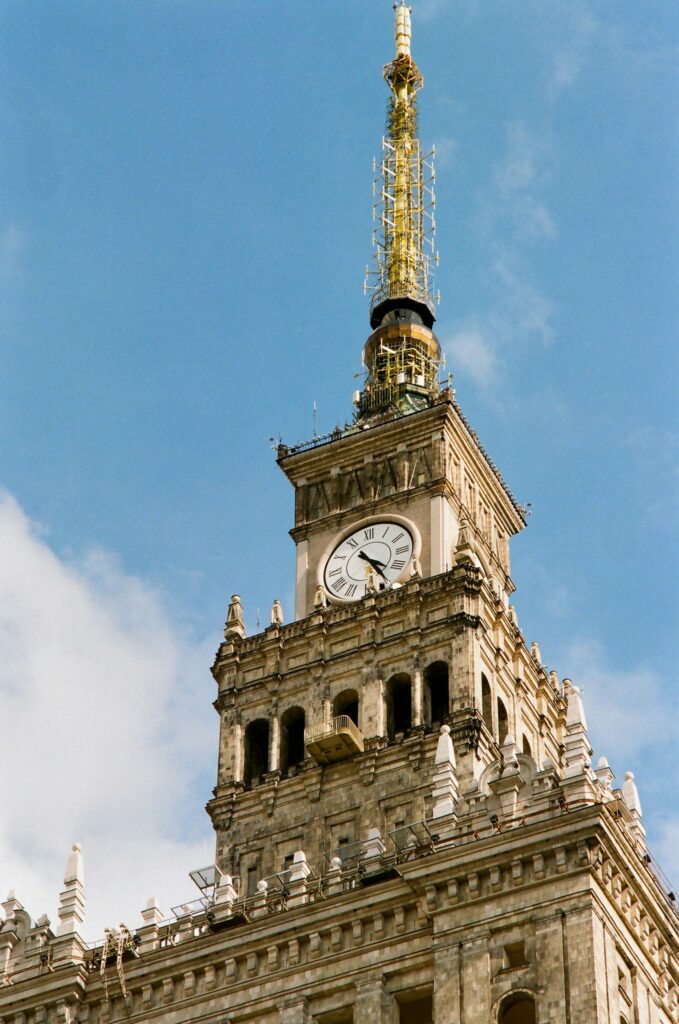
The upper parts of the facade are clad in architectural ceramics (faience), which are hollow inside. Using ceramics instead of solid stone significantly reduced the weight of the structure at great heights. These tiles feature a special glaze that allows the building to self-clean more effectively during rainfall.
The Millennium Clock
In the year 2000, four clock faces, each over 6 meters in diameter, were installed on the 42nd floor. For a time, it was the highest tower clock in the world, and its unveiling was a key highlight of Warsaw’s new millennium celebrations. The mechanism is radio-controlled, ensuring perfect precision.
Giant Foundations
The entire building rests on a massive, monolithic concrete slab up to 3 meters thick, poured into a deep excavation. This solution was essential to evenly distribute the nearly half-million-ton mass across Warsaw’s challenging soil. As a result, the building settles in a controlled and extremely stable manner.
The Congress Hall
The Congress Hall was once one of the largest performance venues in Central Europe. Depending on configuration, it could accommodate up to 3,000 people. It is currently closed due to long-term renovation works.