
Architecture as a System, Not a Sculpture – Museum Soumaya
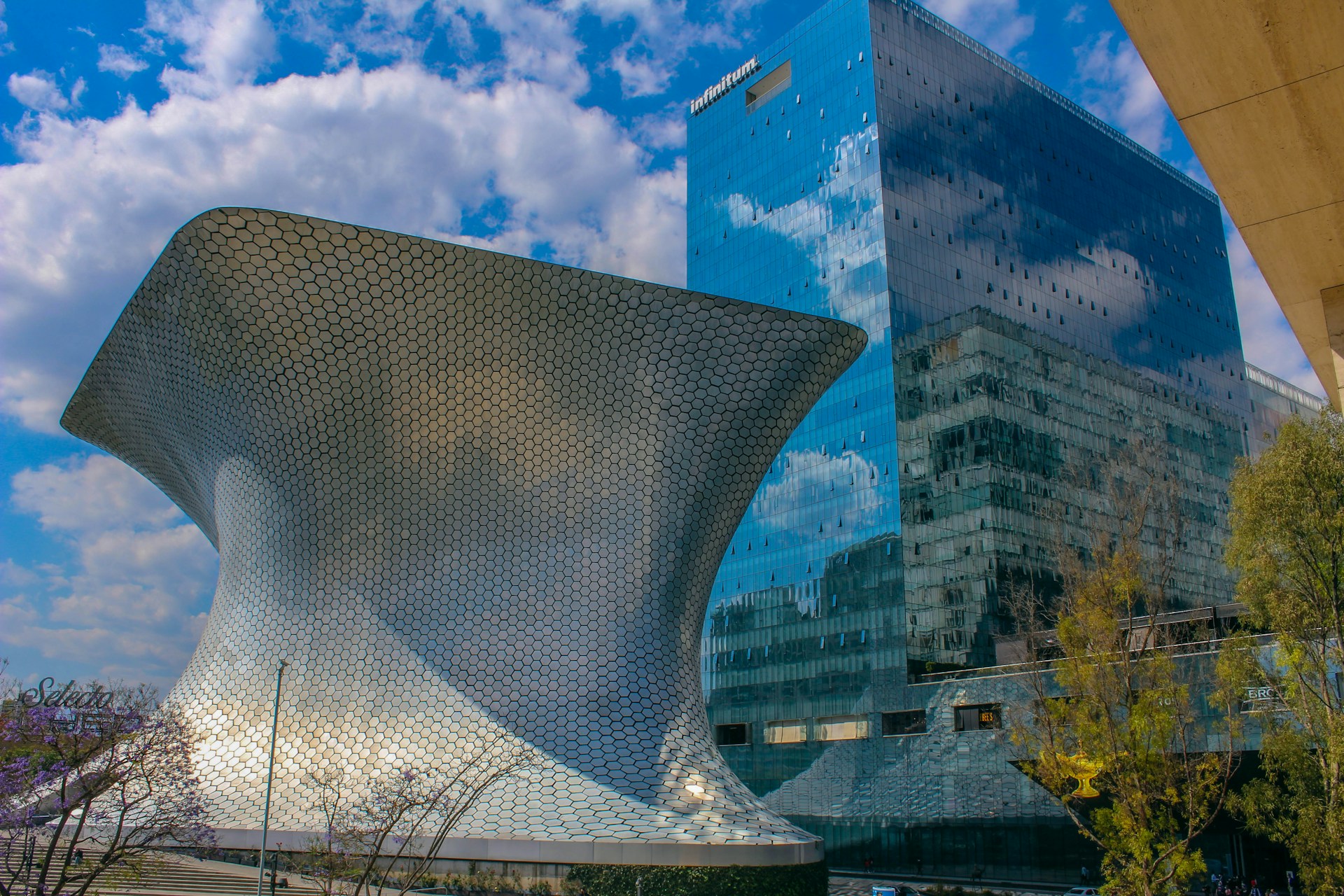
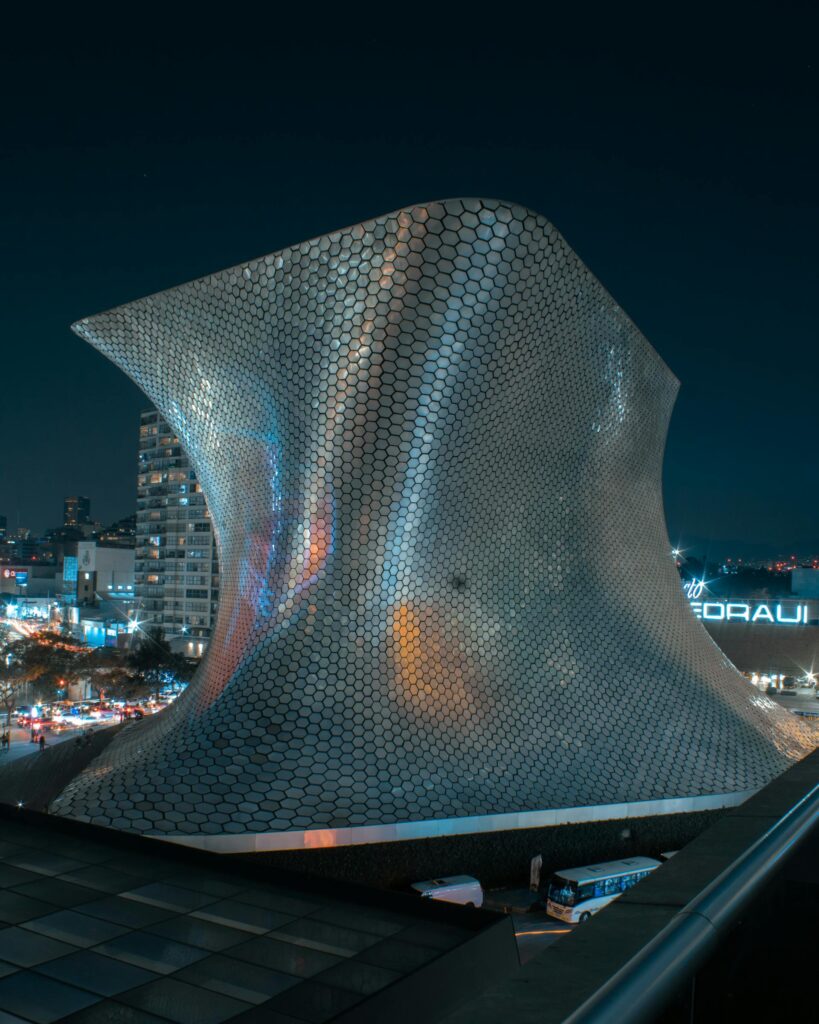
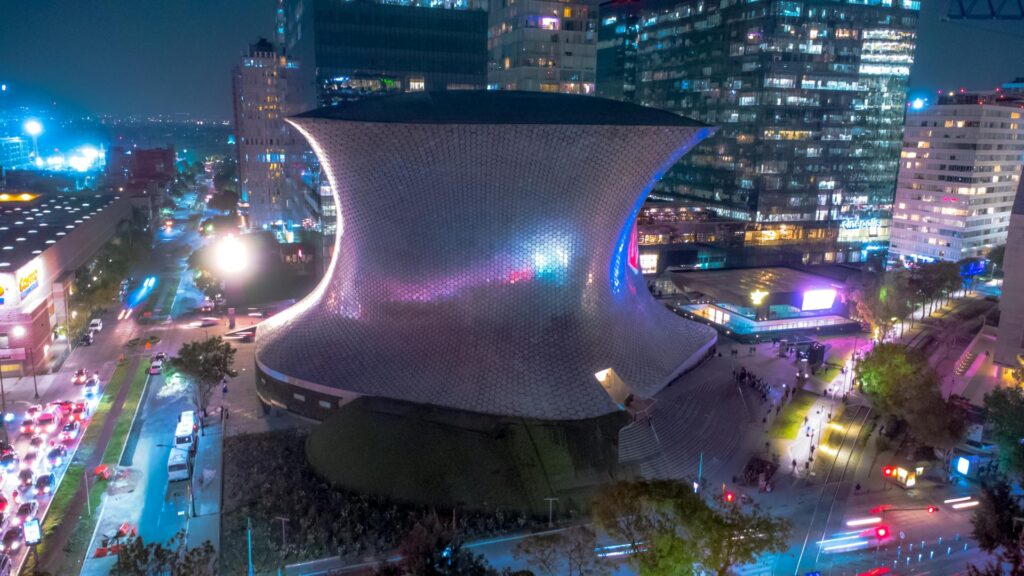
Museo Soumaya in Mexico City does not engage the city through scale or historical reference. Instead, it operates as an autonomous object — a freestanding volume that detaches itself from its surroundings while simultaneously organizing them. Within a district dominated by offices and retail, the museum is neither background nor axial landmark; it becomes a spatial anchor around which public space is redefined.
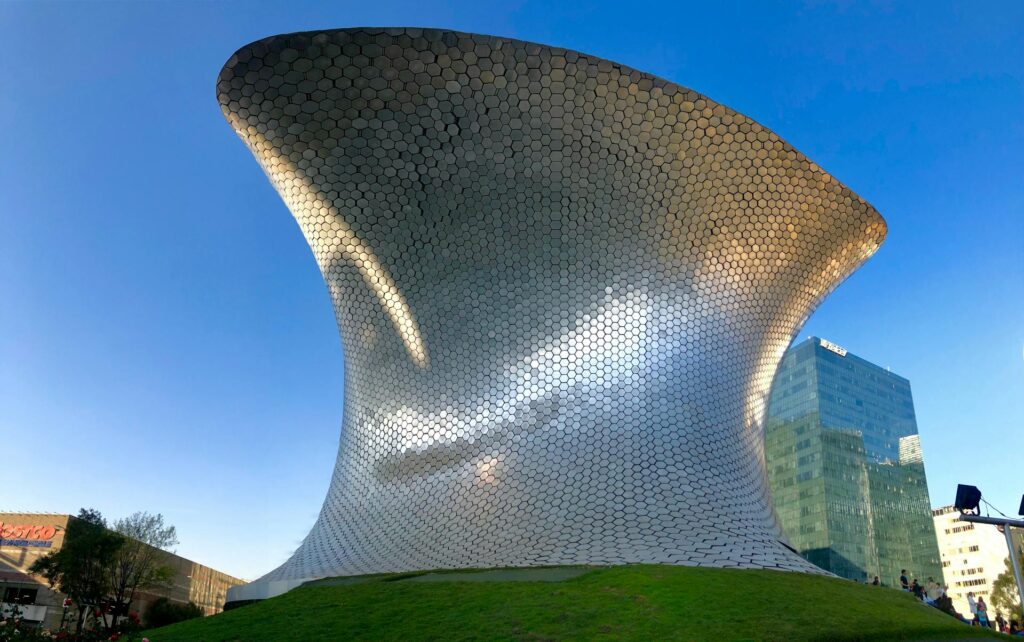
Often described as “sculptural,” Soumaya is, in fact, a rigorously technical project. Its free-form geometry is not the result of an expressive gesture but of a clear structural and envelope logic: a centralized load-bearing core paired with a highly repetitive façade system. Here, aesthetics emerge as a consequence of engineering decisions rather than their motivation, placing form at the end — not the beginning — of the design process.
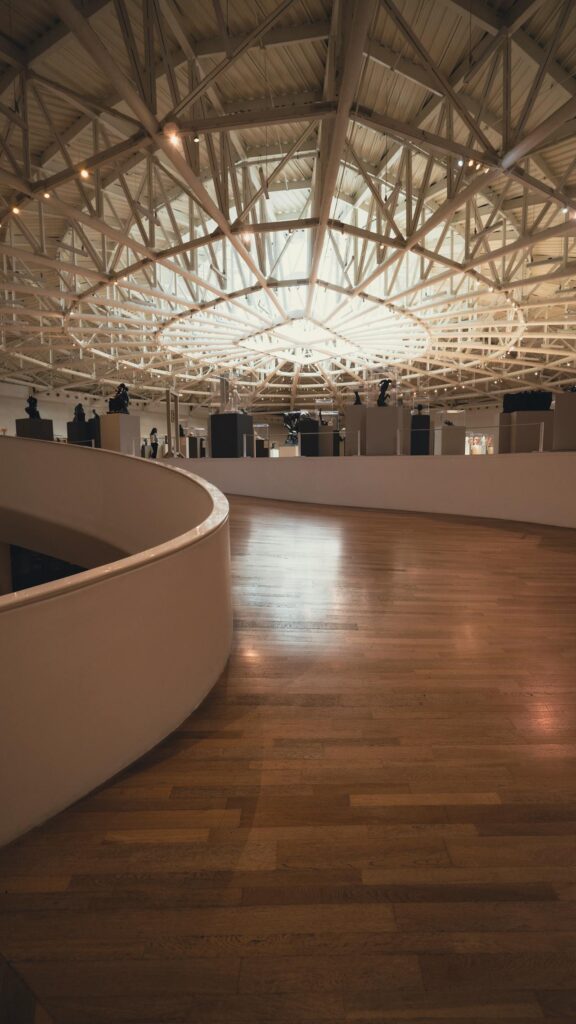
The most radical move is the complete elimination of interior columns. All structural loads are transferred through the core, allowing the exhibition floors to remain open, flexible, and non-hierarchical. Circulation is organized through a continuous system of ramps that spiral upward, replacing the traditional sequence of galleries with a fluid, almost urban experience of movement.
In this sense, Soumaya is less a museum as a building and more a museum as a system — logistical, structural, and operational. Its iconic presence is not driven by symbolism, but by the disciplined execution of repeatable components and controlled tolerances. The building demonstrates how far conventional construction systems can be pushed before they stop looking conventional at all.
Museum Soumaya in Numbers
46 m
Architectural height of the building
16 000
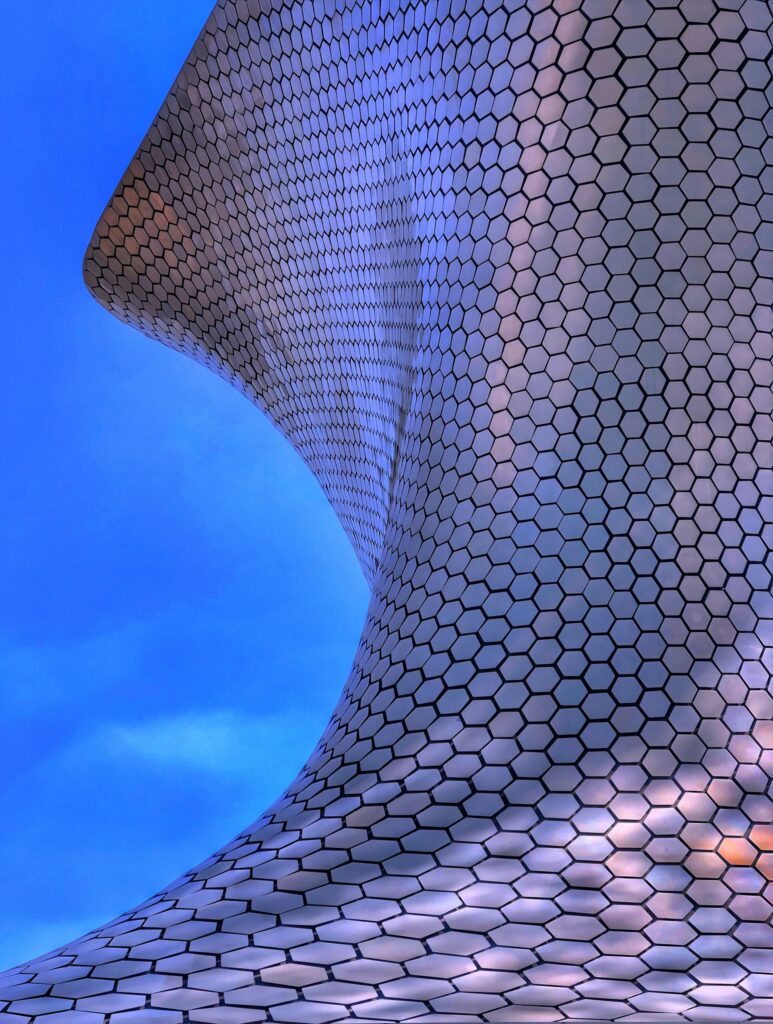
Hexagonal aluminum façade panels
0
There are no windows on the facade (natural light enters exclusively through the skylight on the top floor)
28
Unique, curved vertical steel columns forming the building’s skeleton
~17 000 m²
Total gross floor area
7
Horizontal perimeter rings (steel belts) that stabilize the asymmetrical structure
47 cm
Maximum diameter of the steel tubes used in the main structural frame
10 degrees
The average tilt of the exterior walls, creating the iconic “twist” effect
6 000 m²
Dedicated exhibition space across all floors
66 000
Artworks in the Carlos Slim Foundation’s collection housed within the museum
2011
Year of completion and opening to the public
800 mln $
Estimated construction cost of the Plaza Carso complex, with the museum as its centerpiece
Museo Soumaya redefines monumentality not through scale, but through structural efficiency — a building where repetition, tolerance, and system logic produce an icon without symbolic excess.
A Repetitive Skin for a Non-Repetitive Geometry
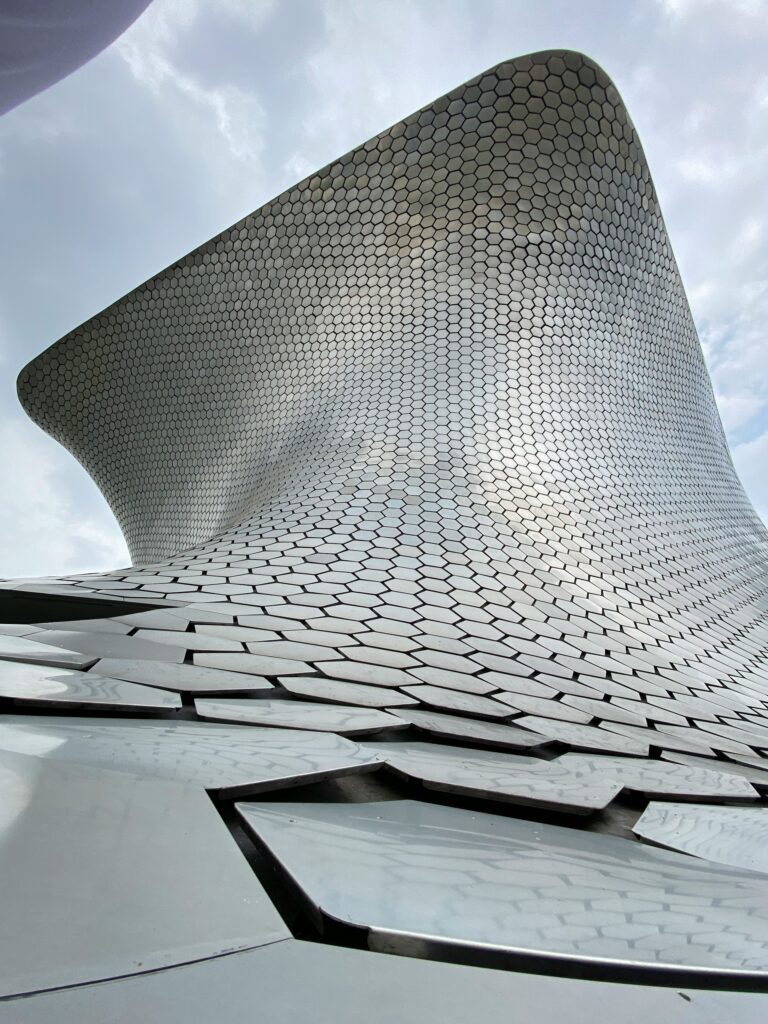
Museo Soumaya is conceived as a tightly integrated system in which structure and façade are inseparable. The building’s stability is generated by a central reinforced concrete core working in tandem with a perimeter steel framework composed of inclined columns and horizontal ring beams. This structural cage does not simply support the floors; it defines the geometry of the envelope itself. The façade is therefore not hung onto a finished structure but evolves directly from it, translating structural forces and tolerances into a continuous external surface.
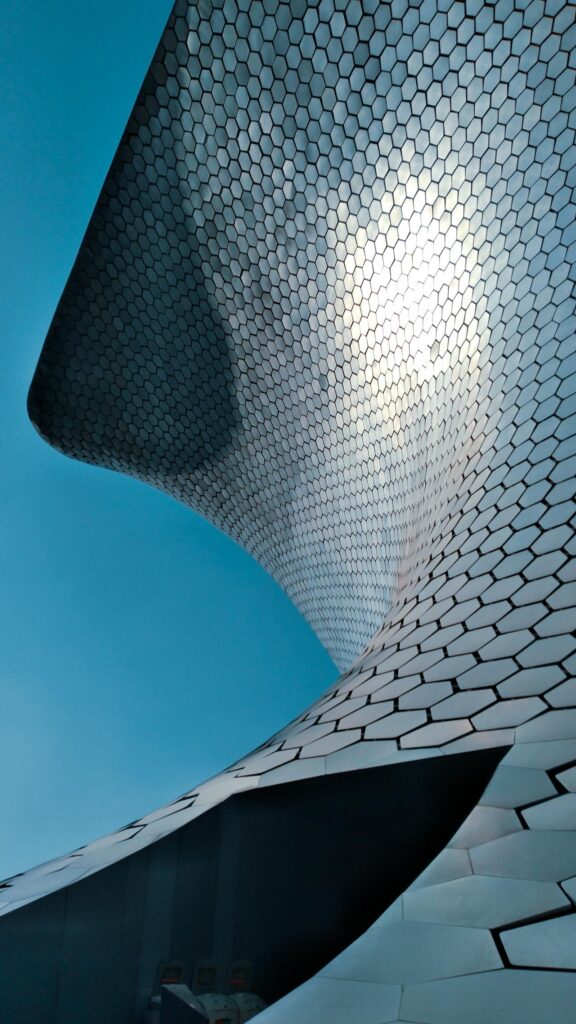
The hexagonal aluminum cladding acts as the final operational layer of this system. By repeating a single panel geometry across a doubly curved surface, the façade absorbs variations in curvature without requiring bespoke elements. This allows the building to maintain formal continuity while remaining within industrial fabrication limits. At the same time, the reflective skin masks structural complexity, visually unifying elements that are, in reality, all slightly different. The result is a building where construction logic, structural efficiency, and external appearance collapse into a single architectural mechanism — an object defined less by expression than by the disciplined coordination of its systems.
Exhibitions as Accumulation, Not Selection
Museo Soumaya presents its exhibitions as a dense, almost encyclopedic narrative rather than a selective curatorial statement. The museum’s collection spans more than three millennia, and this breadth is reflected in an exhibition strategy that favors accumulation over minimalism. Works are often displayed in large groupings, sometimes salon-style, allowing visitors to read the collection through quantity, repetition, and comparison rather than through isolated masterpieces. This approach shifts the focus from singular icons to patterns—stylistic, thematic, and historical—encouraging a mode of viewing closer to archival research than to conventional gallery contemplation.
The permanent exhibitions prioritize accessibility and continuity over dramatic scenography. Labels, wall texts, and spatial divisions remain deliberately restrained, allowing the artworks themselves to dominate the experience. Sculpture plays a central role, particularly in the upper levels, where generous floor plates enable long sightlines and multi-directional viewing. The extensive presence of Auguste Rodin’s work reinforces this strategy: instead of highlighting a small number of canonical pieces, the museum displays variations, casts, and series side by side, foregrounding process, repetition, and evolution. In doing so, Museo Soumaya frames its exhibitions not as curated narratives with a beginning and an end, but as an open-ended visual archive—one that visitors are invited to navigate freely rather than follow passively.
Trivia
A Nature-Inspired Facade
The building’s exterior is composed of 16,000 hexagonal aluminum tiles that resemble a honeycomb or fish scales. These panels do not touch each other, allowing the building to “breathe” and adapt to temperature fluctuations. This design gives the facade an organic, skin-like quality rather than a rigid, static structure.
The Strategy of Zero Windows
The museum features no traditional windows on its curved side walls. This intentional design choice protects priceless artworks from direct UV radiation, which could cause irreversible damage. Instead, all natural light floods in through a massive skylight located on the top floor.
A 3D Steel Skeleton
The structure is supported by 28 unique vertical steel columns, each with its own specific curvature. These were designed using advanced 3D modeling software typically reserved for the aerospace industry. These “ribs” are what allow the museum to maintain its impossible, asymmetrical shape.
The Largest Column-Free Hall
The sixth floor is an architectural masterpiece of spatial freedom. Thanks to a sophisticated roof suspension system, this level features no internal support columns at all. This allows for total flexibility when displaying large-scale sculptures, such as those by Rodin.
The Rodin Collection
Museo Soumaya holds the largest private collection of Auguste Rodin’s works in the world outside of France. Visitors can see iconic pieces such as “The Thinker” and the monumental “Gates of Hell.” Carlos Slim spent decades curating these pieces before they found their permanent home in this building.
A Mission of Free Access
Admission to the museum is completely free of charge 365 days a year for every visitor. It is a non-profit foundation aimed at bringing world-class art to those who may not have the means to travel to Europe. All operating costs are covered entirely by the Carlos Slim Foundation.
Foundations Built on History
The building stands on the site of what was once the Loreto and Peña Pobre paper mill. The revitalization of this industrial area completely transformed the Polanco district’s identity. The museum now serves as the cultural anchor for the modern Plaza Carso business and shopping complex.
Seismic Resilience
Since Mexico City is in an active earthquake zone, the building had to meet rigorous seismic standards. The flexible steel frame and deep foundations allow it to withstand significant tremors. Engineers from Arup designed the structure so that earthquake energy is dissipated through the skeleton.
A Tribute to Love
The museum is named in honor of Soumaya Domit Gemayel, the late wife of founder Carlos Slim. Slim wanted to commemorate her lifelong passion for art collecting and supporting artists. Consequently, the building is not just a gallery, but a monumental gesture of affection.
The Narrow Waistline
The building is characterized by a distinct “waist,” a narrowing in the middle of its height. This stylistic choice makes the museum appear light and graceful despite the thousands of tons of steel and concrete used. Architect Fernando Romero wanted to avoid the heavy look of a traditional “box” building.
Underground Vaults
Beneath the building are two underground levels that house state-of-the-art storage and conservation labs. This is where specialists work on restoring artworks and preparing new exhibitions. The majority of the collection not currently on display is safely archived here.
Over 30 Centuries of Art
While the building looks futuristic, its collection spans 3,000 years of human history. Items range from Pre-Hispanic sculptures to masterpieces by Picasso, Dalí, and Monet. It is one of the most diverse art collections in the Western Hemisphere.
Pop Culture Icon
Shortly after its opening, Museo Soumaya became the most photographed building in Mexico. Its unique silhouette has appeared in dozens of music videos, films, and global advertising campaigns. It has done for Mexico City what the Guggenheim did for Bilbao.
Local Economic Catalyst
The construction of the museum and the surrounding Plaza Carso brought massive investment to this part of the city. What was once an industrial zone is now Mexico City’s new financial and cultural hub. Tourism in this specific neighborhood has increased by several hundred percent.
The Architect’s Vision
The designer, Fernando Romero, is the son-in-law of Carlos Slim, making this a deeply personal family project. Romero trained under the famous Rem Koolhaas, which is reflected in his bold approach to form and function. The museum was intended to symbolize a modern Mexico ready for global engineering challenges.
Rodin at Unusual Scale
Museo Soumaya holds one of the largest collections of Auguste Rodin sculptures in the world. Many works are displayed in multiples rather than as isolated masterpieces. This emphasizes process, variation, and repetition rather than singular authorship.