
A Radical Vision Born from Expo 67
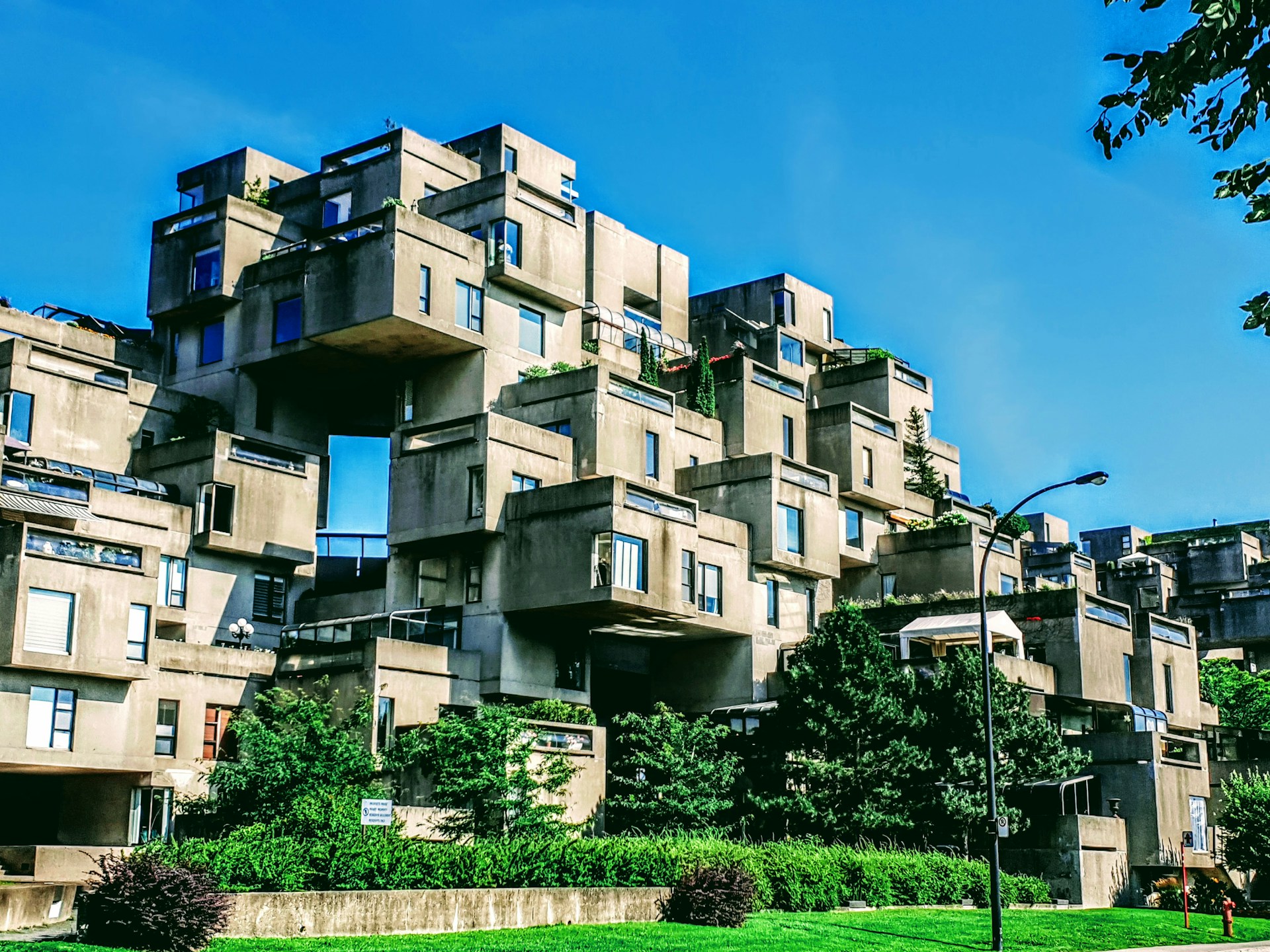
When Habitat 67 rose on the waterfront of Montreal in 1967, it was never meant to be just another housing complex. Designed by architect Moshe Safdie as his master’s thesis at McGill University, the project became the built manifesto of a new way of thinking about cities. Created for Expo 67, the world exhibition that marked Canada’s centennial, the structure proposed a bold alternative to the monotonous high-rise apartment blocks dominating post-war urban development.
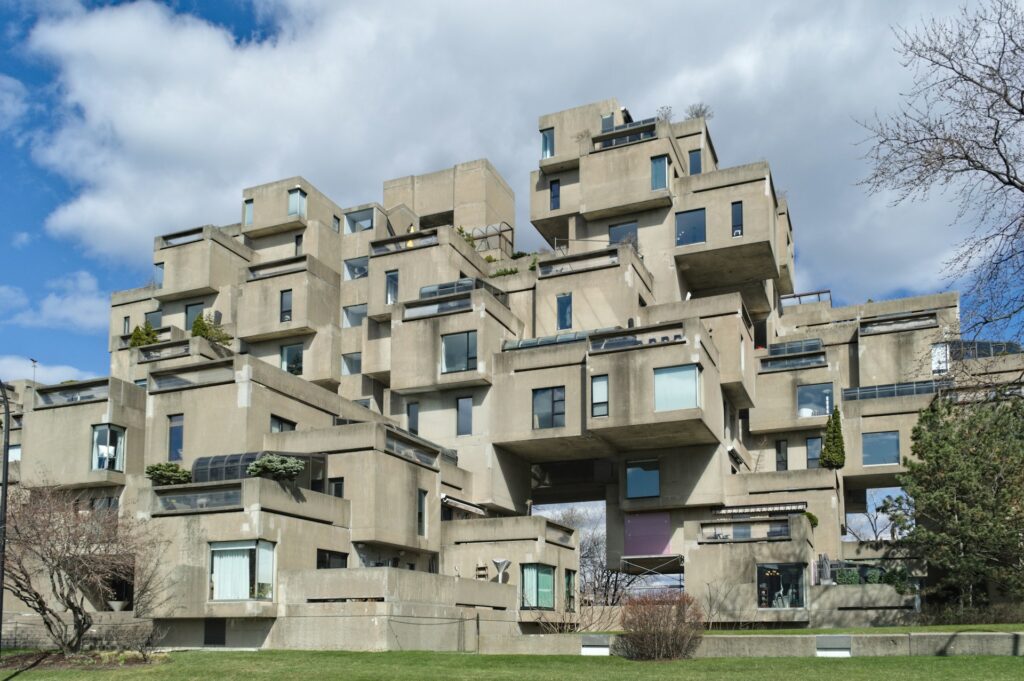
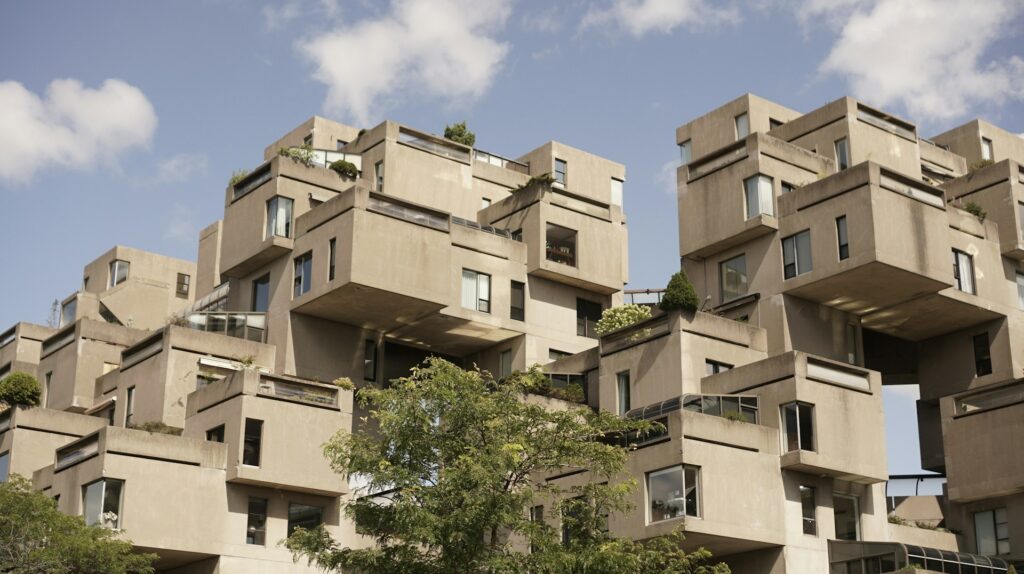
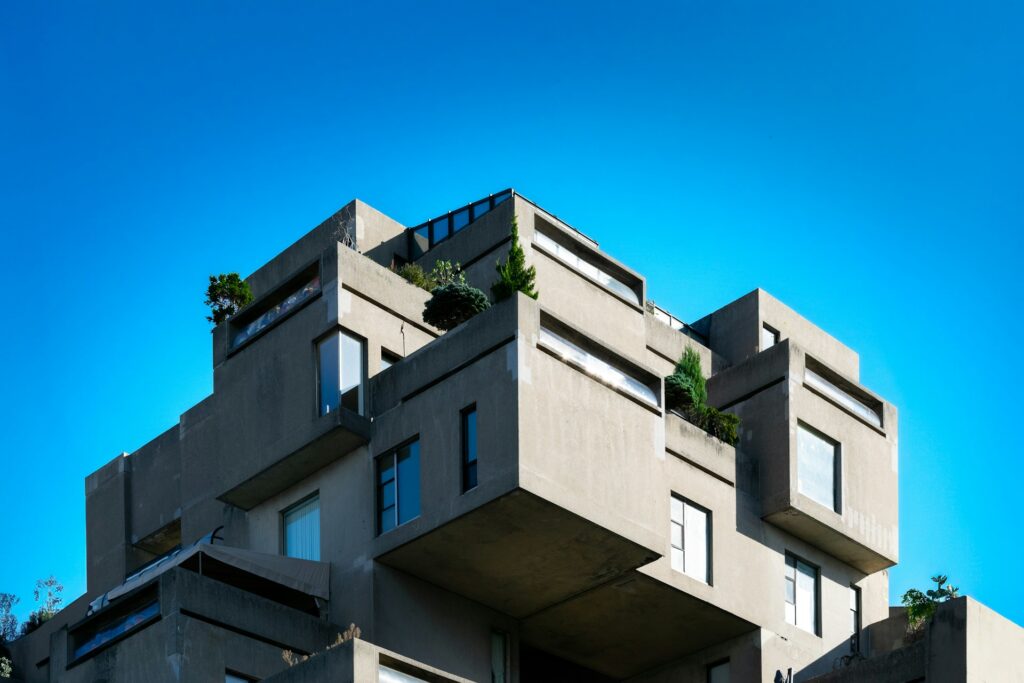
Instead of stacking identical floors in vertical repetition, Habitat 67 reimagined housing as a three-dimensional neighborhood. Composed of prefabricated concrete modules arranged in seemingly chaotic yet mathematically controlled formations, the complex combined the density of an apartment building with the qualities of suburban living: private terraces, natural light from multiple directions, and individual garden spaces. It was an attempt to solve one of the most pressing architectural questions of the 20th century — how to provide high-density housing without sacrificing privacy, identity, and access to nature.
Nearly six decades later, Habitat 67 remains one of the most influential experiments in modular architecture ever constructed. More than an Expo pavilion, it became a prototype for prefabrication at scale, a structural puzzle built from repeated elements, and a permanent symbol of Montreal’s architectural ambition.
Habitat 67 Montreal in Numbers
354
prefabricated concrete modules: This is the most widely accepted figure for the “building blocks” of the complex
90 t
The approximate weight of each individual concrete module
38′ 6″ x 17′ 6″ x 10′ 0″
The dimensions of a single module (approx. 11.7m x 5.3m x 3m)
12
Number of stories
158
The number of apartments available during the Expo 67 world’s fair
15
different housing types: Ranging from one-bedroom units to large four-bedroom family homes
225 to 1,000 sq. ft
The range of private terrace sizes (21 to 93 m2)—every apartment has at least one
$22.4 mln CAD
The total construction cost in 1967 (well over its original $13.5M budget)
50 000 000
Total attendance at Expo 67, where Habitat was the star attraction
186 m²
Size of large apartments
23
Moshe Safdie’s age when he designed the concept as his thesis at McGill University
$1.7 mln CAD
Cost of large aparments
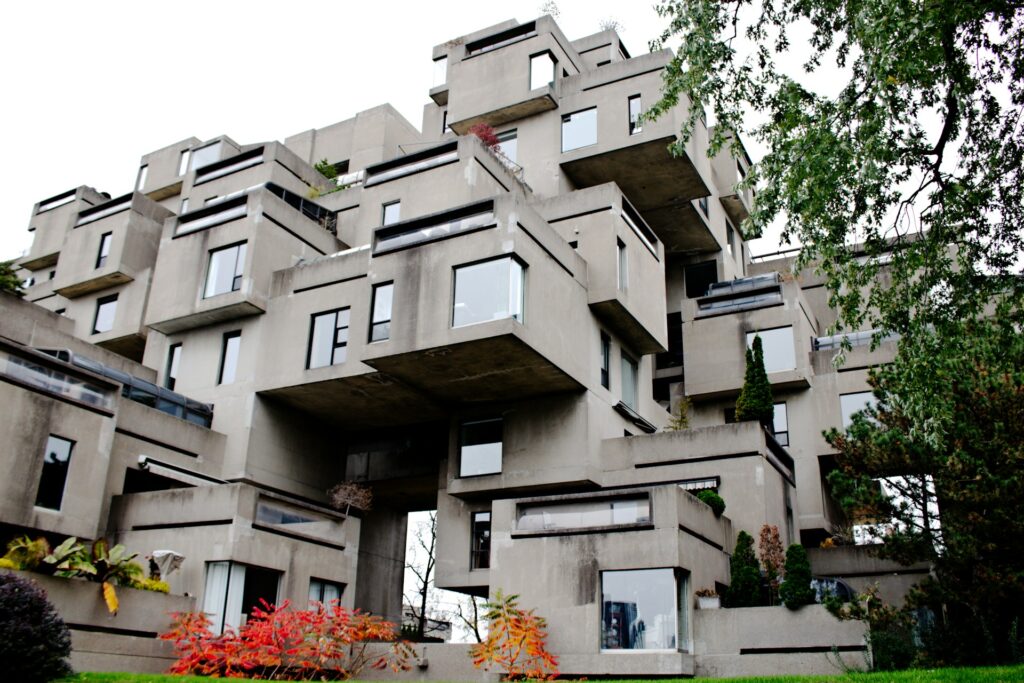
What’s most intriguing about Habitat 67 isn’t its height, but the structural logic that allows 354 prefabricated concrete modules to interlock in a three-dimensional matrix while remaining structurally stable. Instead of relying on a conventional vertical frame, the building distributes loads through a cascading system of stacked boxes, post-tensioned cables, and shear walls that transfer forces both vertically and horizontally. Each module supports and is supported by others, creating a self-bracing composition that appears random yet operates with strict engineering precision.
Engineering a Three-Dimensional Concrete Matrix
Habitat 67 was engineered as a full-scale experiment in prefabricated concrete construction. Each of the 354 modules was cast on-site using reinforced concrete and then lifted into position by crane. Instead of assembling a traditional frame first, the structural logic relied on stacking these heavy three-dimensional units in a carefully calculated sequence. Post-tensioning cables were threaded vertically and horizontally through the modules, compressing the system together and allowing the load to transfer across multiple units rather than through a single central core.
Structurally, the project operates as a hybrid between a load-bearing wall system and a three-dimensional space frame. Every module acts simultaneously as structure, enclosure, and interior space. Shear walls within the boxes stabilize lateral forces such as wind loads from the Saint Lawrence River, while the stepped configuration distributes weight downward in a cascading pattern. The apparent randomness of the composition is, in reality, a precisely engineered matrix where each box supports and is supported by adjacent ones.
One of the most complex engineering challenges was ensuring waterproofing and thermal continuity across hundreds of exposed joints. Because each module has roof surfaces that serve as terraces for other units, drainage, insulation, and structural connections had to be integrated into a compact system. The result was not just a housing project, but a prototype for industrialized modular construction at urban scale — decades ahead of contemporary prefabrication trends.
The Economics Behind the Vision
Habitat 67 was conceived as a prototype for affordable, high-density housing, yet it ultimately became one of the most expensive residential experiments of its time. Originally planned as a 1,000-unit complex, the project was reduced to just 158 apartments due to budget constraints. The industrial logic assumed that repetition of prefabricated modules would significantly lower costs through mass production. However, because the scheme was scaled down, the anticipated economies of scale never materialized, dramatically increasing the cost per unit.
The prefabrication process itself, though innovative, proved far more complex than expected. Modules were cast on-site rather than in a fully industrialized factory setting, limiting efficiency. Each unit required precise crane placement, post-tensioning, waterproofing, and custom adjustments due to the unique stacking configuration. What was meant to function like an assembly line became closer to a carefully choreographed construction process. As a result, the final cost reached approximately 13.5 million CAD in 1967 — significantly higher per square meter than conventional concrete apartment blocks built during the same period.
In many ways, Habitat 67 was economically “ahead of its infrastructure.” The vision depended on a mature prefab industry that did not yet exist. Today, with advanced digital modeling, robotic fabrication, and globalized supply chains, similar modular systems are far more feasible. The project’s financial shortcomings were not a failure of concept, but rather a reflection of technological and market conditions in the late 1960s. It stands as a reminder that architectural innovation often precedes economic viability by decades.
Trivia
The Thesis Project
The entire design started as a master’s thesis by a 23-year-old student named Moshe Safdie at McGill University. He never expected his academic project to be chosen as the centerpiece for a World’s Fair. Today, it remains one of the few thesis projects in history to actually be built on such a massive scale.
The Lego Inspiration
Safdie used LEGO bricks to build the initial models of the complex because they were the perfect tool for modular design. He spent thousands of hours stacking the toy blocks to find the most stable and aesthetically pleasing configuration. This playful origin story has become a legendary piece of architectural lore.
A Garden for Everyone
The main goal of the project was to provide the “luxury of a house” within the density of a city. Every single apartment in the complex has its own private roof garden or terrace. These outdoor spaces are actually the roofs of the modules located directly below them.
Built Like a Factory
The building was constructed using an on-site assembly line to cast the concrete modules. Each 90-ton box was poured into a mold, cured, and then fitted with its own kitchen and bathroom before being lifted. A giant crane then placed each “box” into its precise position like a high-stakes game of Tetris.
The “Streets in the Sky”
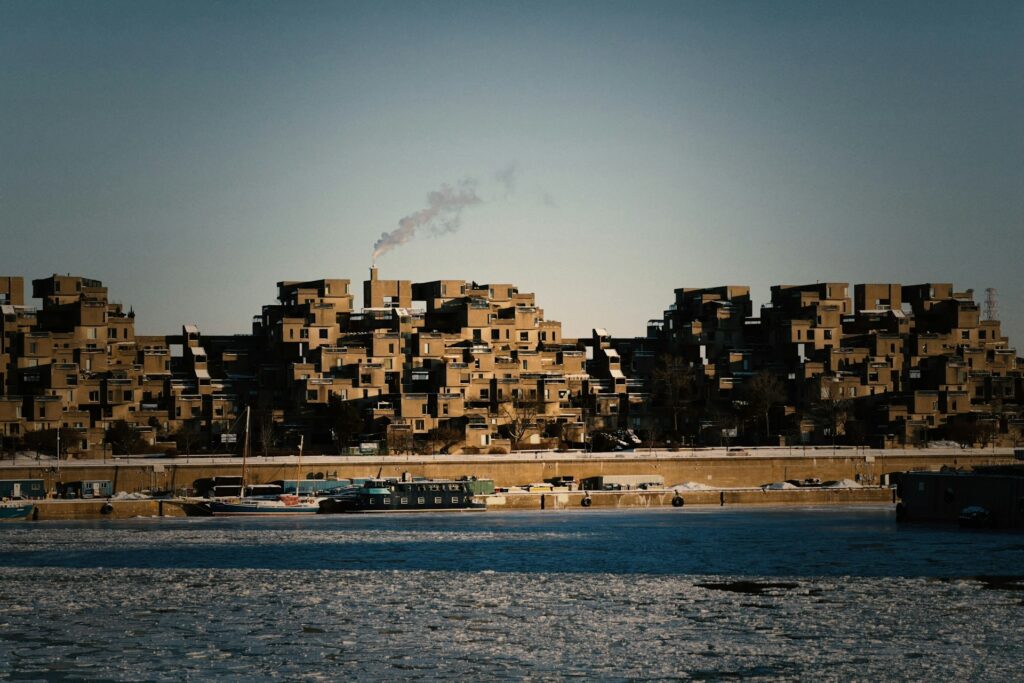
Instead of dark, interior hallways, Habitat 67 features open-air walkways that connect the various levels. These “pedestrian streets” were designed to encourage neighbors to interact and socialize outdoors. They offer stunning views of the Saint Lawrence River and the Montreal skyline.
Failure of Modernism?
While it is now a beloved landmark, it was originally criticized for being far too expensive to replicate. The goal was to create affordable mass housing, but the high construction costs made it a luxury destination instead. This irony is often discussed by urban planners when debating the future of modular cities.
The Great Buyout
For the first 18 years, the building was owned by the Canadian government and the units were rented out. In 1985, the tenants formed a partnership and purchased the entire complex for $11.5 million CAD. This transition turned the experimental project into a stable, prestigious co-op community.
The Architect’s Home
Moshe Safdie actually kept a unit for himself, which he meticulously renovated years later. His personal apartment consists of four modules and features a minimalist, light-filled interior. In 2017, it was opened to the public for tours to celebrate the building’s 50th anniversary.
A National Monument
In 2009, the Quebec government officially designated Habitat 67 as a National Heritage Site. This status protects the building from any major exterior changes that would ruin its iconic silhouette. It is now considered as culturally significant as Montreal’s historic cathedrals.
Living with the Elements
The building’s Brutalist concrete exterior has faced some challenges with Montreal’s harsh, freezing winters. Over the decades, the complex has undergone multi-million dollar renovations to repair water damage and improve insulation. Despite the maintenance costs, residents say the unique views make it worth every penny.
Surfing at its Doorstep
Right in front of the building, there is a permanent standing wave in the Saint Lawrence River known as “Habitat 67.” It attracts surfers from all over the world who ride the river waves while the building towers behind them. This creates a surreal contrast between avant-garde architecture and extreme sports.
A Cinematic Star
Because of its futuristic and somewhat “dystopian” look, the building has appeared in several films and music videos. It serves as a perfect backdrop for stories set in the future or on other planets. Even decades after its completion, it still looks more modern than most buildings constructed today.