
Between Duomo and La Scala: The Logic of Galleria Vittorio Emanuele II
Completed in 1877, the Galleria Vittorio Emanuele II represents a pivotal moment in the transformation of European cities. Rather than extending the street network outward, the project introduced a new idea: enclosing urban movement within a controlled architectural volume. This was not a response to fashion or decoration, but to scale, climate, and the growing intensity of metropolitan life.
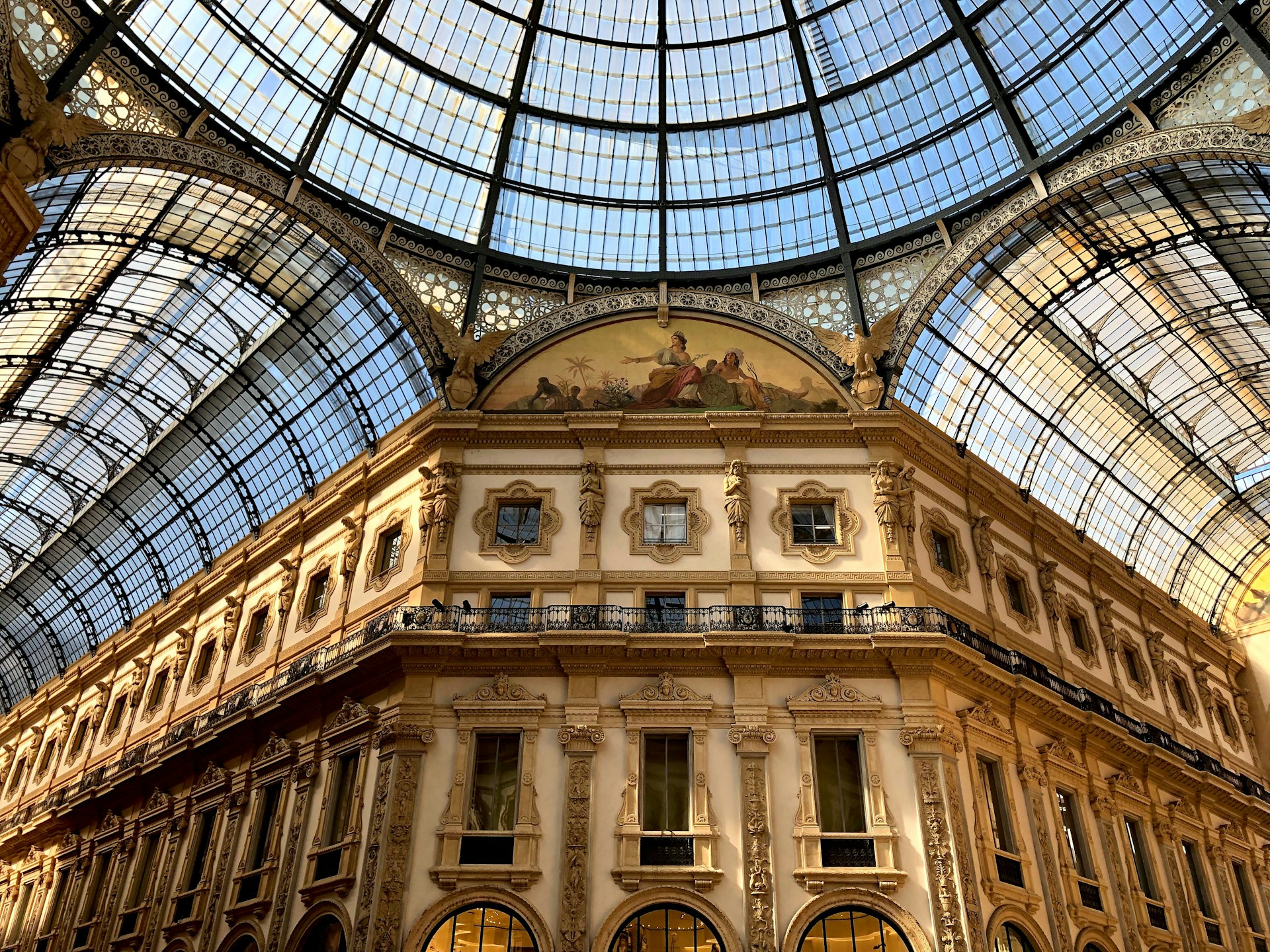
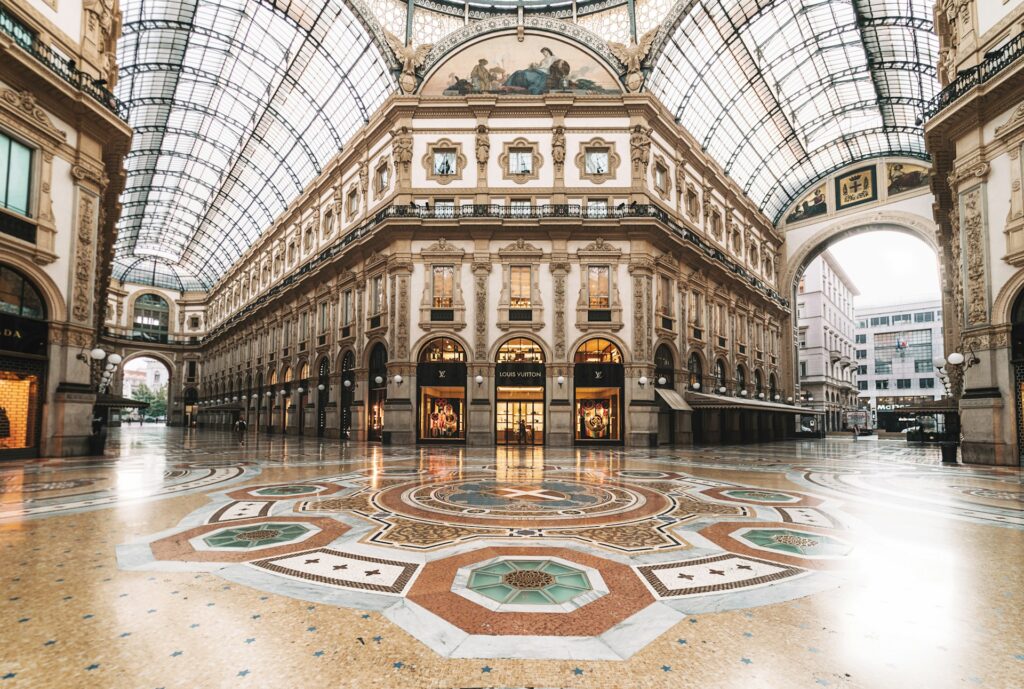
Located between Piazza del Duomo and Piazza della Scala, the Galleria operates as an infrastructural connector as much as a civic interior. Its cross-shaped plan organizes pedestrian flow along two primary axes, intersecting beneath a central dome that functions as a spatial regulator. Movement slows, sightlines expand, and the city briefly becomes an interior condition defined by light and proportion.
The building’s iron and glass structure allowed for dimensions that masonry alone could not achieve. Large uninterrupted spans, consistent bay widths, and a continuous glazed roof created an environment that remains visually open while structurally precise. Daylight penetrates deep into the plan, reducing the need for artificial illumination long before energy efficiency became an architectural concern.
Beyond its physical construction, the Galleria established a new urban model. It combines circulation, commerce, and public life within a single architectural system, anticipating later typologies such as railway halls, department stores, and modern transit concourses. The logic is clear: architecture becomes a framework for everyday use, measured through geometry, repetition, and durability rather than spectacle.
More than a landmark, the Galleria Vittorio Emanuele II is a working prototype. It demonstrates how architecture can shape collective behavior through spatial control, structural clarity, and long-term adaptability — principles that continue to define successful public interiors today.
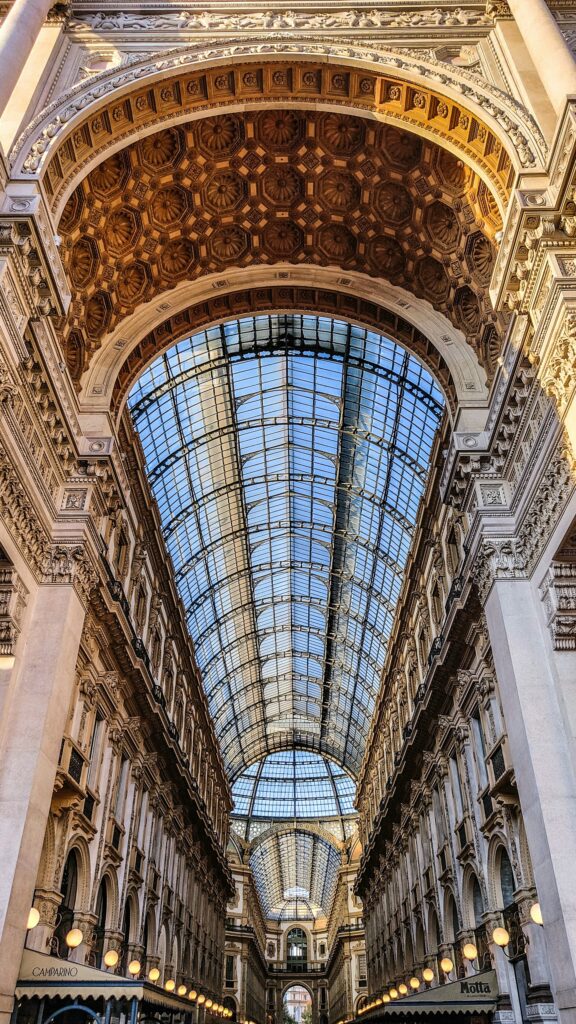
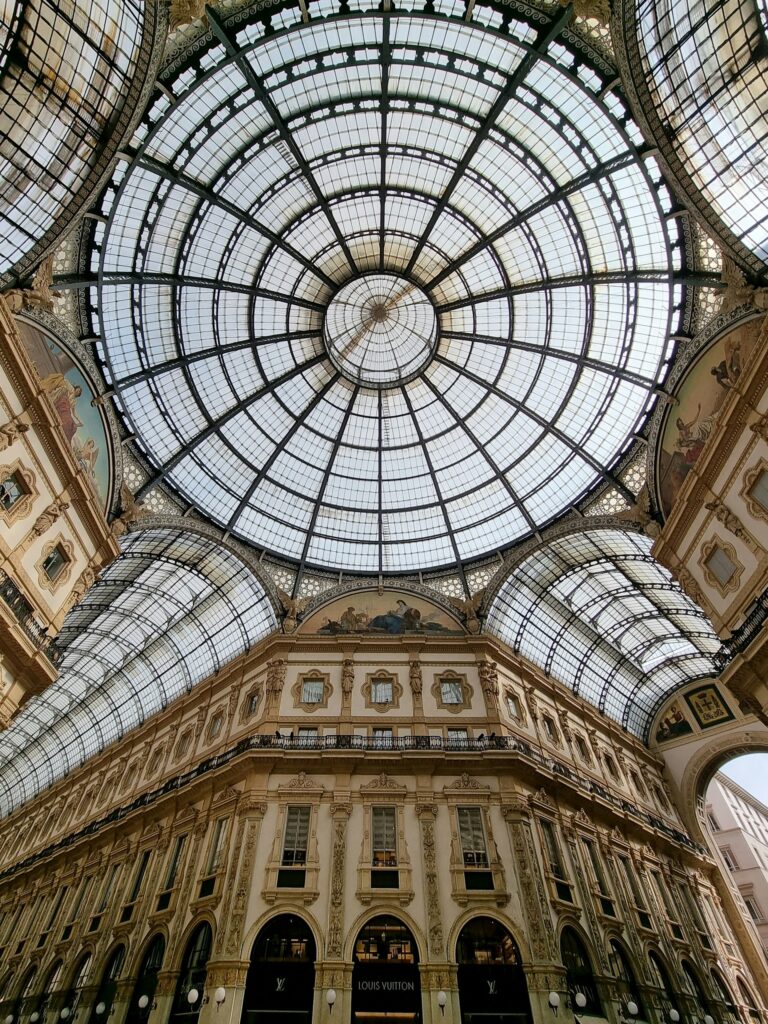
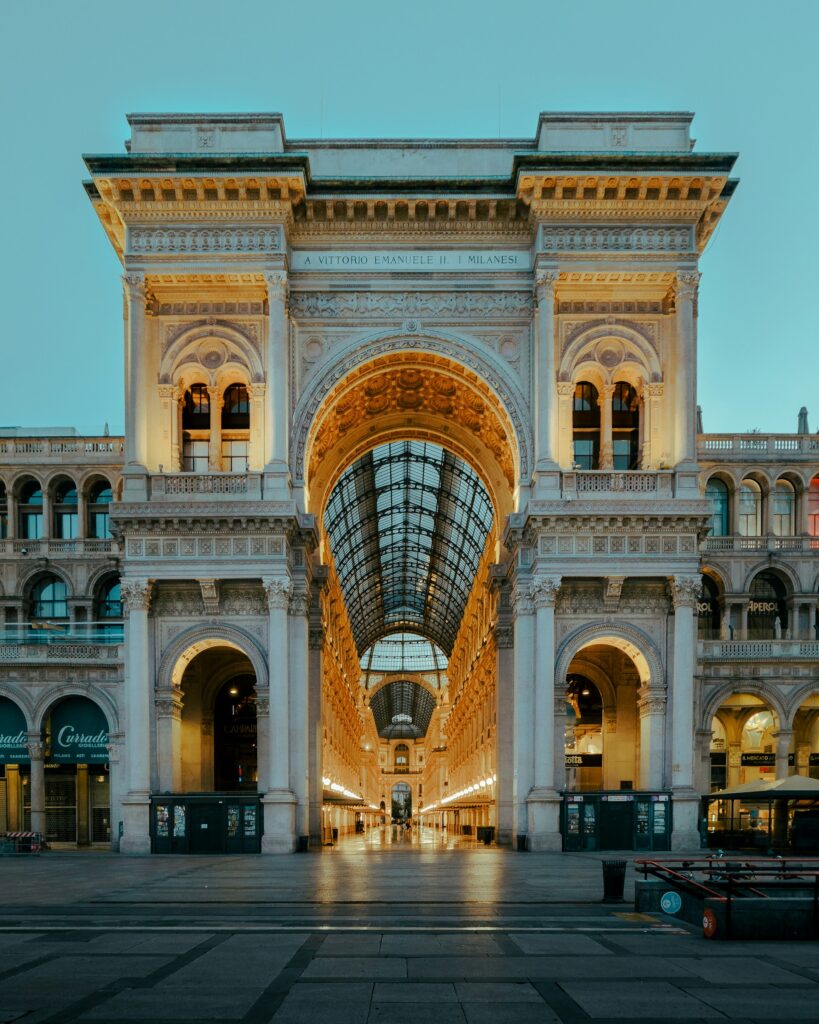
Vittorio Emanuele II Gallery in Numbers
47 m
Height of the central dome
196 m
Length of the main arm of the gallery
37 m
The diameter of the central, impressive dome crowning the “octagon”
14,5 m
Width of the gallery corridors
~14 000 m²
Total area of roof glazing
170
commercial premises – shops, cafes, restaurants and offices
1200
gas lamps – light points originally illuminated the gallery in the 19th century
353,9 t
So much iron was used to create the gigantic structure of the roof frame and dome.
The Galleria doesn’t simply connect two squares; it internalizes the city itself, transforming a public street into a controlled interior where light, structure, and circulation merge into a single urban system.
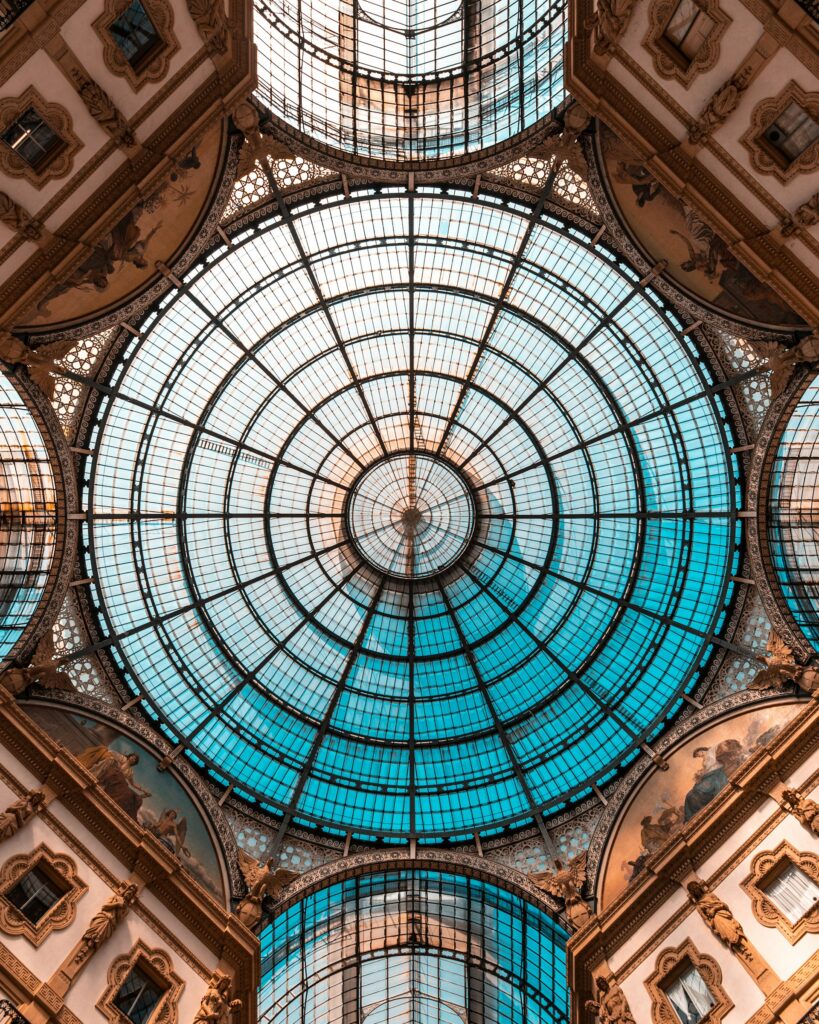
Public Architecture, Private Capital: The Financial Life of Galleria Vittorio Emanuele II
The Galleria Vittorio Emanuele II is often described as priceless, yet its everyday operation is governed by very real numbers. Although the building is legally protected and cannot be sold, real estate analysts estimate its commercial value at around 700 million euros, placing it among the most valuable retail assets in Europe. This figure does not reflect historical or cultural significance, but purely the income potential generated by its location, scale, and prestige.
That potential translates directly into municipal revenue. In 2023, the City of Milan generated approximately 67.7 million euros from rental income within the Galleria, marking the highest annual return in its history. This income comes from around 170 commercial units, including retail, hospitality, and office spaces, all owned by the city and leased through public tenders. Unlike many historic landmarks, the Galleria functions as a self-financing piece of urban infrastructure, continuously contributing to the city budget.
Rental levels inside the building belong to the global top tier. In the most prestigious area beneath the central dome — the Octagon — annual rents reach between 12,000 and 15,000 euros per square meter, placing the Galleria alongside Fifth Avenue in New York and Bond Street in London. Individual leases can reach extraordinary levels. Historical tenants such as Prada are reported to pay around 1.9 million euros per year for their flagship spaces, although these contracts are subject to special conditions due to long-term presence and heritage considerations.
New leases are governed by competitive tenders that impose significant financial thresholds even before a contract is signed. Brands entering the bidding process are required to deposit security amounts that can reach several hundred thousand euros, with figures around 500,000 euros frequently cited for prime locations. This mechanism effectively limits access to the strongest global brands and ensures long-term financial stability for the property owner — the city.
Private capital has also played a key role in maintaining the building’s condition. The major restoration campaign carried out between 2014 and 2015 was financed entirely through private sponsorship, with fashion houses and financial institutions contributing approximately 3 million euros. This model allowed Milan to preserve one of its most important public interiors without drawing on municipal funds, reinforcing the Galleria’s status as an economically autonomous heritage asset.
The financial ecosystem extends beyond retail. Hotels operating within the Galleria, such as luxury boutique properties overlooking the central space, charge around 1,000 euros per night for their highest-category rooms, with prices fluctuating depending on season and events. At ground level, even everyday consumption reflects the economic status of the place: a coffee or aperitif at a historic café typically costs around 12 euros when seated service is included — a small but telling indicator of the space’s commercial gravity.
Taken together, these figures reveal the Galleria Vittorio Emanuele II not as a frozen monument, but as a living financial organism. Its iron-and-glass structure shelters not only public life, but a carefully regulated economic system that has operated continuously since the late 19th century. In this sense, the building is less a relic of the past than an enduring model of how architecture, commerce, and public ownership can coexist at the highest level.
Trivia
The Architect’s Fatal Fall
The Galleria was designed by Giuseppe Mengoni, who won a competition against 175 other architects to realize this ambitious project. Tragically, he died just one day before the official inauguration on December 30, 1877, after falling from the top of the triumphal arch. Some locals believe it wasn’t an accident but a suicide driven by the heavy criticism his design received during construction.
The Mystery of the Bull
In the central octagon, there is a famous floor mosaic of a bull representing the coat of arms of Turin. Tradition dictates that you must place your right heel on the bull’s “testicles” and spin backward three times for good luck. This practice is so popular that a deep hole constantly forms in the mosaic, requiring the city to repair it several times a year.
The Golden Branding Rule
The city of Milan enforces a unique aesthetic law that requires every business inside the Galleria to have a gold-on-black sign. Even global brands like McDonald’s or Prada must abandon their corporate colors to maintain the building’s 19th-century elegance. This rule ensures that the visual harmony of the “Salotto di Milano” is never disrupted by modern advertising.
The Rattino Engine
Before electricity, the Galleria was lit by 1,200 gas lamps that had to be lit simultaneously every evening. To achieve this, a small automated steam engine nicknamed “il rattino” (the little rat) raced along a track near the ceiling to ignite the jets. Crowds of Milanese citizens used to gather at dusk just to watch this high-tech Victorian spectacle.
World War II Destruction
The stunning glass roof you see today is actually a faithful reconstruction of the original 19th-century design. During the Allied bombings in August 1943, almost 100% of the 14,000 square meters of glass was shattered, leaving the interior exposed to the elements. It took years of meticulous work after the war to restore the iron and glass structure to its former glory.
The World’s First Prada
In 1913, Mario Prada opened his very first luxury leather goods shop, Fratelli Prada, right inside the Galleria. The shop still operates today in its original location, featuring mahogany shelves and marble floors designed by the founder himself. It serves as a historic anchor for the mall, representing the birth of one of the world’s most powerful fashion dynasties.
A Royal Construction Cost
Building the Galleria was a massive financial undertaking that cost approximately 20 million Italian lire at the time. King Vittorio Emanuele II personally laid the foundation stone on March 7, 1865, using a silver trowel. Today, that investment pays off as the city earns over 67 million euros annually in rent from the luxury tenants.
The Seven-Star Hotel
The Galleria is home to one of the most exclusive hotels in the world, the Galleria Vik Milano (formerly TownHouse Galleria). It famously claimed a “seven-star” status, offering ultra-luxurious suites with direct views into the interior of the shopping arcade. Guests can literally sleep just a few meters above the historic mosaics and high-end boutiques.
Four Continents in Mosaics
High above the central octagon, four large mosaic lunettes represent Europe, Asia, Africa, and America. These artworks were designed to show Milan’s ambition as a global center of trade and culture during the 19th century. Interestingly, Australia is missing because it was not considered a major world continent by the designers at that time.
The Triumphal Arch Scale
The main entrance from Piazza del Duomo is a massive triumphal arch that stands 32 meters high. It was designed to rival the height of the neighboring buildings and create a grand transition into the “Living Room of Milan.” This arch is so large that it serves as a separate architectural monument in its own right.
A Project of a New Nation
The Galleria was conceived shortly after the unification of Italy as part of Milan’s modernization. It was meant to signal economic strength and civic ambition. Architecture became a political statement of national progress.
The Record-Breaking Dior Rent
The competition for space inside the Galleria is so fierce that brands participate in high-stakes public auctions for leases. In 2019, the fashion house Dior won a 250-square-meter space by bidding an incredible 5.4 million euros in annual rent. This made it one of the most expensive commercial leases per square meter anywhere on the planet.
First Electric Light
In 1883, the Galleria became one of the first public places in Europe to be illuminated entirely by electric light. This transition from gas to electricity happened shortly after the opening of the nearby Edison power station. The change allowed the nightlife in the Galleria to flourish, turning it into a true 24-hour social hub.
The 360-Degree View
While most visitors stay on the ground floor, there is a Highline Galleria path that allows people to walk along the rooftops. From this vantage point, you can see the intricate ironwork of the 47-meter-high dome up close. It also offers a unique 360-degree view of the Milan skyline, including the spires of the Duomo.
The Camparino Tradition
The Galleria is the birthplace of the iconic Camparino in Galleria bar, opened by Davide Campari in 1915. It was here that the tradition of the Milanese “Aperitivo” was popularized among the city’s elite and intellectuals. Today, people still pay a premium to stand at the bar and sip a Campari Soda in the same spot where history was made.
Three Capitals and One City
The mosaic floor beneath the central dome features the coats of arms of Turin, Florence, Rome, and Milan. Turin, Florence, and Rome represent the three historical capitals of Italy, while Milan was never a capital. Its inclusion reflects its role as the country’s economic and commercial center at the time of the Galleria’s construction.