
The Durian That Works
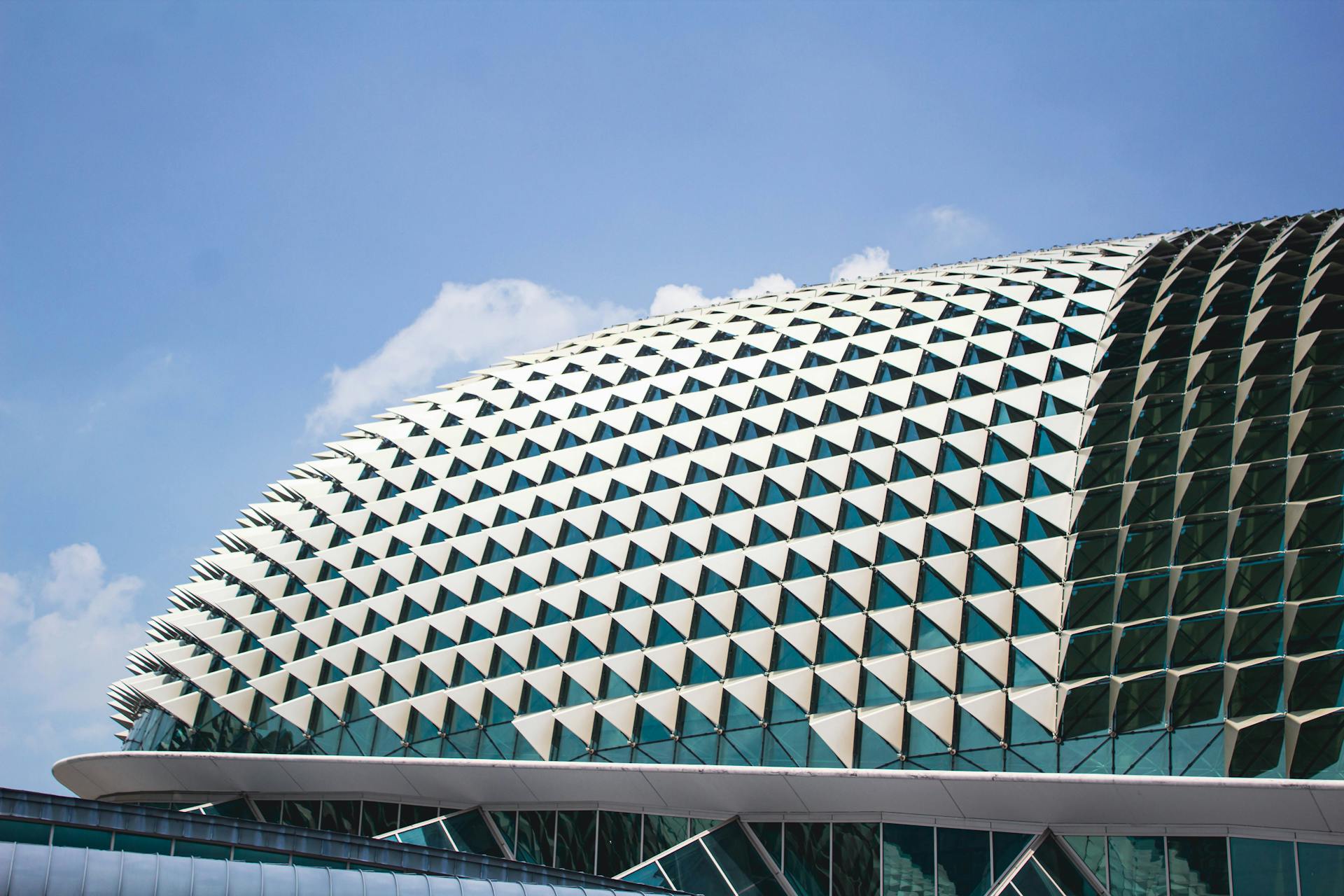
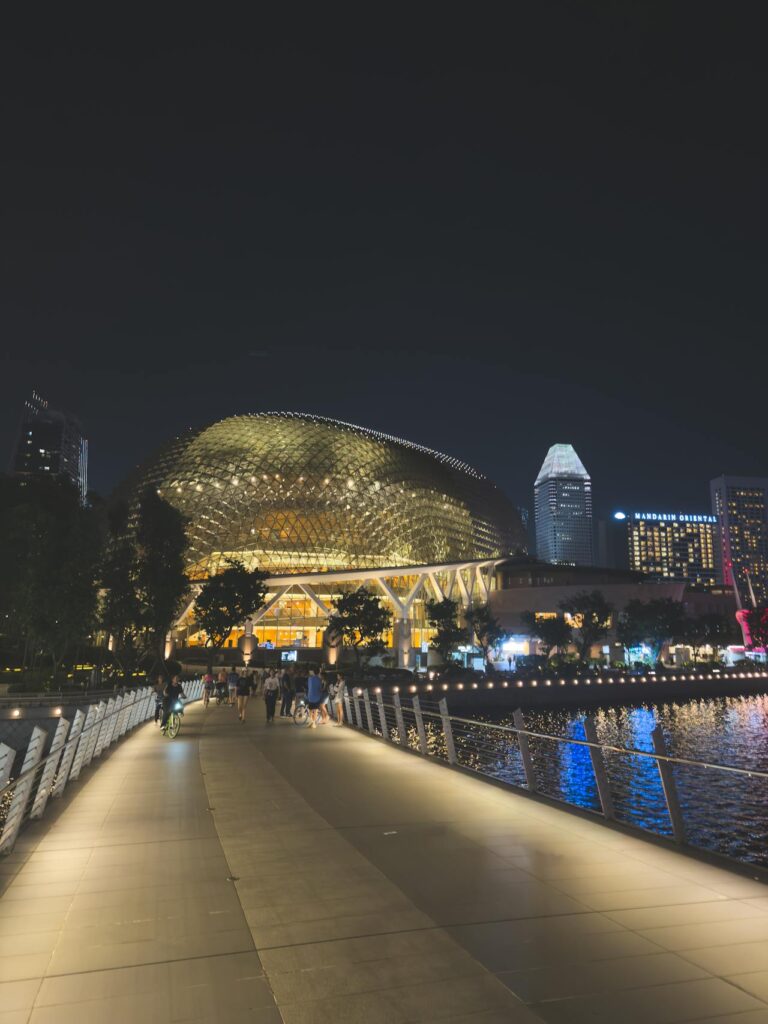
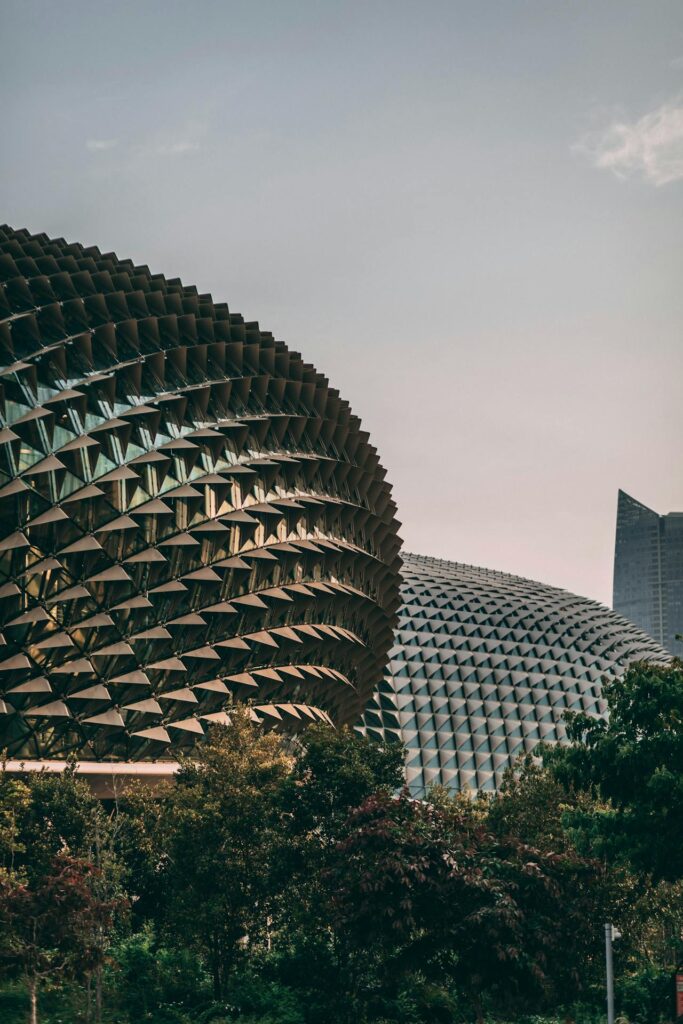
Often nicknamed the “durian” for its spiked, bulbous silhouette, Esplanade dominates Singapore’s waterfront with a form that immediately provokes comparison rather than understanding. At first glance, the twin domes read as an exercise in expressive architecture. In reality, the building operates as a precisely calibrated environmental system, engineered to perform under extreme solar exposure, high humidity, and the stringent acoustic requirements of world-class performance spaces. What is frequently perceived as visual excess is, in fact, the physical trace of environmental and technical optimization.
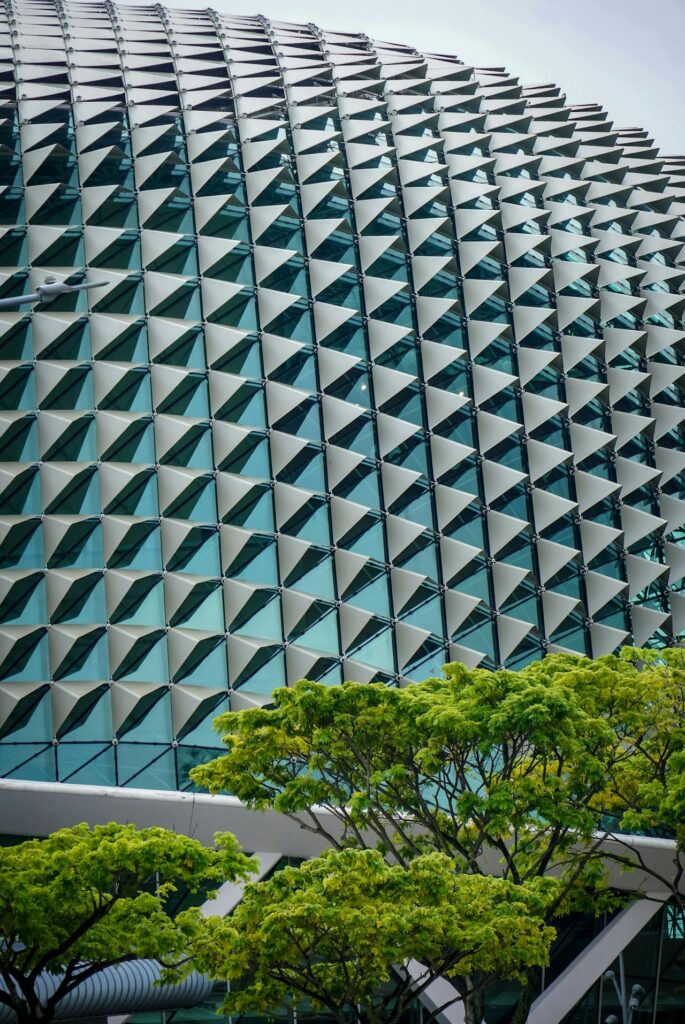
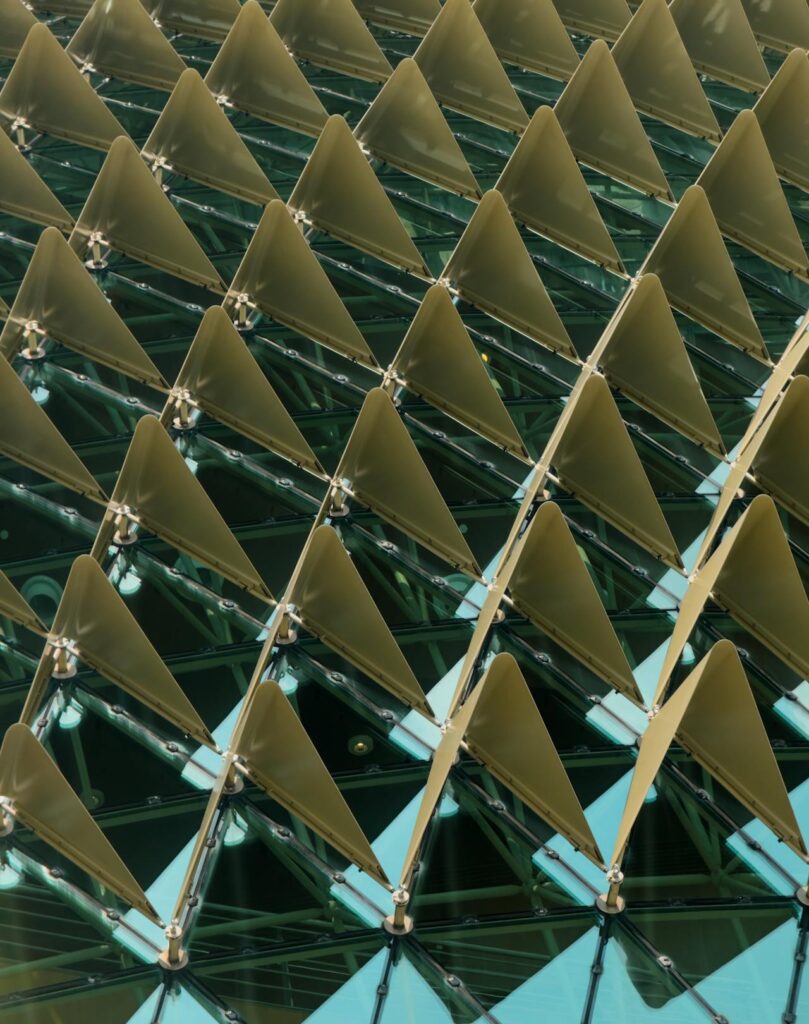
The durian-like façade is not a symbolic gesture but a performative device. Composed of more than 7,000 individually angled aluminum sunshades, it functions as a secondary climatic skin mediating between tropical sunlight and the interior environment. Each element is positioned to reduce direct solar gain while maintaining daylight and outward views — a necessity rather than an aesthetic choice in Singapore’s equatorial climate, where shading defines architectural viability. The building’s distinctive appearance emerges directly from this environmental logic.
Behind this climatic layer, the complex integrates two highly specialized performance venues — a concert hall and a theatre — each governed by strict acoustic, structural, and spatial criteria. These constraints, together with circulation requirements and the building’s role along the Marina Bay waterfront, collectively shape the architecture. The result is not an expressive object but a consequential form: an identity generated through performance data, environmental conditions, and precision engineering. Esplanade demonstrates how architecture can become iconic not by pursuing imagery, but by allowing constraints to visibly define the building.
Esplanade – Theatres on the Bay in Numbers
7 139
The total number of triangular aluminum sunshades (the “thorns”) forming the building’s skin
2
Primary domes forming the concert hall and theatre volumes
1 600
Seating capacity of the Concert Hall (plus space for a 200-voice choir)
1 948
Seating capacity of the Theatre, designed in a traditional European horseshoe shape
~60 000 m²
Gross floor area
1,8–2,3 s
Adjustable reverberation depending on configuration
1 000 000
The approximate number of rivets used to secure the façade elements
4 470
The exact number of pipes in the massive Klais pipe organ
10 t
The weight of the heaviest acoustic chamber doors (out of 13 total)
3 000
The average number of performances and events hosted annually
70%
The percentage of annual programs that are free to the public
600 mln
The total construction cost in Singapore Dollars (SGD)
What’s most intriguing about this building isn’t its appearance, but the environmental logic that transforms solar control into architecture. Esplanade operates as a calibrated climatic system, where thousands of individually angled sunshades mediate heat, light, and humidity in an equatorial context. Rather than producing form through expression, the building allows performance constraints to shape its identity, redefining how iconic architecture can emerge from environmental necessity.
The Façade as Environmental Infrastructure
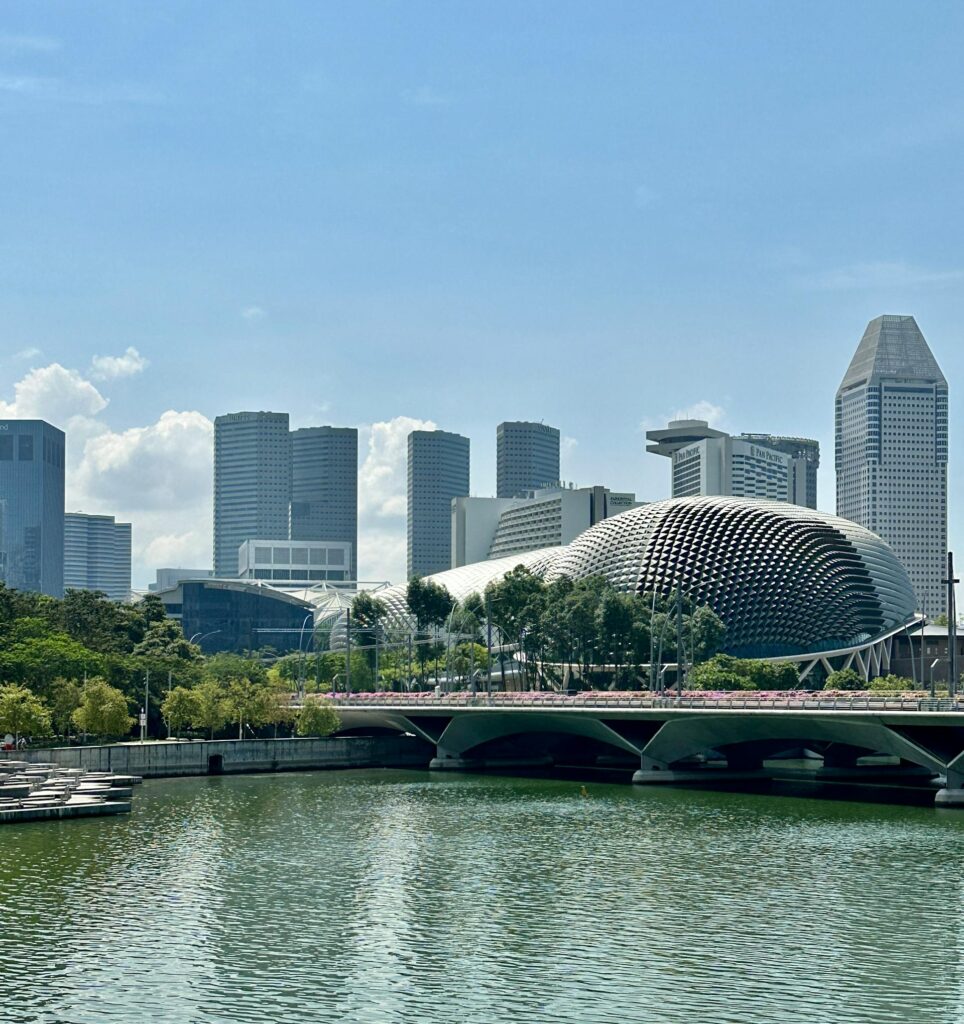
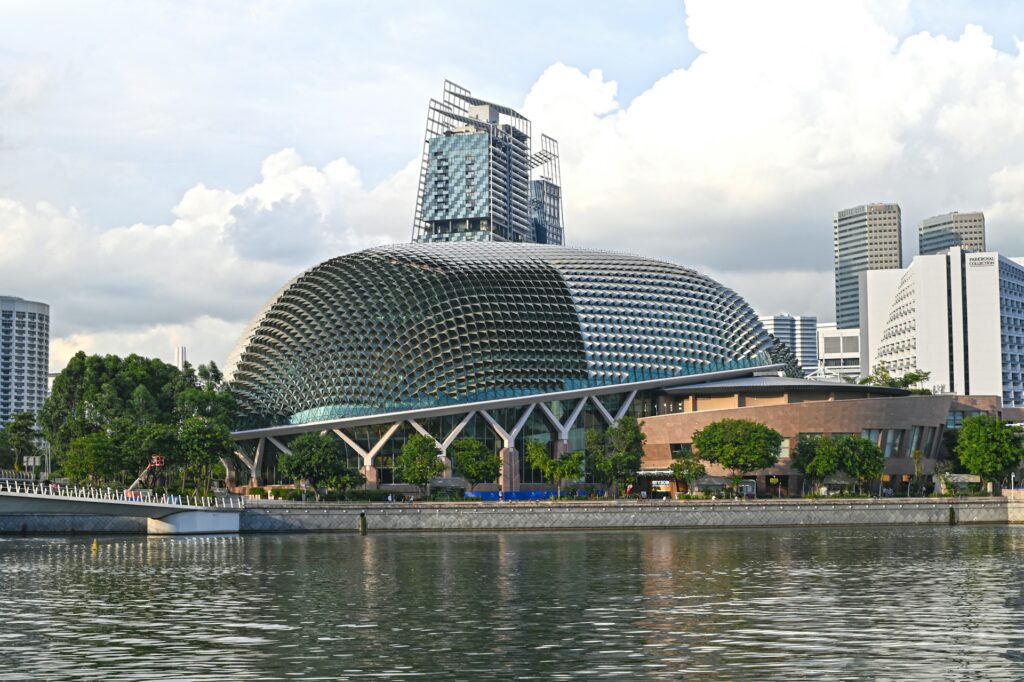
The façade of Esplanade is often interpreted as an expressive gesture, yet its logic is fundamentally quantitative and environmental. Located at an equatorial latitude of roughly 1° north, the building is exposed to high solar intensity throughout the year, making shading a primary architectural requirement rather than a secondary optimization. Instead of relying on heavily tinted glazing or internal blinds, the project introduces a double-skin façade in which solar radiation is intercepted before it reaches the glass envelope. This strategy addresses heat gain at its source, reducing cooling loads while preserving daylight penetration across the complex’s approximately 60,000 m² of gross floor area.
This climatic layer is composed of 7,139 aluminum sunshading panels distributed across the two primary domes. Rather than using a repetitive module, the system is geometrically differentiated: each panel is oriented according to its precise position on the curved surface and its exposure to the sun. While the panels appear visually irregular, their configuration is driven by environmental calibration, not formal variation for its own sake. The result is a ventilated buffer zone between the shading layer and the glazed enclosure, improving thermal performance while maintaining outward views toward Marina Bay. What reads as texture is in fact the accumulation of thousands of micro-adjustments responding to solar angles and curvature.
Behind this façade sit acoustically sensitive performance spaces whose requirements further influence the envelope’s design. The Concert Hall and Theatre volumes are enclosed within independent acoustic shells, meaning the façade must simultaneously manage solar control, environmental stability, and acoustic isolation. The external skin therefore plays a critical mediating role: it protects interior conditions while allowing the building to remain visually open and publicly legible. Rather than acting as ornament, the façade becomes an infrastructural system — one whose numerical density and environmental precision ultimately define the building’s identity. In Esplanade, visual distinctiveness is not designed first, but emerges from the disciplined resolution of climate, performance, and scale.
Measured, Not Heard by Accident
Acoustics were treated as a primary structural constraint in the design of Esplanade, rather than a secondary layer applied after the architectural form was established. The complex houses two fundamentally different performance environments — a symphonic concert hall and a lyric theatre — each requiring distinct acoustic profiles. To achieve this, both venues were designed as independent acoustic volumes, structurally separated from the surrounding building to prevent vibration transmission and external noise intrusion. This approach allows the performance spaces to function as isolated instruments within a larger architectural system.
The Concert Hall is engineered for unamplified orchestral and choral music, where clarity and reverberation must be carefully balanced. Its acoustic performance is actively tunable: a system of adjustable reverberation chambers allows the reverberation time to shift between approximately 1.8 and 2.3 seconds, depending on musical requirements. Above the stage, movable acoustic reflectors shape early sound reflections toward the audience, enhancing presence and spatial definition. The hall is also equipped with a 4,740-pipe Klais organ, whose scale and tonal range further influenced the acoustic volume and geometry of the space.
In contrast, the Theatre prioritizes speech intelligibility and acoustic control across a wide range of dramatic and amplified performances. The room geometry, surface treatments, and volume are optimized to limit excessive reverberation while maintaining even sound distribution across all 1,948 seats. Crucially, the façade and external structure support this internal acoustic performance by shielding the halls from the noise of the surrounding city and waterfront. In Esplanade, acoustics are not confined to the interior; they inform the building’s structural logic, spatial hierarchy, and relationship to its urban context, reinforcing the idea that performance requirements can drive architectural form at every scale.chanism capable of converting tourism, entertainment, and gaming into sustained national value.
Trivia
An Architectural Nickname
While the architects originally intended for the design to evoke traditional Asian lanterns, the local public immediately dubbed it “The Big Durian.” The name stuck so firmly that it has become a central part of the building’s identity and national pride. Today, it is likely the most famous “fruit-shaped” building in the world.
Mathematical Precision of the Façade
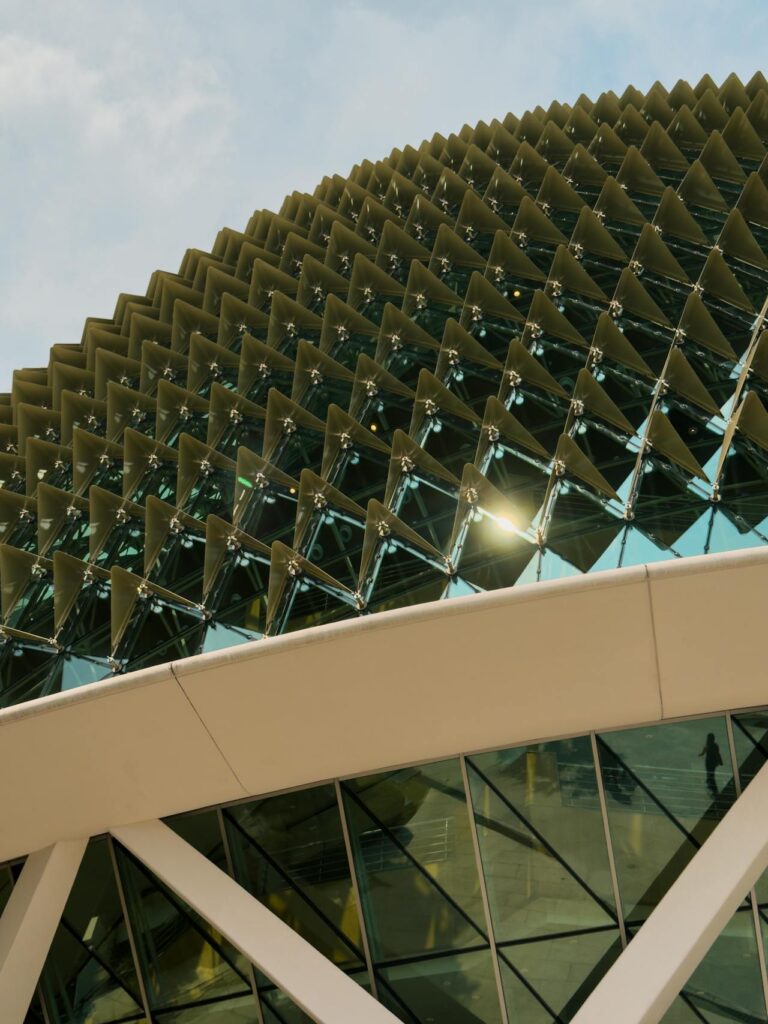
The outer skin of the building is composed of exactly 7,139 triangular aluminum sunshades. Remarkably, no two panels are identical in their orientation, as each was uniquely angled to reflect light efficiently. This level of complexity required cutting-edge software that was revolutionary in the late 1990s.
Defeating the Tropical Heat
Without its characteristic spikes, the glass domes would act like giant greenhouses in Singapore’s equator sun. The aluminum panels block direct UV rays while still allowing for a panoramic view of the Marina Bay skyline. This ingenious solution significantly reduces the energy needed to cool the massive interior spaces.
World-Class Acoustics
The main Concert Hall is widely considered one of the top five acoustic venues in the world. Designed by the legendary acoustician Russell Johnson, it features a sophisticated system of movable acoustic canopies. These allow technicians to “tune” the room perfectly for everything from solo recitals to full symphonic orchestras.
Hidden Reverberation Chambers
Tucked away inside the Concert Hall are massive acoustic chambers with a volume of 9,500 cubic meters. They feature 13 pairs of concrete doors, with the heaviest weighing a staggering 10 tons each. By opening or closing these doors, engineers can adjust the reverberation time to create the perfect sonic environment.
Regal Pipe Organ
The Concert Hall houses a magnificent pipe organ built by the renowned Johannes Klais Orgelbau. The instrument consists of 4,470 pipes and was custom-designed to match the hall’s contemporary aesthetic. It serves as the musical heart of the building, regularly mesmerizing audiences with its power and range.
Horseshoe-Shaped Theatre
The main Theatre was modeled after traditional European opera houses with a horseshoe-shaped seating layout. This design ensures an intimate connection between the performers and the audience despite the large capacity. In fact, the furthest seat is located only 40 meters away from the stage.
Art for Everyone
The Esplanade operates on a mission of “arts for all,” hosting thousands of free performances every year. It is estimated that approximately 70% of their total annual programming is accessible to the public at no cost. This makes the venue a vibrant community hub rather than an elitist institution.
Foundations on Reclaimed Land
The building sits on land that was reclaimed from the sea, which presented a significant engineering challenge. To ensure the structure’s stability, foundation piles were driven 30 meters deep into the ground. This solid base supports thousands of tons of concrete and steel right at the water’s edge.
Mountaineering Maintenance
Cleaning the 7,139 aluminum spikes is a task reserved for professional rope-access technicians. The process takes several weeks and requires extreme precision to avoid damaging the delicate mounting systems. Every single panel must be cleaned by hand, making the maintenance of the façade a truly heroic effort.
A Stage the Size of a Field
The stage in the main Theatre is immense, covering an area of approximately 1,200 square meters. It is equipped with advanced systems of traps and movable platforms that allow for lightning-fast scenery changes. This infrastructure allows the venue to host the most complex Broadway-scale productions.
A Record-Breaking Budget
The construction of the complex cost approximately 600 million Singapore Dollars. At the time of its opening in 2002, it was one of the most expensive cultural investments in Asia. This figure reflects Singapore’s ambition to establish itself as a global capital for the arts and design.
A Library with a View
The third floor is home to library@esplanade, Singapore’s first public library dedicated entirely to the performing arts. Beyond books, it houses music scores, film scripts, and a massive collection of audio recordings. Patrons can enjoy their research while looking out over the beautiful Marina Bay.
The Forbidden Fruit Paradox
There is a funny irony in the fact that “The Big Durian” is a national symbol in a city where carrying actual durians on the subway is strictly forbidden. The Esplanade is directly connected to the MRT network via underground linkways. It remains the only “durian” officially allowed to linger near the public transport system.
Protection Against Vibrations
The entire complex was engineered to isolate external noise, such as city traffic and passing ships. The halls are built as independent “box-within-a-box” structures resting on rubber pads that dampen vibrations. This ensures absolute silence inside, even during the heaviest tropical thunderstorms.
Heart of the Huayi Festival
The Esplanade is the primary venue for the Huayi Festival, which celebrates Chinese artistic expression. During this time, the building is filled with traditional music and cutting-edge contemporary theatre from across the globe. It is a perfect example of how the building bridges tradition and modernity.