
The Sonic Heart of Hamburg: Elbphilharmonie
The Elbphilharmonie is a building conceived not from elevation drawings, but from sound waves. Long before its glass façade began to rise above the Elbe, the project was defined by acoustic parameters, structural isolation, and mathematical precision measured in millimetres rather than meters. What emerged is not merely a concert hall placed on the waterfront, but a spatial instrument—one in which architecture, engineering, and music are inseparable.
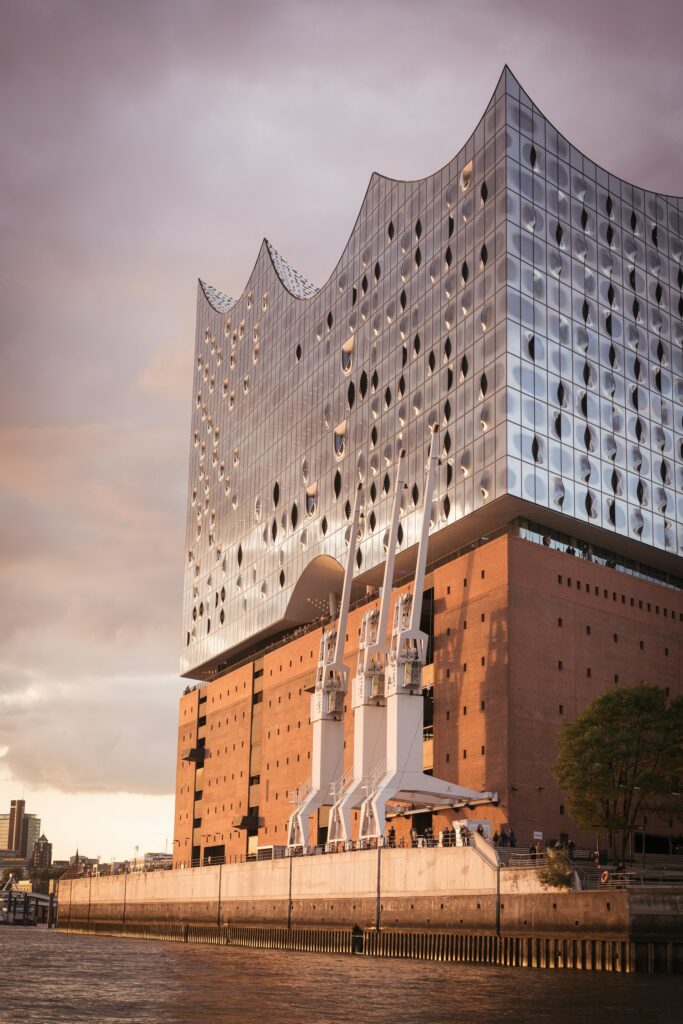
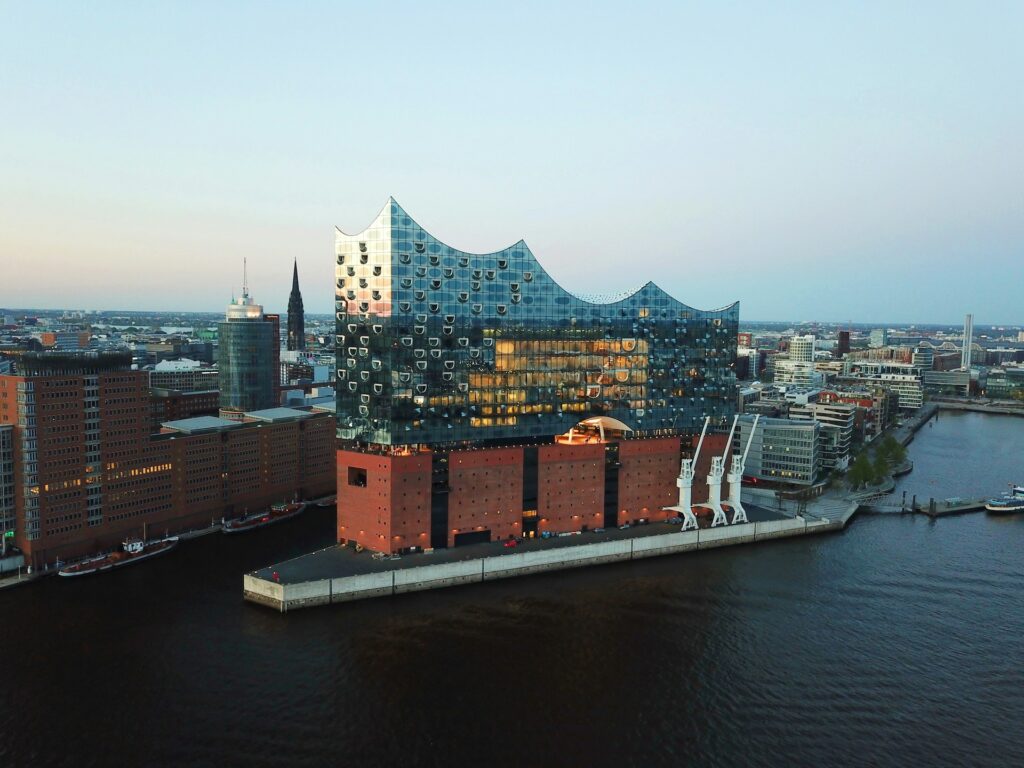
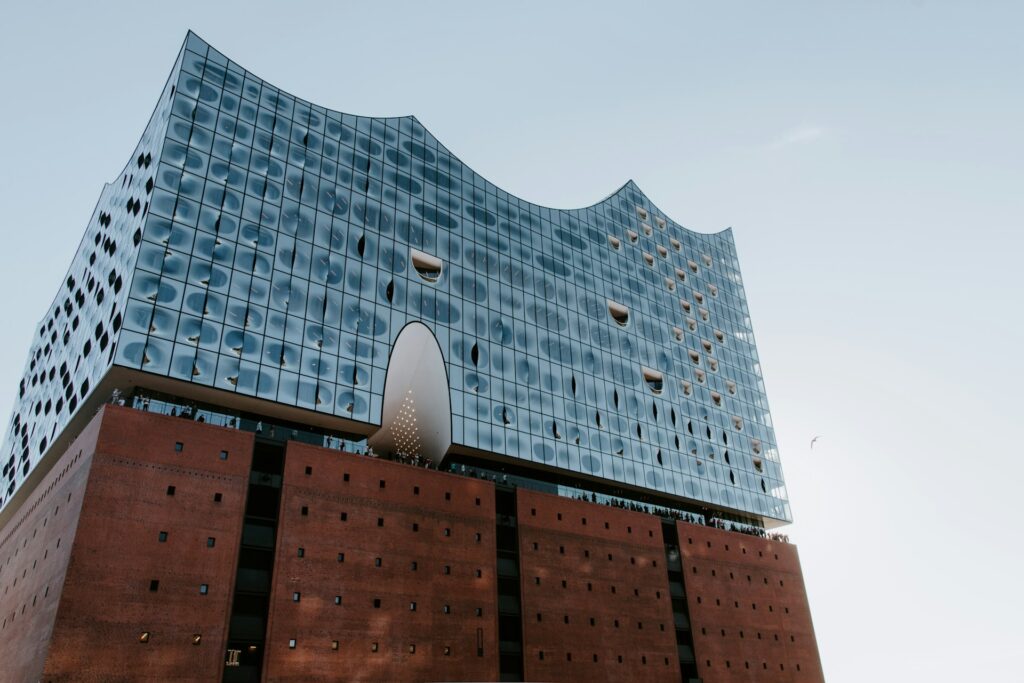
The building occupies a paradoxical position in the city. It rests on the massive brick body of the former Kaispeicher A, a 1960s warehouse once designed for storing cocoa, tea, and tobacco, yet above this inert base floats a form that appears almost weightless. The transition between these two worlds is not symbolic but structural: a new building erected on top of an old one, separated by complex load transfer systems and acoustic buffers, ensuring that the vibrations of the city never reach the concert halls above.
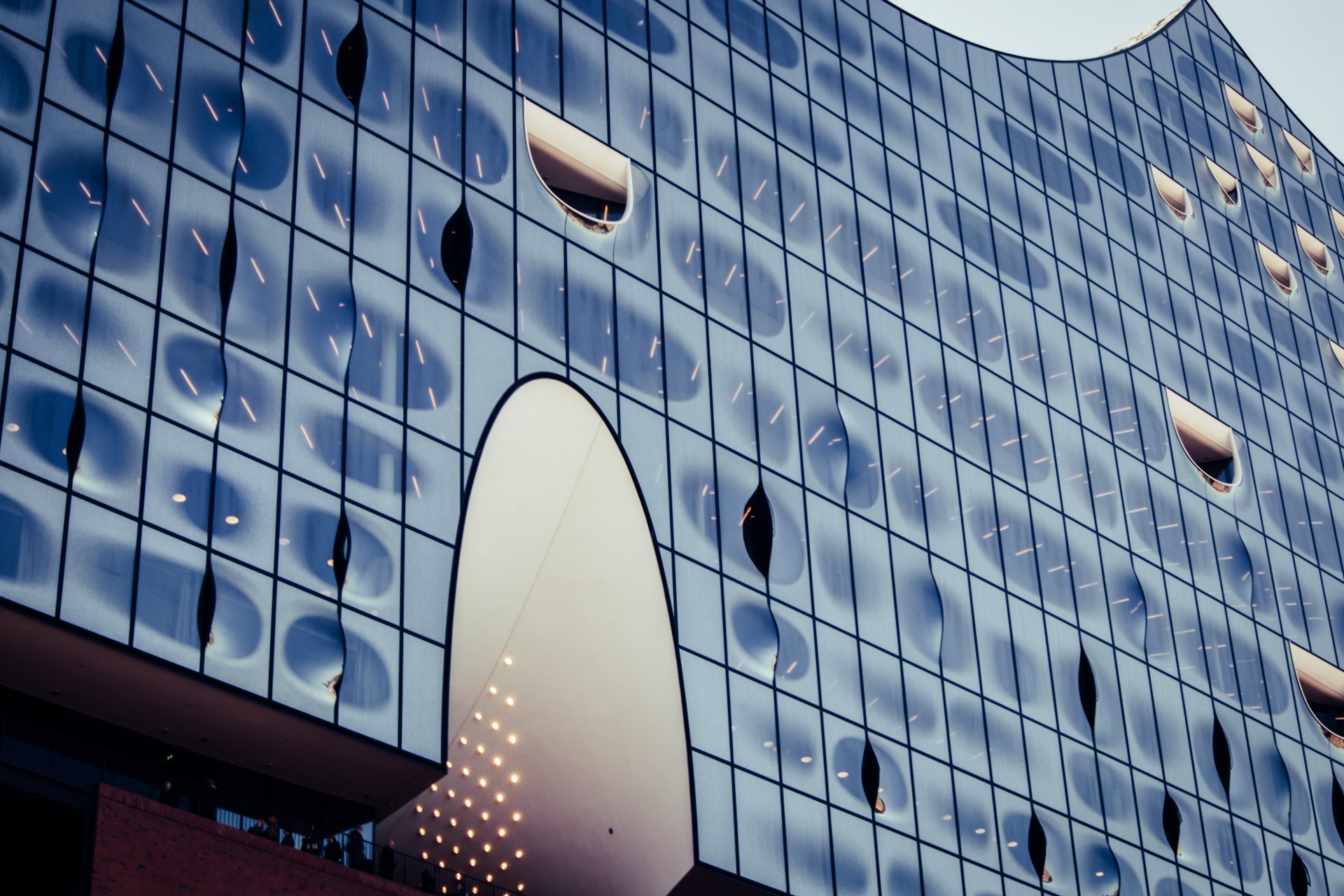
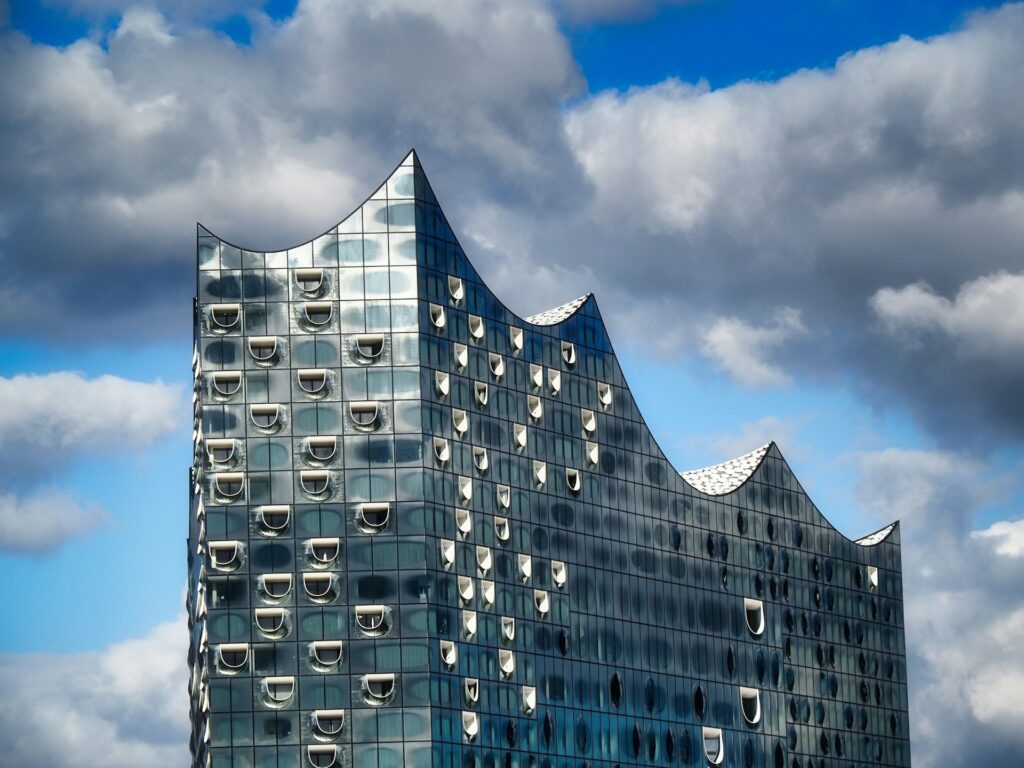
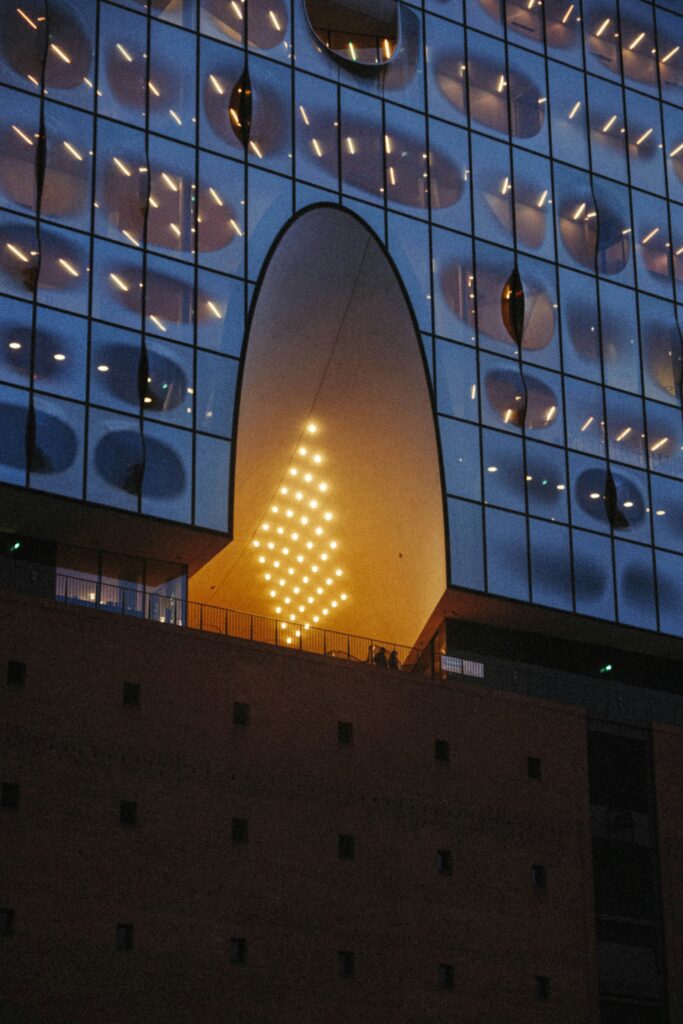
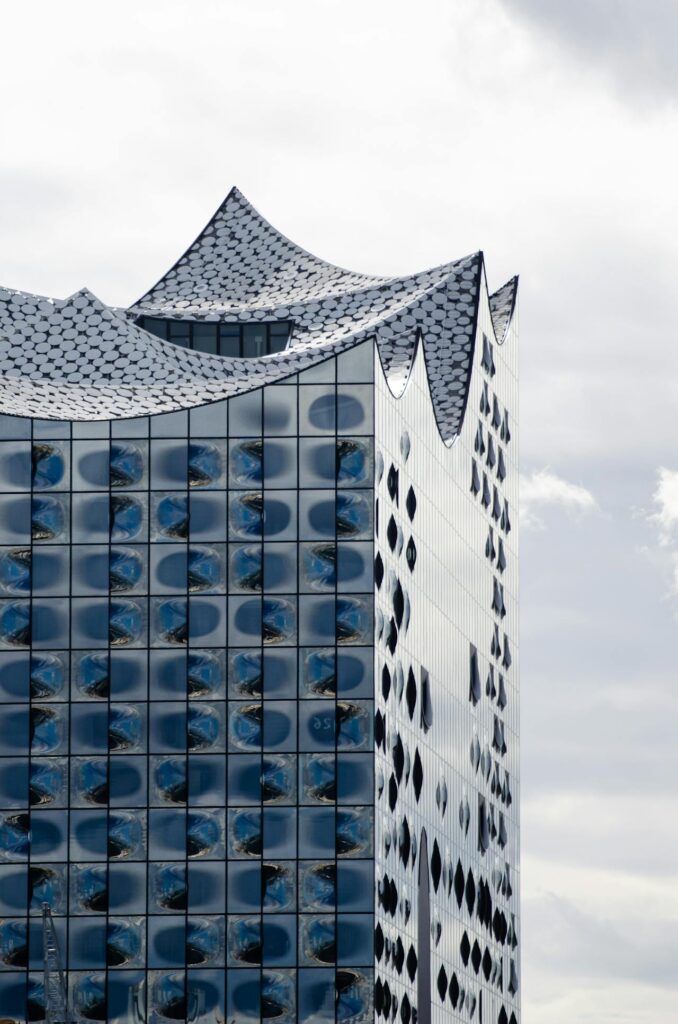
What defines the Elbphilharmonie visually—the undulating glass crown—is in fact a direct consequence of internal requirements. The curved roofline responds to the geometry of the main hall, while the façade is composed of thousands of individually shaped glass panels, each adjusted to control reflections of light, heat, and sound. From a distance, the building reads as a continuous wave; up close, it reveals itself as a dense field of precise repetitions and variations.
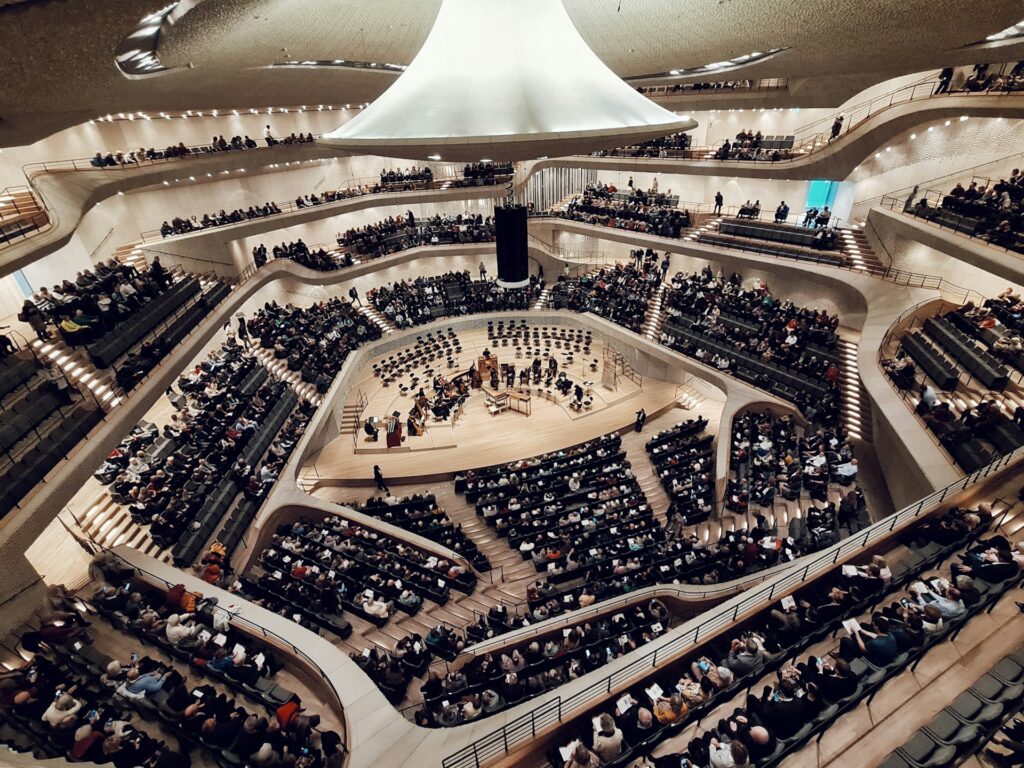
At its core lies the Große Saal, a vineyard-style concert hall designed around the audience rather than the stage. Here, sound governs space with absolute authority. Every surface, angle, and texture is optimized to deliver uniform acoustics to all seats, resulting in an interior that resembles a carved geological formation more than a traditional auditorium. The famous “White Skin” lining the hall is not decorative—it is a data-driven surface shaped by acoustic simulation and refined through physical modelling, down to tolerances of fractions of a millimetre.
Yet the Elbphilharmonie is not an isolated object. It acts as an urban condenser, drawing the city upward through its public plaza, escalators, foyers, and viewing platforms. Thousands of visitors pass through daily without attending a concert, turning a highly specialized acoustic machine into a civic space. In this way, the building performs two roles simultaneously: one governed by strict scientific precision, the other by openness and public access.
This entry looks beyond the iconography. By examining verified numbers—dimensions, quantities, tolerances, material volumes, and acoustic parameters—we read the Elbphilharmonie not as a sculptural landmark, but as a sum of calculated decisions. It is a building where form is the result of data, and where architecture becomes audible long before it becomes visible.
Elbphilharmonie Hamburg in Numbers
110 m
Total height
10 000
panels of plaster and paper to disperse sound
1 096
Facade elements
2 100
Capacity of the Great Hall (Großer Saal)
4 765
Number of pipes in organs built by the Klais workshop
82 m
The length of “The Tube,” the longest curved escalator in Europe
2007–2017
Full project implementation time
789 mln EUR
Total cost, more than 10 times the original budget!
What’s most intriguing about this building isn’t its sculptural silhouette alone, but the way it transforms sound into urban form. The Elbphilharmonie does not merely sit on Hamburg’s waterfront; it extends the city upward, turning a former warehouse into a public promenade suspended above the Elbe. By merging an open civic plaza with one of the most acoustically precise concert halls ever built, it creates a rare unity between infrastructure, culture, and everyday urban life.
Façade Of The Elbphilharmonie
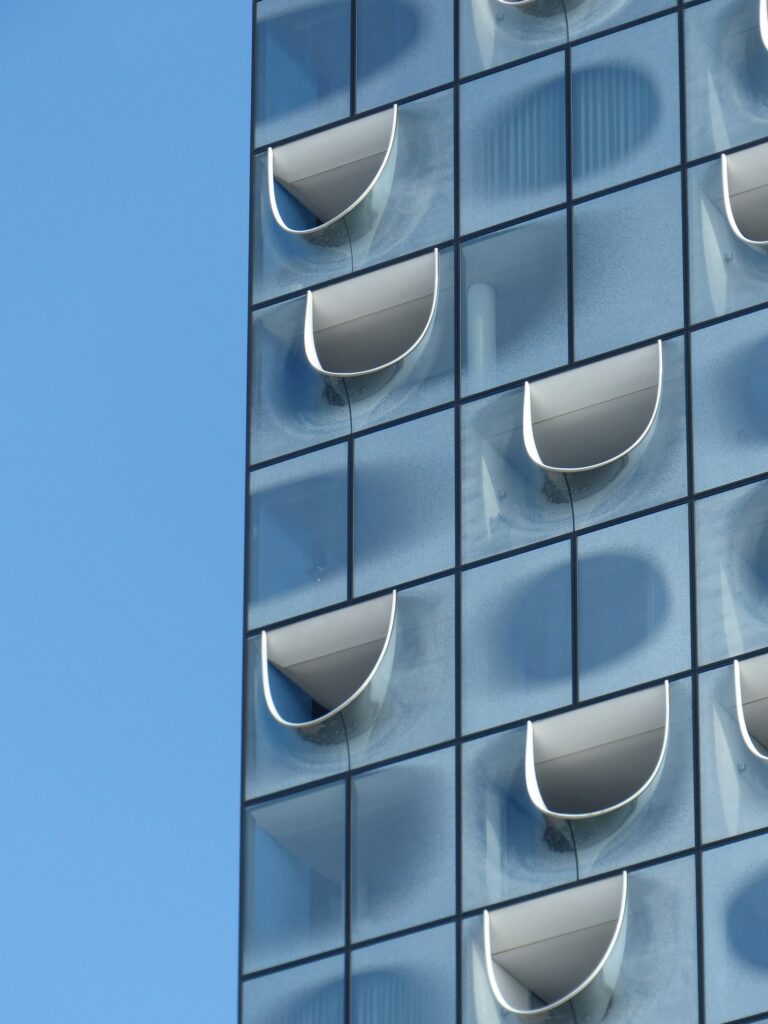
The glass façade of the Elbphilharmonie is often described as sculptural, yet its defining quality lies in precision rather than expression. Designed by Herzog & de Meuron and engineered and built by Gartner, the façade is composed of 1,096 prefabricated modules, each one geometrically unique. No two elements share the same curvature, inclination, or proportion, a direct consequence of the building’s continuously undulating form.
Each module is a complete façade unit consisting of an aluminium frame and insulated glazing. The glass itself is not hot-formed into complex three-dimensional shapes; instead, curvature is achieved through carefully controlled cold bending during installation. This approach allowed the engineers to produce large-format panels—some reaching nearly five metres in height—while maintaining optical clarity and structural performance. The absence of repetitive elements transformed the façade into a logistical and manufacturing challenge, where every panel was individually numbered, fabricated, and installed in a predetermined sequence.
The characteristic white pattern printed on the glass is not decorative. Applied as a ceramic frit, it regulates solar gain and glare, contributing to thermal comfort inside the building. The density of this pattern varies depending on orientation and exposure, meaning the façade responds subtly to its environment while maintaining a visually continuous surface when seen from a distance.
Structurally, the façade is supported by a bespoke aluminium substructure developed specifically for this project. Standard curtain wall systems were insufficient for the combination of size, curvature, and tolerance requirements involved. Installation demanded millimetre-level precision, as deviations could not be absorbed by repetition or modular adjustment.
What ultimately defines the Elbphilharmonie façade is not the quantity of glass, but the elimination of standardization. The building’s iconic wave-like silhouette is the visible result of thousands of individual decisions, each resolved at the scale of a single panel. In this sense, the façade is less a skin than a catalogue of calculated variations—an interface where architecture, engineering, and fabrication converge.
Acoustics Of The Elbphilharmonie
The Elbphilharmonie was designed around sound long before its exterior form was defined. The geometry of the main concert hall, the structure of the building, and even its construction sequence were subordinated to acoustic performance. The acoustic concept was developed by Nagata Acoustics, under the direction of Yasuhisa Toyota, and represents one of the most rigorously engineered sound environments ever built.
At the core of the building lies the Große Saal, designed in a vineyard configuration in which the audience surrounds the stage on all sides. This layout reduces the maximum distance between listener and orchestra to approximately thirty metres, ensuring acoustic intimacy regardless of seating position. Unlike traditional shoebox halls, where sound travels longitudinally, the Elbphilharmonie relies on a dense, multidirectional reflection field to achieve clarity and spatial balance.
The hall is conceived as a structurally independent object: a massive reinforced-concrete “box” weighing approximately 12,500 tons, fully isolated from the surrounding building. It rests on 362 steel spring elements, preventing vibrations from the city, the hotel, or the public plaza from reaching the performance space. This complete acoustic decoupling was non-negotiable and dictated major structural decisions across the entire project.
The most distinctive acoustic feature is the so-called White Skin. Covering walls, balustrades, and ceilings, it consists of roughly 10,000 individually designed panels, each milled with a unique micro-relief pattern. These patterns were generated algorithmically based on acoustic simulation, controlling how sound waves are scattered, absorbed, or reflected. There is no repetition: every panel responds to its precise position within the hall.
Crucially, the White Skin is not a visual statement but a data-driven surface. Its geometry operates at the millimetre scale, shaping sound rather than space. Even minor deviations in depth or angle would have altered acoustic performance, which is why fabrication tolerances were exceptionally tight and installation followed a strictly defined sequence.
Trivia
Built on Springs
The Grand Hall is completely detached from the rest of the building to prevent harbor noise from disturbing the music. The entire auditorium rests on 362 giant steel springs that act as massive shock absorbers. This engineering feat ensures absolute silence inside, regardless of the heavy ship traffic outside.
The Longest Tube in Europe
Visitors enter the building through “The Tube,” a unique 82-meter-long curved escalator. Because of its slight arch, you cannot see the end of the journey until the very last moment, creating a futuristic experience. The trip takes exactly 2.5 minutes and delivers you directly to the observation deck.
A Massive Budget Increase
The project’s initial budget was estimated at just €77 million, but the final cost skyrocketed to nearly €789 million. This enormous discrepancy made the construction one of the most controversial public projects in German history. Today, however, it has become a profitable global icon and the pride of Hamburg.
Foundations in the Riverbed
The 200,000-tonne weight of the building sits atop an old brick warehouse that required massive reinforcement. Engineers drove 1,745 reinforced concrete piles deep into the bed of the Elbe River to ensure the structure wouldn’t sink into the mud. This hidden foundation is what allows the glass superstructure to safely tower over the water.
A Public Plaza in the Clouds
At a height of 37 meters, the Plaza serves as a public observation deck connecting the old warehouse with the new glass top. It is a completely open space where anyone can enjoy a 360° panoramic view of Hamburg. Every year, it attracts more visitors than the famous Neuschwanstein Castle in Bavaria.
Luxury Under the Glass Roof
The Elbphilharmonie is not just for music; it also houses The Westin hotel and 44 private luxury apartments. Residents of these apartments hold some of the most prestigious addresses in Germany with views overlooking the harbor. These exclusive properties are among the most expensive real estate in the country.
A Roof Like a Stormy Sea
The top edge of the building is not flat but follows a wave-like silhouette to mimic the Elbe River. The roof is covered with 6,000 white shimmering sequins that sparkle in the sun like sea foam. This distinctive design makes the building’s silhouette recognizable from many miles away.
Old and new share the same structure
The glass superstructure rises from the brick body of the former Kaispeicher A warehouse, originally built in the 1960s. The project preserves and reuses the massive base while radically transforming its function.