
A Cathedral Designed Around a Problem, Not a Solution
An Architectural Problem Before It Was a Building
The Cathedral of Santa Maria del Fiore was conceived not as a finished architectural vision, but as an open-ended challenge. From the moment construction began in 1296, Florence committed itself to a scale that exceeded the technological capacity of its time. The city decided first how large, how dominant, and how symbolic the cathedral should be—only later asking how such a structure could actually be built.
This reversal of logic is crucial. Unlike many medieval cathedrals, Santa Maria del Fiore was not driven primarily by liturgical refinement or stylistic continuity. It was a civic project, financed, managed, and symbolically owned by the city itself. The cathedral was meant to embody Florence’s economic power, political autonomy, and cultural ambition in stone—visible proof that a republic of merchants could rival emperors and popes.
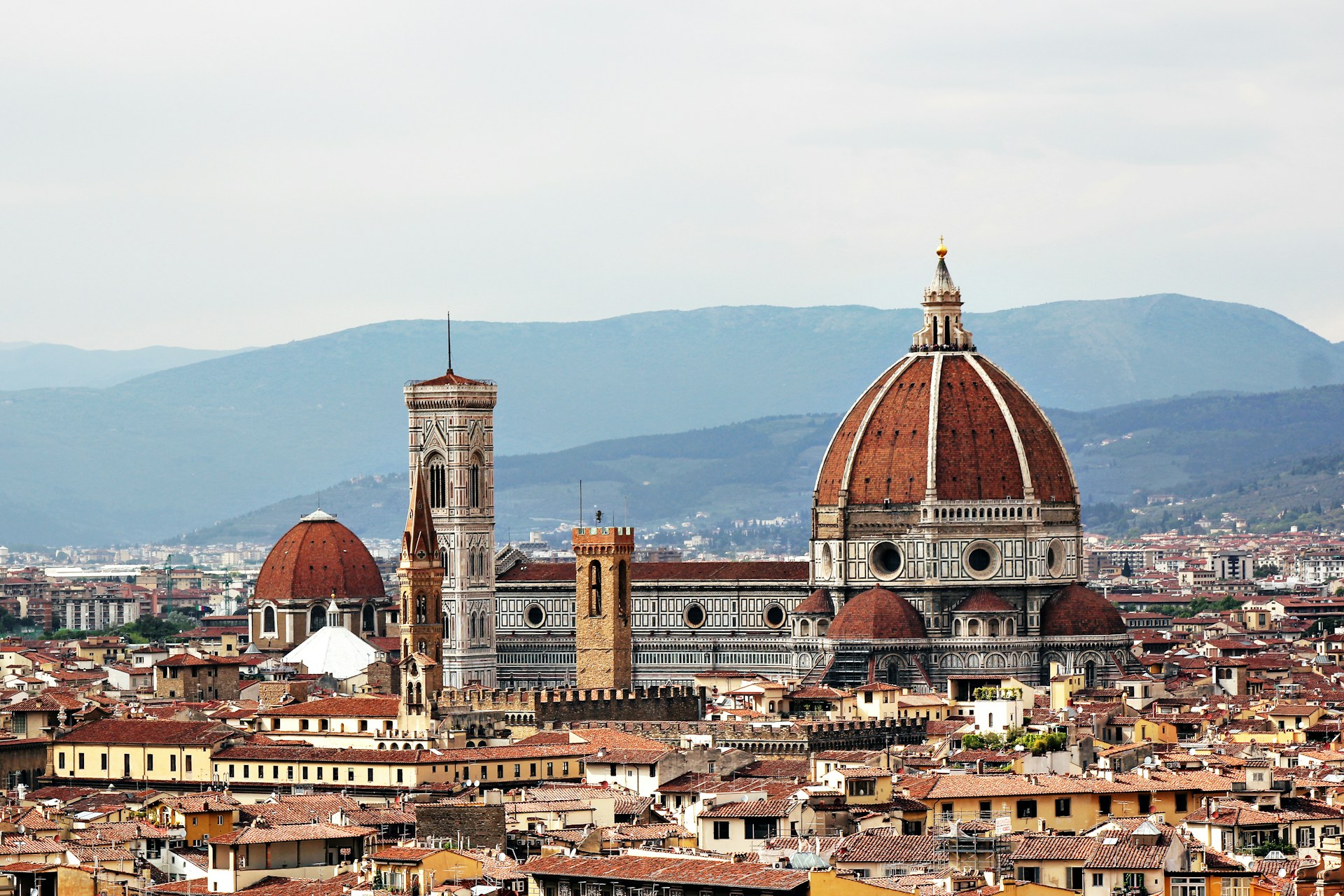
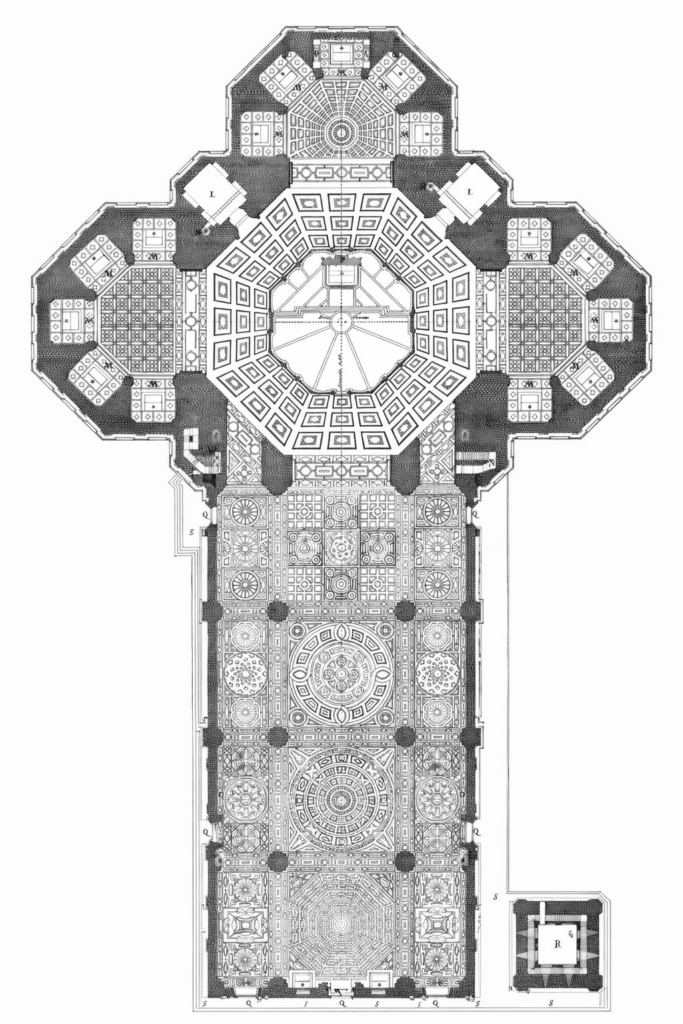
The most radical decision was embedded directly into the plan: an enormous octagonal crossing, designed to carry a dome larger than anything constructed since antiquity. At the time of its approval, no known method existed to span such a space in masonry. For more than a century, the cathedral stood incomplete, its crossing covered by a provisional roof, a permanent reminder of an unresolved architectural problem looming at the heart of the city.
What makes Santa Maria del Fiore exceptional is that this uncertainty was not corrected—it was preserved. The building became a container for future invention, deliberately waiting for a solution that had yet to be imagined. When Filippo Brunelleschi finally proposed his dome in the early 15th century, he did not simply complete the cathedral; he redefined the relationship between geometry, structure, and construction.
As a result, Santa Maria del Fiore occupies a unique position in architectural history. It is simultaneously Gothic and proto-Renaissance, monumental yet controlled, conservative in material and revolutionary in logic. Its form is not the outcome of stylistic evolution, but of numerical, geometric, and structural negotiation carried out over generations.
This is why the cathedral cannot be understood through façade or ornament alone. Its true meaning lies in its plan, proportions, and unresolved risks—a building designed around a problem, and ultimately transformed into a solution that changed architecture forever.
Cathedral of Santa Maria del Fiore in Numbers
153 m
Total external length of the basilica
90 m
Width at the transept
114,5 m
Total height from the ground to the tip of the copper ball atop the lantern
30 000
Maximum historical standing capacity of the interior
45,5 m
External diameter of the dome
42,2 m
Internal diameter (the “clear span”) of the dome
37 000 t
Estimated total weight of the dome’s structure
4 000 000
Number of bricks used in the dome’s construction
2
The dome consists of a thick inner shell to support the weight and a thinner outer shell to protect against the elements
0
The number of internal support structures used to hold the dome up during its 15th-century construction (a feat of engineering)
8
The number of main ribs – The visible vertical white marble ribs that provide primary structural support
16
The number of concealed ribs – Intermediate ribs hidden between the two shells to distribute the load
463
The precise number of stairs to climb to the top of the Dome
414
The number of stairs to reach the top of Giotto’s Bell Tower (Campanile)
3 600 m²
The surface area of the “Last Judgment” fresco by Vasari and Zuccari (the largest mural painting in the world)
44
The total count of monumental windows, designed by masters
140
The total duration of construction (from 1296 to 1436)
16
The time it took to complete the dome specifically (1420–1436)
3
Types of marble – White (Carrara), Green (Prato), and Red (Maremma) used for the exterior cladding
1887
The year the current Neo-Gothic facade was finally completed, over 450 years after the cathedral was consecrated
What’s most compelling about this cathedral isn’t its monumentality, but the decision to design a dome before knowing how to build it. Santa Maria del Fiore turned architectural uncertainty into a catalyst for invention, permanently altering the relationship between form and structure.
From Civic Ambition to a 600-Year Construction Timeline
The idea of Santa Maria del Fiore was born in the late 13th century, at a moment when Florence was rapidly transforming from a medieval city into one of Europe’s richest commercial powers. The existing cathedral, Santa Reparata, no longer reflected the city’s political confidence or demographic growth. In 1296, the Florentine Republic approved a new cathedral project whose scale was deliberately excessive. Contemporary chronicles make this clear: the building was intended to be “so large and magnificent that it could not be surpassed by human industry.” From the start, the project was less about worship than about civic self-representation.
Arnolfo di Cambio’s initial design set the tone. He proposed a vast structure combining Gothic construction with an unusually centralized plan, culminating in an enormous octagonal crossing. Crucially, the dimensions of this crossing implied a dome larger than any built since antiquity. No construction method existed to realize it—but the city approved the plan anyway. Florence chose ambition first, solutions later.
After Arnolfo’s death, construction progressed slowly through the 14th century under multiple masters, including Giotto and Francesco Talenti. By the mid-1300s, the nave, transept, and massive piers supporting the future dome were largely complete. Yet the cathedral remained structurally unresolved. For decades, the crossing was covered only by a temporary wooden roof. The building stood as a monumental architectural question mark in the heart of the city—finished everywhere except where it mattered most.
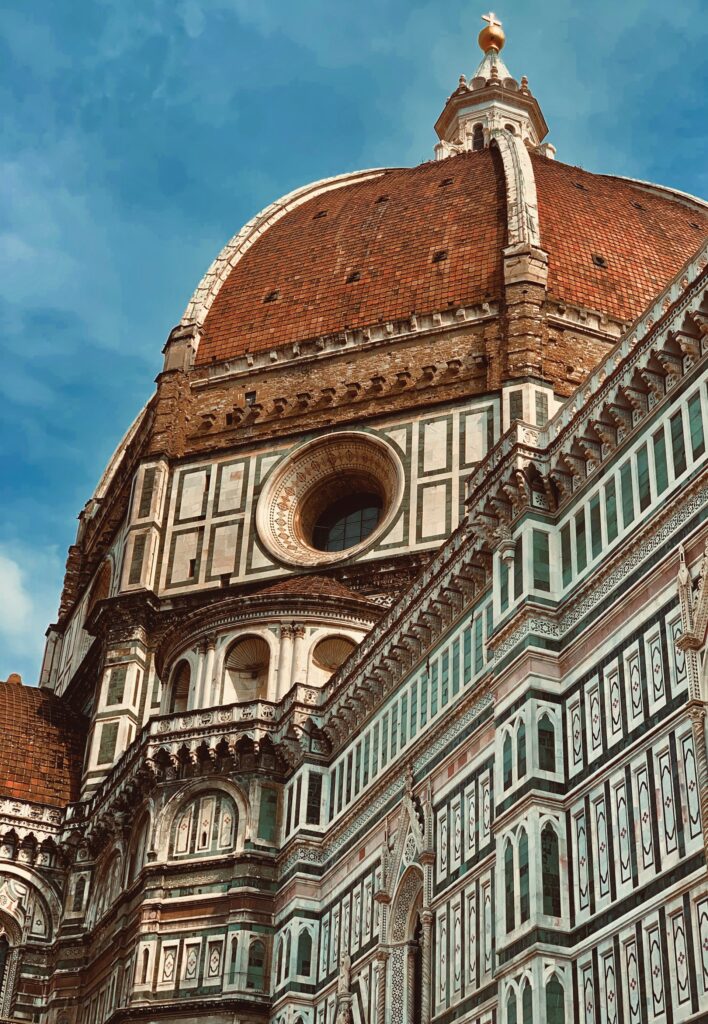
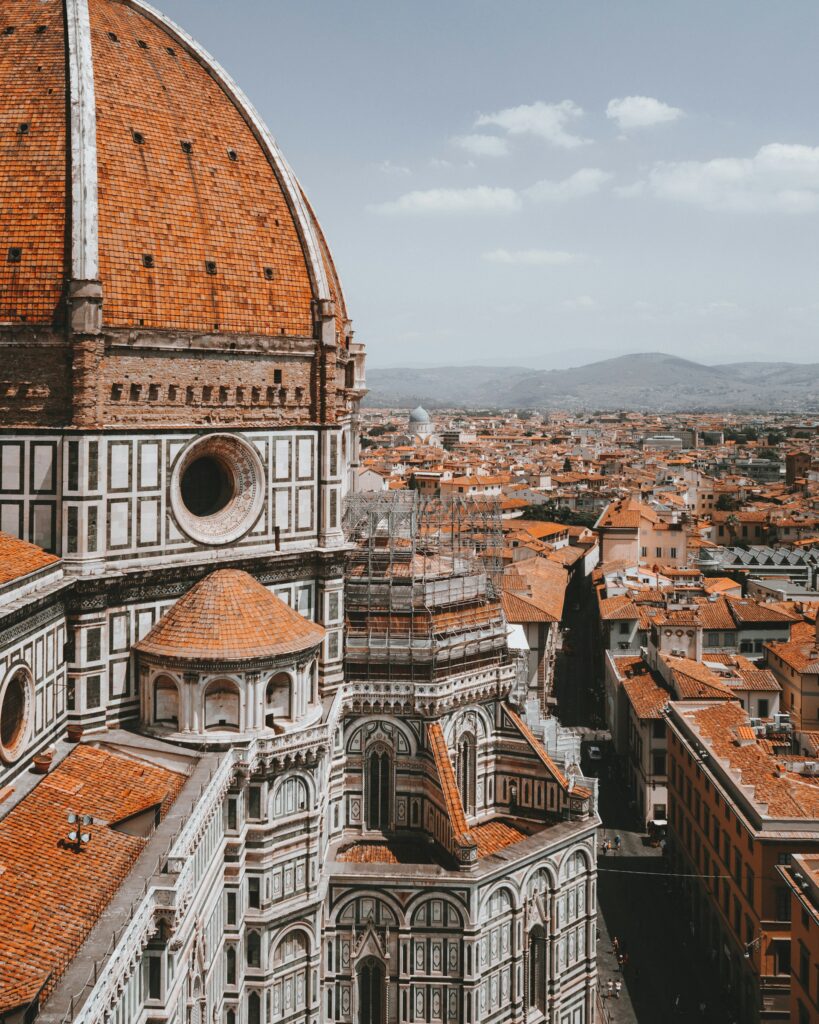
The crisis turned into opportunity in the early 15th century. In 1418, the Opera del Duomo announced a competition to solve the dome problem. Filippo Brunelleschi’s proposal rejected traditional centering and instead relied on geometry, a double-shell structure, horizontal stone and iron chains, and a self-supporting brick pattern. Construction began in 1420 and progressed upward without full scaffolding, astonishing contemporaries. When the dome was completed in 1436, it immediately redefined architectural possibility across Europe. The cathedral was consecrated by Pope Eugene IV, even though parts of the building—including the lantern—remained unfinished.
The lantern atop the dome, also designed by Brunelleschi, was completed after his death and finally installed in 1471, sealing the structure both symbolically and structurally. With this, the cathedral reached its definitive silhouette. Yet visually, Santa Maria del Fiore was still incomplete. Its exterior remained largely bare brick, especially on the façade, a condition that would persist for centuries.
Throughout the Renaissance and Baroque periods, multiple façade designs were proposed—by artists including Alberti and Michelangelo—but none were executed. In the late 16th century, the unfinished medieval façade was dismantled, leaving the cathedral with a blank western front. By then, the building’s identity was already fixed by its dome; the absence of a façade became an accepted, if awkward, reality.
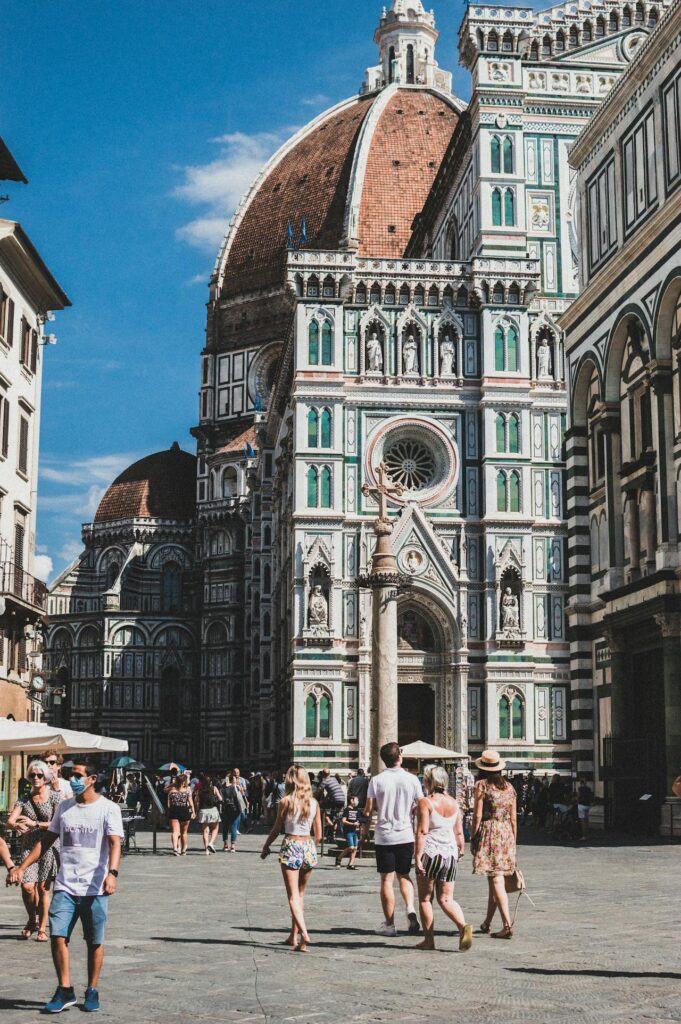
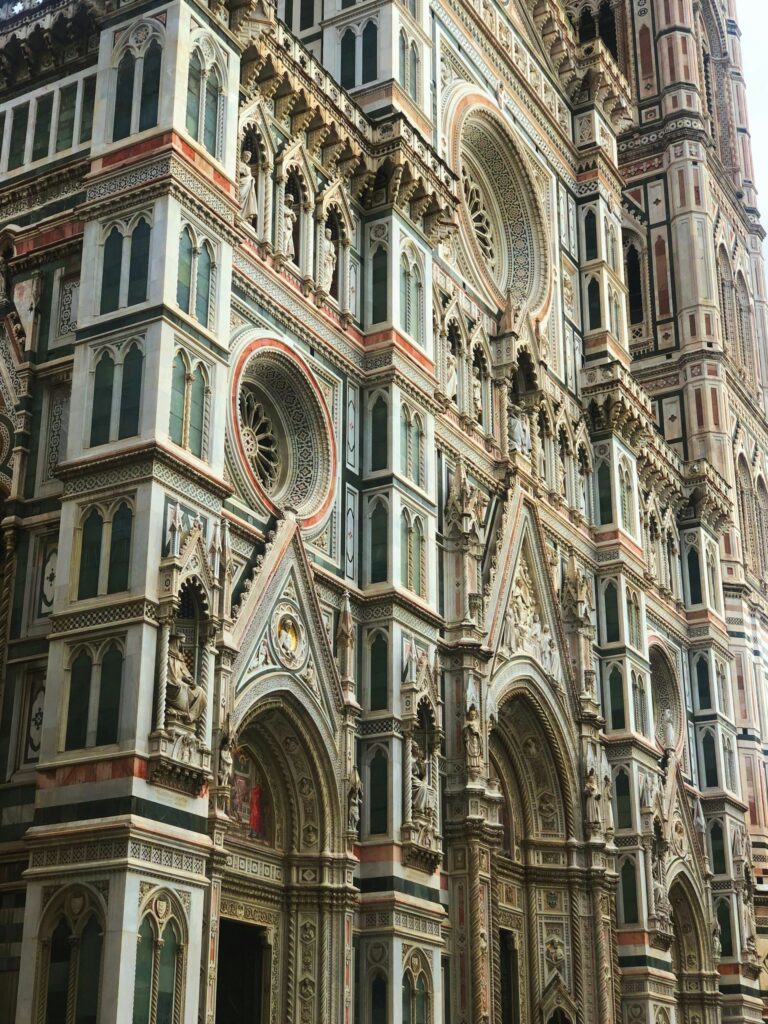
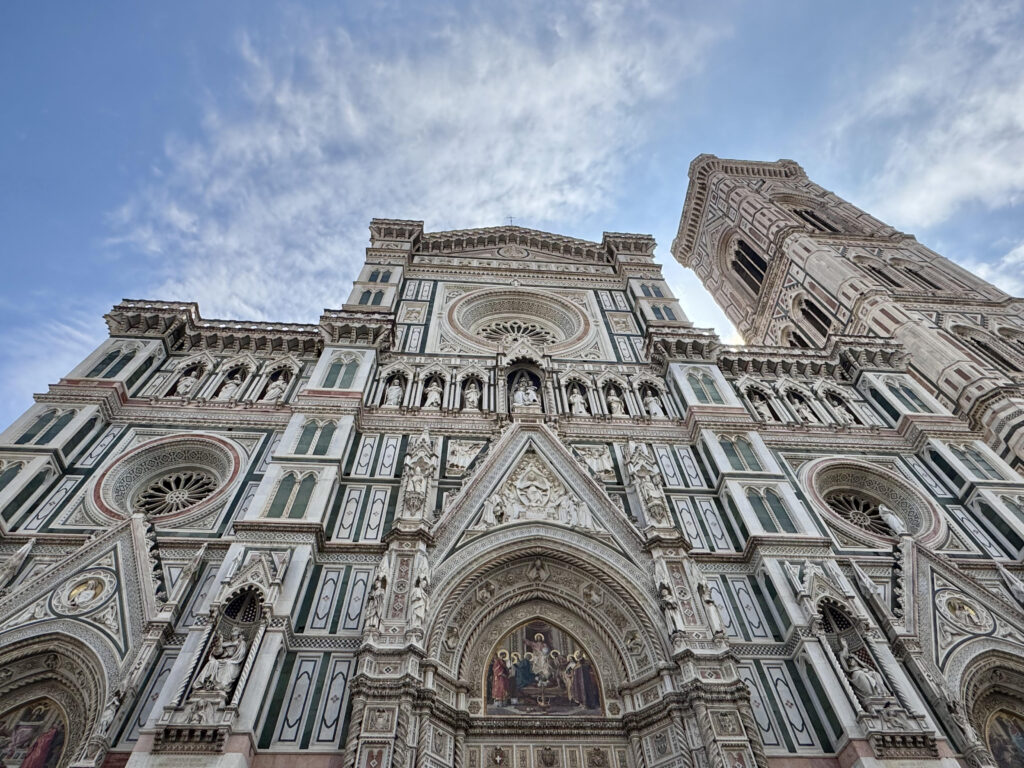
Only in the 19th century, amid Italy’s national unification and a renewed interest in medieval heritage, was the façade finally resolved. Between 1871 and 1887, Emilio De Fabris designed and completed the current polychrome marble façade, consciously echoing medieval Gothic forms rather than Renaissance classicism. The result was not a continuation of Arnolfo’s original work, but a historicist reinterpretation—a 19th-century answer to a 13th-century ambition.
In total, Santa Maria del Fiore took nearly six centuries to reach its present form. Few buildings illustrate so clearly how architecture can span generations, ideologies, and technologies. Conceived as an act of civic defiance, completed through engineering innovation, and visually finalized in an age of nationalism, the cathedral is less a single project than a compressed history of Florence itself, written in stone, brick, and geometry.
A Cathedral Built by Numbers—and by Its Creators
Santa Maria del Fiore is often attributed to a single genius—Brunelleschi—but in reality it is the result of layered authorship, where each major contributor left behind not a style, but a set of measurable decisions. This cathedral was shaped less by individual expression and more by how successive architects, artists, and engineers expanded, fixed, or constrained a numerical framework that no single generation could fully control.
When Arnolfo di Cambio laid out the original project in 1296, his most radical act was dimensional rather than visual. He fixed the cathedral’s length at roughly 153 meters, its transept width at about 90 meters, and—most critically—defined an octagonal crossing capable of carrying a dome of around 45 meters in diameter. At a time when no such masonry structure had been built since antiquity, Arnolfo effectively embedded an unsolved equation into the plan. His legacy is not a solution, but a quantified risk that would shape the next five centuries.
That risk was amplified vertically by Giotto di Bondone, appointed master builder in 1334. Giotto’s Campanile introduced a sharply defined counterpoint to the cathedral’s mass: an approximately 85-meter-high tower rising from a compact 15 × 15 meter base. Numerically, it established a dialogue between slender vertical proportion and overwhelming horizontal bulk. Even unfinished at Giotto’s death, the tower recalibrated Florence’s skyline and framed the cathedral not as a solitary object, but as part of a measured urban composition.
By the mid-14th century, Francesco Talenti inherited a structure that was vast yet incomplete. His contribution lay in consolidation. Talenti completed the nave vaults, expanded the apse structures, and finalized the colossal piers beneath the future dome. These piers, several meters thick, were dimensioned to support tens of thousands of tons of masonry whose form was still unknown. In numerical terms, Talenti transformed uncertainty into capacity, reinforcing the cathedral’s load-bearing system without resolving its central problem.
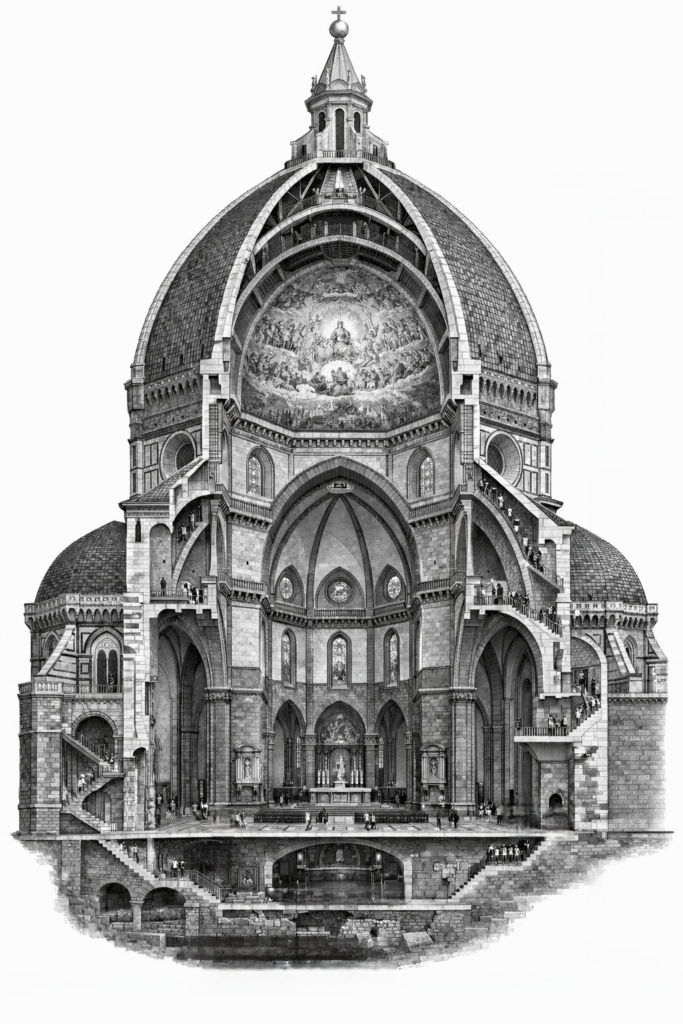
That resolution arrived with Filippo Brunelleschi, whose intervention between 1420 and 1436 remains one of the most radical recalibrations of architecture through numbers alone. Brunelleschi translated Arnolfo’s abstract geometry into a buildable system by dividing the dome into two shells: an external diameter of roughly 45.5 meters and an internal span of about 41 meters, rising to a total height of 114.5 meters above ground. The dome was assembled using approximately four million bricks, arranged in a herringbone pattern that allowed the structure to support itself during construction. Crucially, it required zero full wooden centering from the ground up. Stability was achieved through geometry, 24 vertical ribs, and a sequence of stone and iron chains acting as tensile rings. Brunelleschi did not overpower gravity with mass; he redistributed it with calculation.
More than a century later, the interior void of the dome was visually occupied by Giorgio Vasari and Federico Zuccari. Between 1572 and 1579, they covered approximately 3,600 to 3,800 square meters of curved surface with The Last Judgment. This intervention added no structural weight of consequence, yet it fundamentally altered perception. By subdividing a vast, continuous surface into readable zones, the fresco transformed pure scale into narrative order—an optical solution measured in thousands of square meters rather than tons.
The final author of Santa Maria del Fiore arrived in the 19th century. Between 1871 and 1887, Emilio De Fabris completed the long-unfinished façade, nearly six centuries after construction began. Using three distinct marbles—white from Carrara, green from Prato, and pink from Maremma—he imposed proportional order and historical coherence on a building that had long existed without a formal face. The façade added little volume, but it resolved alignment, rhythm, and scale across a surface measured in repetition rather than innovation.
Taken together, these contributions reveal Santa Maria del Fiore not as a single architectural act, but as a cumulative system of constraints and responses. Each generation inherited dimensions it could not revise, only reinterpret. From Arnolfo’s impossible octagon to Brunelleschi’s force-controlled dome and a 19th-century façade completing a medieval ambition, the cathedral stands as a six-century calculation—one solved incrementally through measurement, geometry, and risk rather than style alone.
Trivia
Brunelleschi’s Machines
Filippo Brunelleschi had to invent entirely new hoisting machines to lift millions of bricks to such extreme heights. He created the first-ever system of reversible gears powered by oxen, which allowed the direction of the load to change without turning the animals around. This invention was so revolutionary that it was later studied by Leonardo da Vinci himself
A Kitchen in the Clouds
To save time and energy, Brunelleschi organized a small kitchen and canteen directly on the scaffolding levels of the rising dome. Workers spent their entire day hundreds of feet in the air, eating meals and drinking diluted wine provided by the site managers. This prevented the dangerous and exhausting trek down hundreds of stairs multiple times a day.
The Reverse Clock
Above the main entrance inside the cathedral sits an extraordinary liturgical clock painted by Paolo Uccello in 1443. Its single hand moves in the opposite direction of modern clocks, and the dial is divided into 24 hours. It tracks “Italic Time,” where the 24th hour of the day ends exactly at sunset.
The Cementless Mystery
The construction of the dome does not rely on traditional wooden centering to hold it up during the building process. Brunelleschi used a “herringbone” brick pattern (spina di pesce), which allowed the bricks to lock themselves into place before the mortar even dried. Architects still study this system today, trying to fully grasp the mathematical genius behind its self-supporting nature.
The World’s Largest Fresco
The interior of the dome features “The Last Judgment,” covering 3,600 square meters, a project started by Giorgio Vasari. It remains the largest surface area in the world decorated with the fresco technique. To complete it, artists had to work in extreme conditions, suspended directly over the vast void of the cathedral’s interior.
The Copper Ball and Lightning
At the very top of the lantern sits a massive copper ball gilded in gold, crafted by Verrocchio, the teacher of Leonardo da Vinci. In 1601, a powerful lightning strike caused the two-ton ball to fall and crash into the piazza below. To this day, a white marble slab on the pavement marks the exact spot where the sphere landed.
The “Young” Facade
Although the cathedral is centuries old, its colorful marble facade was actually completed in the late 19th century. For hundreds of years, the building stood with “naked” brick walls because the original medieval design was never finished. The current look is the result of a competition won by Emilio De Fabris in 1871.
Secrets Beneath the Floor
Hidden beneath the current cathedral are the remains of a much older church called Santa Reparata. During excavations, archaeologists discovered early Christian mosaics and the tombs of famous Florentines. Among them lies the modest grave of Brunelleschi himself, a rare honor for an architect at that time.
The Double Shell
The dome is not a single solid mass but consists of two separate shells with a hollow space in between. The thick inner shell supports the weight, while the thinner outer shell protects the structure from rain and wind. This brilliant design significantly reduced the total mass while allowing the dome to maintain its massive scale.
The Contest of the Egg
In 1418, a public competition was held to solve the problem of how to build a dome over the massive central opening. Brunelleschi famously defeated his rival Lorenzo Ghiberti by demonstrating a trick with an egg. He proved that he could make an egg stand upright on a marble table, just as he would stand the dome without support.
The Gates of Paradise
The East Doors of the Baptistery, standing directly in front of the cathedral, are inseparable from its history. Michelangelo famously remarked that Ghiberti’s bronze panels were so beautiful they were fit to be the “Gates of Paradise.” It took Ghiberti 27 years of painstaking work to finish this single masterpiece.
A Solar Meridian
In 1475, the astronomer Paolo dal Pozzo Toscanelli installed a gnomon in the cathedral’s dome. A ray of sunlight passing through a hole in the lantern allows for the precise determination of the summer solstice. This instrument was used to calibrate the calendar and to monitor the structural stability of the building over time.
The Double Shell
The dome is not a single solid mass but consists of two separate shells with a hollow space in between. The thick inner shell supports the weight, while the thinner outer shell protects the structure from rain and wind. This brilliant design significantly reduced the total mass while allowing the dome to maintain its massive scale.
The Contest of the Egg
In 1418, a public competition was held to solve the problem of how to build a dome over the massive central opening. Brunelleschi famously defeated his rival Lorenzo Ghiberti by demonstrating a trick with an egg. He proved that he could make an egg stand upright on a marble table, just as he would stand the dome without support.
The Gates of Paradise
The East Doors of the Baptistery, standing directly in front of the cathedral, are inseparable from its history. Michelangelo famously remarked that Ghiberti’s bronze panels were so beautiful they were fit to be the “Gates of Paradise.” It took Ghiberti 27 years of painstaking work to finish this single masterpiece.
The Eight Sides of the Baptistery
The Baptistery of St. John, which sits across from the cathedral, is built on an octagonal plan. In Christianity, the number eight symbolizes resurrection and the “eighth day” of creation. It is one of the oldest buildings in the city, with foundations dating back to Roman times.
Controversial Frescoes
For years, there was an intense debate about whether the frescoes inside the dome should be removed or painted over. Many feared the weight of the plaster and the chemicals used by the artists might damage Brunelleschi’s structure. Ultimately, during a major restoration in the 1990s, the decision was made to preserve and fully clean them.
Interior Acoustics
The interior of the cathedral appears surprisingly austere and empty compared to its lavish exterior. This minimalist decor was intentional to emphasize the sheer volume of the space and draw the mind upward. The resulting acoustics are so unique that organ music resonates in a haunting, “otherworldly” manner.
Climbing Between Walls
The climb to the top of the dome takes you through narrow corridors and stairs hidden between the two masonry shells. As you ascend, the walls begin to lean and narrow, providing a physical sensation of the dome’s curvature. It is the only place in the world where you can walk “inside” the skeleton of such a massive vault.
A Symbol of the Republic
Santa Maria del Fiore was not just a church but a symbol of the power of the Florentine Republic. It was built on such a grand scale to outshine the rival cities of Pisa and Siena. Every citizen of Florence was required to pay a special tax toward its construction, making it the collective property of the people.