
Dancing Against Gravity: Absolute World Towers in Numbers and Form
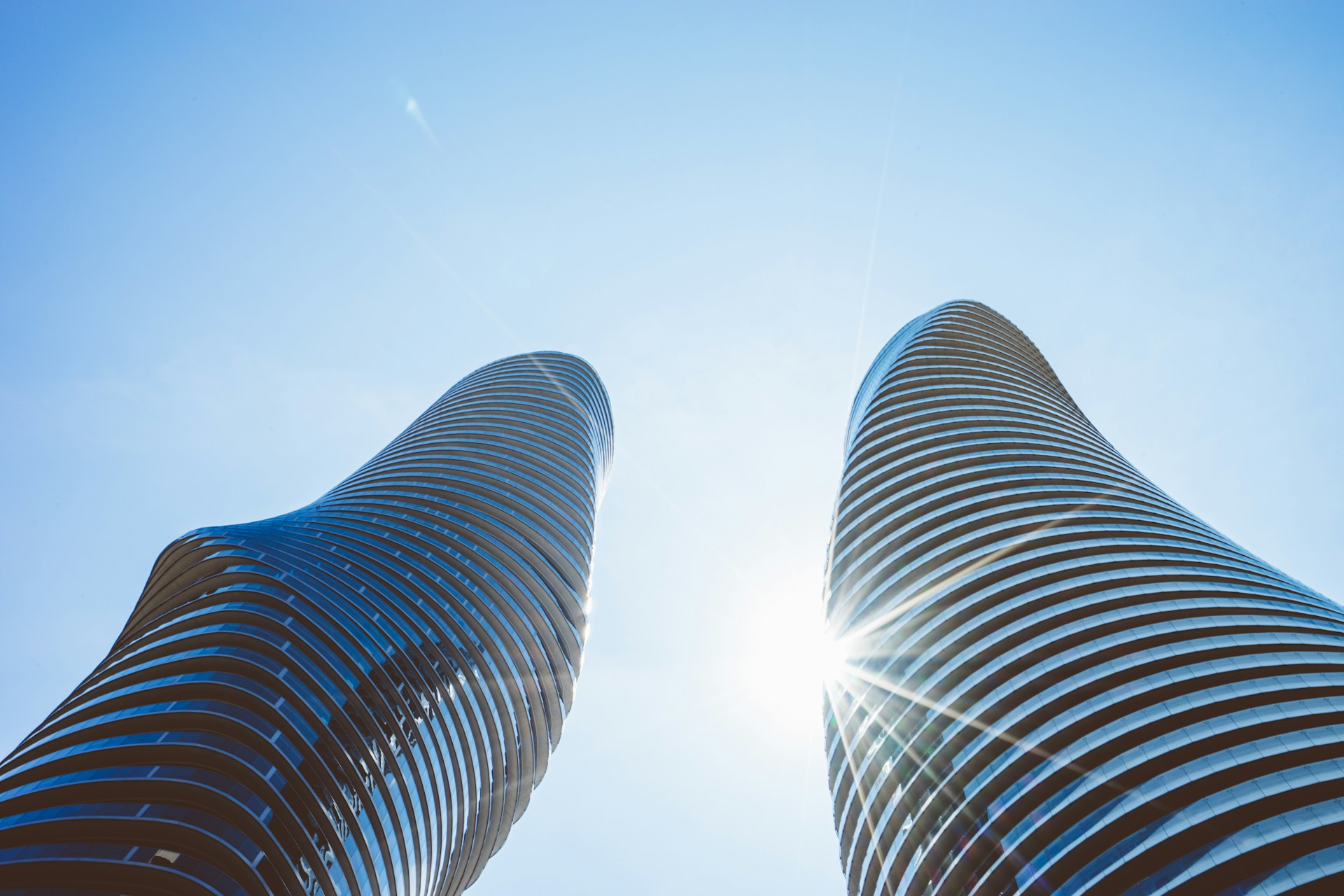
In a world of contemporary architecture dominated by rigid right angles and steel pragmatism, Absolute World Towers emerge as a manifesto of rebellion against monotony. These two residential towers, affectionately nicknamed “Marilyn Monroe” by locals, are far more than luxury apartment buildings. They represent a mathematical triumph over gravity and an aesthetic shift toward nature-inspired form—one that permanently altered the suburban skyline of Toronto.
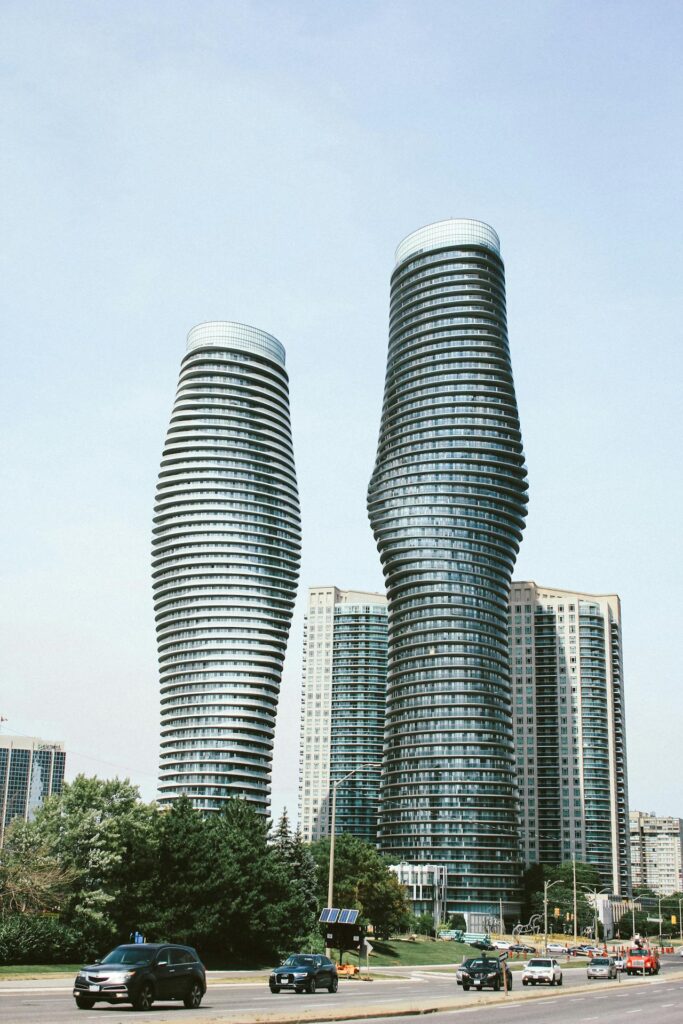
The true core of the project, however, is not its height, but a precise choreography of numbers, geometry, and rotation. The taller of the two towers rises to 179.5 metres, distributing its structure across 56 storeys. What makes it globally exceptional is the fact that each floor rotates relative to the one below by a variable angle ranging from approximately 1 to 8 degrees, resulting in a cumulative twist of 209 degrees from ground level to roof. In the world of Buildings in Numbers, it is rare to encounter a structure where the absence of repetition becomes the governing design principle—here, each of the 920 residential units offers a distinct relationship with the city, a different perspective, and a unique sequence of light.
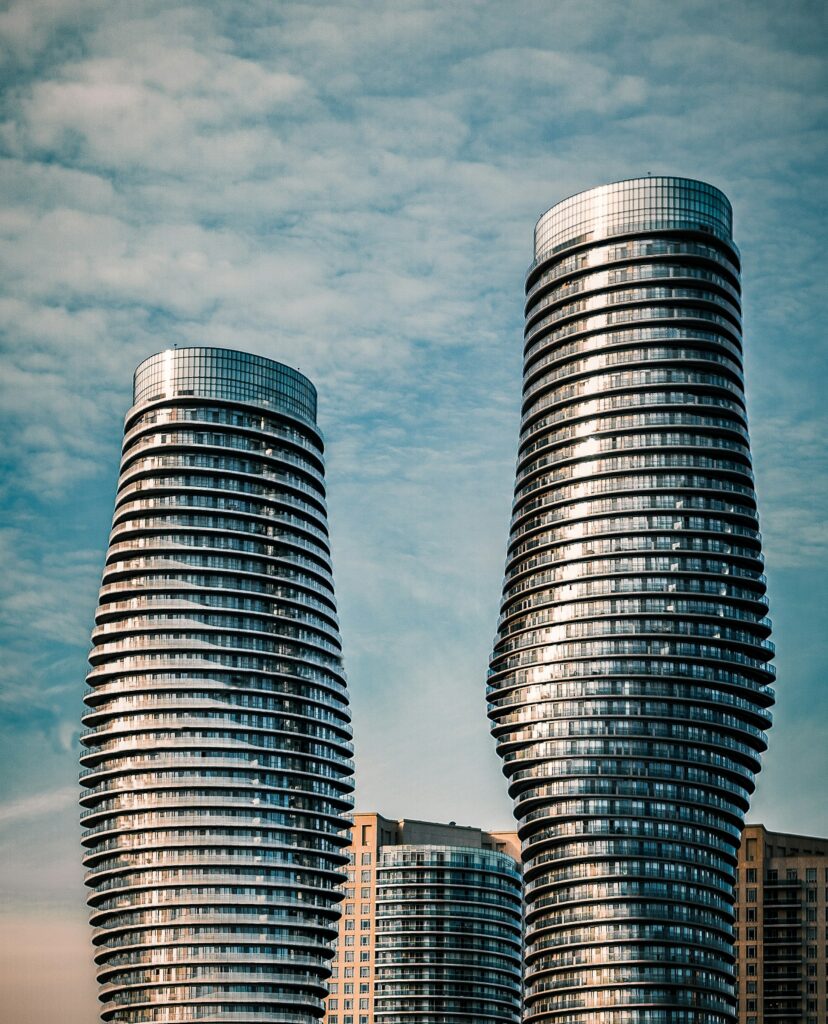
Continuous elliptical balconies wrap around the towers, dissolving conventional vertical divisions and giving the mass a fluidity reminiscent of the human body in motion. Designed by the visionary studio MAD Architects, Absolute World Towers demonstrate that a building’s statistics—metres, degrees, and thousands of tonnes of concrete—can be arranged into architectural poetry. These are structures that do not merely stand still, but appear to move, ripple, and respond to their surroundings, proving that in 21st-century architecture the most courageous—and most beautiful—line is the one that dares to bend.
What ultimately makes Absolute World Towers such a compelling case study is the tension between their organic appearance and their rigorous structural logic. Beneath the flowing silhouette lies a conventional reinforced-concrete core and a systematically repeated structural system, forced to adapt continuously to a changing geometry. The towers are therefore not static sculptures placed in the city, but processes cast in concrete—sequences of numbers, decisions, and compromises that together form one of the most recognizable residential experiments of the early 21st century.
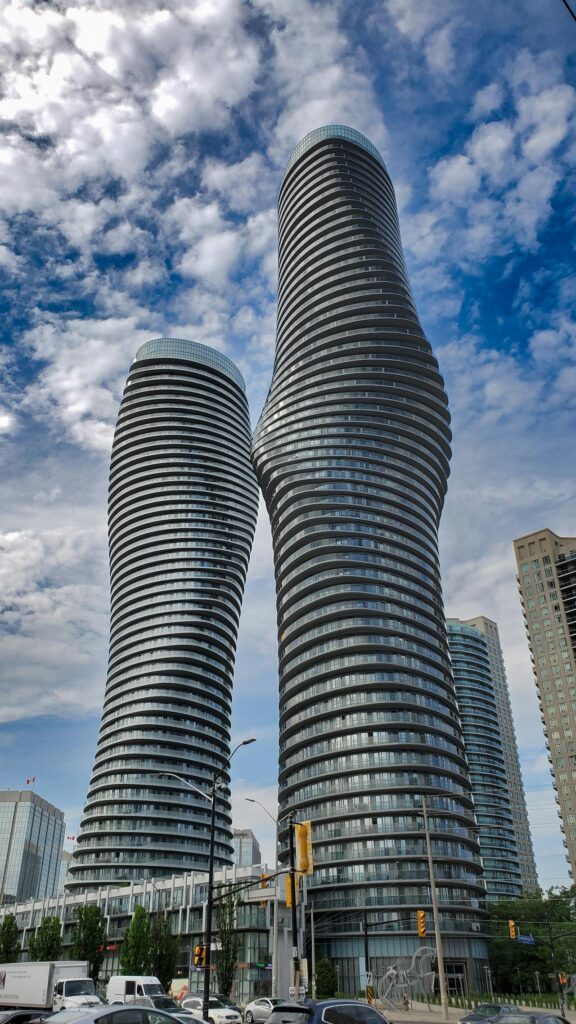
Absolute World Towers in Numbers
179,5 m
Architectural height of the Tower A
158,0 m
Architectural height of the Tower B
209°
Total twist of the taller tower from ground level to roof
8°
Maximum degree of twist of a single floor relative to the previous one Tower A
0
Identical floor plates
41 000 m²
Gross Floor Area of Tower A
56
Number of levels hightest Tower
920
Total number of apartments in both buildings
600 m²
Penthouse area at the top
24 h
In that time all the apartments in the first tower were sold after its announcement
31
That’s how old Ma Yansong (founder of MAD Architects) was when he won the design competition
450 mln CAD
Toatal cost of complex (2012)
What’s most intriguing about the Absolute World Towers isn’t their iconic silhouette, but their radical rejection of the functionalist repetition that has defined multifamily housing for decades. While a traditional skyscraper optimizes its vertical core for maximum plan predictability, MAD Architects’ design transforms the building into a dynamic rotation algorithm. Here, mathematical precision—a twist of precisely 209 degrees—serves to dematerialize the form. Through the use of continuous, elliptical balconies, the buildings cease to be static monoliths and become rather visual records of movement, redefining the relationship between the private interior and the limitless suburban panorama. This is architecture that doesn’t “stand” in space, but shapes it through rotation.
Trivia
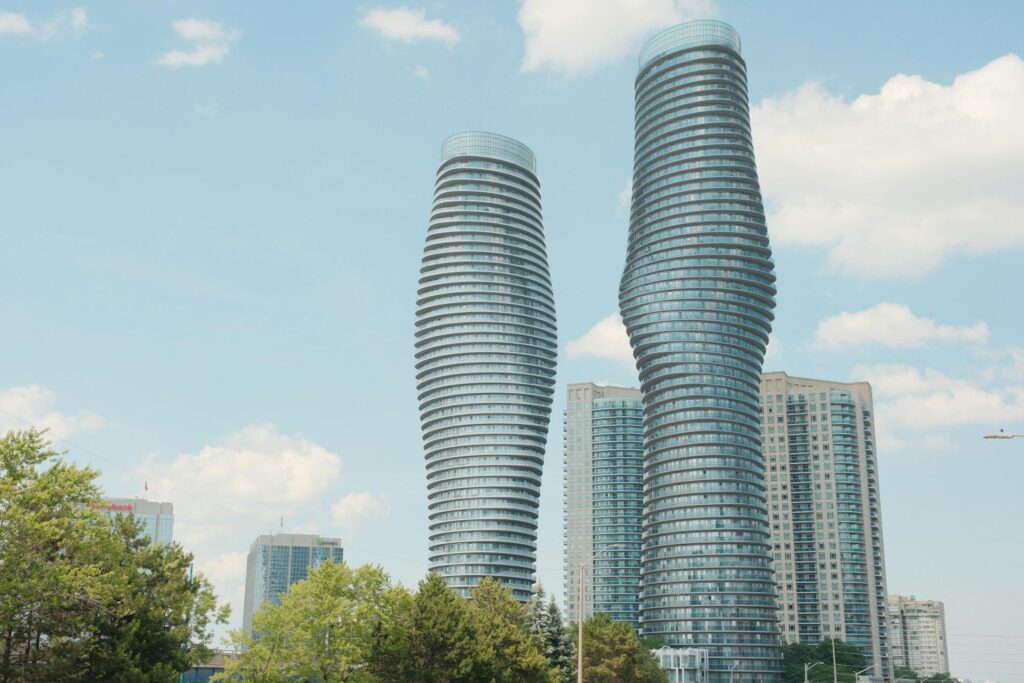
The “Marilyn Monroe” Silhouette
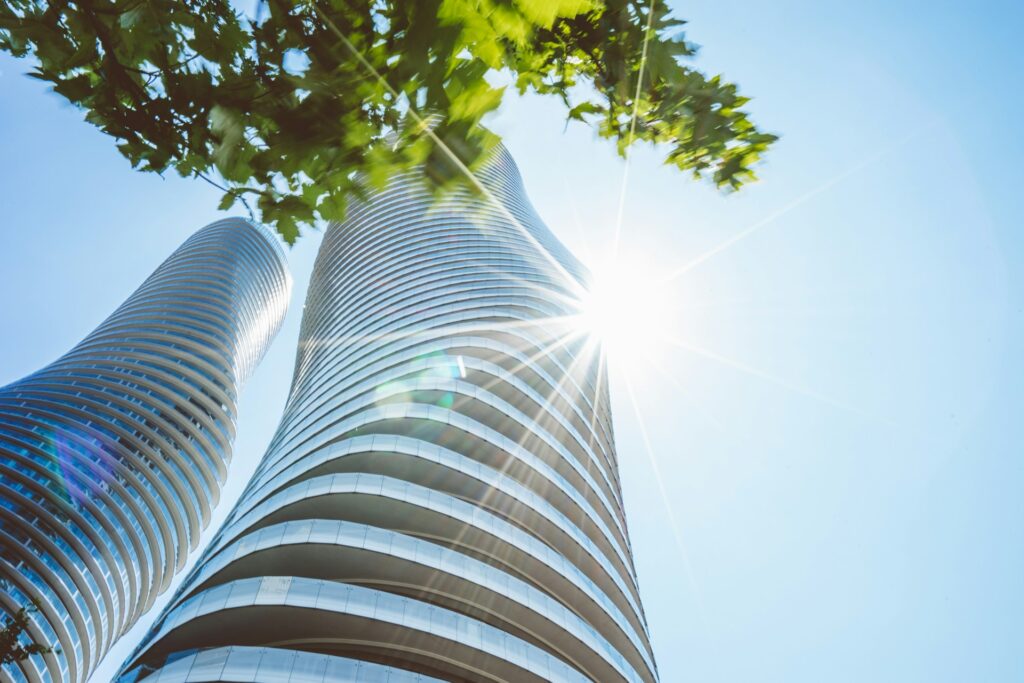
The skyscraper earned its famous nickname because of its hourglass figure, which locals compared to the iconic white dress pose of the Hollywood actress. This curvaceous effect was achieved through a calculated “acceleration” of the rotation—while the lower floors twist by only 1°, the middle section of the tower jumps to an 8° rotation per floor to create a distinct “waistline”.
The end of the “shoebox” era
Ma Yansong’s victory marked the first time such a radical, organic design won a competition for a residential building in North America. The project shattered the monopoly of boring, boxy developer architecture that had dominated Mississauga for decades. It proved that mass-market housing could simultaneously be a piece of sculpture and a highly functional home.
The Zaha Hadid influence
Ma Yansong, the lead architect, refined his talent at the London firm of the legendary Zaha Hadid. The influence of her “school”—characterized by fluid lines, an absence of right angles, and a futuristic flair—is clearly visible in Absolute World. It is one of the few projects that successfully translated radical deconstructivism into the world of commercial luxury real estate.
Balconies as acoustic barriers
The wide concrete platforms extending beyond the window line serve an unexpected soundproofing function. They effectively deflect noises coming from the busy Mississauga streets, creating a quieter zone directly against the building’s facade. This allows residents to enjoy a sense of calm even on the lower floors located near major intersections.
Instant sales success
The first tower was completely sold out within just 24 hours of the reservation launch. The level of public interest was so overwhelming that the developer had to immediately change plans and commission a second, companion tower. This sales velocity remains a record-breaking benchmark for the real estate market in the Greater Toronto Area.
The shifting rhythm of shadows
Because every floor is rotated, the building casts a unique, spiral shadow upon itself that changes every hour. This phenomenon makes the facade feel “alive,” as it looks completely different in the morning, at noon, and in the evening. The architects utilized this effect to naturally regulate the solar heating of the apartments during the summer months.
The core as the only constant
Although the entire buildings appear to be swirling, their central concrete elevator cores rise perfectly vertical. Every floor plate is rotated around this stable axis by a specific number of degrees to create the illusion of a twisting structure. It is a mathematical dance centered around a single, unchanging straight line hidden deep within the concrete.
Wind with nothing to grab onto
The smooth, elliptical shape of the towers is not just an aesthetic choice, but a highly advanced aerodynamic solution. These buildings naturally break up air vortices, which significantly reduces structural stress during high-wind events. Consequently, engineers were able to use less steel for structural stiffening compared to traditional, rectangular skyscrapers.