
An Island Museum Beneath a Floating Dome
Located on Saadiyat Island in Abu Dhabi, Louvre Abu Dhabi is not simply a museum — it is a spatial manifesto about light, geometry, and cultural exchange. Opened in 2017, the project redefines what a universal museum can mean in the 21st century. Rather than replicating the historic palace of Louvre Museum, this institution translates its spirit into a contemporary architectural language rooted in the Gulf’s climate and landscape.
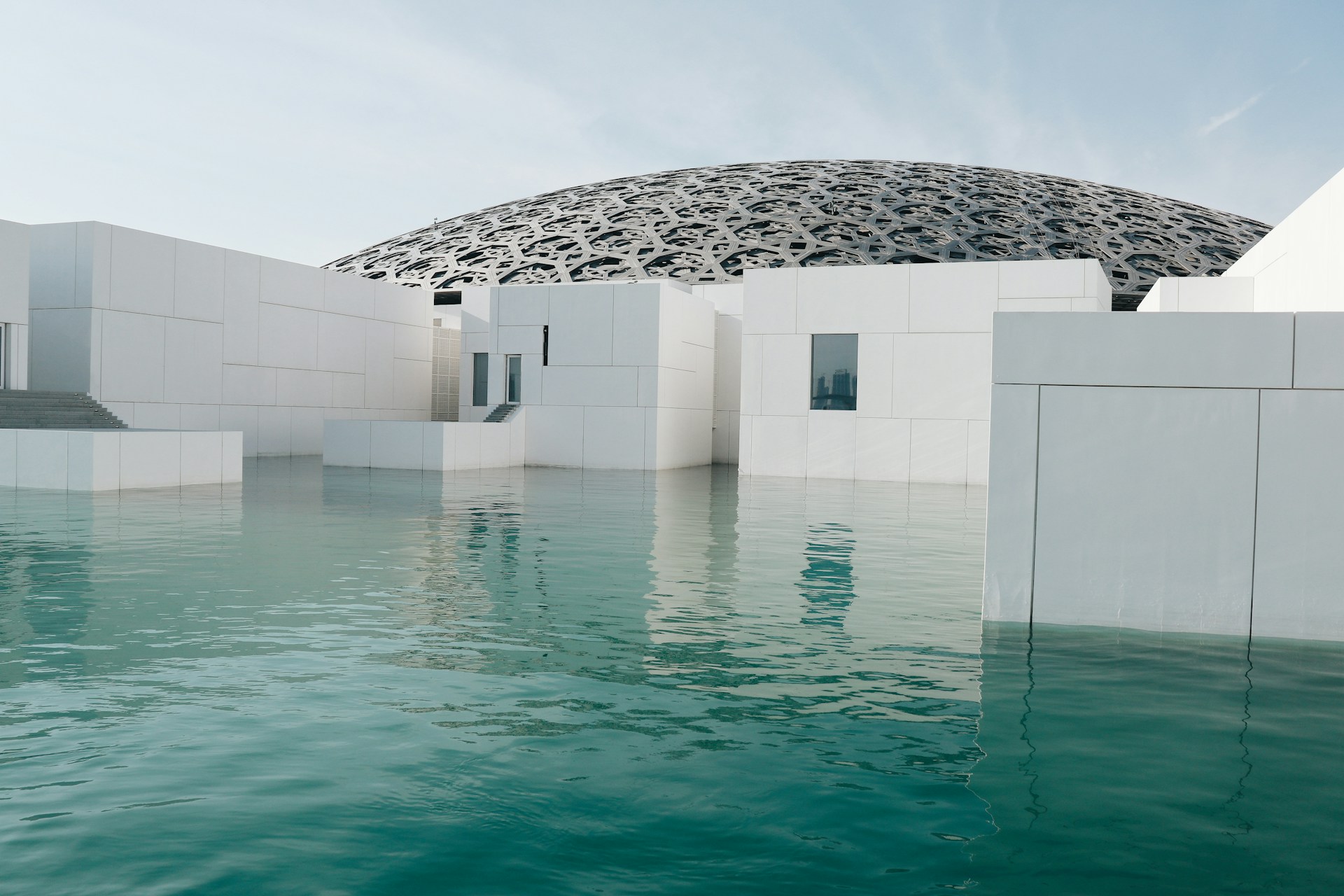
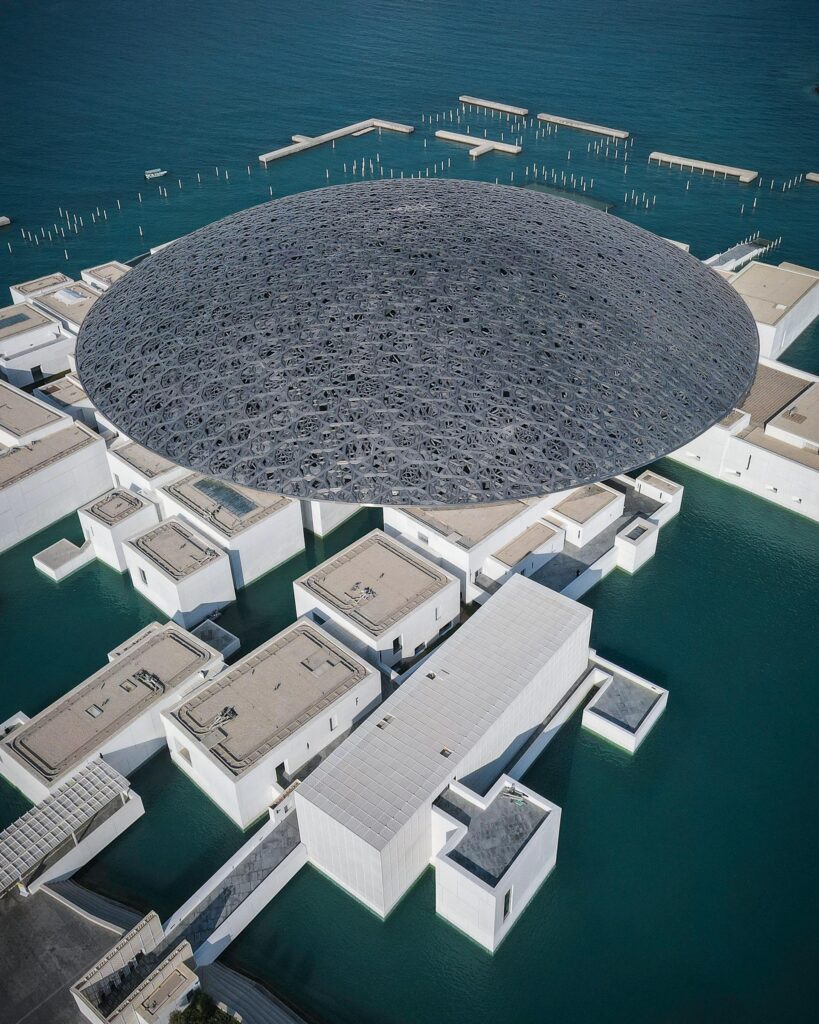
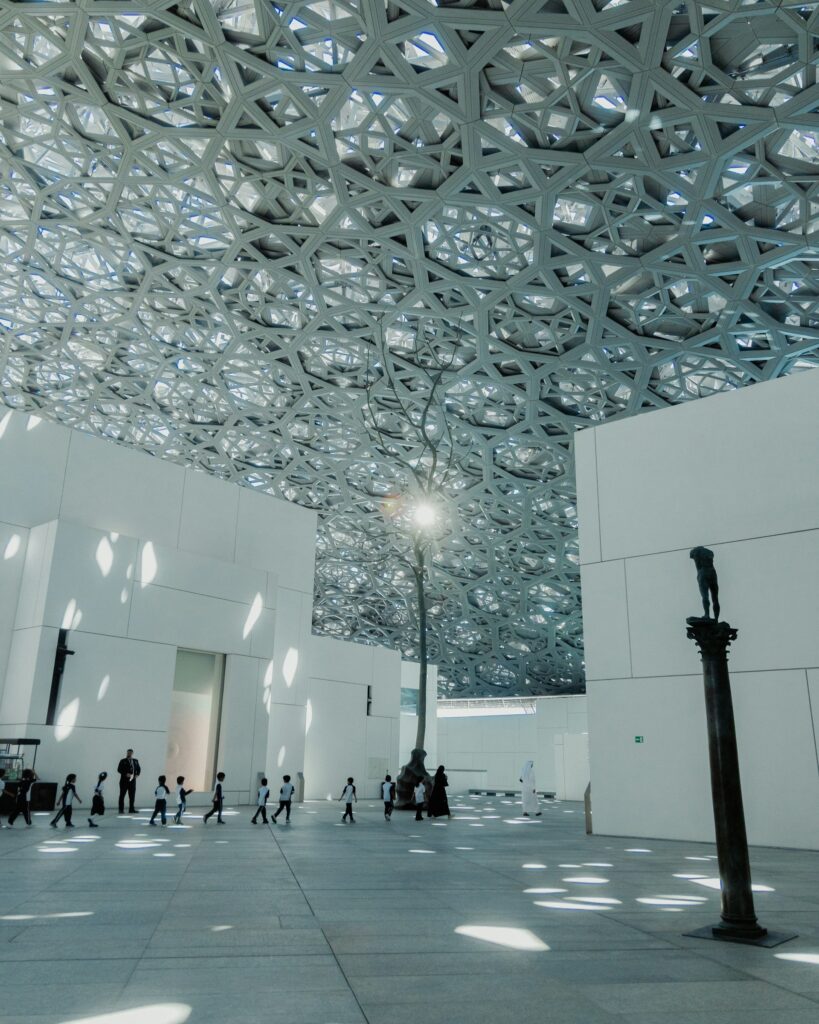
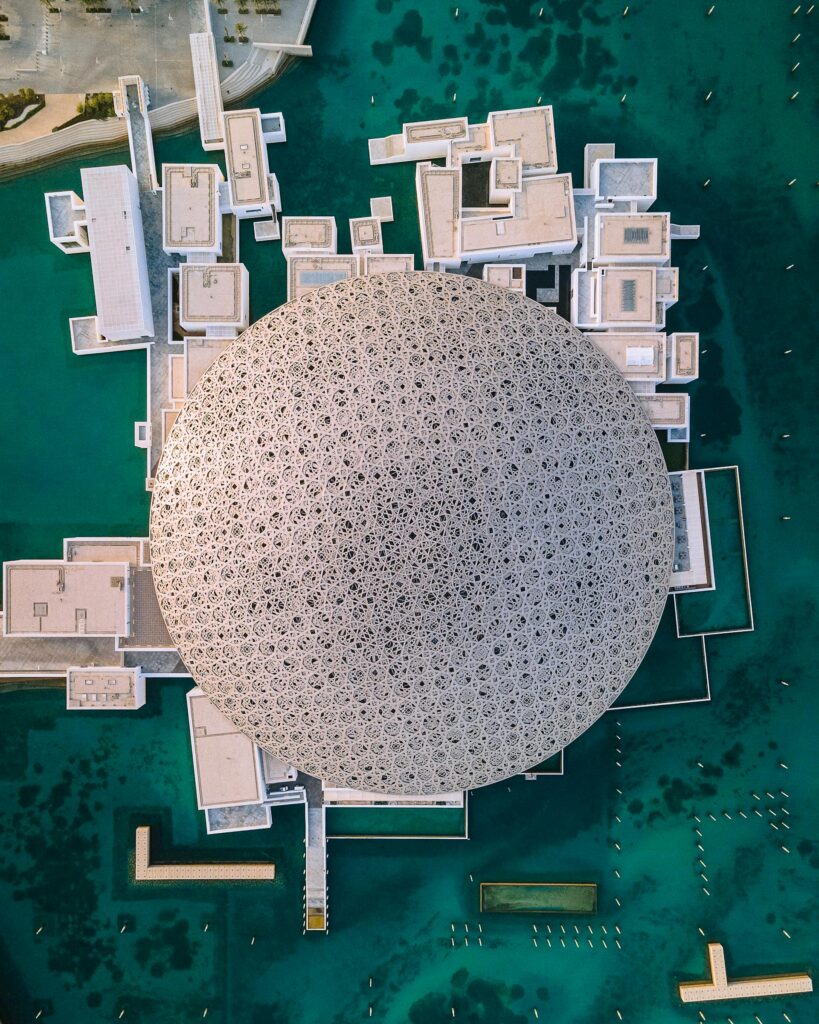
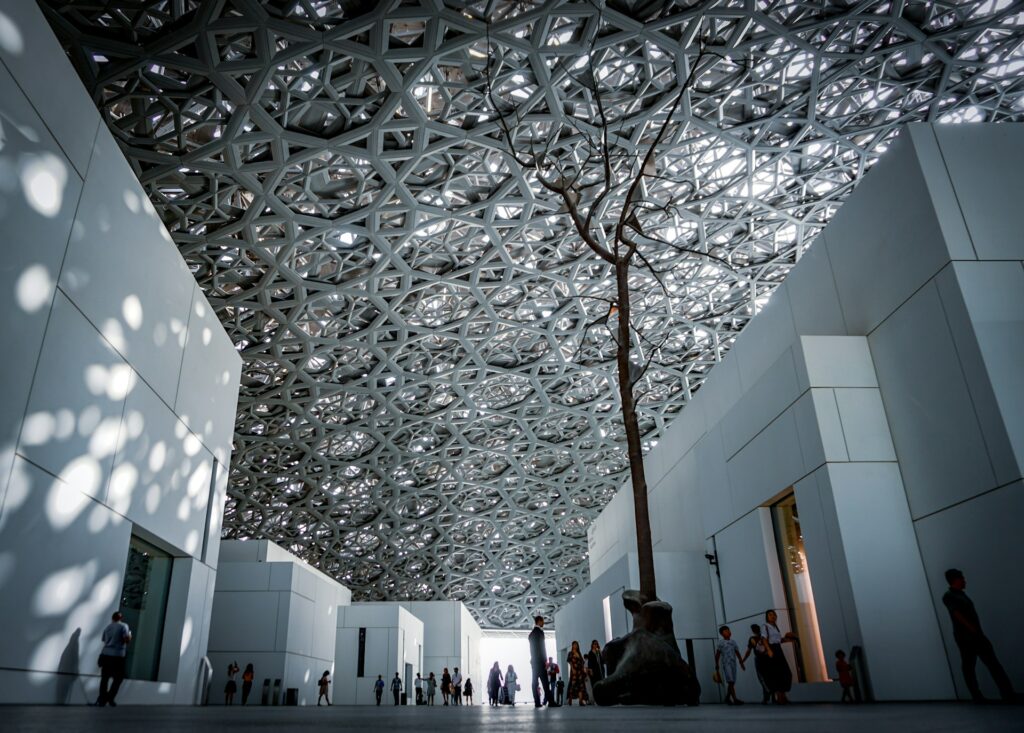
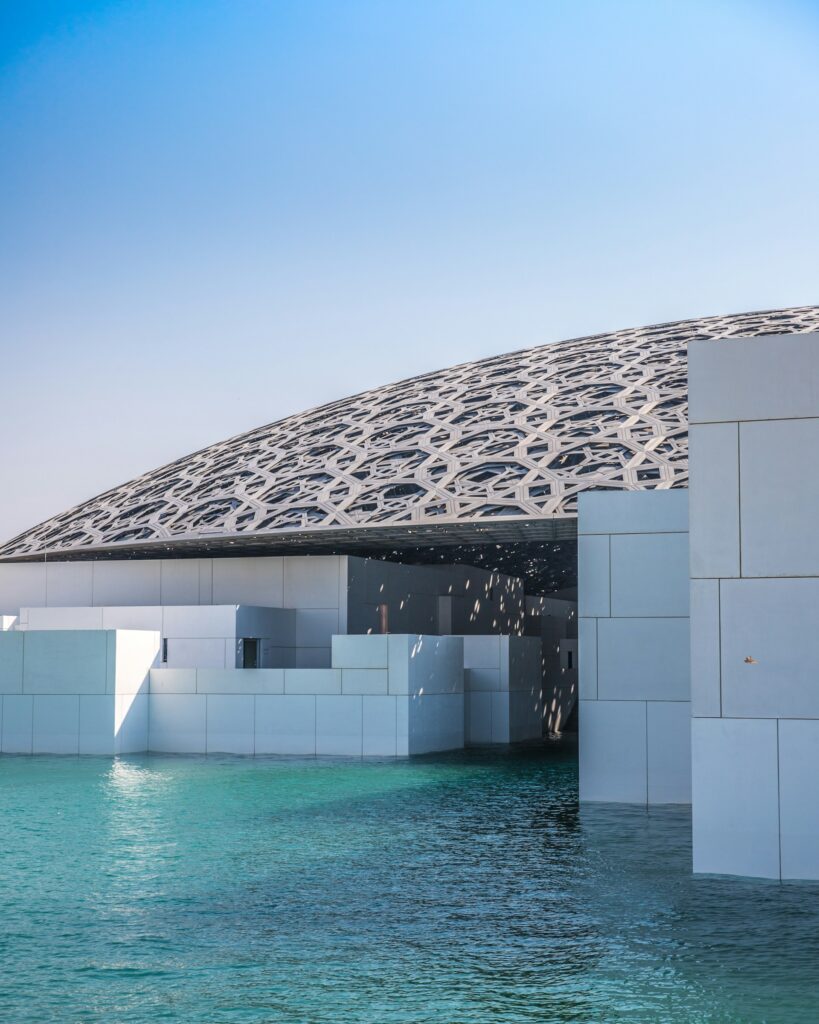
Designed by Jean Nouvel, the building is conceived as a “museum city” composed of 55 detached white volumes arranged beneath a vast perforated dome 180 meters in diameter. The dome appears to float, filtering sunlight through an intricate geometric lattice inspired by traditional Arabic mashrabiya patterns. The result is the now-iconic “rain of light” effect — shifting beams that animate walls, water, and visitors throughout the day.
What makes Louvre Abu Dhabi particularly compelling is the way architecture becomes infrastructure for storytelling. The museum spans approximately 24,000 square meters, including 8,000 square meters of gallery space, presenting artworks from different civilizations side by side. Rather than organizing history by geography, the curatorial approach emphasizes shared human themes — trade, religion, power, portraiture — positioning the building itself as a physical metaphor for cultural dialogue.
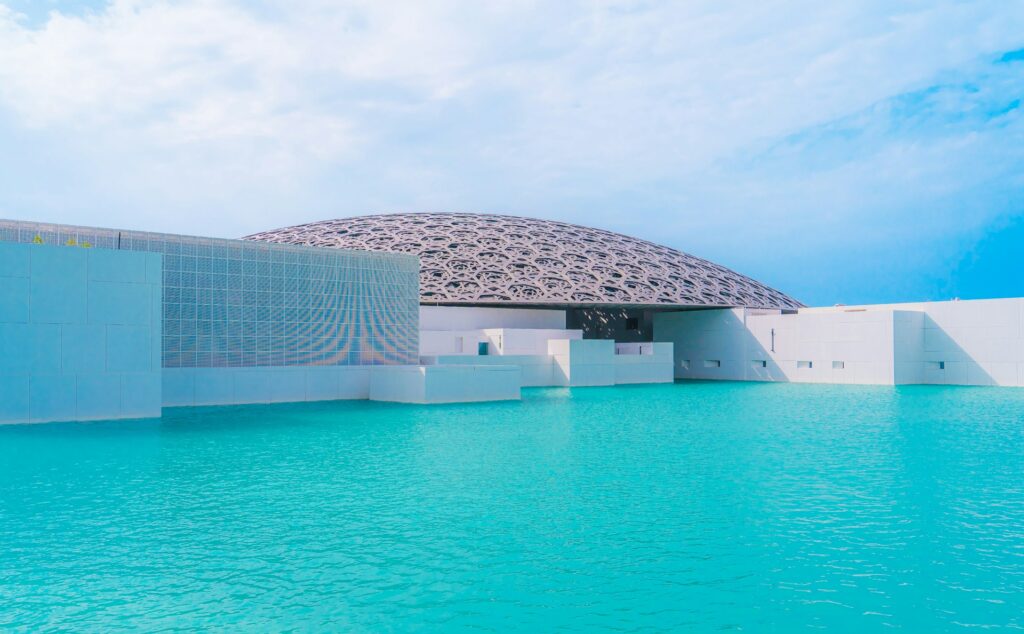
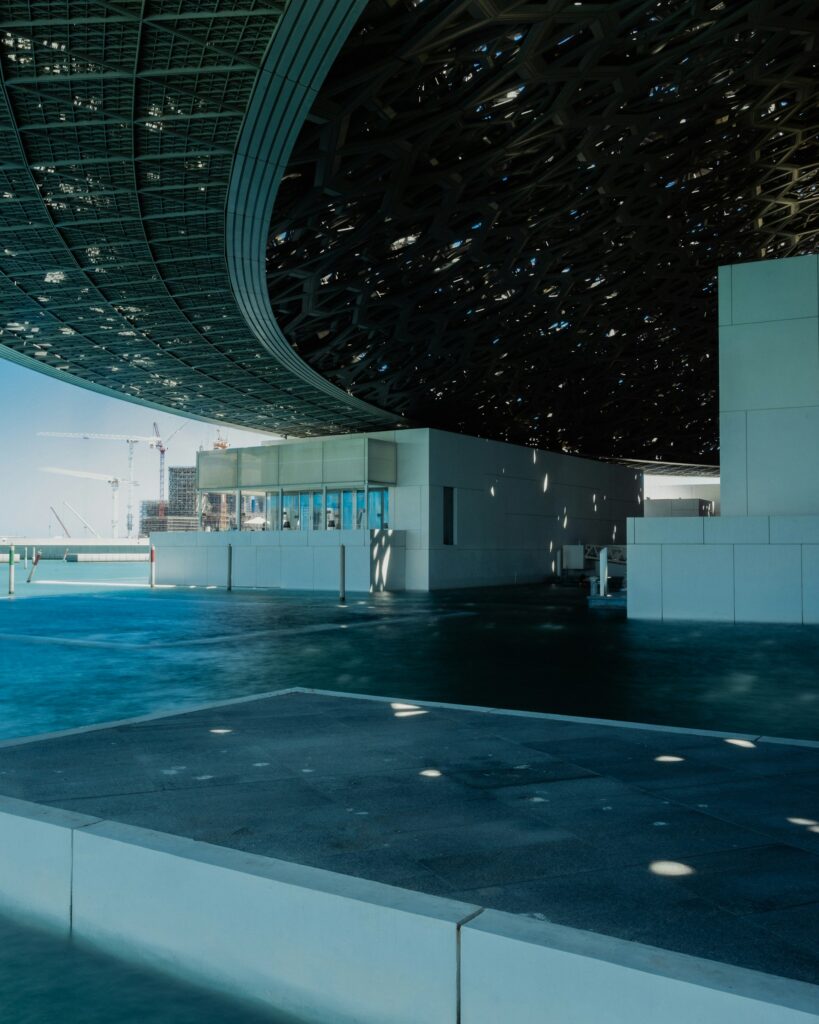
Set between land and sea, surrounded by shallow water channels that moderate temperature and reflect light, the museum dissolves the boundary between structure and environment. It is at once monumental and porous, engineered and poetic — a controlled microclimate beneath a 7,500-ton steel canopy that seems almost weightless against the Arabian sky.
This is architecture not of height, but of atmosphere — a project where scale, engineering, economics, and symbolism converge into one of the most significant cultural buildings of the Middle East.
Louvre Abu Dhabi in Numbers
180 m
The total diameter of the giant dome’s base
7 500 t
The total weight of the dome (comparable to the Eiffel Tower’s steel structure)
7 850
The exact number of unique aluminum and stainless steel „stars” forming the roo
8 layers
The dome’s composition: 4 outer layers (aluminum) and 4 inner layers (stainless steel)
110 m
The span between the four massive, hidden concrete piers that support the entire structure
13 m
he size of the largest individual star element in the geometric pattern
36 m
The height of the dome’s peak above sea level (29 meters above the ground floor)
55
The number of individual white buildings that make up the „museum city” under the dome
23
Permanent gallery spaces inspired by the layout of an Arabic settlement
920
Approximate number of objects on display at opening
300+
Artworks loaned from French institutions during early years
€400 mln
Paid for use of the “Louvre” name (30-year agreement)
4 500
The number of specialized LED luminaires used to light the gallery interiors
85
The number of massive pre-assembled steel „super-modules” used to construct the dome
110 000 m2
The total surface area of the dome’s intricate cladding
24 000 m2
The total exterior facade area made of Ultra-High Performance Concrete (UHPC) panels
3 900
The number of high-tech glass panels used in the gallery ceilings to optimize natural light
15 m
The depth of the temporary „watertight” cofferdam built to allow construction on the dry seabed
1 km
The length of the underground service tunnel connecting the museum to the Saadiyat Cultural District logistics hub
4
The only four support points for the 7,500-tonne dome, all of which are concealed within the museum buildings to create a „floating” effect
What makes the Louvre Abu Dhabi a structural marvel isn’t its role as a museum, but the micro-climatic engineering of its 180-metre-wide „floating” dome. By utilizing an 8-layer geometric lattice, it transforms harsh Arabian sunlight into a controlled „Rain of Light,” reducing interior temperatures by up to 5°C without traditional heavy cooling. It’s not just an aesthetic roof; it’s a perforated environmental shield that redefines the relationship between monumental architecture and desert thermodynamics
Engineering the Floating Dome: Structure, Climate, and Precision
The engineering of Louvre Abu Dhabi revolves around one dominant element: its 180-meter-wide dome. Weighing approximately 7 500 tons, the steel structure spans the museum like a shallow, floating canopy without visually overwhelming the site. Structurally, the dome is supported by only four concealed piers integrated within the surrounding buildings, creating the illusion that it hovers above the complex. The dome itself consists of eight superimposed layers — four external and four internal — forming a three-dimensional lattice that distributes loads efficiently while maintaining structural stiffness across the massive span.
The geometric complexity of the dome required advanced parametric modeling and precision fabrication. Its pattern incorporates 7 850 star-shaped elements arranged at varying scales and angles, producing both structural redundancy and controlled permeability. The layered configuration allows forces to be transferred through a triangulated network of steel members, minimizing deflection across the 180-meter diameter. Prefabricated steel segments were assembled on site with millimeter-level tolerances, ensuring that the final structure behaved as a unified shell rather than a series of independent frames.
Environmental engineering was equally critical. The perforated dome reduces solar gain by filtering harsh Gulf sunlight, lowering cooling demands while creating the signature “rain of light” effect inside the galleries. The museum’s location between land and sea was intentionally leveraged: shallow water channels surrounding the structure contribute to passive cooling by reflecting light and reducing surface temperatures. The dome acts as a giant shading device, cutting direct radiation while still allowing diffused daylight to animate interior spaces — a synthesis of structural logic and climatic strategy.
Beneath the canopy, the museum’s 55 white concrete volumes form a low-rise urban fabric engineered for thermal stability and durability in a marine environment. Corrosion-resistant materials, high-performance glazing, and advanced HVAC systems were integrated to maintain strict museum conservation standards in a desert climate where summer temperatures exceed 45°C. The result is not a skyscraper of height, but a megastructure of atmosphere — a building where structural span, environmental control, and geometric precision converge into a single engineered statement.
The Economics of a Cultural Megaproject
The financial model of Louvre Abu Dhabi represents one of the most ambitious cultural investments of the 21st century. The total value of the 2007 intergovernmental agreement between the United Arab Emirates and France is estimated at approximately €1 billion, including cultural cooperation, artwork loans, expertise, and brand licensing. Around €400 million was paid for the use of the Louvre name over a 30-year period, while hundreds of millions more were allocated to art loans and advisory services from major French institutions, including the Louvre Museum. The construction cost alone exceeded $600 million, positioning the museum among the most expensive standalone cultural buildings ever delivered in the Middle East.
Beyond construction expenditure, the museum must be understood as part of a broader economic diversification strategy led by Abu Dhabi. Situated on Saadiyat Island, the project anchors a long-term masterplan aimed at transforming the emirate from an oil-dependent economy into a global cultural and tourism hub. Cultural infrastructure in this context is not a cost center, but a catalyst asset — designed to stimulate real estate value, attract foreign investment, generate employment, and increase international visitation.
Tourism impact has been substantial. In its first full year of operation, the museum attracted over 1 million visitors, exceeding projections and reinforcing its position as a regional destination. Increased tourism translates into hotel occupancy growth, aviation demand, retail spending, and secondary service-sector expansion. Cultural branding also enhances soft power, strengthening international positioning and long-term economic resilience.
The economic logic extends further: landmark architecture functions as both symbol and multiplier. By associating with the globally recognized Louvre brand, Abu Dhabi effectively accelerated its cultural credibility by decades. While the upfront capital investment was significant, the project’s long horizon — 30 years of institutional collaboration — frames the museum not as a short-term expense, but as strategic infrastructure. In this sense, Louvre Abu Dhabi is not merely a museum; it is a financial instrument embedded in urban development, tourism economics, and geopolitical branding.
Trivia
The Floating Illusion
The 7,500-tonne dome appears to float weightlessly above the museum galleries. This effect is achieved by resting the massive structure on only four concealed piers hidden within the museum buildings. It creates a seamless „levitating” aesthetic that defies its immense industrial weight
The Rain of Light
The dome’s unique 8-layer cladding is designed to create a cinematic effect known as the „Rain of Light.” As the sun moves, light filters through 7 850 stars to create shifting patterns on the museum floor. This mimics the dappled sunlight found in traditional Emirati palm oases.
Micro-Climate Engineering
The perforated dome acts as a giant „parasol” that protects the buildings from the intense Arabian heat. By shading the outdoor plazas, it reduces the ambient temperature by up to 5°C compared to the surrounding desert. This creates a comfortable micro-climate that allows visitors to walk between galleries outdoors
A Modern Medina
Instead of one massive building, the museum consists of 55 individual white structures. These are inspired by the low-rise, clustered layout of traditional Arab settlements known as Medinas. This design encourages exploration and mirrors the urban fabric of the region.
Extreme Precision
The assembly of the dome required a surgical level of engineering accuracy. Each of the 85 „super-modules” had to be placed with a tolerance of less than 5 millimeters. This precision ensures that the complex geometric pattern remains perfectly continuous across the 180-meter span.
Marine Foundations
The museum was built inside a massive temporary „dry dock” created by a 28-meter deep cofferdam. Once the structures were completed, the dam was removed, allowing the sea to flow back in and surround the buildings. This gives the Louvre Abu Dhabi its iconic „museum on the sea” appearance.
Ultra-High-Performance Concrete
The exterior walls are made from 24,000 square meters of Ultra-High-Performance Concrete (UHPC). This material was specifically chosen for its incredible density and resistance to the corrosive salt air. It ensures the museum’s pristine white facade remains intact despite the harsh maritime environment.
The Underground Highway
Beneath the public galleries lies a highly secure, 1-kilometer-long service tunnel. This „underground highway” allows for the discreet transportation of priceless artworks and logistical supplies. It connects the museum directly to a centralized district hub for maximum security and efficiency.
Geometric Complexity
The dome’s pattern is based on a complex geometry that repeats across eight different layers. Each layer is rotated at a specific angle to break up the sunlight and prevent direct heat transfer. This mathematical complexity was modeled using advanced digital software to ensure perfect light distribution.
Thermal Inertia
The museum uses the high thermal mass of its stone and concrete floors to maintain stable interior temperatures. This reduces the energy load required to cool the vast gallery spaces. It is a sophisticated blend of ancient passive cooling techniques and modern HVAC technology.
Seismic Resilience
Despite its rigid appearance, the dome is engineered to withstand significant thermal expansion and seismic activity. The four support points are equipped with specialized bearings that allow the structure to shift slightly without cracking. This flexibility is vital for a building of this scale and material composition.
Celestial Navigation
The star-shaped patterns in the roof are more than just decorative elements. They pay homage to the history of Arab navigation, where sailors used the stars to find their way across the desert and sea. The building thus serves as a bridge between ancient celestial wisdom and modern architectural innovation.