
The Sphere Las Vegas – When Architecture Becomes a Screen
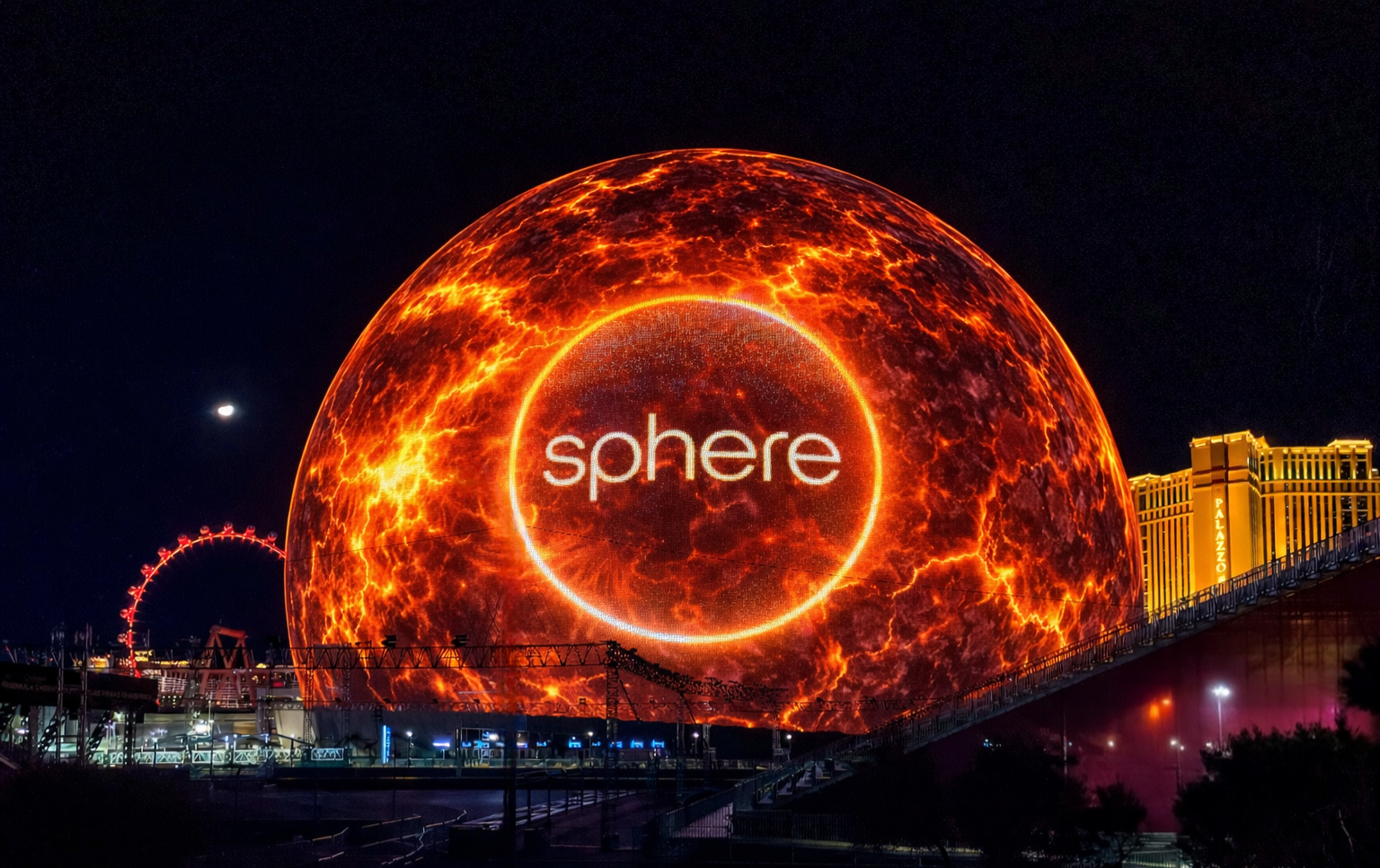
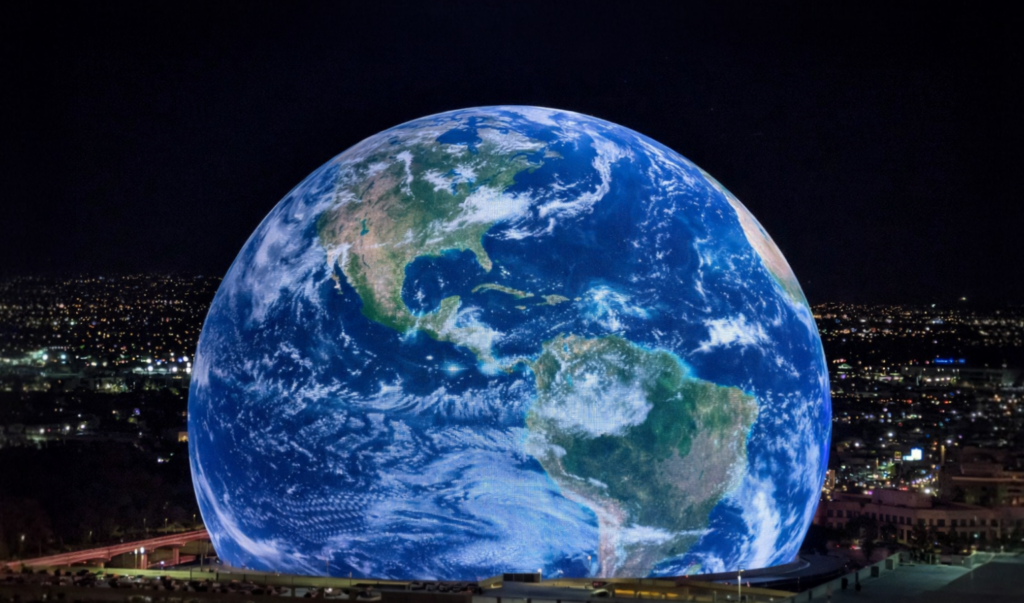
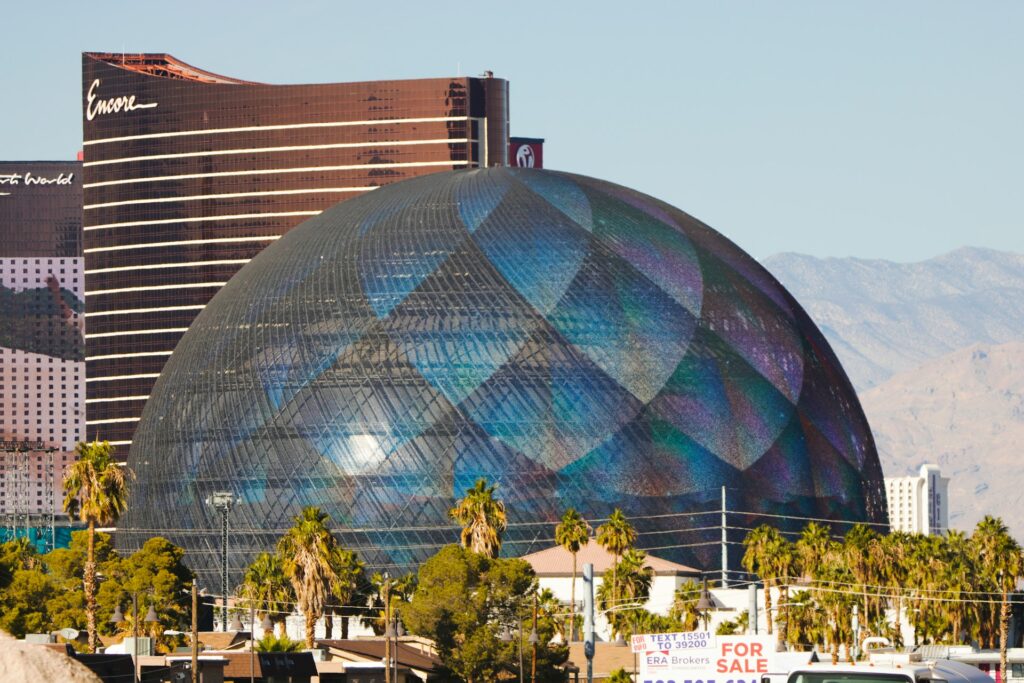
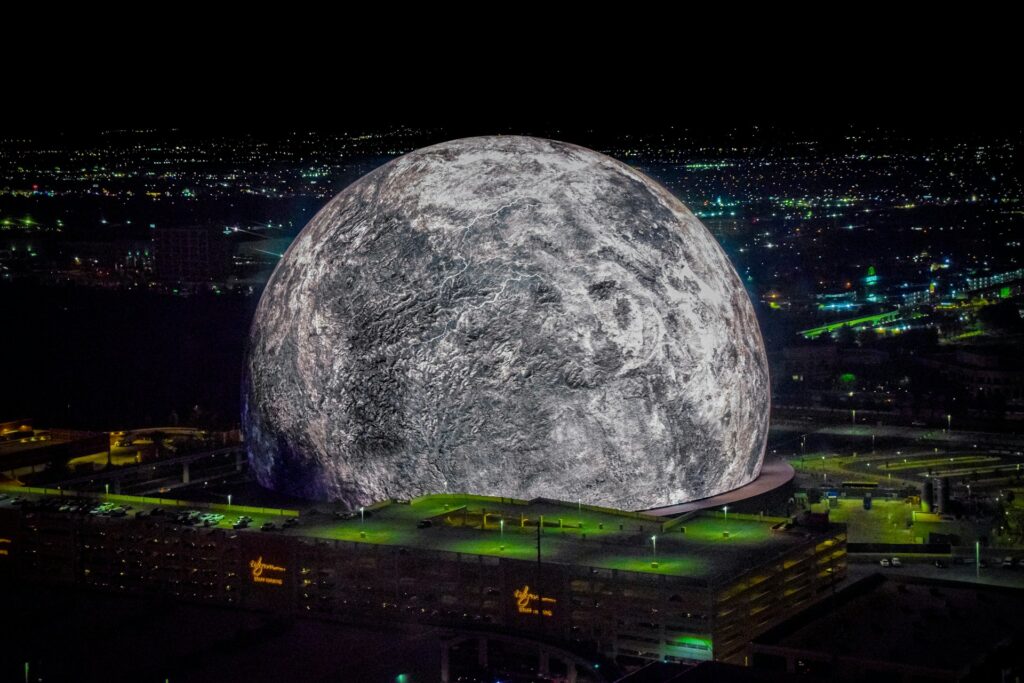
In the heart of the Nevada desert, just off the Strip, a building has emerged that redefines architecture as media. Sphere in Las Vegas is not simply an entertainment venue — it is a fully spherical structure rising 112 meters high with a 157-meter diameter, wrapped in what is currently the largest LED display on Earth. From the outside, it operates as an urban-scale digital surface. From the inside, it becomes a fully immersive environment.
Completed in 2023 at a cost of approximately $2.3 billion, the project was conceived to push beyond the limits of conventional arena design. The exterior Exosphere spans over 54,000 square meters, composed of roughly 1.2 million programmable LED nodes, capable of projecting high-resolution imagery visible from miles away. The building has no permanent façade — its identity is fluid, defined entirely by content.
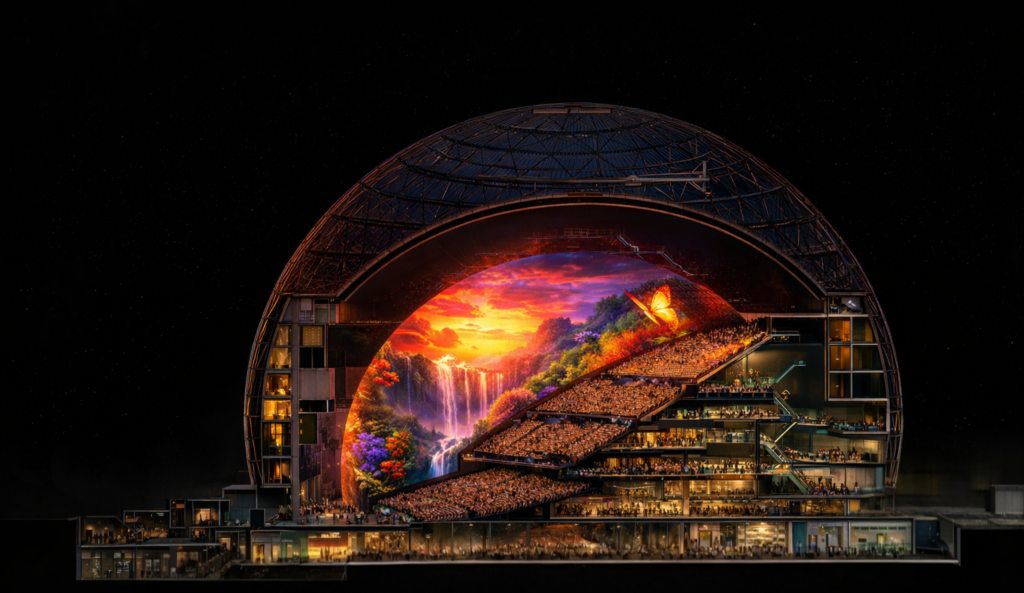
Inside, the architectural logic continues. A 15,000-square-meter interior screen, wrapping around the audience with a resolution exceeding 16K, transforms the venue into a continuous digital canvas. The auditorium accommodates 17,600 seated guests (up to 20,000 for standing events) and integrates an advanced spatial audio system with tens of thousands of precision-controlled sound points, alongside haptic seat technology that synchronizes physical vibration with visual and acoustic stimuli. This is not an arena with a large screen. It is a programmable spatial experience.
The Sphere demonstrates how architecture in the 21st century can shift from static form to dynamic interface — from building as object to building as platform. In Las Vegas, a city built on spectacle, architecture has evolved into something unprecedented: a structure that operates simultaneously as landmark, media device, and immersive machine.
The Sphere Las Vegas in Numbers
112 m
The total height of the structure, currently the largest spherical building in the world
157 m
The width of the building at its widest point
84 000 m³
The amount of concrete used for the main structure
13 000 t
The weight of the steel roof, which required a precision lift to set in place
54 000 m²
The surface area of the exterior LED display. It is the largest LED screen on Earth
1.2 mln
The number of LED „pucks” covering the exterior. Each puck contains 48 individual LED diodes capable of displaying 256 million colors
8 inches (20 cm)
The distance between each LED puck on the facade
15 000 m²
The surface area of the interior LED screen that wraps over the audience
16K x 16K
The resolution of the interior display, the highest resolution LED screen in existence
725 t
The weight of the internal steel frame supporting the massive 16K screen
167 000
The total number of speakers in the „Holoplot” audio system, which can target specific sound waves to individual seats
10 000
The number of „Immersive Seats” equipped with haptic technology (vibration and movement) and environmental effects (wind, scent, and temperature)
18 600
The number of fixed seats inside the venue
20 000
The maximum capacity including standing room
25 Gbps
The bandwidth available for the building’s internal systems
4th
4th Largest Crawler Crane in the world (the Demag CC 8800) – This crane had to be shipped from Belgium specifically to build the dome
320 Degrees
The field of view of the interior screen, which literally wraps behind the peripheral vision of the audience
3 000
The number of construction workers on site during the peak of the build
29.11.2023
The official opening date (headlined by U2)
$2.3 Billion
The total cost of construction, making it the most expensive entertainment venue in Las Vegas history
The Sphere Las Vegas – Key Questions
How big is The Sphere in Las Vegas?
The Sphere rises 112 meters (366 ft) high and spans 157 meters (516 ft) in diameter, making it the largest spherical entertainment structure in the world.
Its exterior LED surface covers approximately 54,000 m², while the interior immersive screen spans around 15,000 m².
The venue accommodates 17,600 seated guests, with a maximum capacity of 20,000 people.
Why is The Sphere considered technologically unique?
It features the world’s largest LED façade, composed of roughly 1.2 million programmable LED nodes.
Inside, a 16K-resolution wraparound screen surrounds the audience, supported by an advanced spatial audio system with 167,000 individual speakers.
Integrated haptic technology transforms the venue into a fully immersive, multi-sensory environment.
How much did The Sphere cost and when was it built?
Construction began in 2018 and the venue officially opened in 2023.
The total project cost reached approximately $2.3 billion, making it one of the most expensive entertainment venues ever built.
At peak construction, over 3,000 workers were involved in delivering the project.
What’s most intriguing about this building isn’t its size, but the structural and digital logic that allows a 157-metre sphere to operate as both architecture and screen. The Sphere turns a 54,000 m² LED surface into a programmable façade, redefining how buildings can function as immersive media infrastructure.
Engineering The Sphere in Numbers: Steel, Scale and Digital Infrastructure
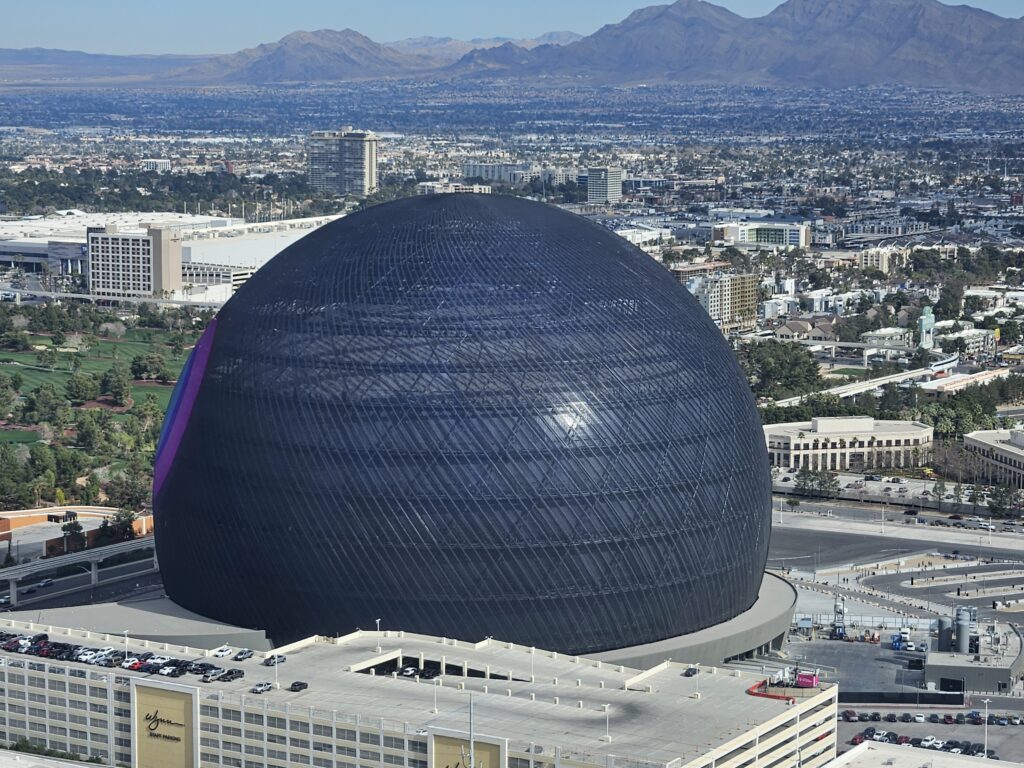
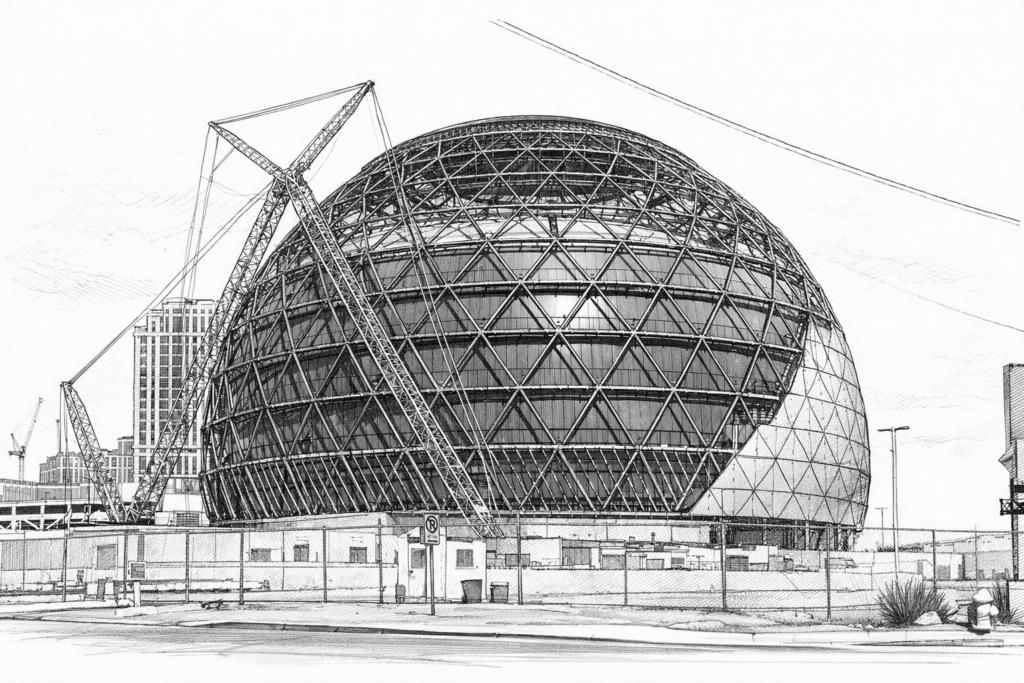
The engineering of Sphere is defined by geometry. A 157-meter diameter sphere is not a conventional vertical structure — it distributes loads radially rather than linearly. The building relies on a massive steel space frame composed of thousands of curved members forming a triangulated lattice. This exoskeletal logic allows the structure to maintain stability while carrying the weight of the LED façade, interior screen system, catwalks, and suspended technical infrastructure.
Structurally, the Sphere is built around a reinforced concrete core combined with a long-span steel dome system. The outer shell supports approximately 54,000 m² of programmable LED surface while resisting wind loads typical for the Las Vegas desert environment. The curvature of the form reduces localized stress concentrations, but it also required extremely precise fabrication tolerances — even minor deviations would multiply across the spherical geometry.
Inside, the engineering challenge shifts from structure to integration. The 15,000 m² interior screen is suspended within the steel framework without overloading the primary structure, while an advanced audio system with 167,000 speakers is embedded throughout the venue. Every component — visual, acoustic, mechanical — is coordinated within a dense three-dimensional matrix, making the building not only a structural object, but a synchronized technological system.
The Economics of the Dome: Turning Billions into Gold
The construction of The Sphere was a financial roller coaster that ultimately peaked at a staggering $2.3 billion. Originally budgeted at approximately $1.2 billion, the price tag nearly doubled due to global supply chain issues, inflation, and the sheer unprecedented nature of its technological complexity. This astronomical sum makes it the most expensive entertainment venue in Las Vegas history, surpassing the construction costs of even the most iconic luxury casino resorts like the Wynn or the Bellagio.
The venue’s revenue model is built on three main pillars: high-profile musical residencies (such as U2 and The Eagles), proprietary immersive films, and massive external advertising. In the fourth quarter of 2025 alone, the Sphere segment generated a massive $394.3 million in revenue, proving that the initial gamble is paying off. Their flagship film, Postcard from Earth, has grossed over $300 million since its debut, while newer immersive experiences have generated nearly $290 million in ticket sales in record time, confirming that audiences are willing to pay a premium for „one-of-a-kind” experiences.
The true „golden goose,” however, is the building’s outer shell—the Exosphere. Brands are reportedly paying $450,000 for a single day of advertising on this massive digital canvas, or roughly $650,000 for a week-long campaign (which includes the help of an in-house team of 300 designers). While the daily operating costs are significant, the most recent reports show an „adjusted operating income” of $128 million per quarter, signaling that this high-tech marvel has officially transitioned from a risky experiment to a cash-generating powerhouse in the heart of Nevada.
Trivia
Vision-Defying Resolution
The interior LED screen boasts a 16K x 16K resolution, making it the highest-resolution display of this scale in the world. The imagery is so sharp that the human eye cannot distinguish individual pixels even from a close distance. This creates a perfect illusion of reality where the line between the physical room and the digital image completely vanishes.
Sound That Follows You
The Holoplot audio system consists of over 160,000 speakers hidden behind the massive LED screen. Using beamforming technology, sound is directed precisely to specific rows rather than „spilling” across the entire hall. This allows the venue to broadcast different languages to different sections of the audience simultaneously without any interference.
The Fourth Dimension of Sensation
The Sphere is not just about sight and sound; it features haptic systems installed in 10,000 specialized seats. Guests can literally feel the ground shake, gusts of wind, or temperature shifts programmed to match the scenes on screen. Specialized scent machines can even disperse the smell of a forest or a sea breeze to complete the immersion.
A Massive Steel Skeleton
The building’s exoskeleton is an engineering masterpiece weighing a staggering 13,000 tons. To erect it, the world’s fourth-largest crawler crane was brought in from Belgium and operated for 117 consecutive days. The entire structure is designed to withstand extreme desert winds and the heavy vibrations generated by the massive sound system.
The World’s Largest Billboard
The exterior screen, known as the Exosphere, covers an area of over 580,000 square feet. It is made of 1.2 million LED pucks, each containing 48 diodes capable of displaying millions of different colors. It is the most powerful advertising tool on the planet, visible from miles away and even from commercial aircraft.
Architecture Built on Math
While the building looks like a modern sculpture, its design is rooted in classical geometry and geodesic formulas. Architects had to solve hundreds of complex mathematical equations to ensure the curved screen wouldn’t distort the displayed images. Every LED panel was precision-cut and fitted to the spherical surface with millimeter-level accuracy.
A Desert Energy Revolution
The facility consumes massive amounts of power but aims to be the most eco-friendly building of its kind. Approximately 70% of its electricity is intended to come from solar energy generated at dedicated farms in Nevada. Additionally, the excess heat generated by millions of LEDs is recovered and used to heat water within the complex.
The Custom „Big Sky” Camera
To create content for such a massive screen, engineers had to build their own camera system called Big Sky. It features a single sensor with the highest resolution in the world, replacing the need to stitch footage from multiple smaller cameras. Just one second of footage from this device takes up hundreds of gigabytes of hard drive space.
Intelligent Cooling Systems
Millions of LED diodes emit a tremendous amount of heat that could potentially cause system failures. Between the outer shell and the inner screen, there is a massive air cavity that acts as a natural insulator. The HVAC system can pump millions of cubic meters of air to maintain a constant temperature for both the electronics and the guests.
Foundations and Concrete Mass
The entire spherical structure rests on a solid base built using 84,000 cubic meters of concrete. The foundations must support not only the steel roof but also the weight of 20,000 people and heavy stage equipment. They were specifically designed to isolate the building from vibrations generated by the nearby Las Vegas streets.
A Data Center at the Heart of Fun
Hidden beneath the seats is one of the most advanced data centers in the entertainment industry. The internal network bandwidth is an incredible 25 Gbps, allowing for the transmission of uncompressed video in real-time. This server room has enough processing power to manage the digital infrastructure of a medium-sized city.
Record Construction Time and Cost
Construction took over five years and survived a global pandemic, which significantly impacted the final budget. The $2.3 billion cost makes it the most expensive venue in Las Vegas, even surpassing luxury casinos. This investment has permanently changed the city’s skyline and the global standard for mass-scale spectacles.