
A Façade Engineered in Thousands of Unique Data Points
Opened in 1997, the Guggenheim Museum Bilbao represents a decisive moment when architectural form, digital design, and economic strategy converged into a single, measurable outcome. Conceived at a time when Bilbao was transitioning away from heavy industry, the museum was never intended to function solely as a cultural venue. From the outset, it was designed as an urban catalyst — a building whose spatial complexity, scale, and material presence could reframe the city’s global identity.
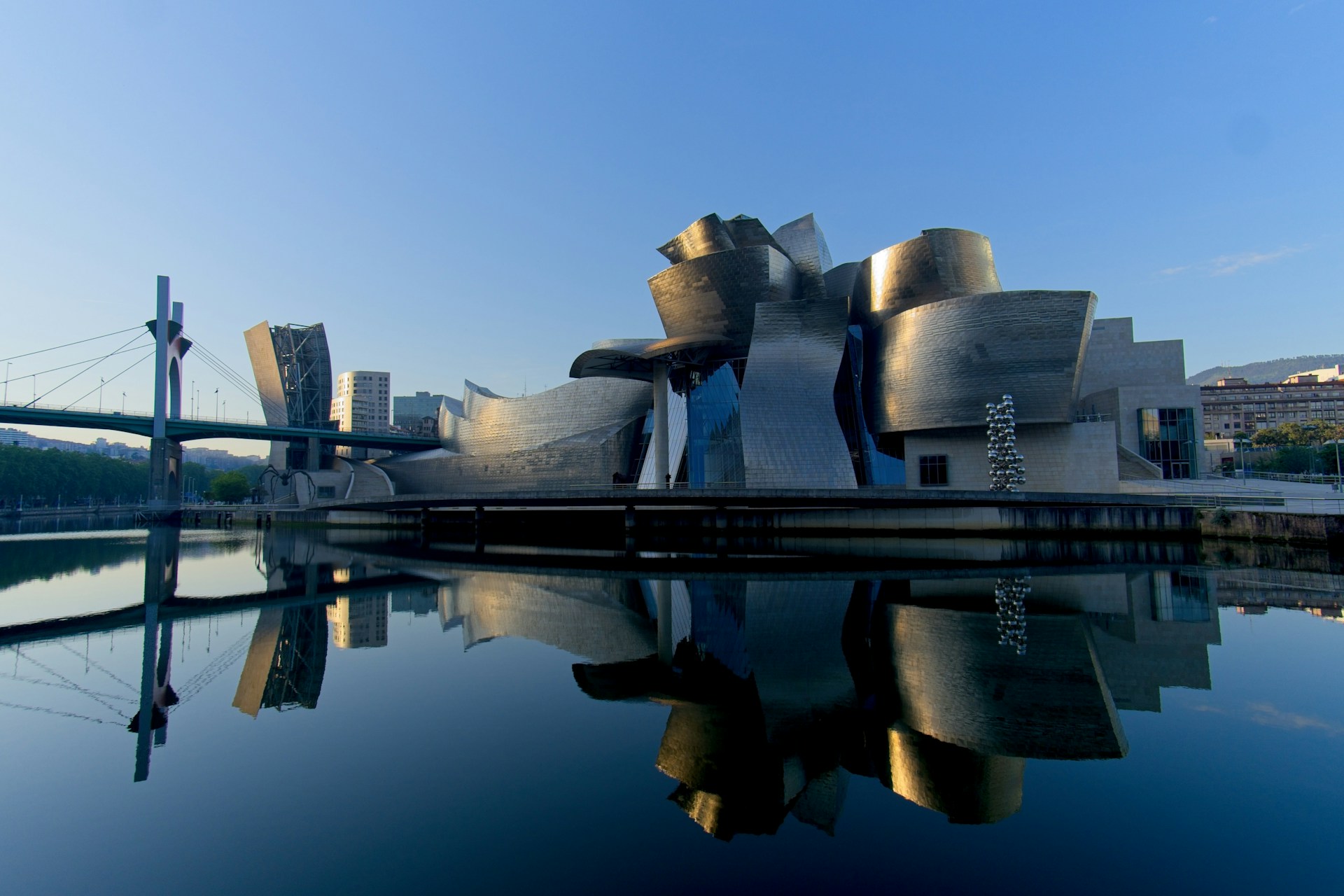
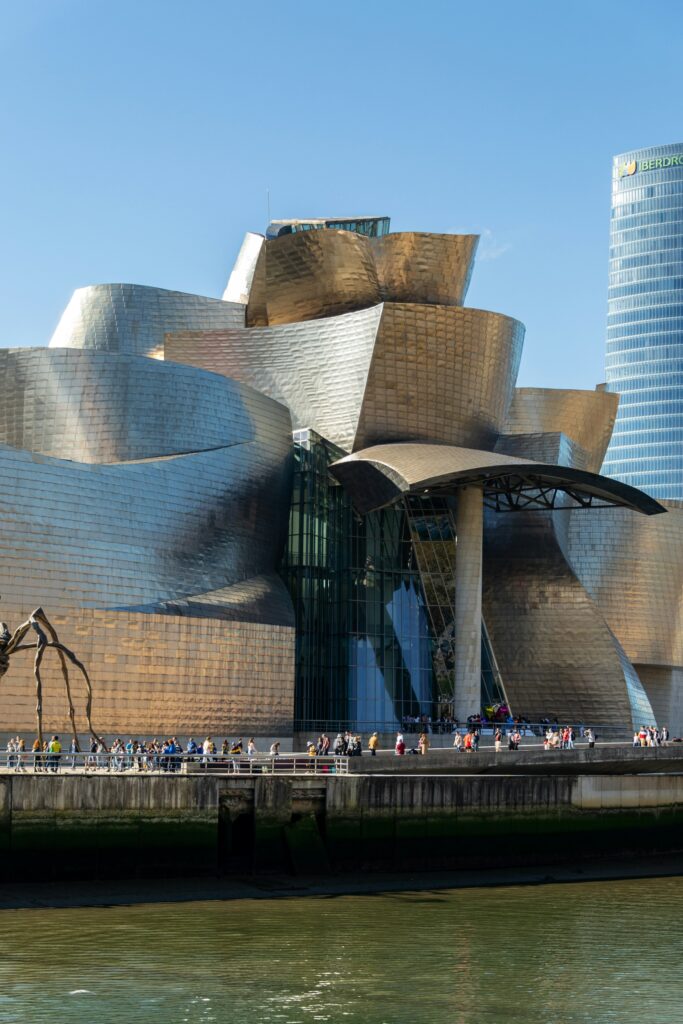
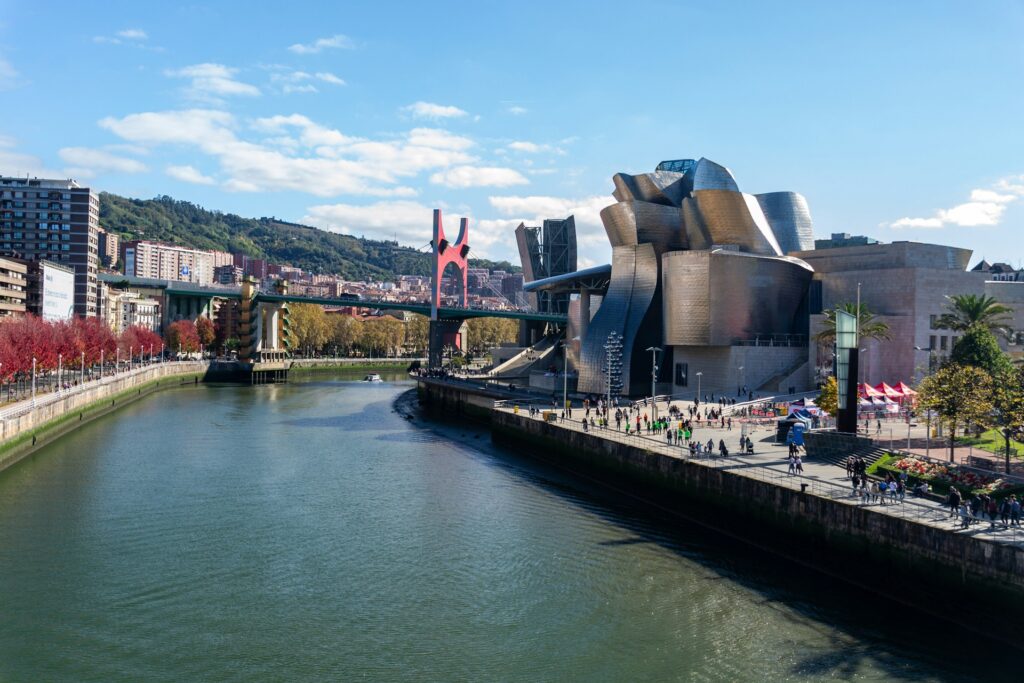
The architecture abandons classical compositional rules entirely. There is no primary façade, no central axis, and no repetitive geometry. Instead, the building unfolds as a sequence of interlocking volumes aligned with the Nervión River, responding directly to the site’s curvature and industrial context. What appears sculptural and intuitive is, in fact, the result of a fully data-driven design process. Aerospace software (CATIA) was used not as a visualization tool, but as a structural and construction framework, enabling the coordination of thousands of unique elements without standardization.
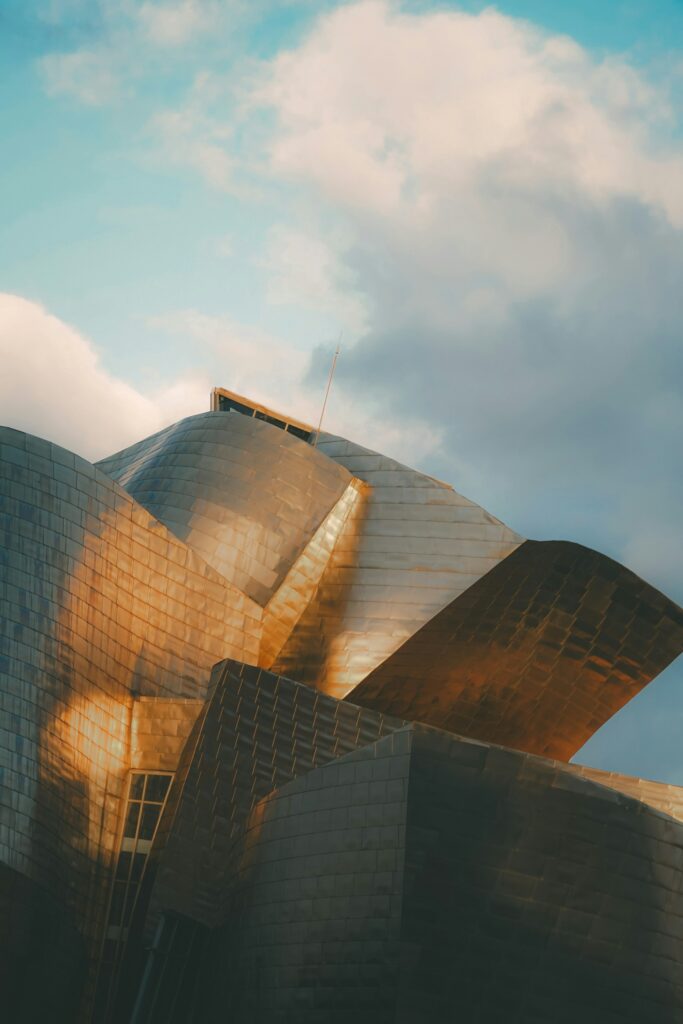
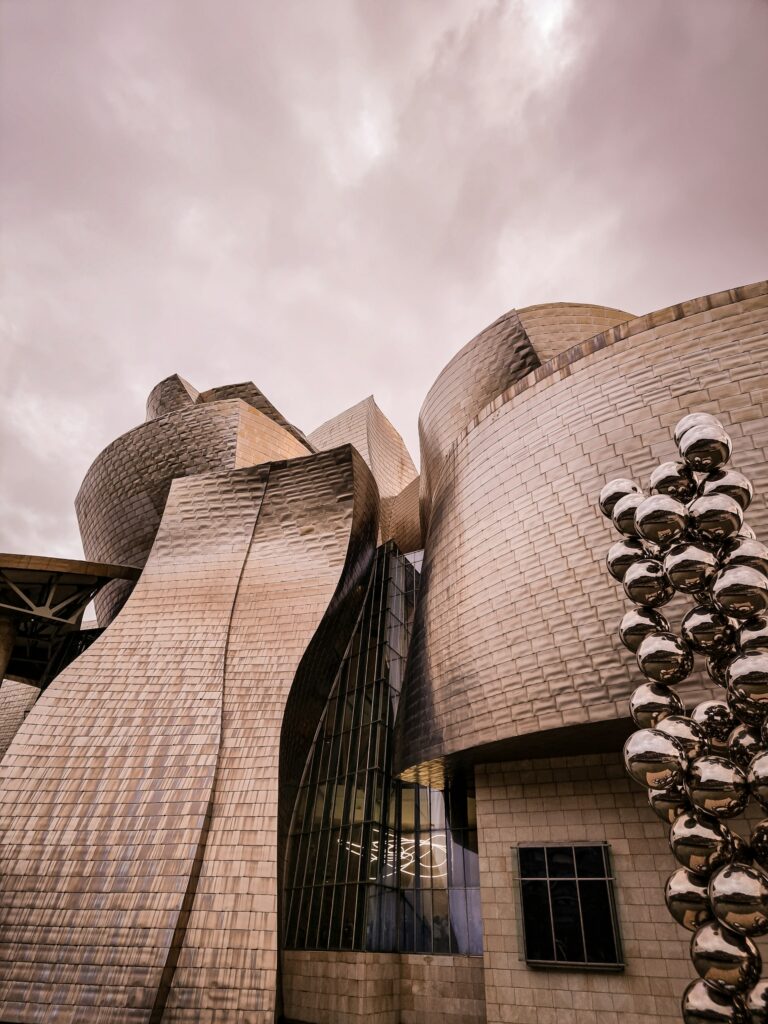
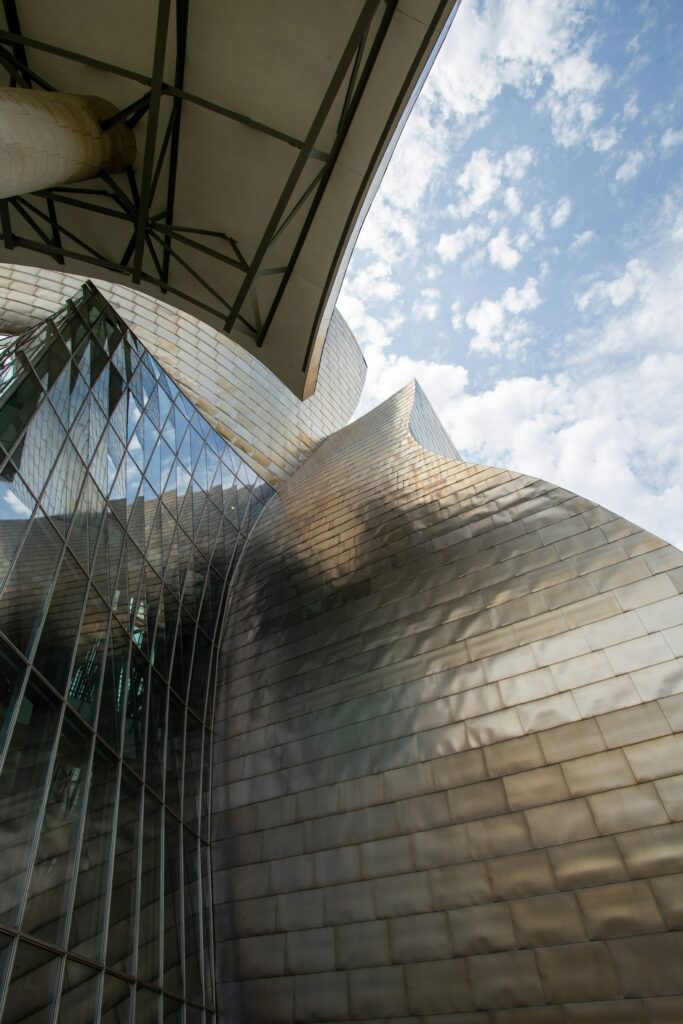
This logic extends to the façade, where approximately 33,000 ultra-thin titanium panels form a skin that is lightweight, corrosion-resistant, and highly reactive to ambient light. The material choice was not symbolic but operational — optimized for Bilbao’s humid maritime climate while minimizing structural load. Each panel is geometrically distinct, eliminating modular repetition and reinforcing the building’s non-linear logic.
Inside, the museum functions as an infrastructural system rather than a sequence of neutral galleries. A 50-metre-high atrium operates as a spatial distributor, connecting exhibition spaces of radically different scales. Some galleries conform to conventional museum proportions, while others extend beyond 130 metres in length, engineered to accommodate works whose mass and dimensions exceed traditional exhibition limits. Structural spans, floor load capacities, and circulation routes were designed to support installations measured in tens of tonnes.
From an economic perspective, the project demonstrates how architectural risk can translate into quantifiable return. With a construction cost of approximately USD 100 million, the museum generated a level of cultural tourism unprecedented for the region, contributing to long-term revenue streams that vastly exceeded initial investment. The so-called “Bilbao Effect” is not an abstract concept but a measurable outcome rooted in infrastructure, accessibility, and spatial ambition.
Guggenheim Museum in Numbers
130 m
Length of the longest gallery
19
Number of exhibition galleries
50 m
Height of the central atrium
1997
The year the museum opened
24,000 m²
Total gross floor area
42 875
Total façade panels (all materials combined)
33 000
Number of titanium panels
23 530 m²
Titanium-coated surface
0,38 mm
Titanium thickness
60 t
Weight of titanium sheets
100 years
Titanium life expectancy in Bilbao’s aggressive, humid environment
89-100 mln USD
Total investment cost
What’s most intriguing about this building isn’t its iconic image, but the precision with which thousands of unique titanium panels are engineered to behave as a single, lightweight envelope.
The Guggenheim Museum Bilbao demonstrates how digital coordination, material science, and construction tolerances can replace repetition, turning architectural complexity into a controllable and durable system.
A Non-Standard Façade Built to Standard Tolerances
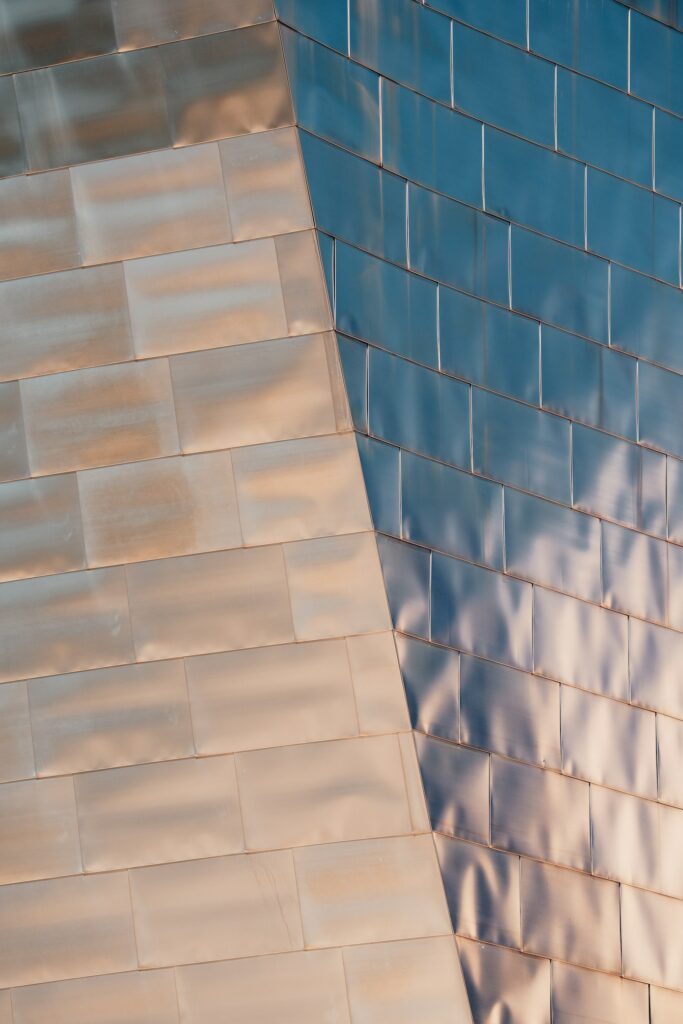
The façade of the Guggenheim Museum Bilbao is not an image applied to a building, but a precisely engineered system. Composed of 42,875 individual panels across multiple materials, it operates as a single, coordinated envelope in which geometry, structure, and material behavior are resolved through data rather than repetition. The titanium cladding—approximately 33,000 panels only 0.38 mm thick—was selected not for symbolism, but for performance: low weight, high corrosion resistance, and long-term durability in Bilbao’s humid, industrial climate.
Despite its apparent irregularity, the façade is governed by strict construction logic. Most titanium panels originate from standardized rectangular blanks, later formed to accommodate complex curvatures, allowing geometric freedom without abandoning fabrication efficiency. Expansion gaps as small as 2 mm absorb thermal movement, while assembly tolerances of roughly 3 mm demand a level of precision more commonly associated with aerospace manufacturing than building construction.
Digital coordination through CATIA enabled each panel to be defined, fabricated, and installed with millimetric accuracy, eliminating the need for modular repetition. As a result, the façade does not merely conceal the building’s structure—it reveals a new paradigm of architectural production, where complexity becomes manageable, predictable, and measurable. In Bilbao, the façade is not a surface; it is the building’s most explicit expression of engineering logic.
Trivia
Russian Titanium Trade
The choice of titanium was made possible by a sudden drop in prices following the collapse of the Soviet Union. Frank Gehry originally considered stainless steel but found that titanium was cheaper and offered a warmer glow. This unique material allows the building to change its color based on the weather and the position of the sun.
Fighter Jet Software
The building’s geometry was so complex that it could not be designed using traditional architectural tools. The team utilized CATIA, a high-end software originally created by Dassault Systèmes to design Mirage fighter jets. This technology allowed for the precise calculation of every single one of the 33,000 titanium panels.
The Accidental Landmark
Jeff Koons’ „Puppy” sculpture was originally intended to be a temporary installation for the museum’s grand opening. The citizens of Bilbao fell so deeply in love with the floral West Highland Terrier that the city decided to purchase it permanently. It is now considered the unofficial guardian of the museum and its most photographed resident.
The Bilbao Effect
Before the museum was built, Bilbao was a struggling industrial city facing a severe economic decline. The $100 million investment transformed the region into a global cultural hub and paid for itself within just a few years through tourism. This phenomenon is now studied by urban planners worldwide as the „Bilbao Effect.”
A Breathing Titanium Skin
The titanium sheets are only 0.38 mm thick and are not fixed rigidly to the structure. They are attached using a clip system that allows them to „breathe” and ripple slightly in the wind. This creates a shimmering, organic appearance that makes the building look like it is alive.
The Acid Bath Finish
Pure titanium is naturally very reflective and could have blinded drivers on the nearby bridges. To prevent this, every panel underwent a specific acid bath to create a satin, matte finish. This treatment ensures the building reflects a soft, golden light rather than a harsh glare.
Limestone from the South
While the metal curves get the most attention, the massive rectilinear sections are made from Spanish limestone. This stone was sourced from a quarry in Huéscar, Granada, and was chosen for its warm, sandy hue. It provides a solid visual anchor that connects the futuristic metal to the traditional Spanish landscape.
The World’s Longest Gallery
Gallery 104, also known as the ArcelorMittal Gallery, is 130 meters long and completely free of internal support columns. It was specifically designed to house Richard Serra’s massive steel installation, „The Matter of Time.” Walking through this space is described as an overwhelming experience of scale and movement.
Glass Fissures
Gehry designed the building so that transparent glass curtain walls fill the gaps between the titanium „sails” and stone blocks. This allows the interior of the museum to be flooded with natural, diffused light throughout the day. At night, the interior glow spills outward, turning the entire museum into a giant urban lantern.
Maman the Giant Spider
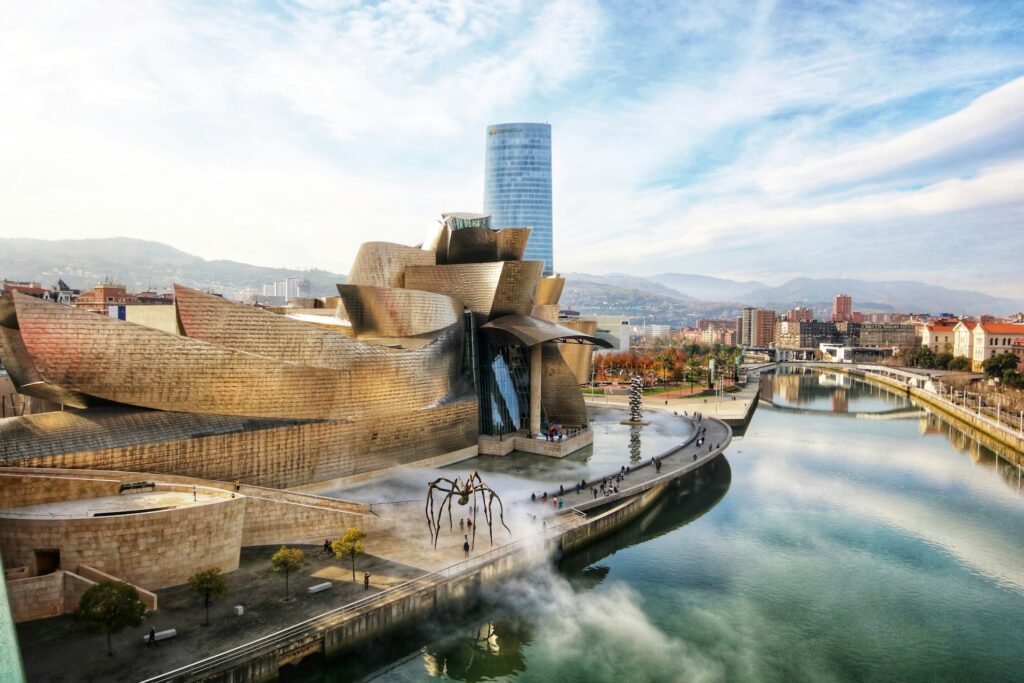
Standing outside the museum is a 9-meter-tall bronze spider sculpture by Louise Bourgeois. It serves as a tribute to her mother, symbolizing weaving, protection, and cleverness. Beneath the spider’s belly, a mesh sac contains 26 white marble eggs.
Water and Fire
The museum is surrounded by a shallow artificial lake equipped with submerged gas nozzles. At night, fire displays designed by Yves Klein erupt directly from the surface of the water. These flames reflect off the titanium walls, creating a spectacular and ever-changing light show.
Integrating the Bridge
Frank Gehry refused to ignore the pre-existing La Salve Bridge that cut through the site. Instead, he integrated it into the design by building a tower that appears to pierce or wrap around the bridge. This makes the city’s transport infrastructure an essential part of the museum’s artistic identity.
Man-Made Fog
A „fog sculpture” created by Fujiko Nakaya regularly blankets the museum’s pond in a thick mist. Thousands of high-pressure nozzles create a dense cloud that temporarily obscures the lower parts of the building. This effect makes the massive structure appear to be floating or emerging from a dream.
Nature over Architecture
Gehry has stated that his inspiration came from natural forms rather than traditional buildings. The museum’s chaotic curves are meant to evoke the look of fish scales, waves, and the cliffs surrounding Bilbao. Because of this, the building has no „front” or „back” and looks different from every single angle.
Deep River Foundations
The museum is built on unstable, marshy ground right on the edge of the Nervión River. To support the thousands of tons of concrete and steel, hundreds of piles were driven 14 meters into the bedrock. This ensures the building remains perfectly stable despite its proximity to the water.
A Symbol of River Renewal
The site of the museum was once a polluted dockland filled with derelict warehouses and shipyards. The construction project forced a massive cleanup of the river and the creation of new public promenades. The museum acted as a catalyst for a city-wide environmental and social rebirth.