
An Architectural Tornado in the Heart of Panama – F&F Tower Panama City
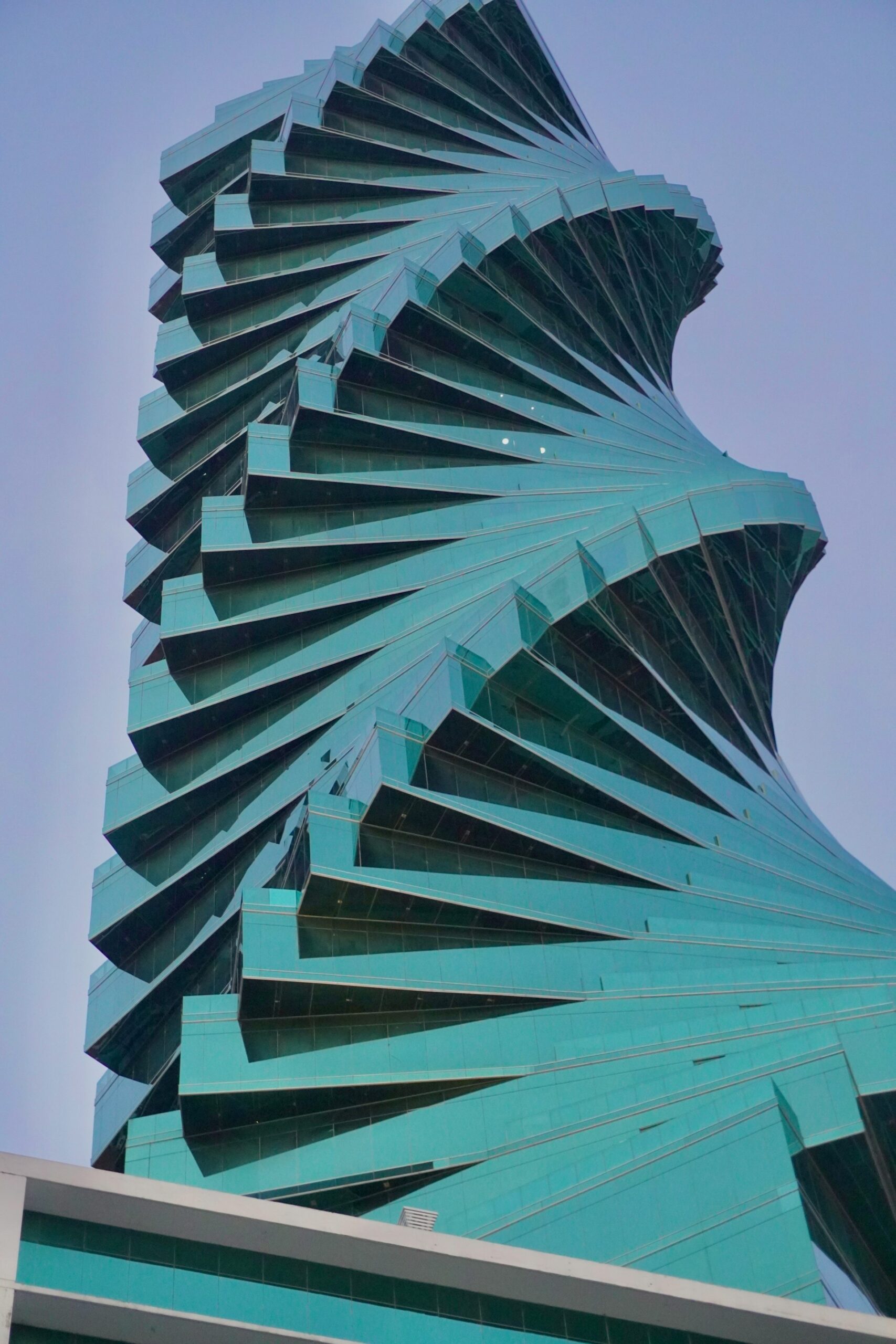
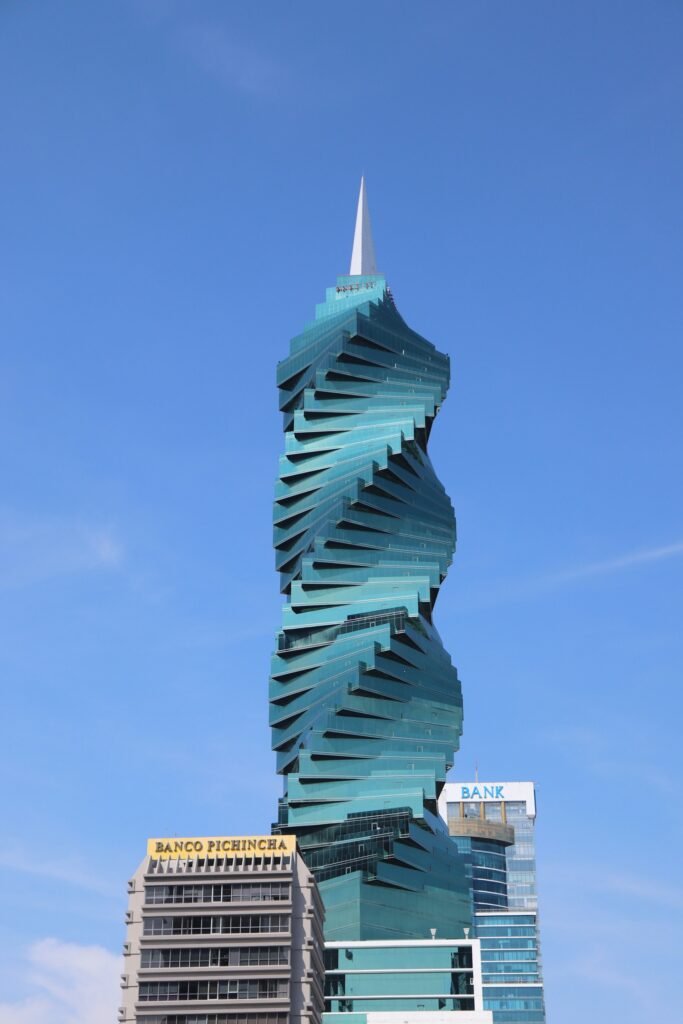
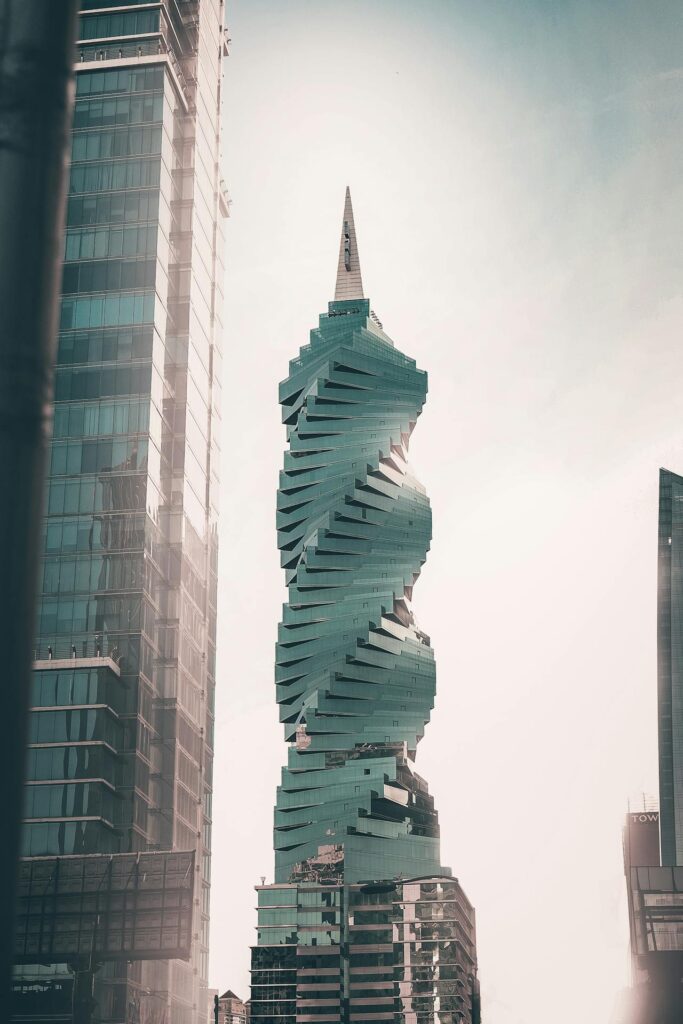
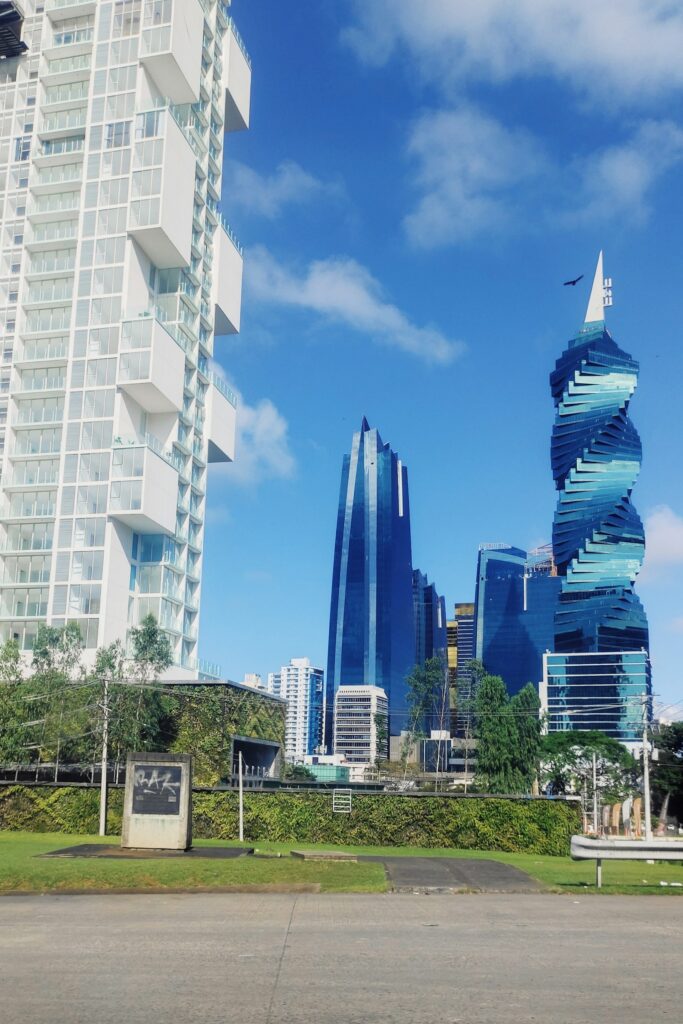
In the dense skyline of Panama City, bristling with glass skyscrapers, one building forces tourists to rub their eyes in disbelief and engineers to bow their heads in respect for its mathematical precision. The F&F Tower, known by the local community almost exclusively as „El Tornillo”—The Screw—is not merely an office building, but a monumental macro-scale sculpture that appears to drill a hole into the steamy, tropical sky. Designed by the visionaries at Pinzón Lozano & Asociados, the tower has become the most potent symbol of modern Panama: a nation that is dynamic, ambitious, and boldly manifesting its status as the financial powerhouse of the region. While traditional skyscrapers climb predictably toward the clouds, the F&F Tower performs a spectacular pirouette before the observer’s eyes, consistently shifting its vector with each successive floor and ultimately completing a full three-hundred-and-sixty-degree rotation around its own axis.
This incredible construction proves that even with a relatively modest budget of fifty million dollars, it is possible to create a world-class architectural icon that challenges the greatest metropolises on the globe. The foundation of this success lies in mathematical repetition—each of the office floors is offset from the previous one by exactly nine degrees, which, across the entire mass of the building, creates a hypnotic effect of movement trapped in glass and concrete. The choice of emerald-green reflective glass was not merely an aesthetic preference; it serves as a critical technological barrier protecting the interiors from the merciless intertropical sun, while simultaneously acting as a mirror reflecting the Pacific Ocean. The F&F Tower is a masterpiece of geometry where the rotation is not just a superficial treatment of the facade, but a result of the actual twisting of entire floor plates around a massive, reinforced concrete core. It was this integrity of form and function that caused the building, shortly after its completion in twenty-eleven, to dominate prestigious architectural rankings and become a global benchmark for all subsequent „twisted skyscraper” projects worldwide.
F&F Tower in Numbers
242,9 m
Architectural height of the towers
315°
Total cumulative rotation
60 753 m²
Total gross floor area
52
Number of levels at which the SkyPark is located
39
Number of office floors forming the primary rotating section
13
Number of above-ground parking floors forming the base
4
Number of balconies on each floor
2011
Completion and occupancy
16 m
the depth at which the foundation piles were placed in the rocky ground of the Calle 50 district
~200 km/h
Design wind speed considered in structural and façade engineering
~21 000 m²
total surface area of the reflective glass pane covering the façade
50 mln USD
Total costs of construction
What’s most intriguing about this building isn’t its height, but the way rotational geometry is embedded directly into its structural system rather than applied as a visual effect. F&F Tower operates through a variable, section-based rotation that reshapes wind behavior, floor orientation, and solar exposure across its full height. In Panama City’s dense and climatically aggressive skyline, the tower doesn’t simply twist for expression — it uses rotation as an infrastructural strategy, turning geometry into performance.
Engineering a Rotational System: F&F Tower
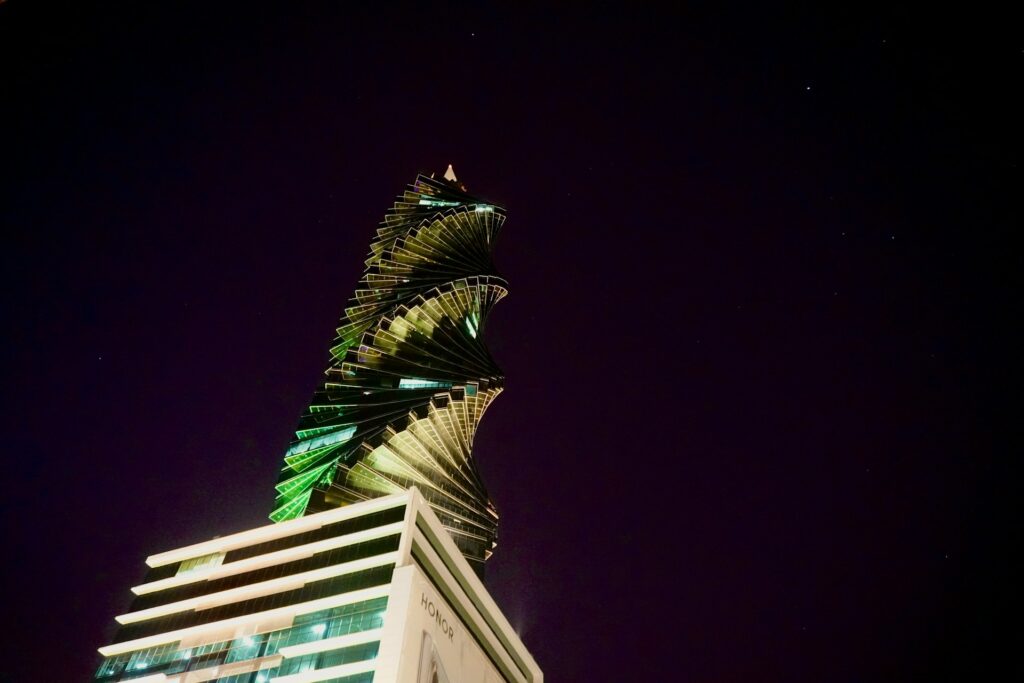
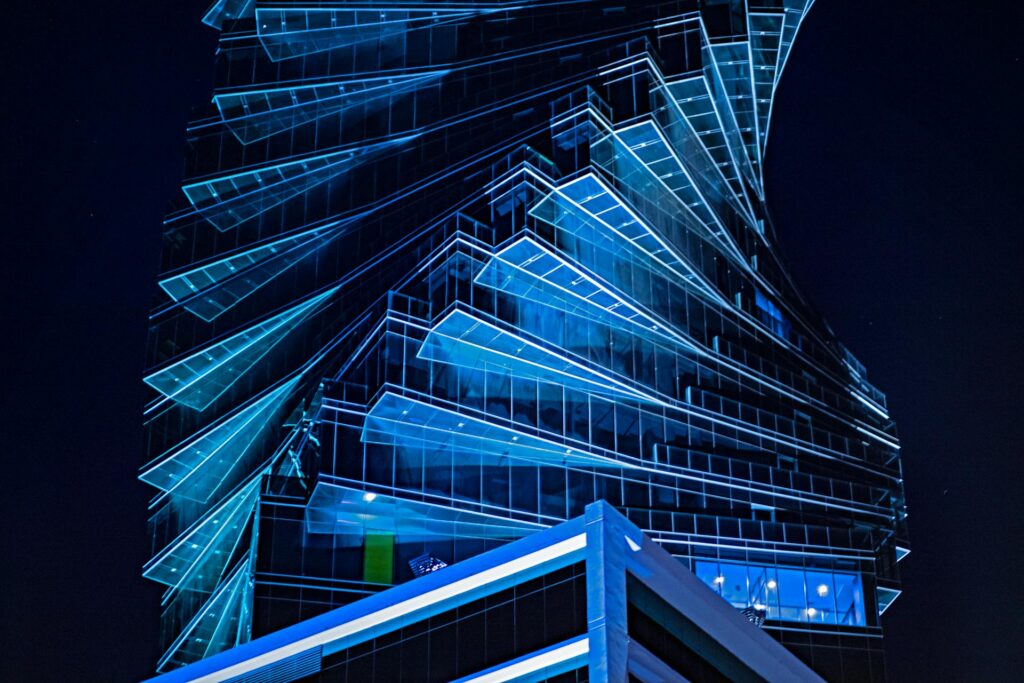
F&F Tower demonstrates a model of twisted high-rise engineering in which rotation is not applied as a visual gesture, but embedded directly into the building’s structural logic. The tower’s geometry is generated through variable, section-based rotation of its floor plates, allowing significant cumulative twist without imposing torsional demands on the primary load-bearing system.
A reinforced concrete shear core provides the building’s main resistance to lateral forces and remains geometrically stable throughout the height of the tower. By resolving rotation at the level of the slabs and perimeter geometry rather than within the core, the structure maintains clarity and efficiency despite its complex appearance. This separation of stability and expression is fundamental to the tower’s engineering strategy.
The rotating geometry also plays an aerodynamic role. In Panama City’s hurricane-influenced climate, the continuously changing orientation disrupts vortex shedding and reduces crosswind excitation compared to a conventional prismatic tower. The building therefore relies on form, rather than supplemental mechanical systems, to moderate wind behavior.
Construction efficiency is achieved through repetition beneath the apparent variation. Although no two office floors share the same orientation, the structural system itself remains highly standardized, enabling economical construction using reinforced concrete. The façade reinforces this logic through continuous perimeter balconies that make the rotation legible while simultaneously providing solar shading and rain protection.
Ultimately, the engineering significance of the F&F Tower lies not in the degree of its twist, but in how deliberately that twist is resolved. Rotation here is a performative system — one that integrates structure, climate, and construction into a single, coherent strategy rather than a purely iconic form.
Trivia
The Illusion of Motion in a Static Mass
Although the building appears to swirl fluidly, this effect was achieved using only straight lines and flat glass panes. The key lies in the mathematical shifting of the balcony edges, which tricks the human eye into perceiving curves that do not actually exist in the concrete structure. As a result, the tower looks flexible despite being a rigid, monolithic slab of reinforced concrete.
The Problem of „Wandering” Plumbing
In a typical skyscraper, water and sewage pipes run in a perfectly straight vertical line, but in the F&F Tower, they had to be designed to accommodate the floor rotation. Engineers had to create a complex system of angled joints and offsets so the pipes could „keep up” with the shifting perimeter of each story. This remains one of the most hidden yet technically challenging elements of the entire construction.
Gravitational Challenges for Cranes
During construction, tower cranes had to be anchored multiple times to the twisting core, requiring custom-made supports of varying lengths. Because every floor offered a different bracing point, the logistics of delivering materials changed every single week as the building rose. Crane operators also had to account for unusual air turbulence generated by the building’s unique spiral form.
Sun-Driven Climate Control
Due to the twist, every office has a unique sun exposure that changes drastically throughout the day. The building’s management system must dynamically calculate cooling power for each section because solar heat gain does not distribute evenly across the facade. This makes energy management in the F&F Tower significantly more complex than in traditional, flat-faced skyscrapers.
Natural Protection from Tropical Rain
Panama experiences sudden, torrential tropical rains that typically flood the balconies of high-rise buildings. In the F&F Tower, the rotation of the floors allows higher levels to act as a giant umbrella for the balconies located directly below them. Consequently, most private terraces remain dry even during heavy downpours, which is a rare luxury in this specific climatic zone.
Window Cleaning as an Extreme Sport
Standard vertical window-washing platforms are almost useless here because of the building’s overhangs and constant rotation. Cleaning crews must use specialized hoisting systems and professional alpine climbing techniques to reach every nook of the glass facade. Every cleaning cycle requires a meticulous logistical plan to prevent equipment from banging against the protruding corners of the floor plates.
Symbolism of Numerology and Angles
The choice of the rotation angle was not accidental, as the goal was to achieve a near-complete turn to symbolize renewal and completeness in Panama’s business culture. The 52 floors correspond to the number of weeks in a year, which local legends suggest brings luck to tenants in their annual financial planning. While this is largely a city myth, the architects often reference it to emphasize the harmony of the project.
Impact on Urban Birdlife
Studies on the aerodynamics of tall buildings have shown that the spiral form of the F&F Tower creates unusual updrafts that local birds of prey frequently utilize. The building’s structure breaks the strong winds coming off the ocean, creating safer flight zones within the dense urban center. This serves as an unexpected, ecological side effect of an otherwise aggressive architectural form.
Acoustics of a Twisted Facade
The tower’s unusual shape causes street noise from the bustling Calle 50 to dissipate rather than climbing straight up a smooth wall. The angles of the facade act as natural acoustic diffusers, making the higher floors significantly quieter than those in neighboring rectangular buildings. This provides a much more comfortable sound environment for the professionals working inside „The Screw.”
The Parking Base as a Visual Anchor
The base of the building, housing 13 floors of parking, intentionally lacks any twist to „anchor” the tower visually to the ground. If the rotation had started from the ground level, the structure might have appeared unstable or caused a sense of vertigo for pedestrians. The static base therefore serves as a vital visual counterweight to the dynamic energy of the spire above.
Recycled Pigments in the Glass
The emerald color of the facade was achieved using metal oxide additives, some of which were sourced from industrial recycling processes. This specific hue not only distinguishes the building from the blue ocean backdrop but also effectively masks salt deposits from the sea air. This allows the skyscraper to maintain a clean appearance for much longer between washing cycles.
The Absence of Identical Views
Because every floor is rotated, an employee on the 20th floor sees a completely different slice of the city panorama than someone sitting in the exact same spot on the 30th floor. This constant variation means that navigating the interior can be confusing for new visitors, who often lose their sense of direction relative to the cardinal points. It is the only building in Panama that offers such a diversified visual experience from every single level.