
When geometry becomes motion: the engineering logic behind Turning Torso
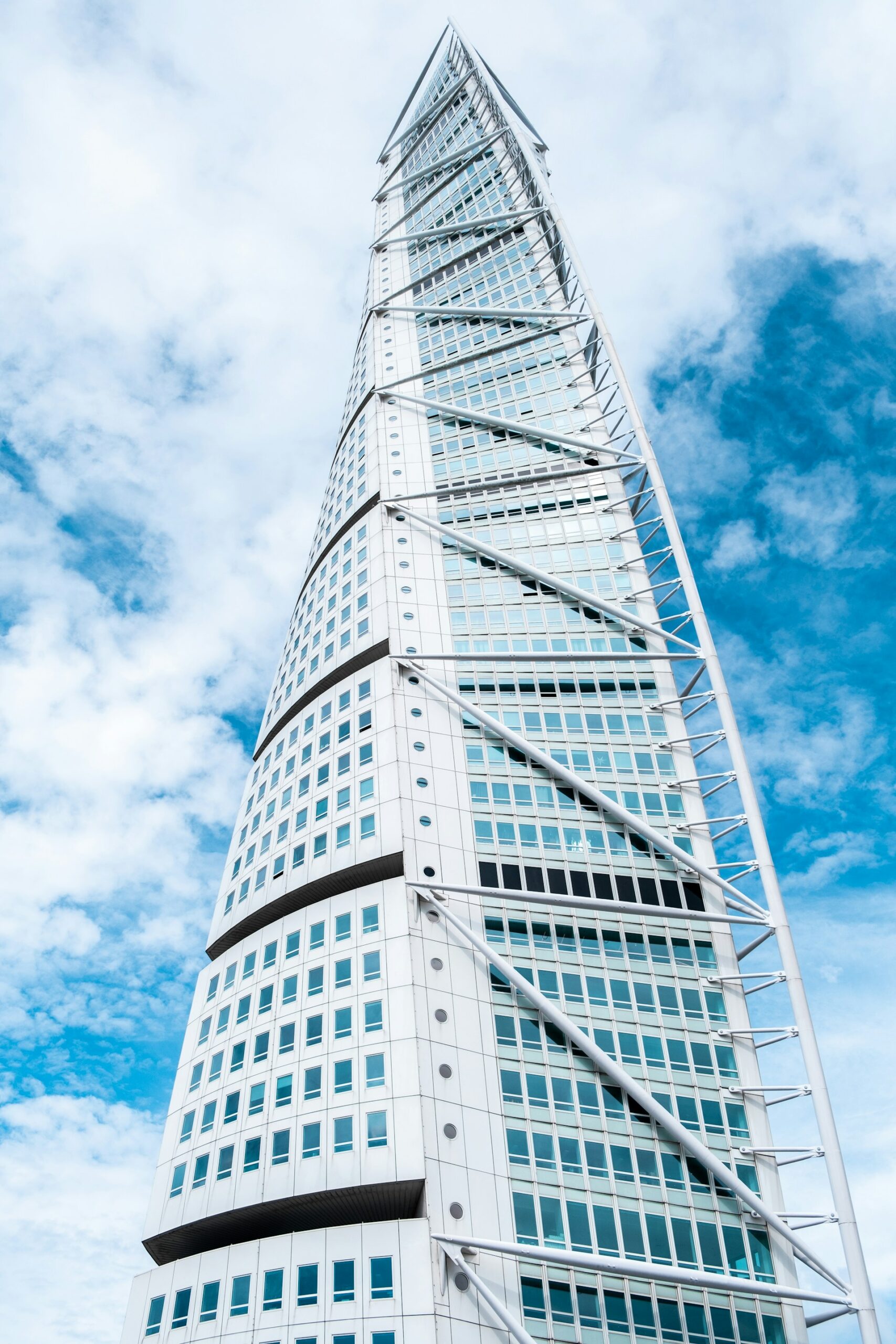
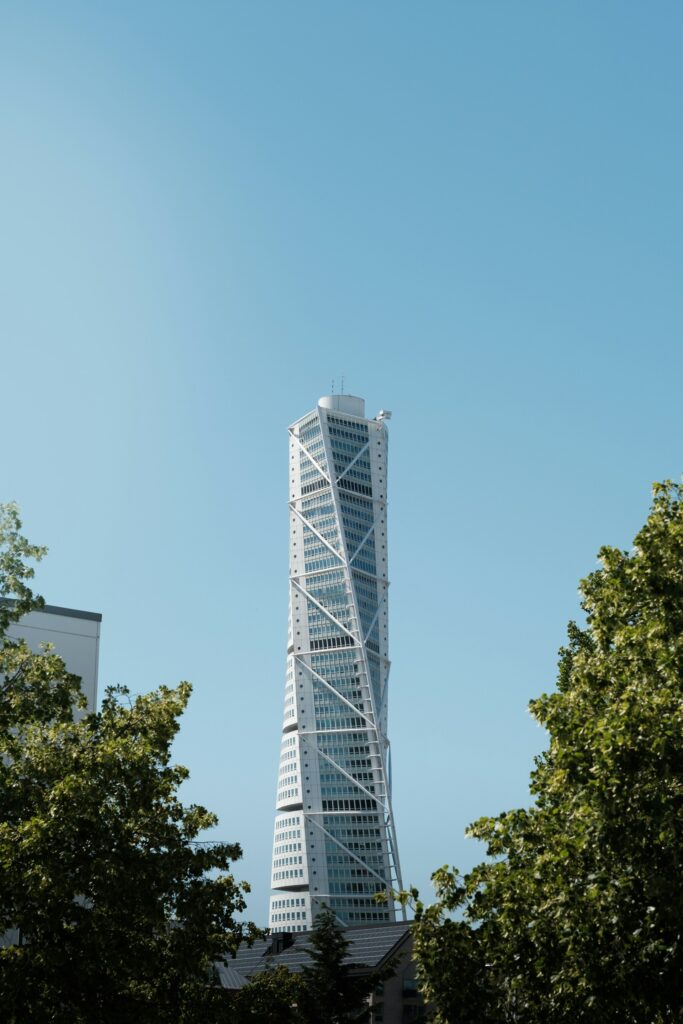
Turning Torso was not created as a response to the need for height or the pressure of density. This building is, above all, a manifesto—a moment when architecture ceases to be a static object and begins to act as a record of movement in space. Its 90-degree twist from foundation to roof is not a formal gesture, but the consequence of a conscious design decision: to demonstrate that a skyscraper can be read as a sequence of forces, not as a vertical block.
Inspiration came from the human silhouette in motion—a torso twisting around its axis—translated into the language of concrete, steel, and geometry. The result is a structure in which each floor differs from the previous one, and the concept of „floor repetition” ceases to exist. Turning Torso doesn’t pretend to convey dynamism through its façade; it actually generates it, forcing the structure to operate under conditions of constant twisting and uneven loading.
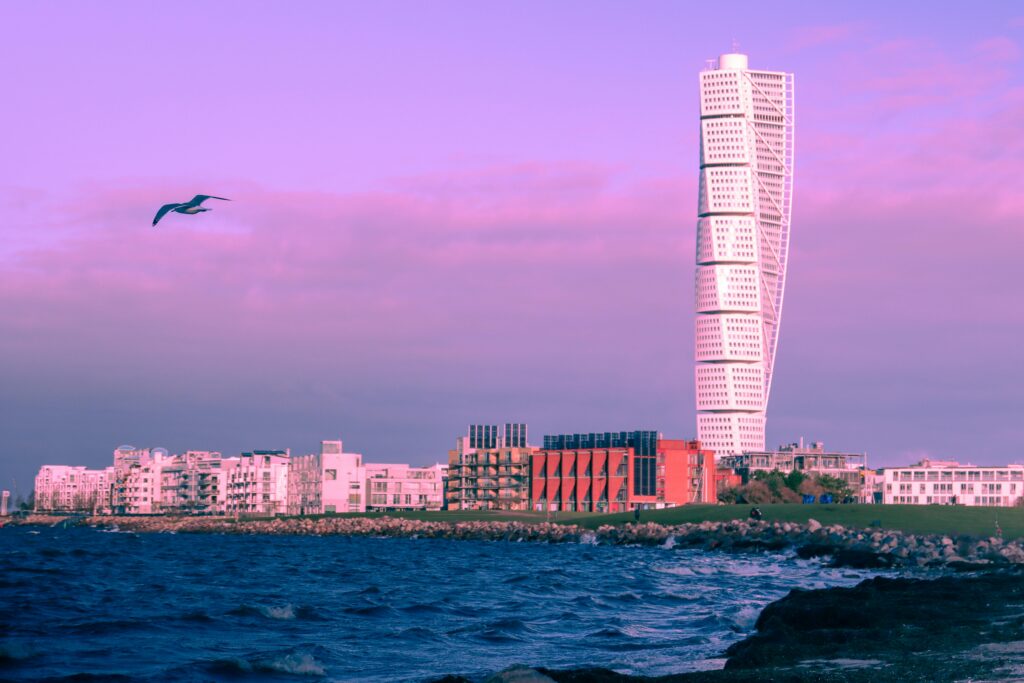
The context of the building’s construction is as important as the form itself. The tower was erected on the site of a former shipyard in Västra Hamnen—a site that for decades was a symbol of Malmö’s industrial hinterland. Turning Torso thus became a transformative tool: a sign of the transition from heavy industry to a city based on knowledge, innovation, and architecture as a vehicle for ambition. It is not only a dominant feature of the city’s skyline but also a turning point in its identity.
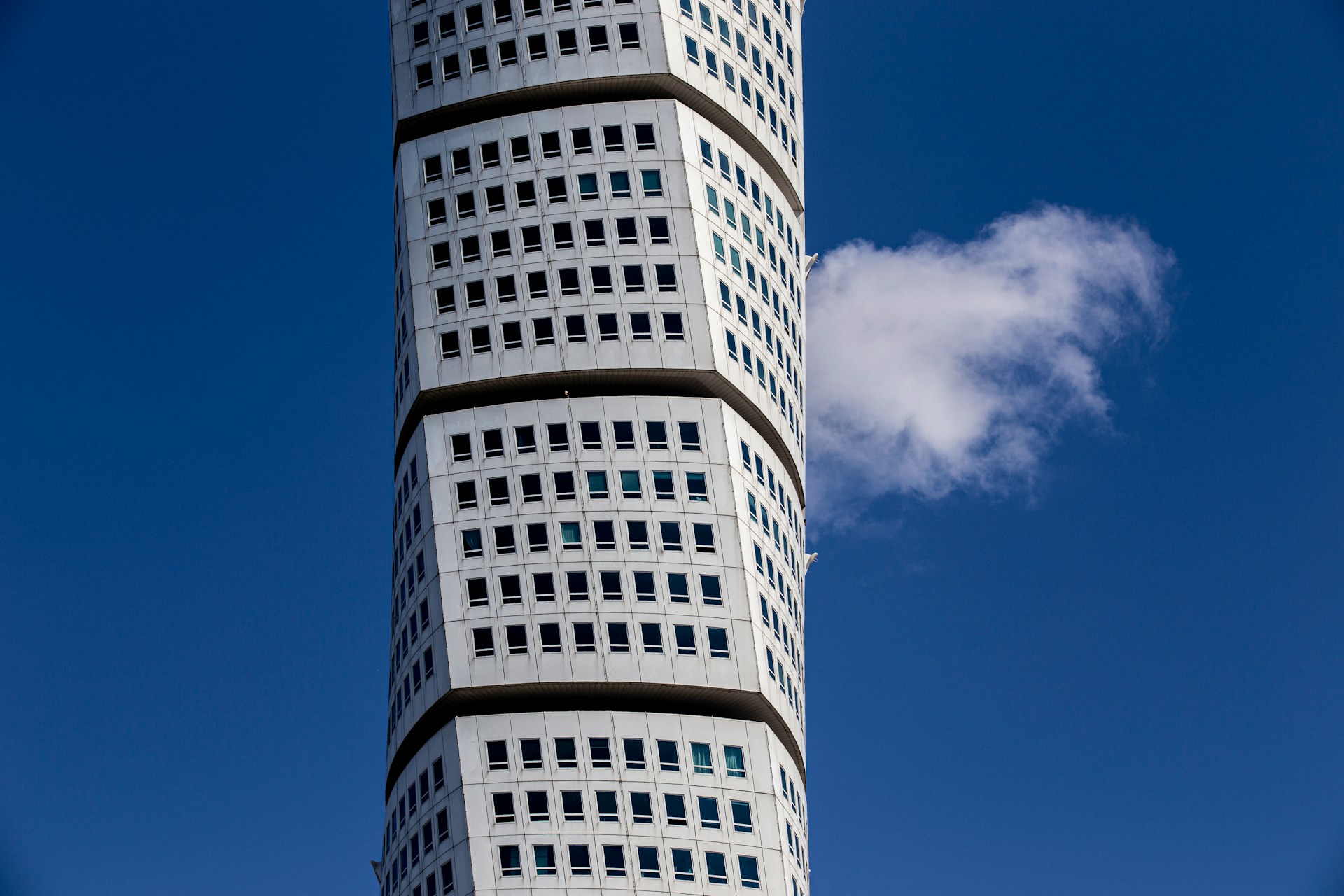
Engineering-wise, the building functions like a precisely tuned mechanism. The reinforced concrete core, the external steel skeleton, and the system of connections between the segments work together to control the forces of wind, torsion, and vibration. Turning Torso doesn’t stand „in spite” of its form—it stands because of it, proving that radical geometry can be the logical outcome of structural discipline, not its negation.
Turning Torso in Numbers
190 m
Architectural height of the towers
90°
Total twist from the base to the top floor
9
tower is composed of nine 5-story „cubes” stacked on top of each other
54
Total number of above-ground levels
15 m
Depth of the foundation piles driven into the limestone bedrock
10,6 m
he constant inner diameter of the concrete core (the building’s „spine”)
2,5 m
Thickness of the concrete core walls at the base (tapering to 40 cm at the top)
820 t
Weight of the external steel framework (the exoskeleton)
2 313
Number of curved aluminum panels used for the facade
30 cm
Maximum allowed sway at the top during a „100-year storm”
147
Number of luxury apartments located from the 3rd to the 9th segment
160 mln EUR
The final construction cost
What defines Turning Torso is not its rotation, but the way its structure turns a sculptural idea into an inhabitable system. By resolving torsion, wind loads, and vertical circulation within a continuously shifting geometry, the tower redefines how far high-rise architecture can depart from repetition without losing structural clarity.
Trivia
Rotation as a structural principle
Turning Torso was not designed as a visually twisted form, but as a structure that physically works in torsion. The rotation is embedded in the geometry of the entire load-bearing system rather than applied at the façade stage. This allows the building to remain stable despite the continuous change in floor orientation.
The core as a torsional spine
The central reinforced-concrete core acts as the primary element resisting torsional forces. It is not merely a circulation shaft but a key structural component of the building. Its wall thickness varies along the height to respond to increasing loads toward the base.
An exoskeleton with a real structural role
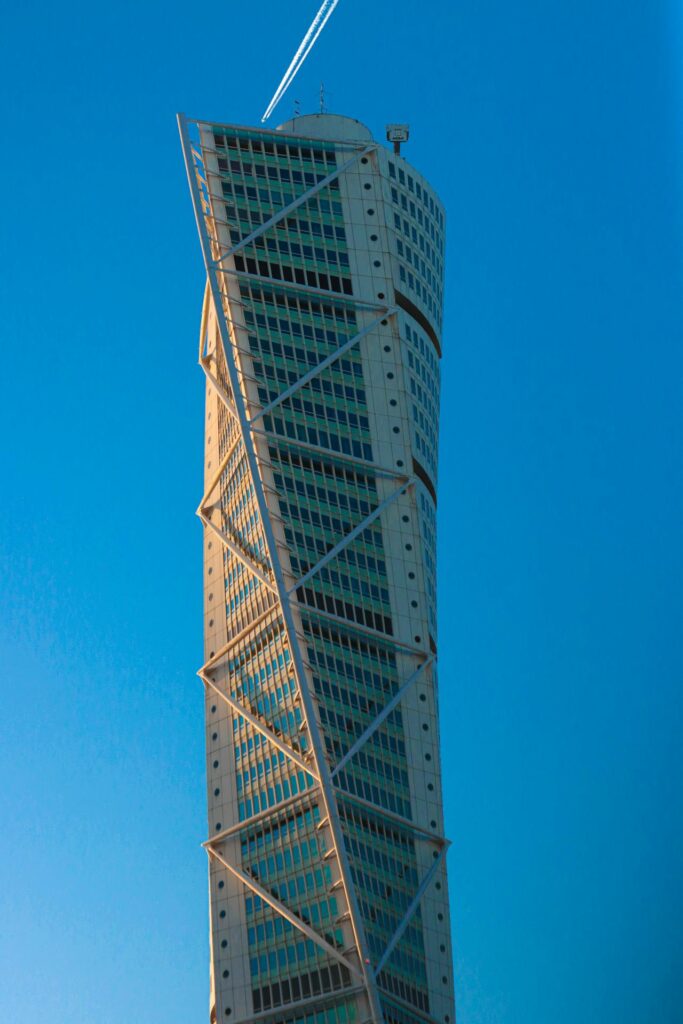
The external steel exoskeleton was designed as an active load-bearing system rather than an aesthetic gesture. It absorbs part of the horizontal wind loads and works together with the core to limit deformation. Without this system, the twisted geometry would not be structurally feasible.
Curvature achieved without curved glass
Although the façade appears fluid and curved, all glazing units are flat. The illusion of curvature is created by inclined frames and curved aluminum panels. This strategy significantly simplified fabrication while preserving the sculptural effect.
Inspired by a Human Spine
The design isn’t just abstract art. Santiago Calatrava based the tower on his own sculpture, Twisting Torso, which mimics the segments of a human spine in a twisted position.
Food Waste to Fuel
Every apartment is equipped with a food waste disposer in the kitchen sink. The organic waste is collected and converted into biogas, which is then used to fuel Malmö’s public city buses.
A Financial Gamble
The construction was so revolutionary that the costs skyrocketed by 100% over budget. The developer, HSB, actually had to sell other assets to ensure the project reached completion.
Navigational Beacon
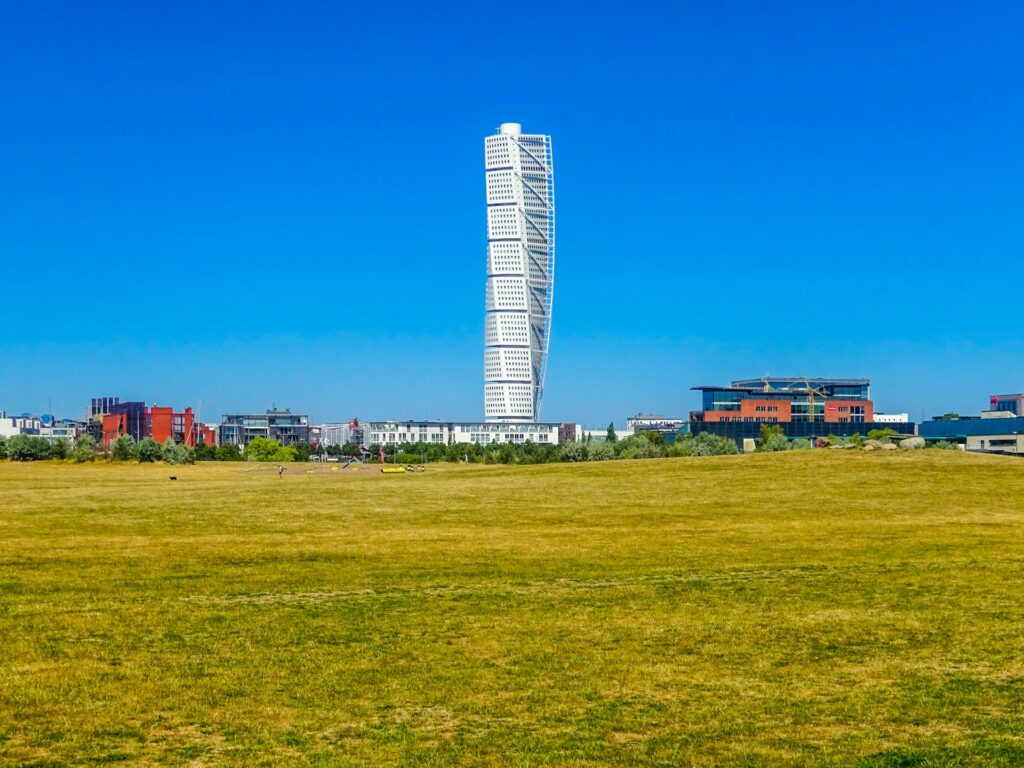
The tower is so tall and distinct that captains of ferries traveling between Malmö and Copenhagen use it as a primary visual landmark for navigation.
The Singing Tower
During extreme storms over the Öresund Strait, the external steel exoskeleton can produce a low-frequency „humming” or „singing” sound as the wind passes through the framework.
The „Twisted” Pioneer
Before the Turning Torso, the architectural world considered „twisted” skyscrapers to be structurally risky and impractical. Calatrava’s success sparked a global trend, leading to buildings like the Shanghai Tower
Seawater Cooling
The building is highly sustainable, using a system that circulates seawater and utilizes geothermal energy for heating and cooling, making it a pioneer in green high-rise living.
Architecture as a tool of urban transformation
The tower was built on the site of a former shipyard, an area historically associated with heavy industry. Its construction marked a symbolic shift in Malmö’s economic and urban identity. The building became a catalyst for the redevelopment of the Västra Hamnen district.