
The Engineered Icon of Singapore: Marina Bay Sands and “the Ship on Top”
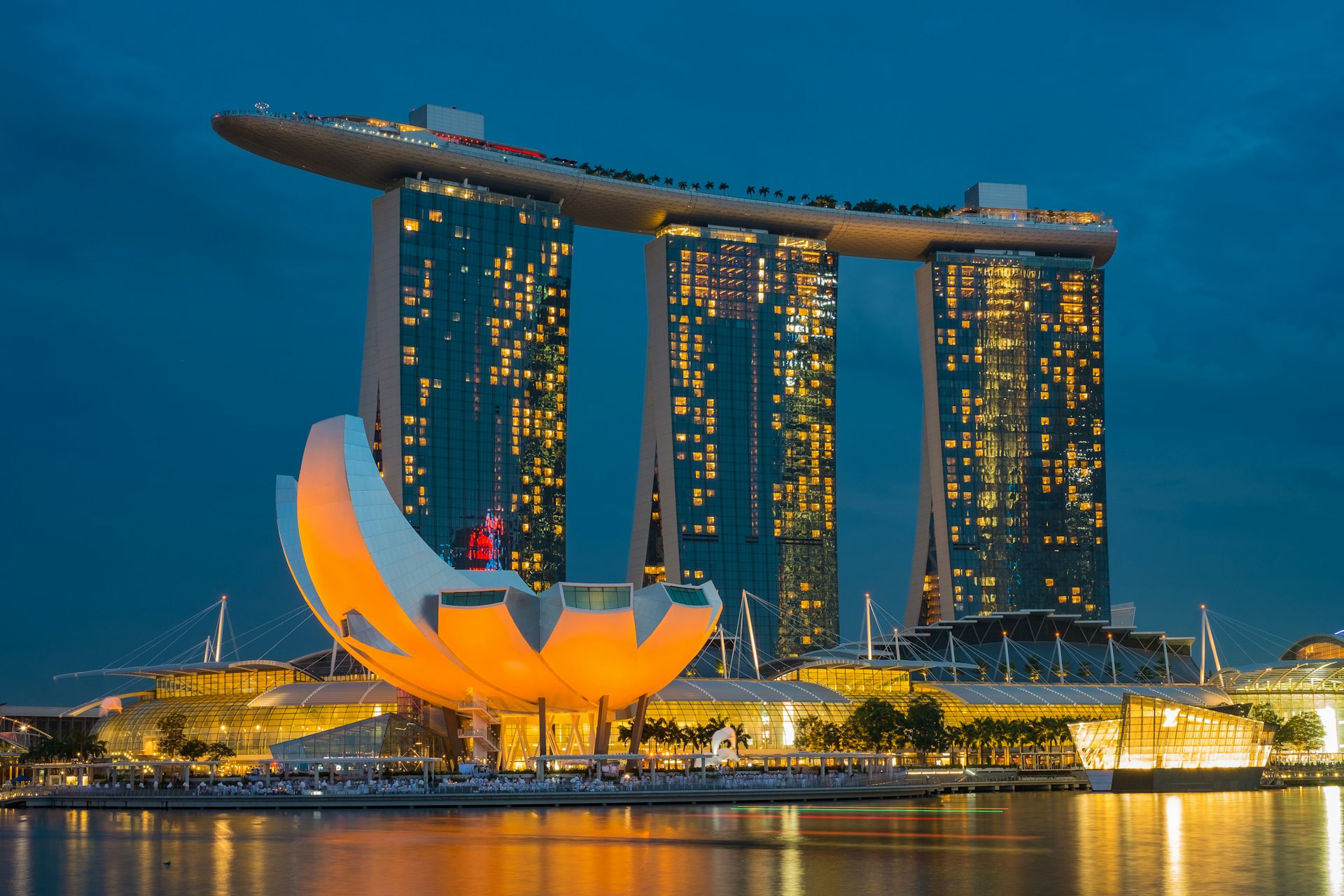
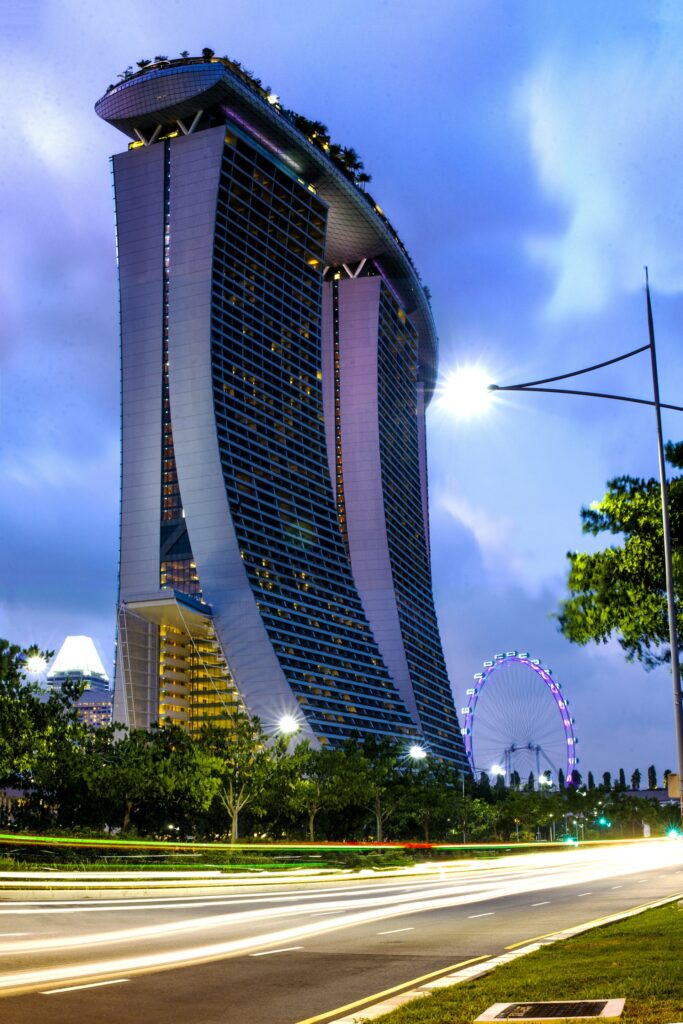
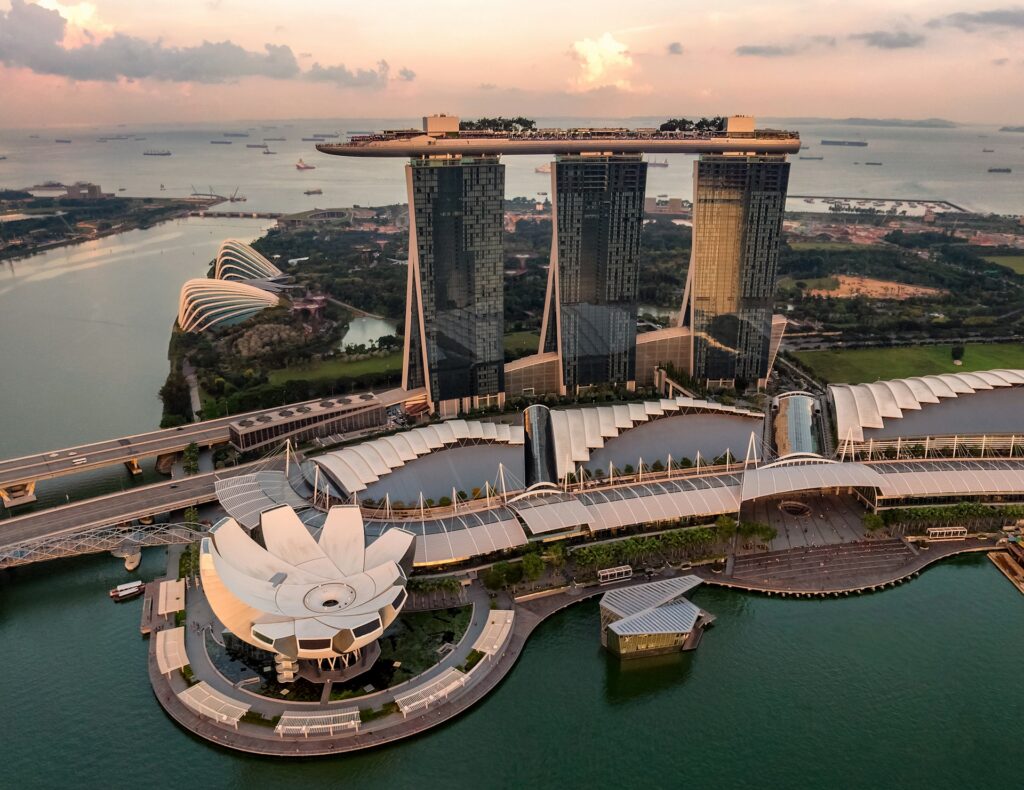
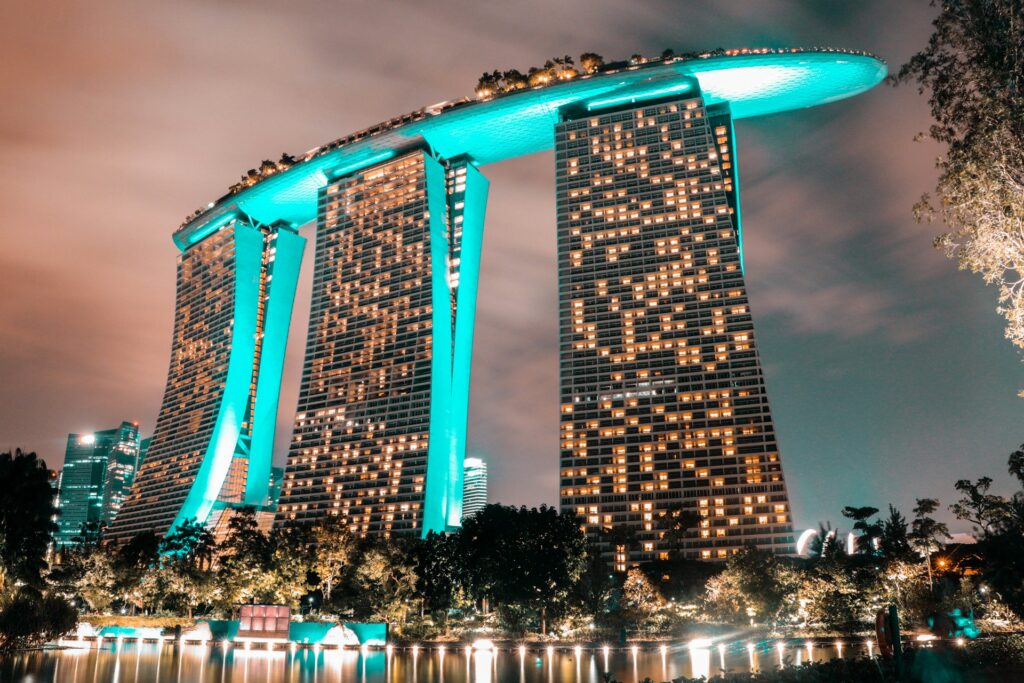
Marina Bay Sands is a project that transcends the traditional concept of a building. Designed as an integrated resort, it combines hotel, entertainment, retail, and cultural functions within a single structure, creating a self-sufficient urban fragment nestled above Marina Bay. The three slender, 55-story towers are not an end in themselves—they support a much more radical idea: a public platform suspended 200 meters above the ground, unifying the entire structure into a single, clear form.
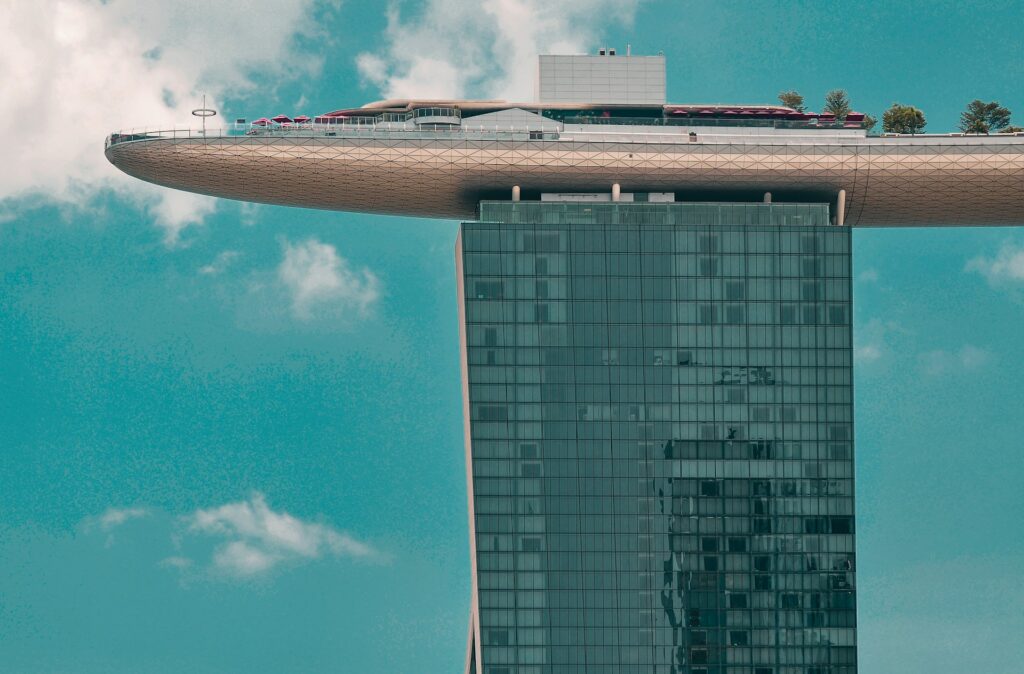
The building’s architecture operates on a scale that deliberately exceeds human perception. Stretching over 300 meters, SkyPark acts as a horizontal skyscraper perched atop vertical structures, balancing between sculpture and engineering feat. It is here that the complex’s most iconic feature—the infinity pool—is located, a visual shorthand for Singapore as a whole: a city built on ambition, control, and spectacle.
Marina Bay Sands does not passively fit into the existing urban context. On the contrary, it was designed as a dominant feature, a point of reference, and a global marketing tool. Its form organizes the cityscape, encloses viewing axes, and redefines the skyline, becoming a contemporary equivalent of monumental, representative buildings familiar from history but filtered through the language of the 21st century.
This architecture doesn’t tell the story of a place, but creates a new narrative—about the power of capital, the possibilities of technology, and the city as a product designed to be viewed, photographed, and consumed. Marina Bay Sands is both a symbol of Singapore’s success and a manifestation of a new type of megastructure: one that doesn’t serve a single purpose, but rather absorbs the entire spectrum of urban life into a single, extremely condensed form.
Although Marina Bay Sands is officially one of Singapore’s greatest architectural icons, in the vernacular of its residents, it functions much more simply. It is most often called „the hotel with the boat on top” or simply „the ship”—a shorthand that aptly captures the scale of the SkyPark suspended above its three towers. This local distance does not diminish the importance of the building, but shows how quickly monumental architecture was tamed and absorbed into the everyday language of the city.
Marina Bay Sands Singapure in Numbers
206,9 m
Architectural height of the towers
3
Hotel towers forming the main structure
191 m
Height of the infinity pool above ground level
57
Number of levels at which the SkyPark is located
12,400 m²
Surface area of the SkyPark
340 m
Total length of the Sands SkyPark
18 185
Number of glass panels on the facade of all three towers
2 561
Official number of hotel rooms at the time of opening
146 m
The exact length of the water surface in the Infinity Pool
3
The pool is not one unit; it is 3 separate basins connected by movable expansion joints so that the towers can move independently
65 m
The length of the cantilever extending beyond Tower 3. It is the largest structure of its kind in the world.
5,5 billion $
The actual cost of purchasing the license and construction itself
What’s most intriguing about this building isn’t its height, but the structural logic that enables a 340-metre-long SkyPark to span three independent towers while accommodating their differential movement. Marina Bay Sands transforms the skyline into an elevated infrastructural layer, redefining how public space can operate within high-rise architecture.
Engineering on Unstable Ground: The Structural Logic of Marina Bay Sands
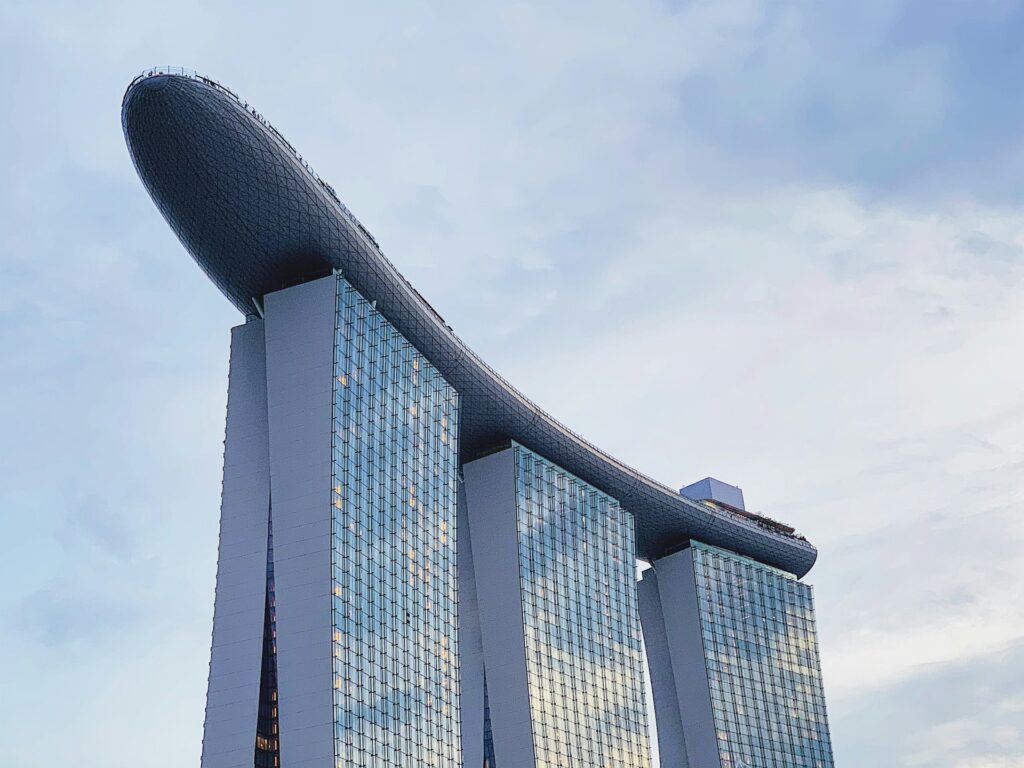
The architecture of Marina Bay Sands is a precise mathematical equation, requiring each of the 250 000 cubic meters of poured concrete to withstand extreme physical forces. The foundation for its success lay in taming the unstable subsoil on land reclaimed from the sea, where the soft marine clay layer in the bay and surrounding areas reached depths of up to 120 meters. To facilitate construction, engineers excavated a trench 1,2 kilometers in circumference, creating an underground groundwater barrier, and then set each of the three towers on a system of piles up to 2,5 meters in diameter, driven deep into the subsoil. However, the geotechnical challenges were only a prelude to the difficulties posed by the structure, whose legs are inclined at a 26,5-degree angle. This deflection, nearly seven times greater than that of the Leaning Tower of Pisa, generated enormous forces, which were counteracted by tensioning steel cables with thousands of tons of force during the concrete prestressing process.
A true display of engineering skill occurred at a height of 200 meters, where three independent towers were connected by the 340-meter-long Sands SkyPark platform. This 16 000-ton structure was erected using hydraulic jacks with a precision of 2 millimeters, a clockwork operation considering the scale of the 700-ton structure. However, the roof is not rigidly attached to the buildings; a bearing system was used, allowing the towers to independently swing up to 500 millimeters under wind pressure. The same mechanism had to be implemented in the infinity pool, which has a water surface length of exactly 146 meters. To prevent the pool from cracking, the pool was divided into three sections connected by movable joints that compensate for the movements of the towers, holding 1,4 million liters of water inside.
Complementing this phenomenon is a cantilever that extends 66,5 meters beyond Tower 3, making it the largest structure of its kind in the world. The entire construction operation required 56 000 tons of reinforcing steel, as well as logistics to support the façade, which consists of 18 185 glass panels. The project, which ultimately cost approximately $5,5 billion, demonstrates that with the proper application of statics, it is possible to create a structure with a usable area of 800,000 square meters that, despite its monumental mass, appears to float lightly above Singapore.
Economic Gravity: How Marina Bay Sands Turned Risk into Numbers
The economic foundation of Marina Bay Sands represents one of the most financially risky—and ultimately most profitable—investments in contemporary architecture. Completed in 2010, the megacomplex required a total capital outlay US$5.5–5.7 billion, making it the most expensive single casino resort ever built. A substantial portion of this figure was not structural cost alone, but land-use rights and casino licensing fees, which exceeded S$1 billion. The site itself occupies roughly 20 hectares of reclaimed land in Marina Bay, further elevating the project’s financial threshold.
The timing of the investment amplified the risk. Las Vegas Sands entered the critical construction phase during the 2008–2009 global financial crisis, a period marked by severe liquidity constraints across the gaming and hospitality sector. At its peak, the project represented one of the largest single capital commitments in the company’s history, pushing the group’s balance sheet to its limits before the resort generated any operational revenue.
From a profitability standpoint, the outcome proved exceptional. In peak years, Marina Bay Sands has generated annual EBITDA exceeding US$1.5 billion, placing it among the most profitable individual buildings in the world. At this level of performance, the original investment was effectively recovered within a timeframe significantly shorter than a decade, an extraordinary result for an asset with an initial cost exceeding US$5.5 billion. Crucially, the hotel component—comprising approximately 1,850 rooms and suites—is not the primary profit engine. Instead, the casino, occupying only a small fraction of the total gross floor area, accounts for approximately 60–70% of operating profit.
The economic model relies on carefully engineered footfall. The complex attracts 18–20 million visitors annually, translating into an average daily flow of 45 000–55 000 people. Many of these visitors engage primarily with publicly accessible features—such as the SkyPark, waterfront promenade, and multimedia light shows—which function as low-cost attractors. Monetization occurs downstream, through the casino and the luxury retail mall, The Shoppes at Marina Bay Sands, where retail turnover per square meter ranks among the highest in Southeast Asia.
Marina Bay Sands has now entered a new phase of capital expansion. An announced development program valued at approximately US$8 billion includes the construction of a fourth tower, accommodating around 1,000 luxury hotel units, alongside a new entertainment arena with a capacity of approximately 15,000 seats. The scale of this reinvestment reflects the resort’s position as the most stable and profitable single asset in the Las Vegas Sands portfolio, outperforming properties in Las Vegas and delivering more predictable cash flows than resorts in Macau.
At a macroeconomic level, the project’s impact extends well beyond the balance sheet of its owner. Government estimates suggest that Marina Bay Sands contributes up to around 1,2% of Singapore’s annual GDP, while supporting more than 10,000 jobs directly and indirectly. In this sense, the complex operates not merely as a building or destination, but as an economic infrastructure—an architectural mechanism capable of converting tourism, entertainment, and gaming into sustained national value.
Trivia
Inspired by Card Decks
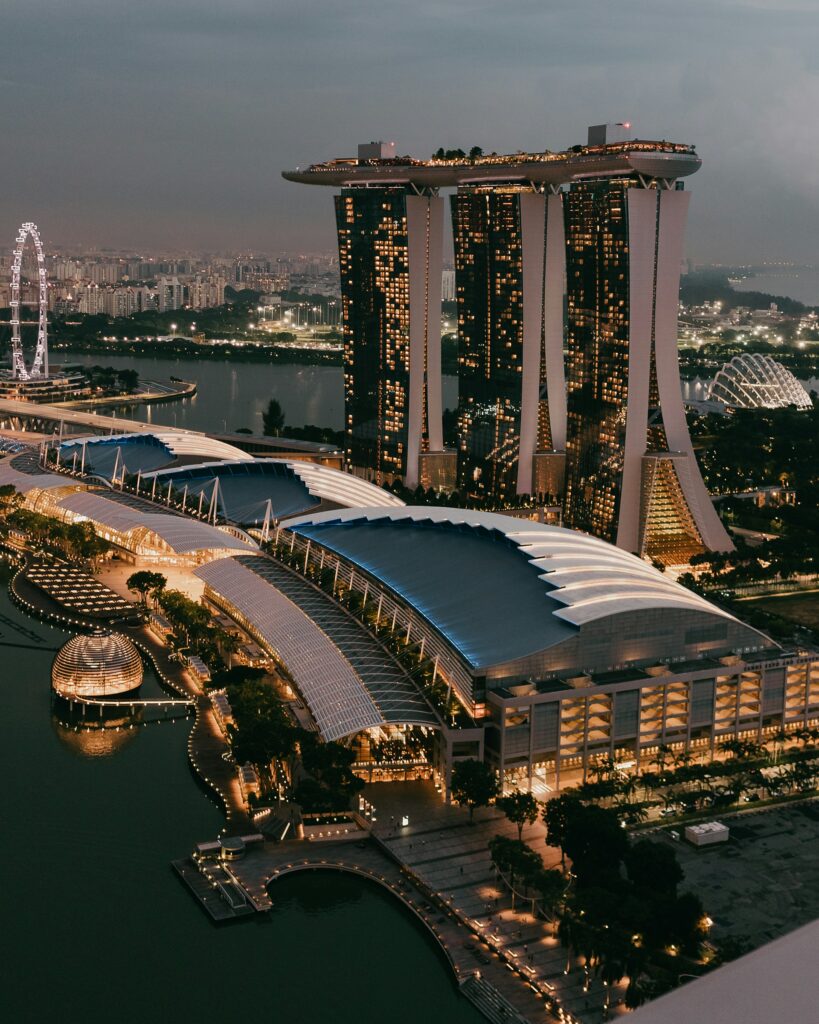
Architect Moshe Safdie designed the three towers to resemble decks of playing cards spread across a table. This design was intended to symbolize fortune and gaming, directly referencing the massive casino located within. Today, this structure stands as the most recognizable landmark in the Singapore skyline.
Principles of Feng Shui
The entire complex was constructed according to strict guidance from Feng Shui masters to ensure the flow of positive energy. The three towers resemble Chinese symbols of prosperity, while the ArtScience Museum is shaped like a hand welcoming wealth. Even the nearby Ferris wheel rotates toward the hotel to „gather” money into the building.
A Building That Became a National Logo
Marina Bay Sands appears on tourism campaigns, currency imagery, and global media more often than any other building in Singapore. In less than 15 years, it has eclipsed colonial landmarks as the country’s most recognizable architectural symbol.
Three Towers That Are Not Structurally United
Despite appearing as a single object, the three towers are structurally independent. They are allowed to move separately by hundreds of millimeters under wind and thermal loads without transferring stress between them.
Private Rooftop Jungle
The SkyPark gardens are home to over 250 species of trees and hundreds of other tropical plants. They create a unique microclimate and provide natural shade for guests relaxing 200 meters up. This lush greenery is meticulously maintained by a large team of gardeners who work mostly at night.
Laser Lighthouse
Every evening, powerful laser beams are emitted from the roof of the hotel during the „Spectra” light show. These lights are so strong that they can be seen from many kilometers away across the city. They serve as a modern symbol of Singapore, guiding tourists toward the heart of Marina Bay.
The Rain-Collecting Museum
The ArtScience Museum, shaped like a lotus flower, functions as a giant rainwater harvesting tank. Rainwater flows through a central opening in the roof, creating a dramatic indoor waterfall within the galleries. This water is later filtered and recycled for use in the building’s plumbing system.
Gaming Levy for Locals
Singapore introduced a special entry fee for the casino that applies only to citizens and permanent residents. It costs 150 SGD per day and is intended to discourage locals from developing gambling debts. Foreign tourists can enter for free simply by presenting their passports at the entrance.
The Hotel with the Ship on Top
Locals rarely use the official name. In everyday Singaporean English, the complex is simply “the hotel with the boat” or “the ship”—a pragmatic nickname that reflects how instantly legible the SkyPark is in the skyline.
Noah’s Ark for the Wealthy
One of the most persistent jokes is that when sea levels finally rise, only Singapore’s elite will escape aboard this “ark” waiting on the roof. The irony is hard to miss: a monumental structure built on reclaimed land, imagined as the last refuge above the waterline.
The Ironing Board
Less poetic but equally popular is the nickname “The Ironing Board.” Locals joke that a giant housekeeper casually left her board balanced on three columns, an everyday metaphor applied to one of the most expensive buildings ever constructed.
Feng Shui and the Direction of Wealth
According to local Feng Shui interpretations, the SkyPark is oriented toward the sea to “pull” prosperity from the water and channel it directly into the casino below. Whether taken seriously or not, the myth reflects how architecture, superstition, and economics intertwine in the public imagination.