
CCTV Headquarters in Numbers – Engineering the Impossible
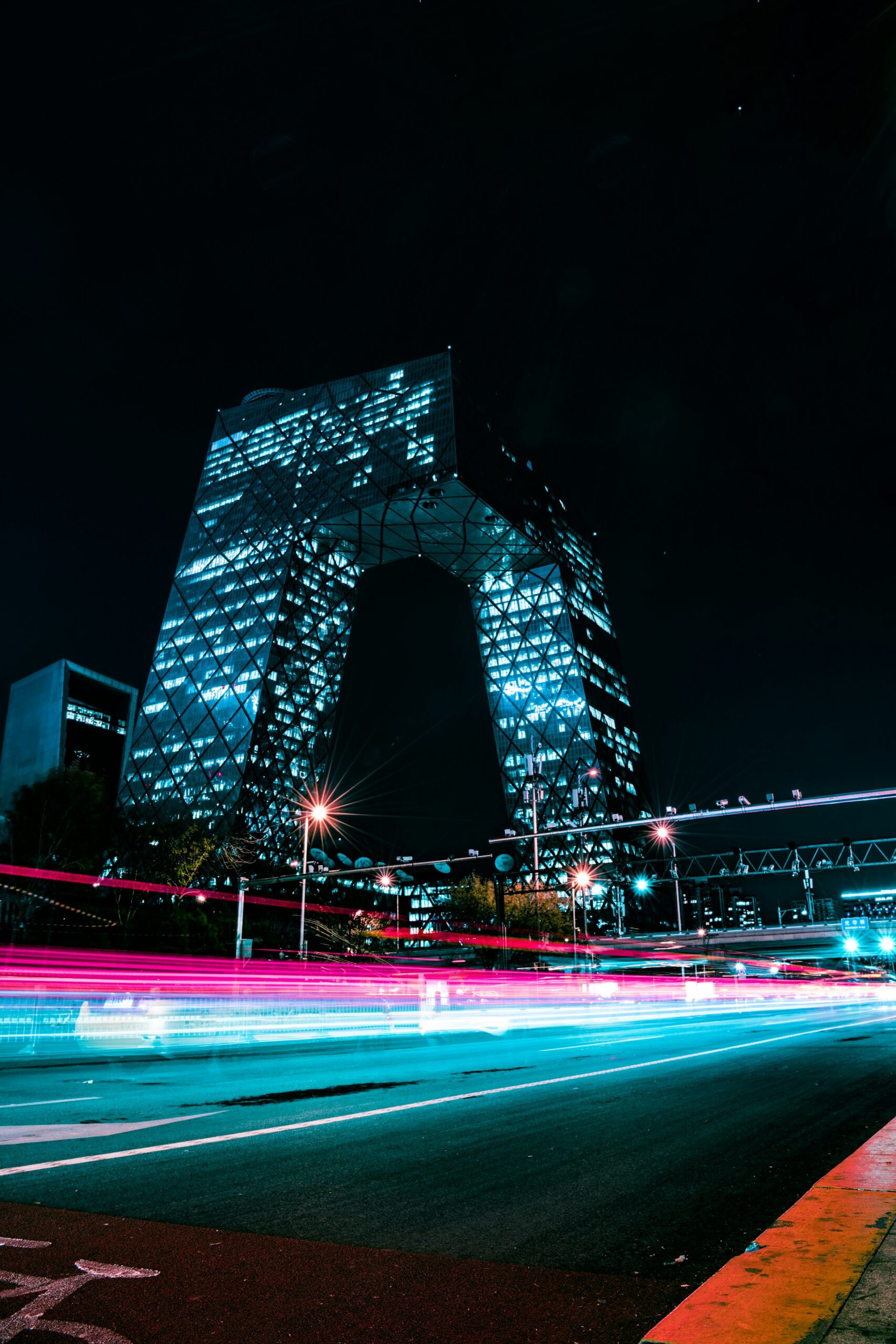
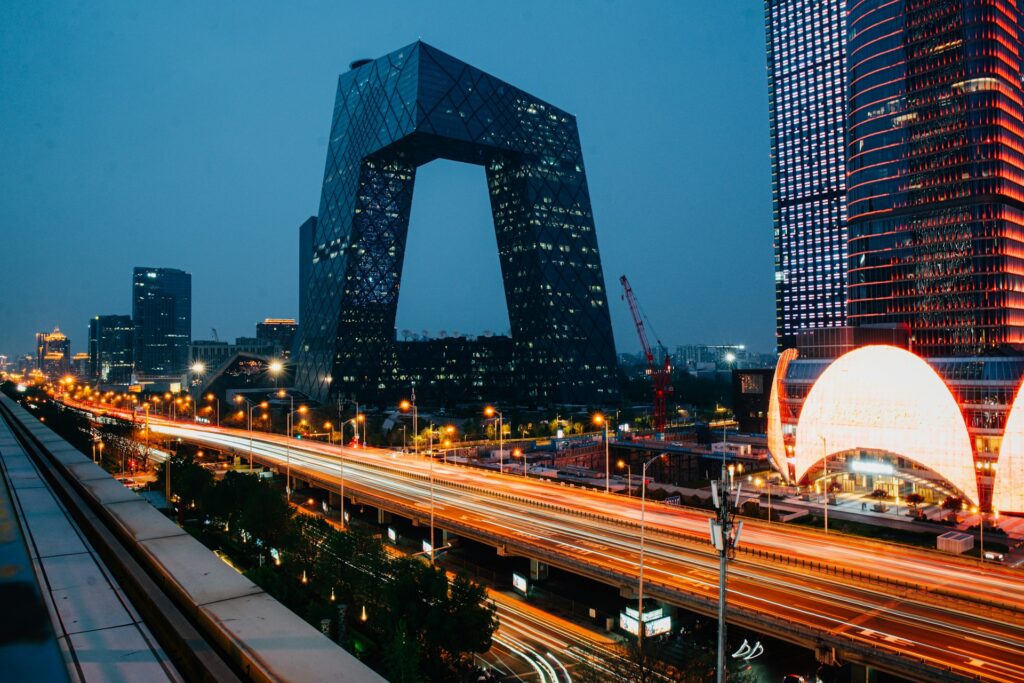
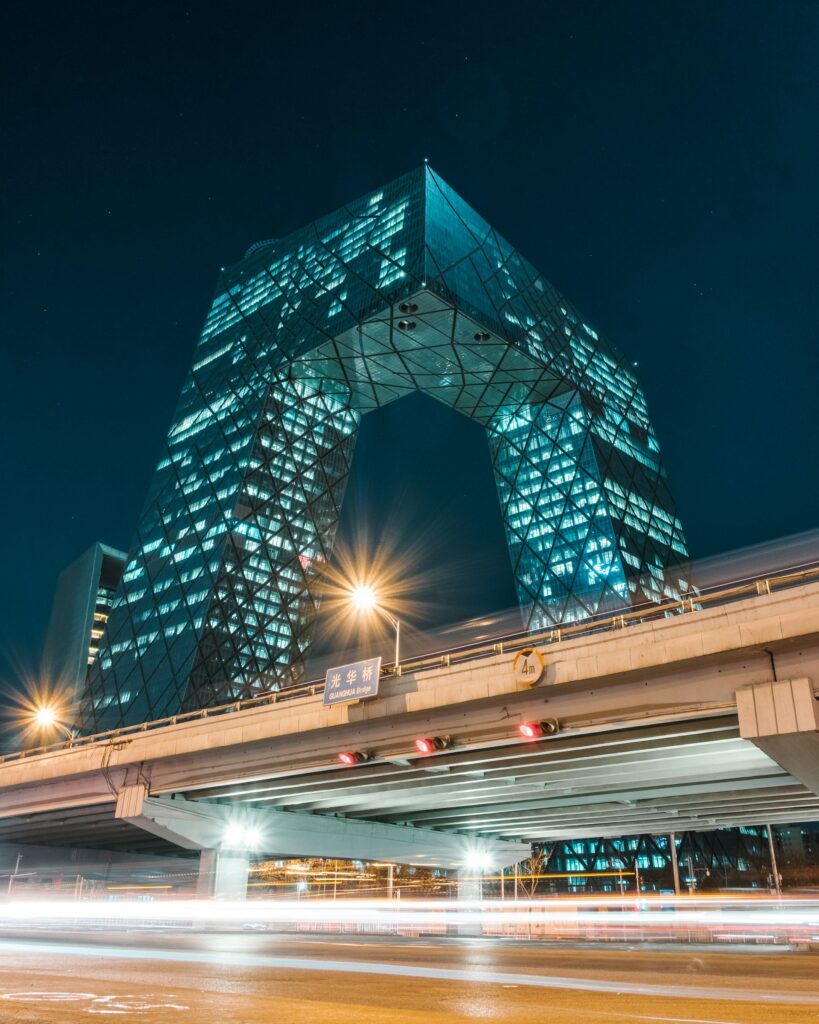
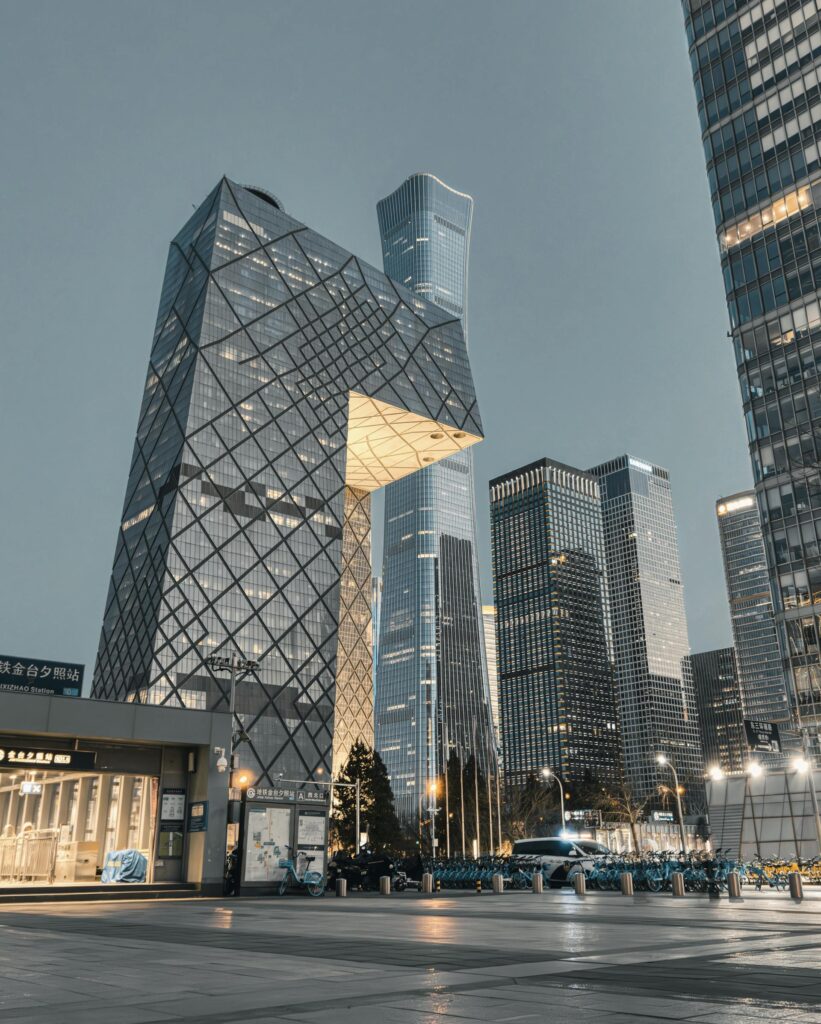
In a city shaped by velocity, density, and ambition, one building in Beijing continues to stand apart—not for its height, but for its form. The CCTV Headquarters is not the tallest tower in the skyline, but it may well be the boldest. At 234 meters, it resists the familiar vertical logic of the skyscraper. Instead of rising, it loops—tilting, bridging, and folding back into itself to form a continuous geometric ring suspended in space. It is a structure that feels simultaneously sculptural and functional, engineered and imagined.
Designed by the Office for Metropolitan Architecture (OMA) under Rem Koolhaas and Ole Scheeren, and structurally engineered by Arup, the project is a landmark of contemporary architecture—not because it follows expectations, but because it deliberately breaks them. The building is composed of two leaning towers, connected both at the base and again high above the ground by a 75-meter cantilevered skybridge, suspended 36 stories in the air. This design creates a single, massive, integrated loop of program and circulation. The result is a headquarters for China Central Television that embodies its function not just in name, but in spatial organization: an unbroken loop of media production, broadcasting, editing, and administration.
To realize this audacious form required pushing the limits of engineering. The entire building is supported by an external steel diagrid—a lattice of angular steel members that eliminates the need for internal columns. This allowed for open, adaptable interiors and gave the façade its distinctive crisscrossed appearance. Each element of the diagrid is unique: no two angles are the same, and every piece was custom-fabricated and placed. The two leaning towers were built separately, tilting toward one another, and then connected mid-air with millimetric precision—a moment that demanded not only computational accuracy, but also on-site mastery.
The numbers behind this achievement are staggering: over 125,000 tons of steel, 550,000 cubic meters of concrete, a floor area of 473,000 square meters, and foundations that reach 60 meters underground. The structure was analyzed using advanced non-linear finite element modeling, designed to resist seismic forces, dynamic wind loads, and the weight of its own asymmetrical geometry.
But beyond its physical metrics, the building resonates with symbolic and cultural depth—especially within the architectural traditions of China. In Chinese spatial philosophy, and particularly within the principles of feng shui, emptiness is not void—it is passage. In many high-rise buildings across East Asia, we observe dramatic openings or voids—what might be seen in the West as ‘holes in buildings’—but which in Chinese thought represent channels for energy, wind, and movement. These voids are sometimes referred to as dragon gates, allowing mythical energy to pass uninterrupted through the structure.
This philosophy holds that the built environment should not obstruct natural flows. Thus, an opening becomes more than a design gesture—it becomes a harmonizing element, a means of aligning a building with its landscape and purpose. While the CCTV Headquarters does not feature a literal hole piercing its center, its entire form is structured around a vast, open negative space. It frames the city rather than standing apart from it. It welcomes light, air, and movement, reinforcing the idea that form is not just mass—it is relationship.
Here, the idea of architecture as monolithic is inverted. The CCTV Headquarters is not a tower of dominance, but a structure of interdependence. Its looped geometry challenges the traditional hierarchy of base, shaft, and crown, and in doing so, it asks new questions about what a tall building can be. It is a gateway and a frame, a conduit and a symbol—designed not only to be seen, but to see through.
As Rem Koolhaas remarked, this building represents a reinvention of the skyscraper as “a collective and dynamic volume,” not a static extrusion of floors. In this way, the CCTV Headquarters becomes more than a headquarters. It becomes an exploration of how architecture can express process, purpose, and philosophy—all through the calculated bending of steel.
In the sections that follow, we will dissect the numbers, trace the construction, and explore the deeper meanings—structural, spatial, and cultural—that have made the CCTV Headquarters one of the most significant architectural works of the 21st century.
CCTV Headquarters in Numbers
234 m
Total height
6°
The angle of inclination of both towers
75 m
Horizontal reach of the cantilever
75
Elevators
473 000 m²
Total usable area of the entire complex
>100 000 m²
Facade area
125,000 t
Total weight of structural steel
850 mln – 1,2 mld USD
Estimated construction cost (figures vary depending on the inclusion of supporting infrastructure and repair costs following the TVCC fire)
41 882
Number of steel elements
13
Number of cantilever floors
10 000
Number of workers the building can accommodate
1242
Number of piles
What’s most intriguing about the CCTV Headquarters isn’t its size, but how it shapes the space around it. Instead of occupying land, it frames it—creating a void that becomes part of the city. More than a building, it’s a spatial gesture: open, dynamic, and inseparable from Beijing’s urban rhythm.
The Diagrid Facade as a Structure and Architectural Narrative
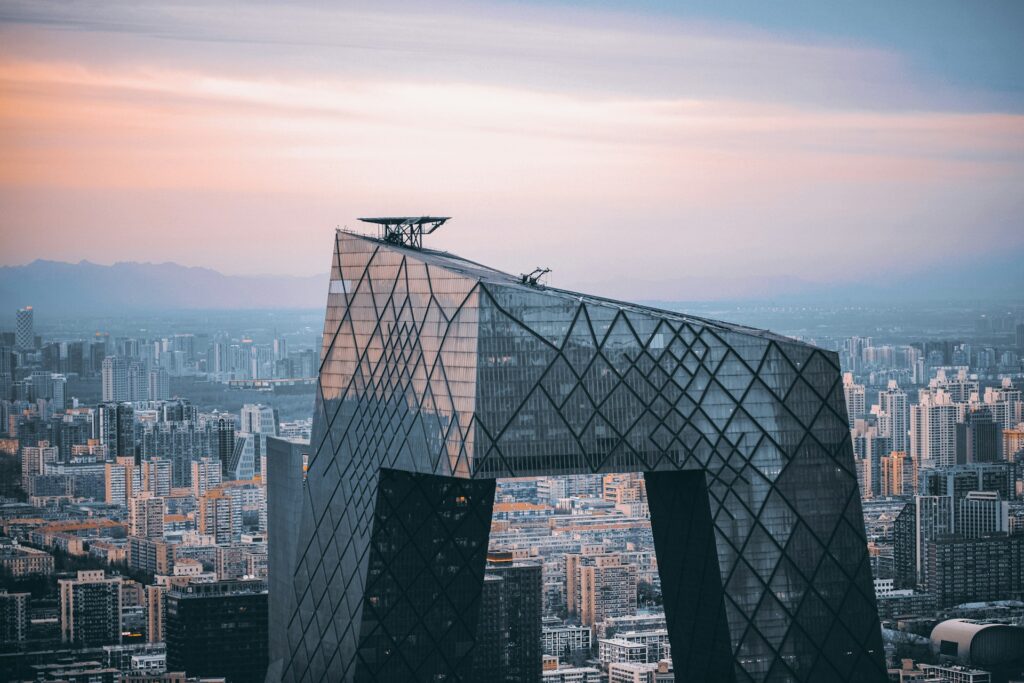
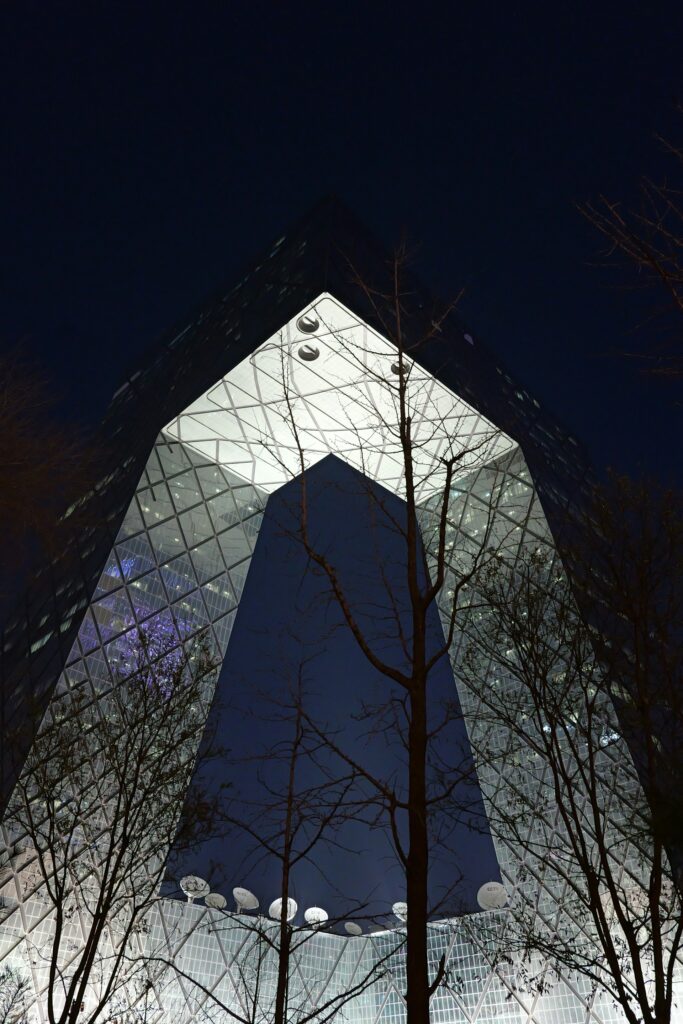
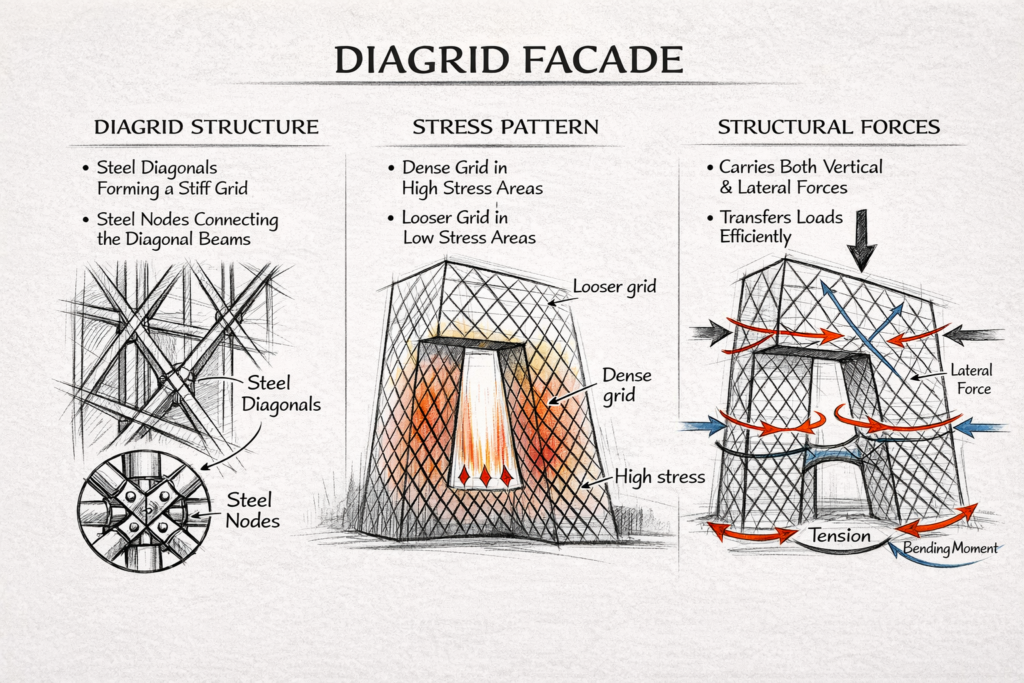
The diagrid façade at CCTV Headquarters represents one of the most radical departures from the traditional understanding of a façade in contemporary architecture. Instead of serving as a shield or decorative envelope, it takes on the role of the building’s primary load-bearing system, simultaneously becoming a record of the structure’s operation. In this building, there is no traditional division between structure and façade – both elements are combined into a single cohesive entity, where geometry stems directly from loads, and form is a consequence of statics.
The diagrid, or diagonal load-bearing grid, is based on an arrangement of diagonal steel elements forming triangular and rhomboidal fields. This system allows for exceptionally efficient transfer of horizontal forces, such as wind and seismic loads, while simultaneously reducing the number of traditional vertical columns. At CCTV Headquarters, this solution was used on an unprecedented scale, as the entire building mass—including the distinctive cantilever connecting the two leaning towers—relies for its stability on the facade.
A distinctive feature of the CCTV diagrid is its variable geometry. The grid has no fixed module, and its density and inclination angles vary depending on local stresses. In areas where the greatest bending moments accumulate, especially in the cantilever area, the façade elements become denser and more massive. Where the loads are lower, the structure becomes sparser. As a result, the façade functions as a three-dimensional static diagram, which can be „read” as a visual record of the forces acting on the building.
A key element of this system are the nodes connecting the individual diagrid members. Each one was individually designed to withstand a unique combination of compression, tension, and shear forces. It is these nodes, not the steel members themselves, that pose the greatest engineering and construction challenges. Their precision determines not only the structural safety but also the clarity of the architectural form.
A crucial aspect of the diagrid façade at CCTV Headquarters is its relationship with the interior space. The structure is not hidden behind layers of finishing, but remains visible from the interior in many places. This allows building users to directly interact with the load-bearing elements, enhancing their awareness of the structure and lending the architecture an educational dimension. The building does not mask its functioning—on the contrary, it highlights it as an integral part of its identity.
The significance of the diagrid façade at CCTV Headquarters extends beyond the building itself. This building has become a benchmark for contemporary high-rise architecture, demonstrating that a façade can assume the role of a primary structural system without losing its clarity and expressiveness. It also demonstrates that complex form does not have to result from arbitrary aesthetic decisions but can be the logical result of calculations and engineering precision.
Trivia
Glass Floor Panels
The cantilever features glass floor sections at 160 meters high, offering a terrifying vertical view of the street directly below.
The Burning Neighbor
In 2009, the adjacent TVCC building was gutted by a fire caused by illegal fireworks, delaying the complex’s opening by years.
Stress Mapping
The irregular „diagrid” pattern on the facade isn’t decorative; it’s a visual representation of where the building carries the most weight.
Big Underwear
Locals quickly nicknamed the building “Dà Kùchǎ” (Big Underwear) due to its shape, a name that has since become a global fun fact.
No Top
Architect Rem Koolhaas wanted to break the trend of „pointing to the sky,” creating a loop that symbolizes a continuous flow of information.
Internal Fire Brigade
Due to its unique shape, the building houses its own dedicated fire station and specialized response team 24/7.
Logistical Maze
The interior is designed so that staff and public visitors can move through the „loop” without ever interrupting live broadcasts.
Construction Timeline
The entire construction process took 8 years to complete, starting with the ground-breaking in 2004 and reaching official completion in 2012.
Acoustic Precision
The news studios are suspended within the steel frame on special vibration-isolation mounts to prevent the vibration of the elevators from being picked up by sensitive microphones.
Thermal Movement
On a hot day, the tips of the two towers can move several centimeters apart due to the sun’s heat before they were permanently locked together.
Waterless Cooling
To protect millions of dollars in electronics, the data centers use air-based VAV systems to avoid any risk of water leaks.
Every Panel Is Unique
There is no repeatable module on the façade. Each panel and each node was individually designed. This is one of the reasons for the immense complexity of the project.