
A brief description of Thomas Klumpp’s futuristic vision
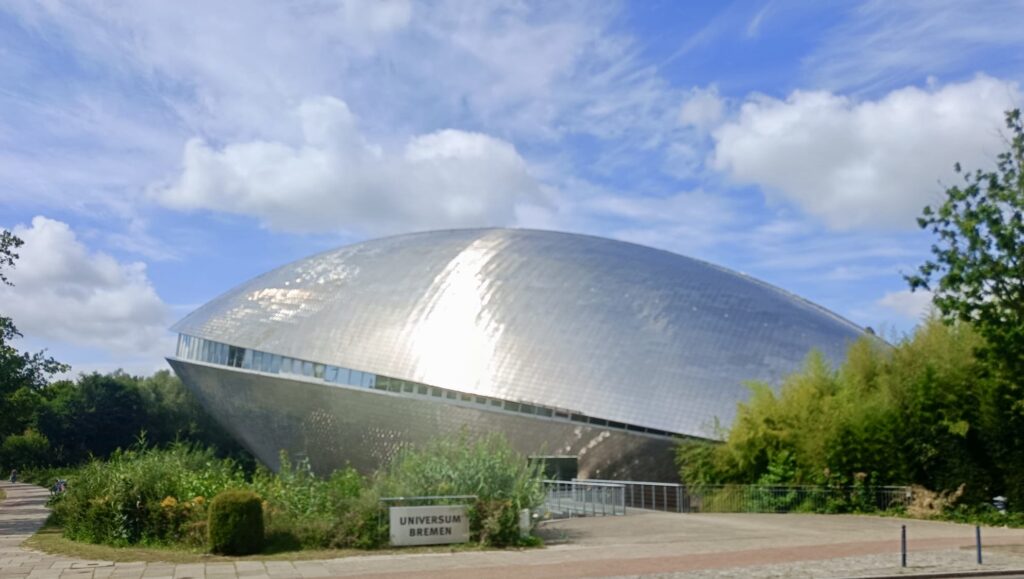
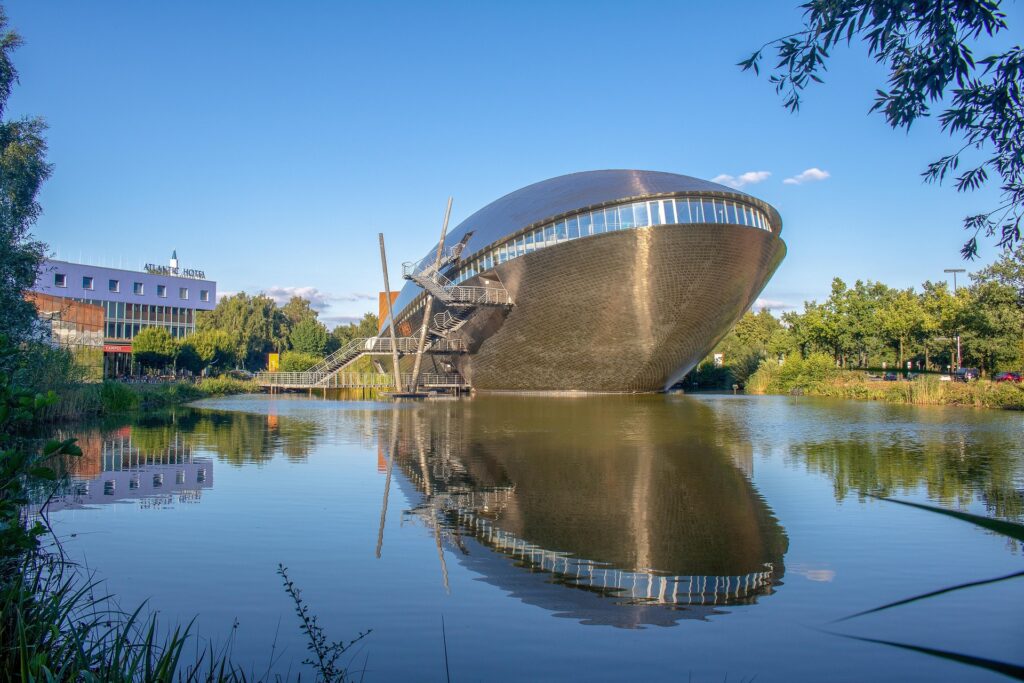
Universum Bremen is one of the most recognizable science centers in Europe, located in the northern part of Bremen. The building combines educational functions with distinctive, almost futuristic architecture, which has become an icon of the city in its own right. This is a project in which the architecture is designed as an integral part of the cognitive experience. The building not only houses science—it is itself a tool for narrating science, technology, and perception.
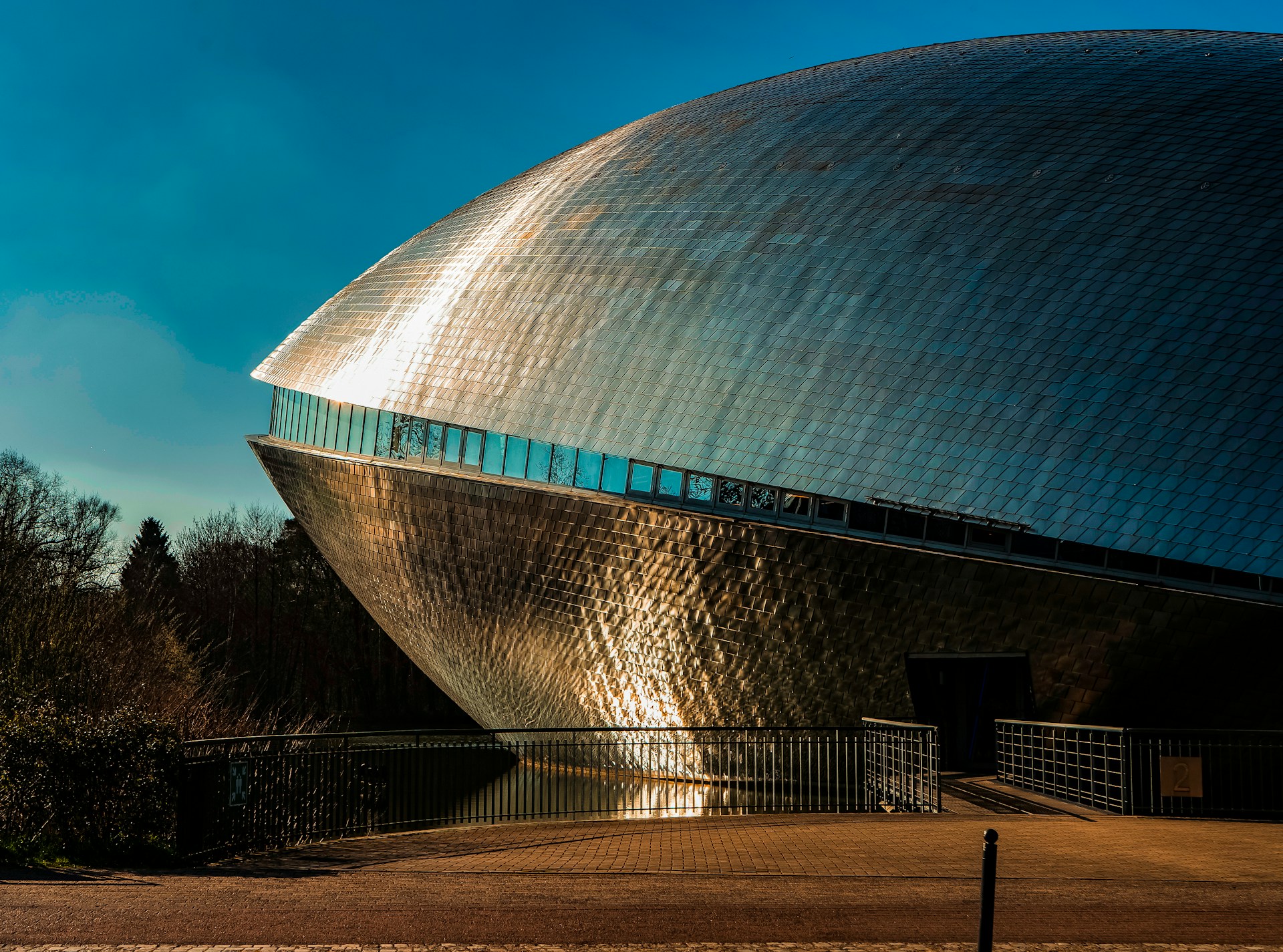
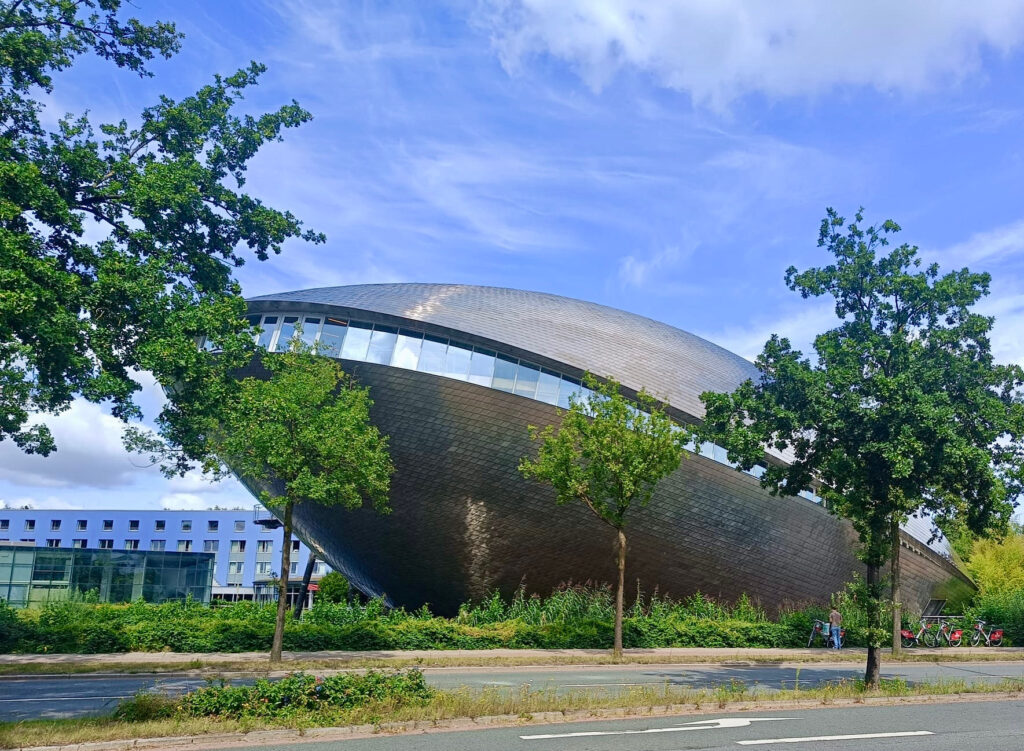
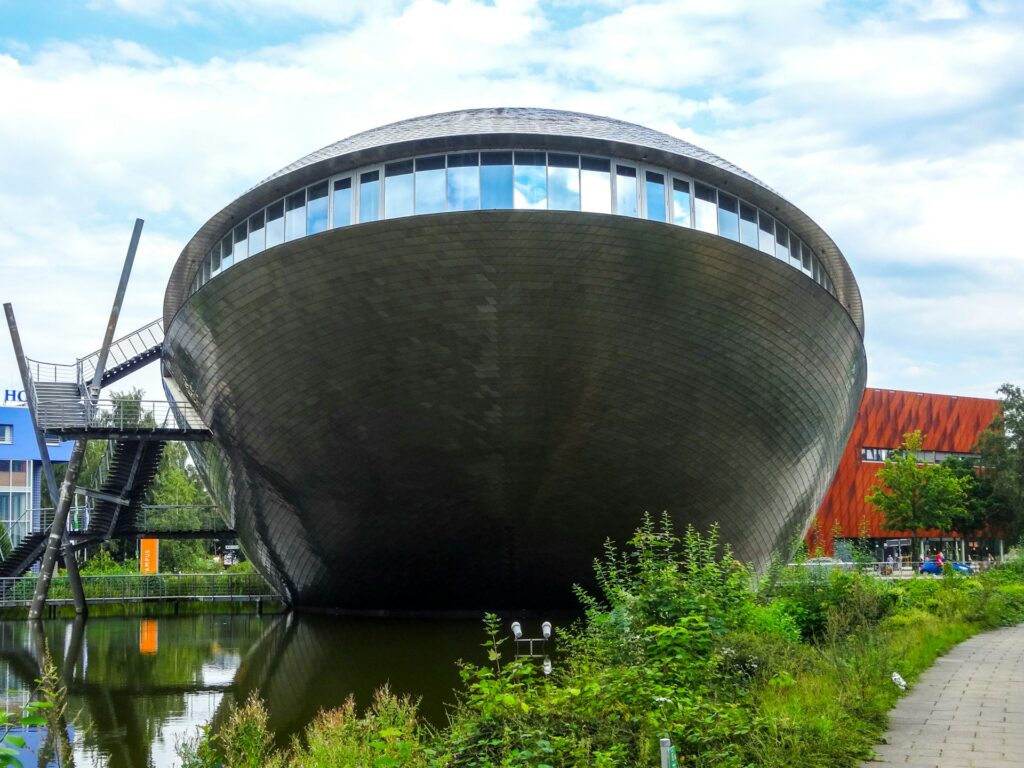
The Universum Bremen building was designed as an organic, irregular volume, devoid of classical axes of symmetry and a clearly legible „front.” This deliberately breaks with the traditional perception of educational institutions as formal and static objects.From an urban planning perspective, Universum acts as an independent sculpture in the landscape, visually detached from the typical campus buildings of Bremen.
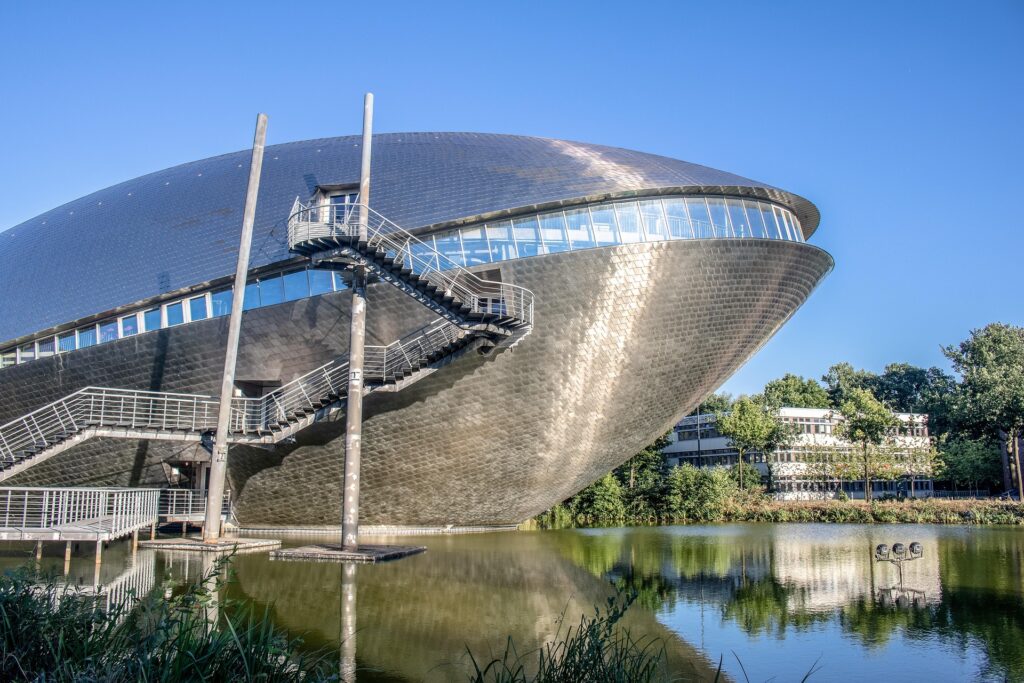
The building’s façade is one of its most distinctive elements. It consists of tens of thousands of scale-like steel panels, each subtly varying in shape and angle, installed in a repetitive yet heterogeneous rhythm, creating a „living skin” effect that reacts to light. It’s a classic example of a parametric façade, though designed before the term became common. Each panel is part of a larger system, in which the geometry, module, and number of repetitions directly influence the final visual effect. During the day, the façade reflects the sky, clouds, and surroundings, while at night—thanks to backlighting—the building transforms into an abstract, luminous form.
Silver Whale in Bremen: The Universe in Numbers
Although it looks like a futuristic whale from the outside, its interior houses a whole scientific microcosm – we check how many numbers are needed to enclose the Universe in one steel block
1
Dominant shape
0
Axis of symmetry
40 000
Stainless steel units
1 500 t
Steel supporting structure
101 m
Total length of the building
450 000
Average number of visitors per year
18.84 mln EUR
Cost of first phase
2000
Year of opening after 2 years of construction
What’s most interesting about this building isn’t a single number, but the way in which a repeating module has been used to create a complex form. It’s the scale and rhythm that determine its perception.
Panels in details
System description
The facade consists of a modular, mechanically fixed stainless steel cladding system composed of rhomboidal panels arranged in a scaled / shingle-like configuration, forming a continuous, non-planar building envelope with variable surface orientation.
The system is designed as a non-load-bearing rainscreen facade, visually continuous and geometrically adaptive to a double-curved primary building volume.
Panel geometry
Panel shape: Rhomboidal (diamond-shaped)
Nominal panel: dimensions: Width: approx. 400 mm Height: approx. 400 mm
Geometric variation:
Minor angular deviations between adjacent panels.
Panels are manufactured in mirrored variants (“Left” / “Right”)
Forming:
Cold-bent / press-formed
Double-curved geometry (two-directional bending)
Edge treatment:
Folded or stiffened edges to increase rigidity and dimensional stability
Material specification
Base material: Stainless steel sheet
Steel grade: Architectural-grade corrosion-resistant stainless steel
(exact grade project-specific; typically AISI 304 / 316 class)
Sheet thickness: approx. 1.0–2.0 mm
Surface finish:
Brushed / satin finish
Directional grain
Material properties:
High corrosion resistance High durability
High reflectivity with diffuse light scattering
Fixing and support system
Fixing method: Mechanical fixing
Fixing points: 4 fixing points per panel)
Fasteners: Stainless steel bolts / screws, Corrosion-resistant
Fixing visibility:
Hidden fixings, concealed behind panel edges
Panel attachment: Fixed to a secondary substructure
Substructure: Combination of steel framing and timber elements,
Adjustable brackets allowing tolerance compensation
Installation logic
Panels installed in a non-linear, overlapping visual sequence
Each panel overlaps adjacent elements visually, not structurally
Orientation alternates between “Left” and “Right” variants
Slight angular offsets introduced intentionally to:
break specular reflections,
enhance light modulation,
emphasize facade depth.
Environmental and performance aspects
Facade function: Rainscreen cladding
Weather protection layer
Drainage:
Open-joint logic behind panels
Water directed behind cladding layer
Ventilation: Cavity ventilation behind panels
Thermal behavior:
Thermal expansion accommodated by fixing tolerances
Maintenance:
Low-maintenance surface
Natural patina and minor surface variation acceptable by design
Quantitative data
Total number of panels: approx. 40,000 units
Panel density:
approx. 6–7 panels per m² (varies locally due to curvature)
Facade character:
High repetition
High geometric differentiation
Architectural intent (technical summary)
The facade system translates numerical repetition into spatial complexity.
While each panel is a standardized element, the overall envelope achieves variability through:
- geometry,
- orientation,
- light interaction,
- and cumulative surface behavior.
The facade acts as a continuous metallic skin, where system logic, not ornamentation, defines architectural expression.